

This Sicily itinerary 7 days route is the one we plan for friends visiting us in Catania, on Sicily’s eastern coast. Every spring the same message arrives from London, Dublin, Munich: “We have a week off in July — what should we do in Sicily?” The answer is always the same: don’t try to see the whole island. Sicily is larger than Wales, and rushing from Palermo to Taormina to Agrigento in seven days means you’ll spend more time behind the wheel than at the table. Instead, pick one coast and go deep. The eastern coast — Catania, Mount Etna, Taormina, Syracuse, and the baroque towns of Val di Noto — is where the island’s greatest density of things to see, eat and do sits within day-trip distance of a single base. This is the itinerary we plan for those friends, refined over years of hosting visitors. It uses Catania as a fixed base for all seven nights, so you unpack once and explore from there.
If you are planning your first trip to the island, our complete Sicily travel guide 2026 covers when to visit, where to go by region and how to get around.
Is Catania a good base for Sicily?
Yes — for eastern Sicily. Catania sits in the geographic centre of the east coast, with the island’s busiest airport (Fontanarossa, ~9.4 million passengers in 2024) and the only mainland rail line that runs both north to Taormina and south to Syracuse. From a single Catania apartment you reach every must-see on this itinerary in 90 minutes or less — without ever changing accommodation.
Comparing Sicily with Sardinia before you commit? See our Sicily vs Sardinia comparison for honest pros and cons. If you are still deciding between Sicily and the Greek islands, our Sicily or Greece comparison explains which destination fits beaches, food, culture and logistics better.
Distances and times from Catania centre:
- Mount Etna south crater (Rifugio Sapienza): 32 km, ~45 min by car; 1 h 50 by AST bus 4-3-1 (one daily, summer season, €6.60 return).
- Taormina: 50 km, ~50 min by car; 1 h 5 min by direct Trenitalia regional train (~7–9 daily, €4.60 one-way).
- Syracuse and Ortigia: 65 km, ~1 h by car; 1 h 15 by direct regional train (~10–12 daily, €7.20 one-way).
- Noto and the Baroque Triangle: 90 km, ~1 h 30 by car; 2 h by train + bus combo (Noto + Modica + Ragusa Ibla doable in one long day).
For western Sicily (Palermo, Trapani, Agrigento) Catania is too far — 2 h 45 to Palermo, 3 h 15 to Agrigento — and you’d lose two travel days on a 7-day trip. Pair Catania with a second base in Palermo on a 10-day itinerary instead. The honest comparison is in our Catania vs Palermo guide.
Why base yourself in Catania (not Taormina)
If you’re also weighing Palermo as your Sicily base, our Catania or Palermo as your Sicily base guide compares both cities head-to-head on day-trip radius, food, beaches and apartment costs — with the honest verdict that Catania wins for eastern Sicily, Palermo for western.
May travellers can fold the festival calendar straight into this itinerary — see our Sicily in May guide for Sant’Alfio (9-10 May), Infiorata di Noto (15-19 May), and Cantine Aperte (31 May) in a Catania-anchored window.
February travellers can stack the itinerary with festivals: see our Sicily in February guide for Sant’Agata Catania (Feb 3-5), Carnevale Acireale Mardi Gras, and Sciacca 400th anniversary.
Couples planning a honeymoon may want a wider regional view first — see our Italy honeymoon guide for Sicily vs Amalfi, Venice, Tuscany and Lake Como, with the case for Catania as the single base.
Planning for October specifically? See our Sicily in October weather guide — average 24°C, sea 22-23°C, harvest festivals and 30-40% shoulder savings.
Planning for September specifically? See our Sicily in September weather guide — average 27°C, sea 25°C, Cous Cous Fest dates, Etna vendemmia and 25-35% off-peak savings vs August.
Planning for March specifically? See our Sicily in March weather guide — average 16°C, sea 14-15°C, almond blossom timing in Agrigento and 50-60% off-peak savings — or our Sicily in April guide for the Easter and Holy Week version of the spring shoulder.
Most travel blogs suggest Taormina as a base for eastern Sicily. We love Taormina — it’s gorgeous — but as a base for a full week it has real drawbacks. Taormina sits on a cliff above the coast, connected to the motorway and railway by a winding road that gets gridlocked in summer. Parking costs €10–15/day and restaurant prices run 30–40% higher than Catania for comparable quality. It’s a day-trip destination, not a hub.
Travelling for a wedding trip? Our romantic 7-10 day Sicily honeymoon itinerary adapts this 7-day route into a relaxed honeymoon plan with a single Catania base, an Etna sunset and wine day, and a Val di Noto baroque day for couples.
Catania works better for three reasons. First, logistics: Catania Fontanotossa airport (CTA) is 7 km from the city centre, the central train station has direct services to Syracuse (1 h 15 min), Taormina-Giardini (50 min) and Messina. Second, cost: a double room in a good B&B in Catania’s historic centre runs €70–110/night in peak season — half what you’d pay in Taormina for the same standard. Third, life: Catania is a working city of 300,000, with markets, nightlife, university bars and a food scene that doesn’t close when the last tourist bus leaves. You’ll feel the difference at 10 pm on a Tuesday.
For a detailed comparison of all the viable base areas in Sicily — Catania, Taormina, Syracuse, Cefalù and more — see our guide to the best areas to stay in Sicily.
Getting around — car, bus or tours?
Rent a car only for the out-of-town days — Etna, the Baroque Triangle (Noto, Modica, Ragusa) and the southern beaches — and walk or use public transport for the city days in Catania, Taormina and Syracuse. At €25–40 per day this saves money, avoids the parking headache in the old town centres and still gives you freedom where it matters.
Renting a car
A rental car gives you the most flexibility, especially for Day 5 (Noto and the Baroque Triangle) and Day 6 (beaches). Pick up at Catania airport, return there on Day 7. If you are heading to Taormina first, see our airport to Taormina transfer guide for all five transport options. Budget €25–40/day for a small car in summer. A few honest warnings: driving in Catania’s historic centre is stressful and largely pointless (the ZTL restricted zone will fine you if you enter), parking in Taormina is a headache, and Sicilian driving style takes some adjusting. Use the car for out-of-town days, walk in the cities.
Public transport and day tours
This itinerary is doable without a car, though Day 5 and Day 6 become harder. Catania’s train station connects to Taormina-Giardini (Trenitalia, ~€5) and Syracuse (~€7.50, roughly hourly). For Mount Etna the AST bus runs daily from Catania to Rifugio Sapienza (€6.60 return), or you can book a guided tour (€40–65 per person, includes transport + guide). Noto is reachable by train via Syracuse (change at Syracuse, total ~2 h) but the baroque towns of Modica and Ragusa need a car or a guided day tour. If you’re set on going car-free, consider swapping Day 5 for a second day in Syracuse or a beach day at Aci Trezza (bus 534 from Catania, 20 min).
Day 1 — Catania: markets, baroque and street food
Giovanni.grasso · CC BY-SA 4.0
Morning: La Pescheria and Via Crociferi
jim · CC BY-SA 2.0
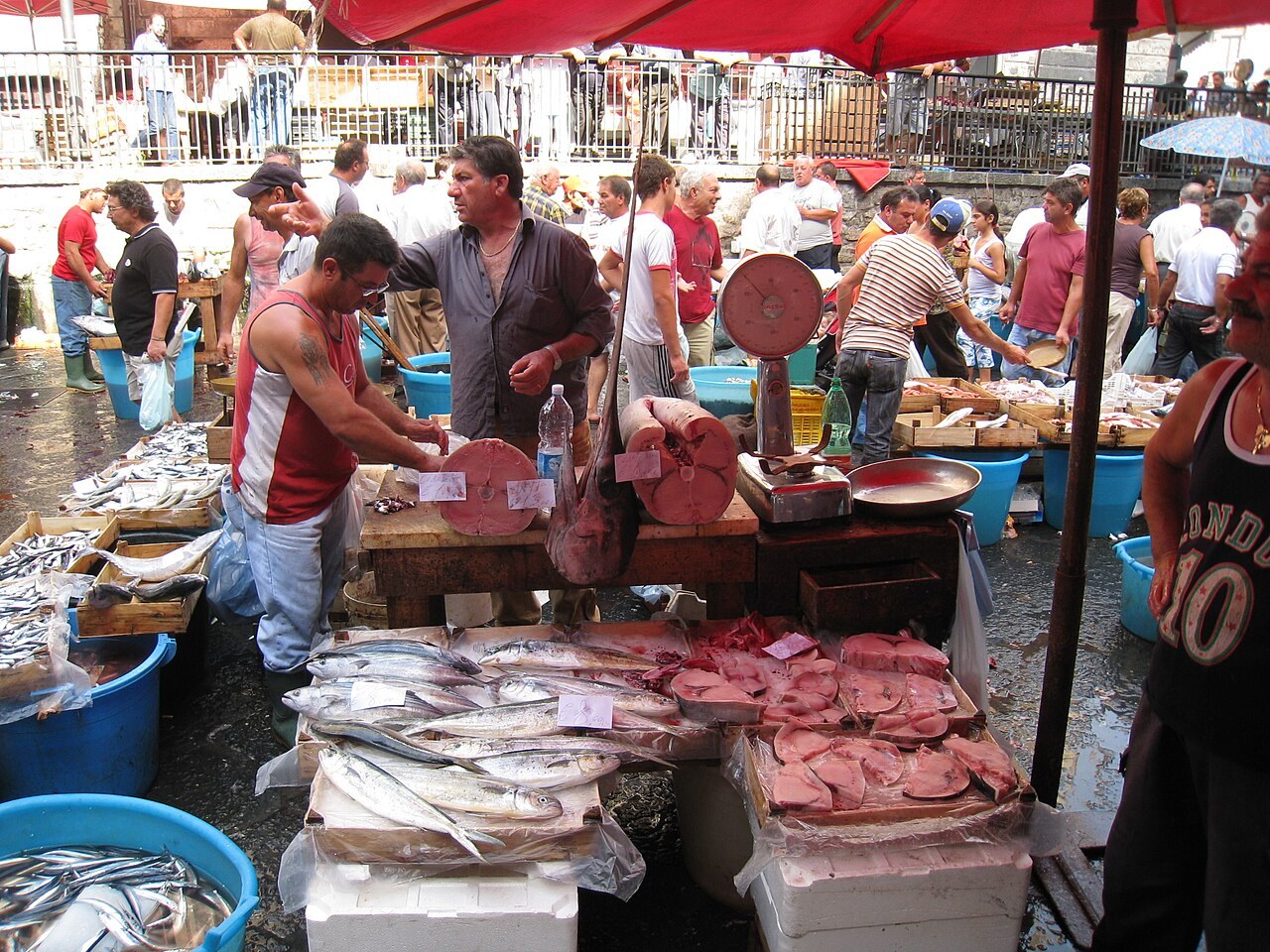
Start at La Pescheria, Catania’s fish market, which opens around 7:00 and winds down by 13:00 (closed Sundays). Enter from Piazza Alonzo di Benedetto, not the main steps from Piazza Duomo — fewer crowds, and you’ll see the fishmongers unloading before the tourists arrive. The noise, the colour, the smell of the sea: it’s the most Catanese experience you’ll have all week. From there walk up to Via Crociferi, a baroque street lined with churches and convents that UNESCO put on the World Heritage list. It’s 200 metres long and quiet even in August — most visitors don’t find it.
Afternoon: Piazza Duomo, Via Etnea and the Roman theatre

Derbrauni · CC BY 4.0
The Fontana dell’Elefante in Piazza Duomo is Catania’s symbol — a lava-stone elephant holding an Egyptian obelisk. The Cathedral of Sant’Agata is free to enter and holds the relics of the city’s patron saint. Walk north on Via Etnea, the main shopping street, with Etna framed at the end on clear days. Halfway up, detour left to the Roman theatre and Odeon (€6, often empty, hidden behind apartment buildings — a surreal contrast). The Giardino Bellini public park is worth 20 minutes if the heat gets to you.
Evening: aperitivo and arancino crawl
Catania’s evening starts late. Around 19:30, head to the streets around Piazza Teatro Massimo for an aperitivo (Spritz runs €4–6). Then do what locals do: eat standing up. An arancino (rice ball, €2–3) from a rosticceria like Savia on Via Etnea or Spinella on Via Umberto is a meal in itself. If you want a sit-down dinner, the streets behind La Pescheria have honest trattorie — look for handwritten menus and locals eating, not photos of dishes on the wall.
Day 2 — Mount Etna: hike Europe’s tallest active volcano
For the full picture — cable car cost, AST bus schedule, the five route options by difficulty, and the 2,800 m self-guided limit — see our dedicated hiking Mount Etna guide.
Wine option on Day 5: swap one day trip for an Etna wine tour from Catania — 10 winery picks, costs, and booking pattern.
Morning: Rifugio Sapienza and the Silvestri craters
SentinelHub · CC BY 2.0
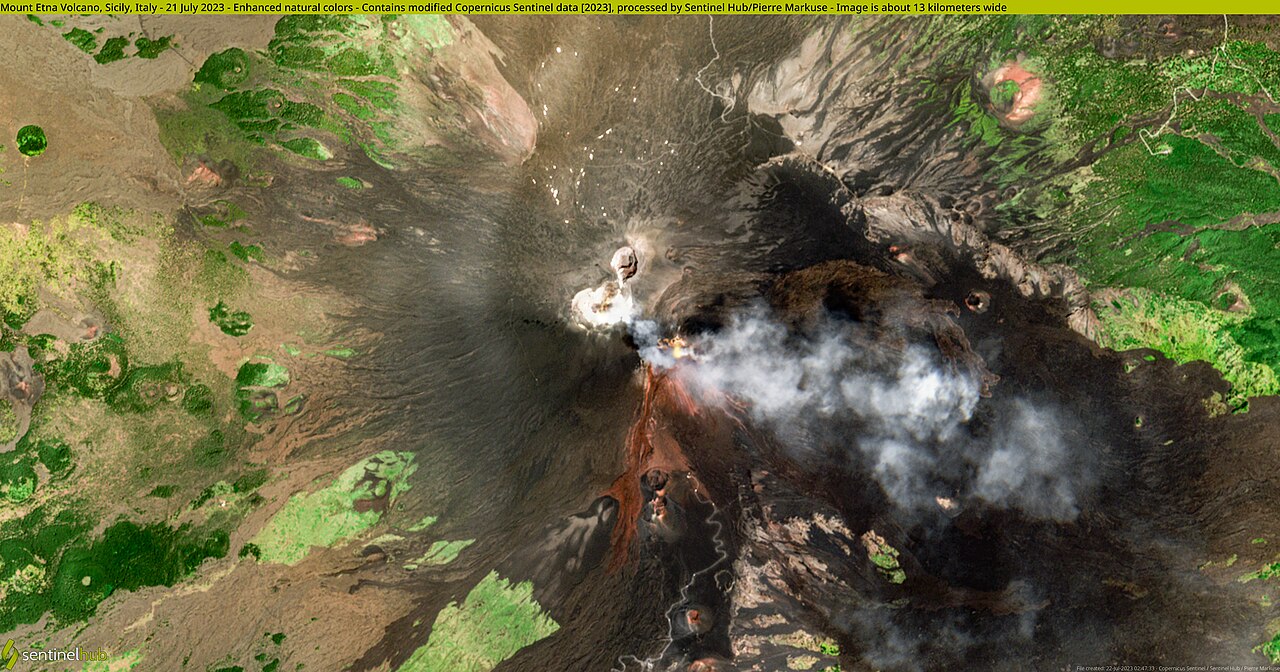
From Catania it’s a 45-minute drive up the south slope to Rifugio Sapienza (1,900 m). The road is good but winding. Leave by 8:30 to beat the tour buses. At Sapienza, the Silvestri craters are free to explore on foot — a 30-minute loop around the rim gives you a taste of the lunar landscape without spending a euro. Bring a jacket: even in summer it’s 10–15 °C cooler than Catania at sea level. The wind at the craters can be fierce.
Afternoon: cable car and 4×4 to 2,900 m (optional)
The Funivia dell’Etna cable car (€35 one way, €70 return) takes you from 1,900 m to 2,500 m. From there, specialised 4×4 buses (€30, included in a €70 combined ticket) drive you to Torre del Filosofo at 2,900 m, where a volcanologist guide leads a walk around the summit craters. The full excursion (cable car + 4×4 + guide) takes about 3.5 hours and costs roughly €70 per person. It’s weather-dependent: if Etna is in a bad mood, the upper section closes. Check Funivia dell’Etna’s website the morning of — they update conditions by 8:00. Even if the top is closed, the cable car ride alone is worth the trip for the views.
On the way back, consider a stop at one of the Etna wineries on the north or east slopes: Nerello Mascalese grown in volcanic soil is a wine you won’t find elsewhere. Many offer tastings for €15–25 with no reservation needed outside peak weekends.
Day 3 — Taormina: Teatro Greco, Isola Bella and Castelmola
Morning: Teatro Greco and Corso Umberto
From Catania, take the train to Taormina-Giardini station (50 min, ~€5) and then the local Interbus shuttle up the hill to the town centre (€2, every 20 min). Alternatively, drive and park at the Porta Catania car park (Lumbi, €5/day) — arrive before 10:00 or you won’t find a spot.
Grey48 · CC0
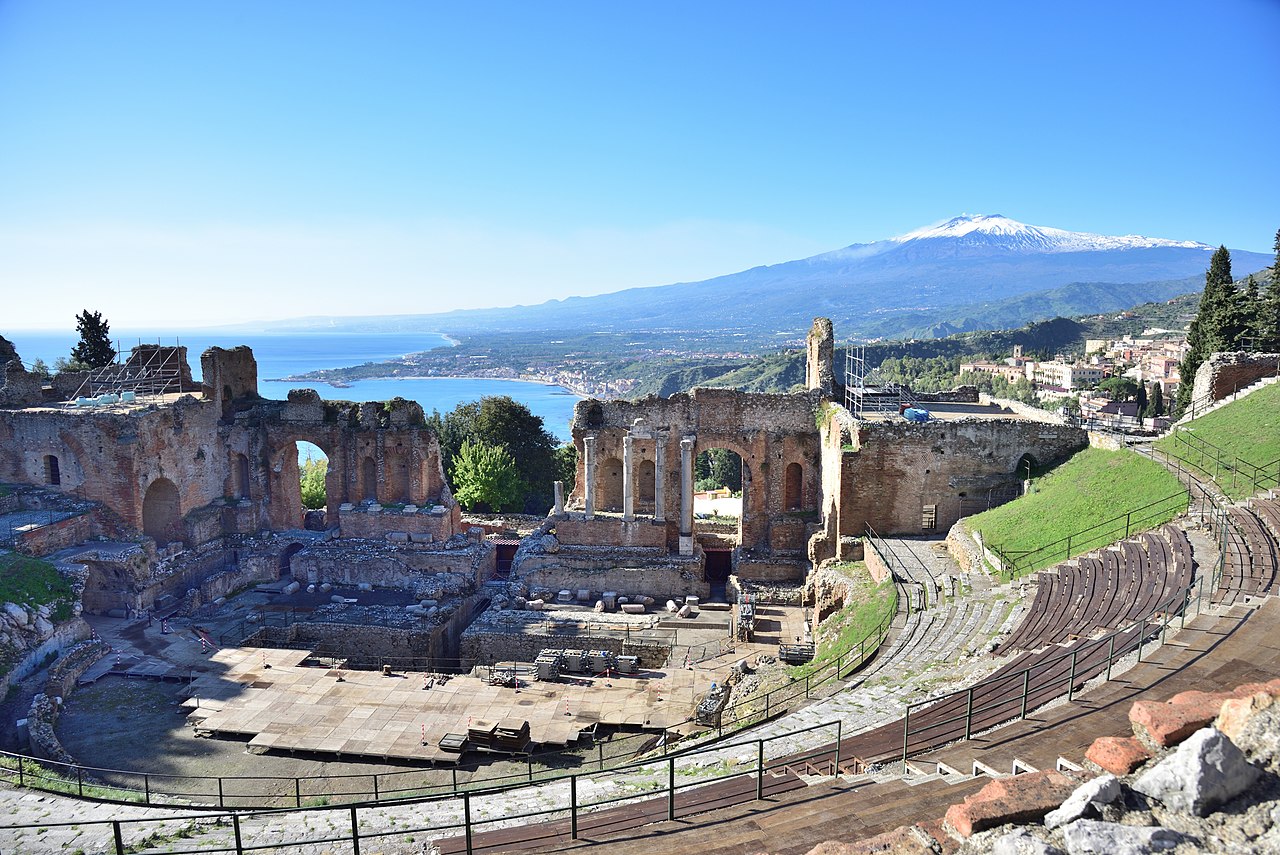
Head straight to the Teatro Greco (€10 entry). Go early: by 11:00 the tour groups arrive and the experience changes. The theatre dates to the 3rd century BC, and the view from the top tier — Etna behind you, the bay of Naxos below — is one of the finest in the Mediterranean. Walk down Corso Umberto, the pedestrian main street, stopping at Piazza IX Aprile for the panoramic terrace.
For a deeper look at what to see and our practical tips, check our complete guide to things to do in Taormina — beaches, restaurants, day trips and the full walking route.
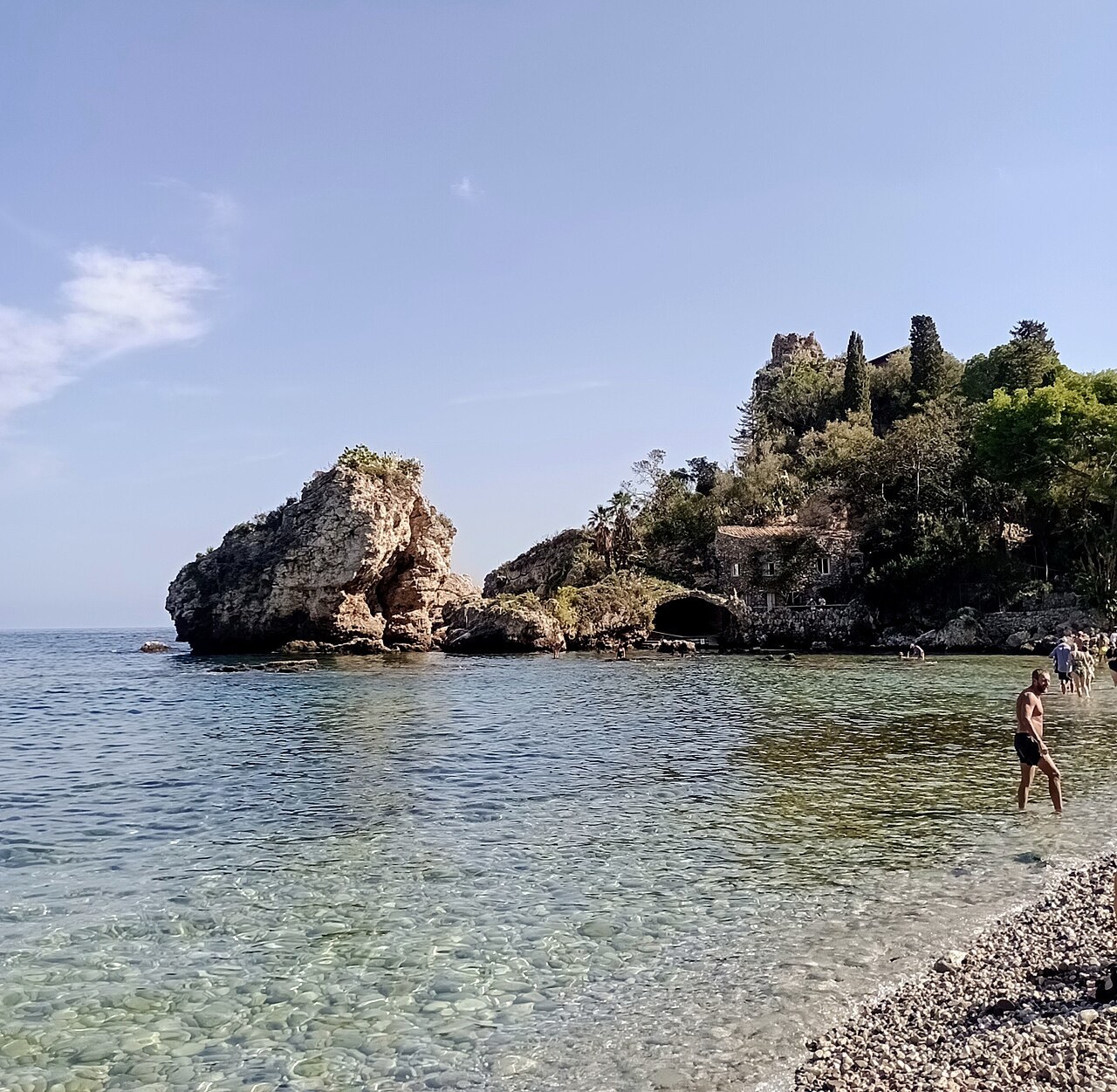
Afternoon: Isola Bella and Castelmola
Jeanne Griffin · CC BY-SA 4.0
Take the cable car (€3 each way) or walk down 300 steps from Corso Umberto to Isola Bella, a pebble beach wrapped around a tiny island nature reserve. The water is clear and cold even in August. Bring water shoes — the pebbles are brutal on bare feet. Sunbed hire runs €15–20 for two; the free area to the left is fine.
If you have energy left, the village of Castelmola sits above Taormina (10 min by car or 30 min on foot). It’s tiny, quiet, and the almond wine at Bar Turrisi is a local ritual. The view from the ruined castle covers Etna, the coast and the Strait of Messina on clear days.
Day 4 — Syracuse and Ortigia: 2,700 years of history
Morning: Parco Archeologico della Neapolis
Take the Trenitalia regional train from Catania Centrale to Syracuse (1 h 15 min, ~€7.50, roughly hourly). From Syracuse station, it’s a 15-minute walk or short bus ride to the Parco Archeologico della Neapolis (€13.50). The Greek Theatre (5th century BC, still used for performances in summer), the Orecchio di Dionisio (a limestone cave with absurd acoustics) and the Roman amphitheatre are the highlights. Budget 1.5–2 hours. Arrive early — there’s almost no shade.
Afternoon: Ortigia island

Zde · CC BY-SA 4.0
Ortigia is the old town of Syracuse, a small island connected by two bridges. It’s one of the most beautiful historic centres in Italy and doesn’t get the attention it deserves outside Italy. Walk the waterfront along Lungomare di Levante, visit the Cathedral (built into the columns of a Greek temple — you can see them in the walls), cool off at Fonte Aretusa (a freshwater spring metres from the sea, full of papyrus), and browse the morning market on Via de Benedictis. Lunch at a seafood restaurant on the waterfront is hard to resist — expect €15–25 for a primo and a glass of wine.
Evening: dinner on the waterfront
If the train schedule allows (last departure to Catania is usually around 21:00, check Trenitalia the day before), have dinner on Ortigia. The restaurants along Via Roma and behind the market are better value than those on the main Piazza Duomo. Pasta alla Siracusana (tomato, aubergine, capers, olives) is the local classic. If you’re driving, you have more flexibility — the A18 motorway back to Catania takes 70 minutes.
Day 5 — Noto and the Baroque Triangle
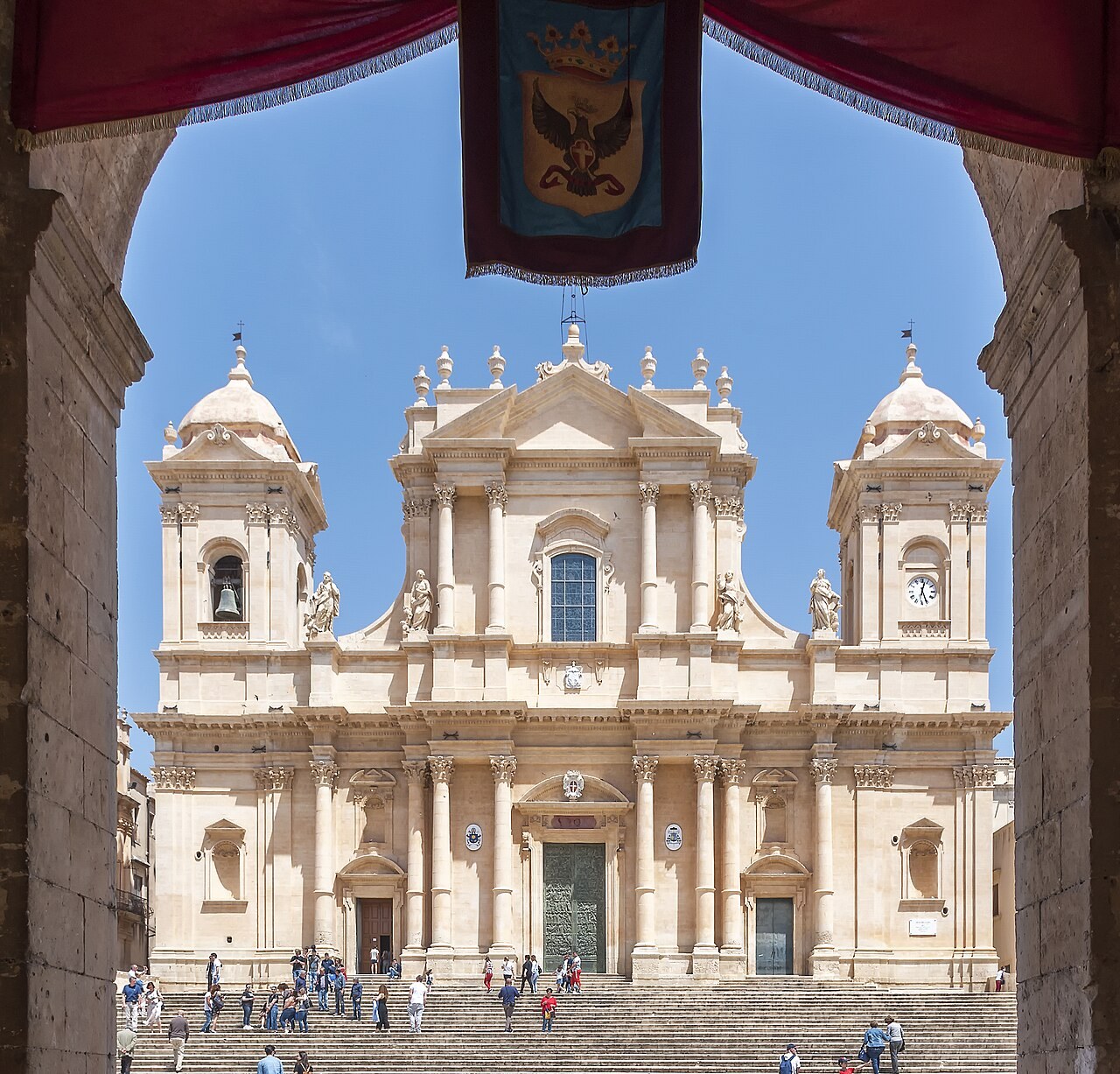
Morning: Noto — the golden city
Dariolp83 · CC BY-SA 4.0
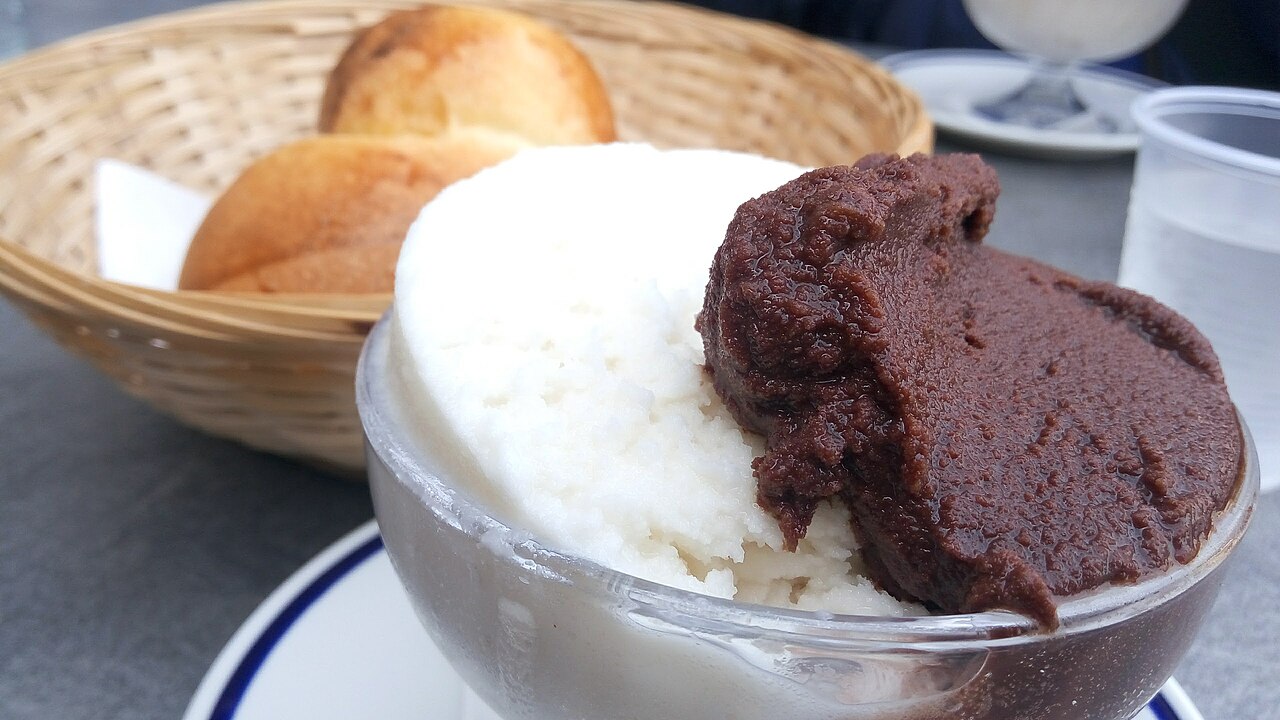
Noto is 35 km south of Syracuse (40 min by car, or train to Noto station + 10 min walk). The entire town was rebuilt after the 1693 earthquake in a unified baroque style, using a local limestone that turns honey-gold in the afternoon light. Walk Corso Vittorio Emanuele from Porta Reale to Piazza del Municipio: the Cathedral of San Nicolò (UNESCO World Heritage), the Palazzo Ducezio town hall, and the church of San Domenico are all within 500 metres. Don’t skip the Caffè Sicilia (if it’s open) for the best granita in the province — pistachio or almond, with a warm brioche.
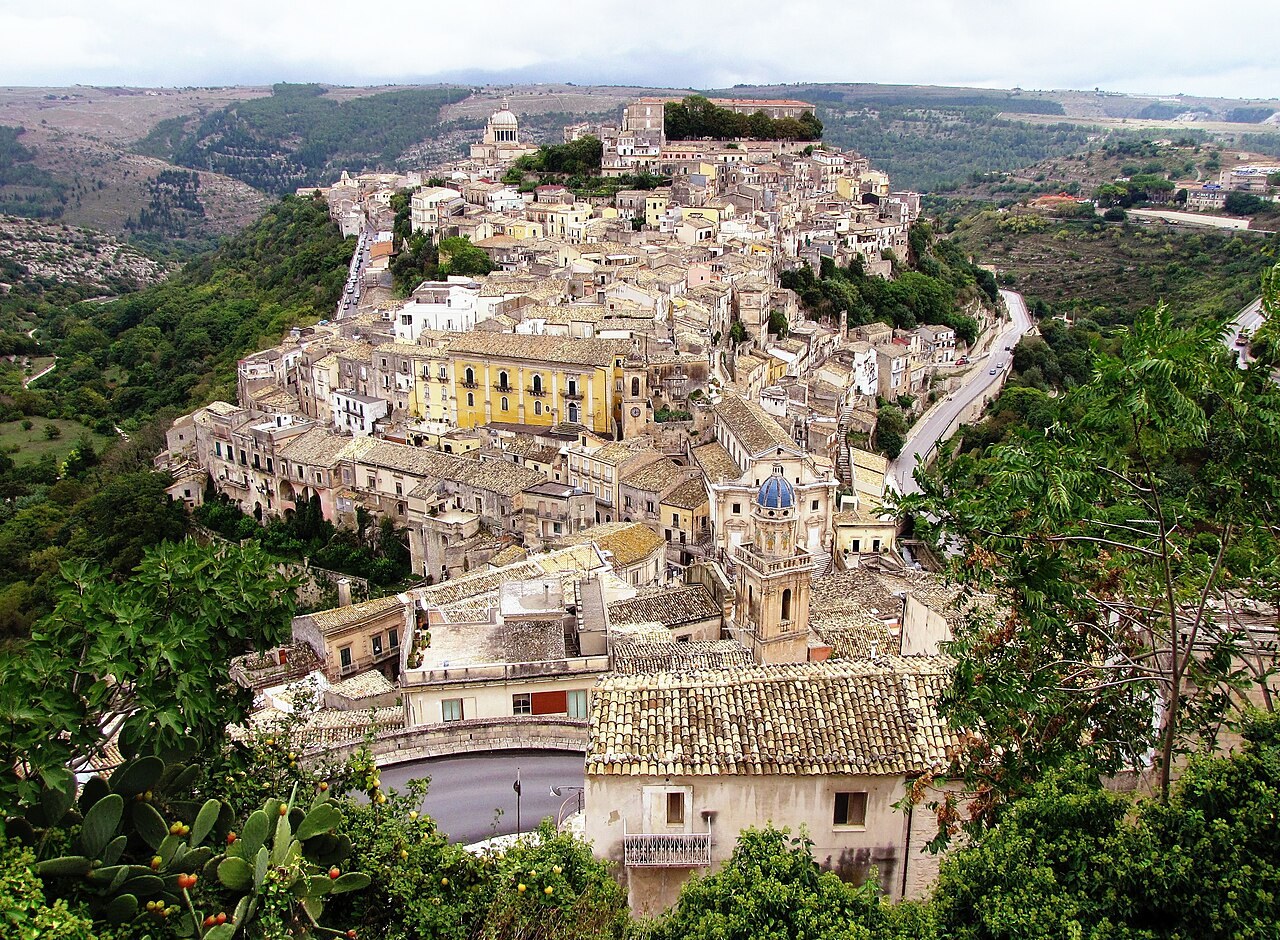
Afternoon: Modica, Ragusa Ibla or a beach
Hein56didden · CC BY-SA 3.0
From Noto you have three choices. Option A: Modica (40 min drive), famous for its ancient chocolate tradition and the church of San Giorgio perched above the old town. Option B: Ragusa Ibla (50 min drive), a quieter, dreamlike baroque village built on a hillside — fans of the TV series “Inspector Montalbano” will recognise every corner. Option C: skip the inland towns and drive 15 minutes south to the beach at San Lorenzo or to the fishing village of Marzamemi for a long seaside lunch. You can’t do all three in one afternoon — pick the one that appeals most. If you have to choose one baroque town, we’d say Ragusa Ibla.
Day 6 — Beach day or hidden gem
Day 6 is the flex day — choose based on the weather, your energy level and what you’ve loved most so far.
Option A: Aci Trezza and Aci Castello (Cyclops Riviera)

gnuckx · CC BY 3.0
Just 20 minutes north of Catania by car or bus 534. Aci Trezza is a fishing village dominated by the faraglioni — basalt sea stacks that mythology says the blinded Cyclops Polyphemus hurled at Odysseus. Have lunch at one of the waterfront restaurants (spaghetti ai ricci di mare, sea urchin pasta, is the specialty when in season). Next door, Aci Castello has a Norman castle on a lava rock promontory and a small beach below.
Option B: beach at Fontane Bianche or San Lorenzo
Fontane Bianche (30 min south of Catania) has fine white sand and shallow turquoise water — the closest thing to a Caribbean beach in eastern Sicily. It’s popular with locals; arrive before 10:00 for a good spot on the free section. San Lorenzo (near Noto, 1 h 15 min) is quieter and backed by a nature reserve.
Option C: Caltagirone
If you want something different, Caltagirone (1 h west of Catania) is the ceramics capital of Sicily. The Scalinata di Santa Maria del Monte — 142 steps, each decorated with hand-painted tiles — is the main attraction. The town is full of workshops where you can buy directly from artisans. It’s less touristy than the coast and offers a glimpse of inland Sicily.
Day 7 — Last morning in Catania
If your flight is in the afternoon, use the morning for the things you missed or want to revisit. A final coffee and cornetto con ricotta at a bar on Via Etnea, a last loop through La Pescheria if it’s a weekday, or simply sit in Piazza Università and watch the city wake up. Catania airport is close — the Alibus shuttle from Piazza Stesicoro takes 25 minutes (€4) and runs frequently. Even with a 14:00 flight you have a full morning in town.
The itinerary on a map
All 15 stops across the 7 days, pinned on the map. Zoom in to explore each day’s route.
Sicily itinerary 7 days at a glance
| Day | Destination | Highlights | From Catania | Est. cost/person |
|---|---|---|---|---|
| 1 | Catania | La Pescheria, Via Crociferi, Roman theatre, arancino crawl | — | €15–25 |
| 2 | Mount Etna | Silvestri craters, cable car + 4×4, winery | 45 min drive | €70–100 |
| 3 | Taormina | Teatro Greco, Corso Umberto, Isola Bella, Castelmola | 50 min train | €25–40 |
| 4 | Syracuse + Ortigia | Neapolis park, Cathedral, Fonte Aretusa, seafood lunch | 1 h 15 train | €30–45 |
| 5 | Noto + Modica/Ragusa | Baroque cathedral, Corso Vittorio, granita, optional baroque town | 1 h 30 drive | €20–35 |
| 6 | Flex day | Aci Trezza, Fontane Bianche, or Caltagirone | 20 min – 1 h | €10–30 |
| 7 | Catania + departure | Final coffee, Pescheria, Alibus to airport | — | €10–15 |
How much does a week in Sicily cost?
Doing this itinerary in November shaves another 10-15% off accommodation versus October, swaps beach days for the olive oil harvest finale and ChocoModica, and keeps the archaeological sites near-empty. See our Sicily in November or Sicily in December guide if late autumn or the Christmas season fits your dates.
Sicily is one of the most affordable parts of western Europe for travellers. Here’s a realistic breakdown for one person in peak season (June–September), based on our experience hosting visitors.
| Category | Budget | Mid-range | Comfortable |
|---|---|---|---|
| Accommodation (7 nights, per person sharing) | €210–280 | €350–500 | €500–700 |
| Food (meals + snacks) | €140–200 | €250–350 | €350–500 |
| Transport (car hire or public) | €50–80 | €120–200 | €200–300 |
| Activities + tickets | €50–80 | €100–150 | €150–250 |
| Total per person / week | €450–640 | €820–1,200 | €1,200–1,750 |
Budget means hostels or shared apartments, street food and markets for most meals, public transport and free attractions. Mid-range means a private B&B or apartment in the centre, one restaurant meal a day, car hire for some days, and the major paid sites. Comfortable means a well-reviewed hotel or design apartment, eating out freely, a rental car all week, and every excursion on the list including Etna summit and wine tastings. Flights from the UK to Catania start around £30–60 return with Ryanair or easyJet if booked 6–8 weeks ahead.
5 mistakes tourists make in Sicily
1. Trying to see the whole island in a week. Palermo is 2.5 hours from Catania by motorway. Agrigento is 2 hours. Adding them to an eastern Sicily itinerary means half your holiday is spent driving. Pick one coast.
2. Not booking the Etna summit early enough. The cable car + 4×4 excursion has limited capacity and sells out in high season. Book at least 2–3 days ahead online, or plan it for your first available clear-weather day.
3. Driving into historic centres. Catania, Taormina, Syracuse and Noto all have ZTL (restricted traffic zones) with cameras. Drive in without a permit and you’ll receive a fine of €80–100 in the post weeks later. Park outside the ZTL and walk.
4. Eating at restaurants next to major monuments. The restaurants directly facing Taormina’s Teatro Greco, Syracuse’s Duomo or Catania’s Piazza Duomo charge premium prices for mediocre food. Walk one or two streets back and the quality jumps while prices drop.
5. Ignoring the siesta hours. Many shops, smaller churches and some museums close between 13:00 and 16:00 (or 15:00–17:00 in Val di Noto). Don’t plan an active sightseeing afternoon between 13:30 and 15:30 — do as locals do: have a long lunch, a coffee, a rest. The late afternoon light is better for photos anyway.
Shorter or longer? 5-day and 10-day versions
For travellers who can stretch to ten days, the natural extension is the Aeolian Islands — start with Lipari, the largest: a 1h30 bus from Catania to Milazzo plus a 45-minute hydrofoil reaches Vulcano for a crater hike, with Lipari and Stromboli adding two more days.
5-day compact version
Keep Days 1–4 as above (Catania, Etna, Taormina, Syracuse). Drop Days 5 and 6 entirely. Use the morning of Day 5 for a final Catania walk and departure. You’ll miss Noto and the beaches, but the four core days cover the essentials. If you have half a day to spare, squeeze in Aci Trezza before departure — it’s 20 minutes from the city and 30 minutes from the airport.
For a deeper, dedicated plan see our 5-day east coast itinerary from Catania — same single-base approach with Val di Noto folded into the last day instead of dropped.
10-day extended version
Add three days to the 7-day itinerary. Day 8: Ragusa Ibla (full day if you chose Modica or the beach on Day 5). Day 9: Piazza Armerina for the Villa Romana del Casale (UNESCO, extraordinary Roman mosaics, 1 h 30 from Catania) and Caltagirone if you skipped it on Day 6. Day 10: second Etna day — this time try the north slope from Piano Provenzana (different landscape, fewer crowds, easier access to lava flows from recent eruptions) or book a sunset hike with a volcanologist. With 10 days, you’ve covered the best of eastern Sicily without the rush.
If your trip lands in winter — Etna skiing, near-empty archaeological sites and 35-50% off August prices — adapt the itinerary using our Sicily in January guide.
Adapting this itinerary for families? The same Catania-base seven-day backbone works with kids — substitute Etnaland (summer) for the heavier hike, swap one wine-tasting day for a Cefalù sandy-beach overnight. The full audience-specific take sits in our Sicily family holiday guide.
In August this same loop pairs with the Sicily in August festival window — Madonna della Catena Aci Trezza 12-14 August, Palio dei Normanni Piazza Armerina 12-14 August, La Vara di Messina 13-15 August, San Bartolomeo Lipari 24 August, and the Etna summit at its best.
In June this same itinerary pairs with the Sicily in June guide — Taormina Film Festival mid-June, INDA Greek tragedies in Syracuse, sea 21-24°C swimming opening. In July see our Sicily in July guide for the Festino di Santa Rosalia Palermo 14-15 July, Madonna delle Lacrime Siracusa 24-26 July, and the Etna summit at 8-18°C.
Frequently asked questions
How many days do you need in Sicily?
Seven days is the sweet spot for one coast: enough to see the highlights of eastern Sicily (Catania, Etna, Taormina, Syracuse, Val di Noto) well. Eastern Sicily (Catania, Etna, Taormina, Syracuse, Val di Noto) fills a week comfortably. If you want to include Palermo and the west coast, you’d need at least 10–14 days, or accept a lot of driving.
What is the best time to visit Sicily?
April to June and September to October. The weather is warm (20–28 °C), the sea is swimmable from late May, the crowds are manageable and prices are lower than in July–August. July and August are hot (35 °C+), crowded and more expensive — but the long evenings and summer festivals are special.
Do I need a car in Sicily?
Not strictly, especially with a Catania base. Taormina, Syracuse and Aci Trezza are all reachable by train or bus. But a car makes the inland Baroque towns and southern beach days much easier and opens up small towns and coves that public transport doesn’t serve well. A good compromise: rent a car for 3–4 days and use trains for the rest.
Is Sicily safe for tourists?
Yes. Sicily is as safe as the rest of southern Italy, which is to say: use normal urban common sense (watch bags on buses, don’t leave valuables visible in a parked car) and you’ll be fine. Petty theft exists in crowded areas — it’s not different from Barcelona or Naples. Violent crime against tourists is extremely rare.
Can I do this itinerary without a car?
Largely, yes. Days 1, 3, 4 and 7 are easy by train and bus. Day 2 (Etna) is doable via the AST bus or a guided tour. Day 5 (Noto) is reachable by train via Syracuse, but the baroque towns of Modica and Ragusa need a car or an organised tour. Day 6 depends on your choice: Aci Trezza is accessible by local bus, beaches further south need transport. See the “Getting around” section above for details.
Which airport should I fly into for eastern Sicily?
Catania Fontanotossa (CTA). It’s the main airport for eastern Sicily, with direct flights from London (Ryanair, easyJet, Wizz Air), Dublin, Manchester, Edinburgh, Munich, Berlin, Düsseldorf, Amsterdam and dozens of other European cities. Palermo airport (PMO) serves the west coast — flying there and driving to Catania adds 2.5 hours and defeats the purpose of a Catania-based itinerary.
Is Catania or Palermo better as a base?
They serve different halves of the island. Catania is better for the east coast (Taormina, Etna, Syracuse, Val di Noto). Palermo is better for the west (Cefalù, Erice, Trapani, Agrigento). If you only have one week, choose the coast that interests you more and base yourself accordingly. For more on this, read our comparison of Sicily’s best base areas.
How much does a week in Sicily cost?
A realistic budget for one person is €450–640 (budget), €820–1,200 (mid-range) or €1,200–1,750 (comfortable), not including flights. The biggest variables are accommodation type, car rental and how often you eat out, which can swing the total by €200–400 per week.
Why is Sicily turning away tourists?
It is not the island as a whole, only specific hotspots. Taormina caps daily coach access in peak summer, Vendicari nature reserve requires a free online reservation in July–August (capacity ~800 visitors/day), and Scala dei Turchi periodically restricts access to the cliff itself for conservation. For a 7-day itinerary in May, June or September none of these limits apply — arrive before 9 am at any controlled site and you side-step the issue.
What is the most beautiful part of Sicily?
Eastern Sicily consistently tops traveller rankings. Taormina‘s Greek theatre above the Ionian sea, the Baroque ensemble of Noto and Ortigia, and the volcanic landscape of Mount Etna make the east the most photogenic and historically dense zone. The Val di Noto (Noto, Modica, Ragusa Ibla) is a UNESCO World Heritage site. Western Sicily — Palermo, Cefalù, Erice — has equally strong heritage but a less concentrated geography.
The information in this guide was correct at the time of writing. Data can change from season to season without notice: before you travel, always check the official channels and websites for updates. We review this guide periodically, but the official channels are always the authoritative source. We also cannot guarantee that the suggested routes or the attractions described are always reachable or accessible: roads, trails and sites may be closed, damaged, altered or unsafe. Assessing the practicability and safety of itineraries and attractions always remains your own responsibility.