
Sicily in July 2026 is the island at peak summer energy — before the Ferragosto crush. Coastal daytime temperatures average 30-34°C, the sea climbs from 24°C in early July to 26°C by month-end, rainfall is essentially zero (5-15 mm all month), and the cultural calendar is extraordinary: the Festino di Santa Rosalia in Palermo on 14-15 July (300.000+ in the streets, Sicily’s most spectacular urban religious festival), the Taormina Arte Festival at the Greek Theatre, the Madonna delle Lacrime feast in Syracuse on 24-26 July, and Mount Etna in its optimal summit window (snow-zero all routes, 14h30m of daylight on 1 July). Accommodation prices run 30-60% above shoulder months — significantly below August’s 50-100% surge. From our base in Catania, this 2026 guide covers weather by region, the complete July festival calendar with exact dates, where to swim, how to beat the heat at altitude, and what a Catania-anchored July trip actually looks like.
Sicily in July at a glance
Sicily in July 2026 means coastal highs of 30-34°C, sea rising from 24°C to 26°C through the month, the Festino di Santa Rosalia on 14-15 July in Palermo, Mount Etna snow-free with 14h30m of daylight on 1 July, and prices 30-60% above shoulder but meaningfully below the August peak. The first three weeks of July are the sweet spot: lighter crowds, manageable heat, and the single most spectacular night in the Sicilian cultural calendar. For a full season-by-season packing list, see our guide on what to pack for Sicily.
Why July works
- Festival calendar unlike any other month. The Festino di Santa Rosalia on 14-15 July is Sicily’s largest urban street festival — 300.000+ people, a golden baroque carro trionfante 11 metres high, and fireworks over the Foro Italico seafront. No sibling month comes close to this single anchor.
- Etna in its prime. Snow-zero on all routes since late June, 14h30m of daylight on 1 July (70 minutes more than 1 August), summit air 8-18°C — longer and lighter than August for high-altitude trekking.
- Lighter crowds before the Italian school holidays. Italian school holidays begin in earnest in late July. The first three weeks of July are substantially quieter than August at every beach and cultural site.
- Sea already excellent. At 24°C on 1 July and rising to 26°C by 31 July, the sea is fully swimmable from day one — comfortable before the August heat-stress of 27-28°C.
- Pescheria Catania in full operation. The fish market runs Mon-Sat 07:00-14:00 all July; it closes for Ferragosto week in mid-August. July is the last full month of abbanniate, swordfish from the Strait of Messina, and ricci di mare before the break.
Where July struggles
- Heat at midday. Catania and Agrigento reach 30-34°C by afternoon. Archaeological sites without shade are brutal 12:00-16:00 — plan sunrise or late-afternoon visits.
- Late July crowd surge. After Italian school holidays begin (roughly 25 July), the August-style pressure builds on the Aeolian islands, Taormina, and Cefalù. The window 1-24 July is distinctly calmer.
- Prices still elevated. At 30-60% above shoulder, July is not a bargain — just a better deal than August. Book accommodation and Taormina Arte Festival tickets 4-6 weeks ahead.
For a cooler shoulder alternative, see our Sicily in May guide (sea 20-22°C, crowds minimal) or the Sicily in June guide for the early-summer window. For the month after, our Sicily in August guide covers Ferragosto, La Vara di Messina, and peak-season logistics.
What is the weather like in Sicily in July?
Coastal Sicily averages 30-34°C by day and 20-25°C at night in July, with sea temperature rising from 24°C to 26°C through the month, only 5-15 mm of rainfall over 1-2 wet days, and 11-12 hours of sunshine per day. Inland and southern areas are hotter (31-35°C in Agrigento). Sirocco events average 1-2 per month in July — rarer than August’s 2-3. Mount Etna’s summit at 3.357 m runs 8-18°C, and the Madonie Mountains at 700-900 m altitude sit 8-10°C cooler than the coast.
July is the second driest month of the Sicilian year after August — roughly a 5% chance of any rain on a given day, with the few events concentrated in brief afternoon storms over the inland mountains. The east coast (Catania, Taormina, Syracuse) benefits from Ionian morning breezes, while the south coast (Agrigento, Sciacca) traps more heat. Humidity runs 55-65% across the island. The real temperature relief is altitude: Etna at 2.000 m sits at 16-24°C, the Madonie plateau villages at 23-27°C — the difference between a punishing midday in Agrigento and a perfectly comfortable morning hike.
| Region | Day °C avg | Night °C avg | Sea °C | Wet days |
|---|---|---|---|---|
| Palermo (NW coast) | 29-32 | 21-23 | 24-25 | 1 |
| Catania (E coast) | 30-34 | 22-24 | 24-26 | 1 |
| Taormina (NE coast, 200 m) | 27-30 | 20-22 | 24-26 | 1 |
| Aeolian Islands | 26-29 | 22-24 | 25-26 | 1 |
| Agrigento (S coast) | 31-35 | 22-24 | 24-25 | 1 |
| Madonie (700-900 m) | 23-27 | 16-20 | — | 2 |
Daylight decreases slightly through July: Catania sees 14 hours 30 minutes of daylight on 1 July and 14 hours flat by 31 July — a loss of only 30 minutes across the four weeks, versus a 70-minute loss in August. Sunrise is around 05:45 in early July, shifting to 06:00 by month end. Sunset at 20:30 most of the month gives long afternoon light for outdoor sightseeing. UV index peaks at 10 — a full burn in 15-20 minutes for unprotected skin.
On Mount Etna, July is technically the optimal month for high-altitude trekking. The summit (3.357 m / 11.013 ft) sees 8-18°C by day, low wind, and effectively zero snow on any route — snow-free since late June, giving more stable footing than June. At 2.000 m (Rifugio Sapienza area), daytime air runs 16-24°C. The combination of longer daylight, lower sirocco risk, and cooler coastal air makes the Catania-to-Etna day trip in July genuinely pleasant from 06:00-13:00, before coastal temperatures peak.
How hot is Sicily in July?
Coastal Sicily averages 30-34°C by day in July, with Catania and Agrigento at the hotter end and Taormina (200 m elevation) and the Aeolian islands slightly cooler at 26-29°C. Inland areas and southern Sicily reach 32-37°C with sirocco events, though July averages 1-2 sirocco days per month (vs 2-3 in August). Nights drop to 20-25°C on the coast — comfortable with a breeze. Sea temperature ranges from 24°C early July to 26°C by month end. This is genuinely hot, but 2-3°C below the August peak — and with 70 minutes more daylight than August, the early morning window (06:00-10:00) before the heat builds is longer.
What is the weather like in Palermo and Catania in July?
Palermo averages 29-32°C by day in July with nights of 21-23°C — slightly cooler than Catania due to Tyrrhenian sea breezes and westerly exposure. Sea at Mondello beach runs 24-25°C. Catania averages 30-34°C by day, 22-24°C at night, with the Ionian coast providing a morning onshore breeze that moderates the heat before 10:00. Both cities see 1 wet day at most across the month, with sunshine averaging 11-12 hours daily. Palermo’s internal courtyards and markets trap heat overnight; Catania’s lava-stone streets radiate heat into the evening. Both cities cool significantly at 22:00 on the seafront — the Catania Lungomare and Palermo Foro Italico waterfront are both worth a late-evening walk.
What to wear and pack for Sicily in July
Light breathable cotton or linen for daytime, SPF 50+ and a wide-brimmed hat as non-negotiables, a light cardigan for air-conditioned interiors and Taormina evenings, and fleece plus windproof shell for any Etna summit visit. Forget jeans, rain gear, and heavy bags.
Daytime essentials: Light cotton or linen t-shirts and short-sleeve shirts, light trousers or shorts, a linen dress for women — anything that breathes and dries fast. Sandals with grip for city walking; trainers for any uneven terrain (Valley of the Temples, Ortigia cobbles, Etna lower paths). A wide-brimmed hat (30-34°C in direct sun with UV index 10 is not optional sunscreen territory — it requires shade). Sunglasses with UV400 protection. SPF 30-50 applied before going out, reapplied at midday. A refillable water bottle: Sicily’s mountain-spring public fountains (fontanelle) run cold throughout the cities.
Evening: A light cardigan or long-sleeve shirt for air-conditioned restaurants and the breezy hilltop of Taormina at 200 m (can be 4-5°C cooler than the coast). Casual smart is standard for dinner in Taormina and Ortigia; no dress code enforced anywhere in July.
For Etna summit visits: A mid-layer fleece and windproof shell are essential even when Catania bakes at 32°C — the summit at 3.357 m sees 8-18°C with occasional wind gusts. Bring more layers than you think you need. Sturdy closed-toe shoes are required on the summit craters — sandals are refused entry above the cable car station.
Beach kit: Swimwear, quick-dry towel, beach shoes for any rocky entry (especially Aci Trezza, Taormina Isola Bella, Aeolian rocky coves). A 1-litre thermos to keep water cool on the beach under 34°C sun.
Leave at home: Umbrellas (1-2 wet days across the whole month), heavy jeans, ski gear or thick jumpers, formal attire, heavy backpacks (ruins the heat-management experience).
The Festino di Santa Rosalia: Palermo’s biggest night of the year
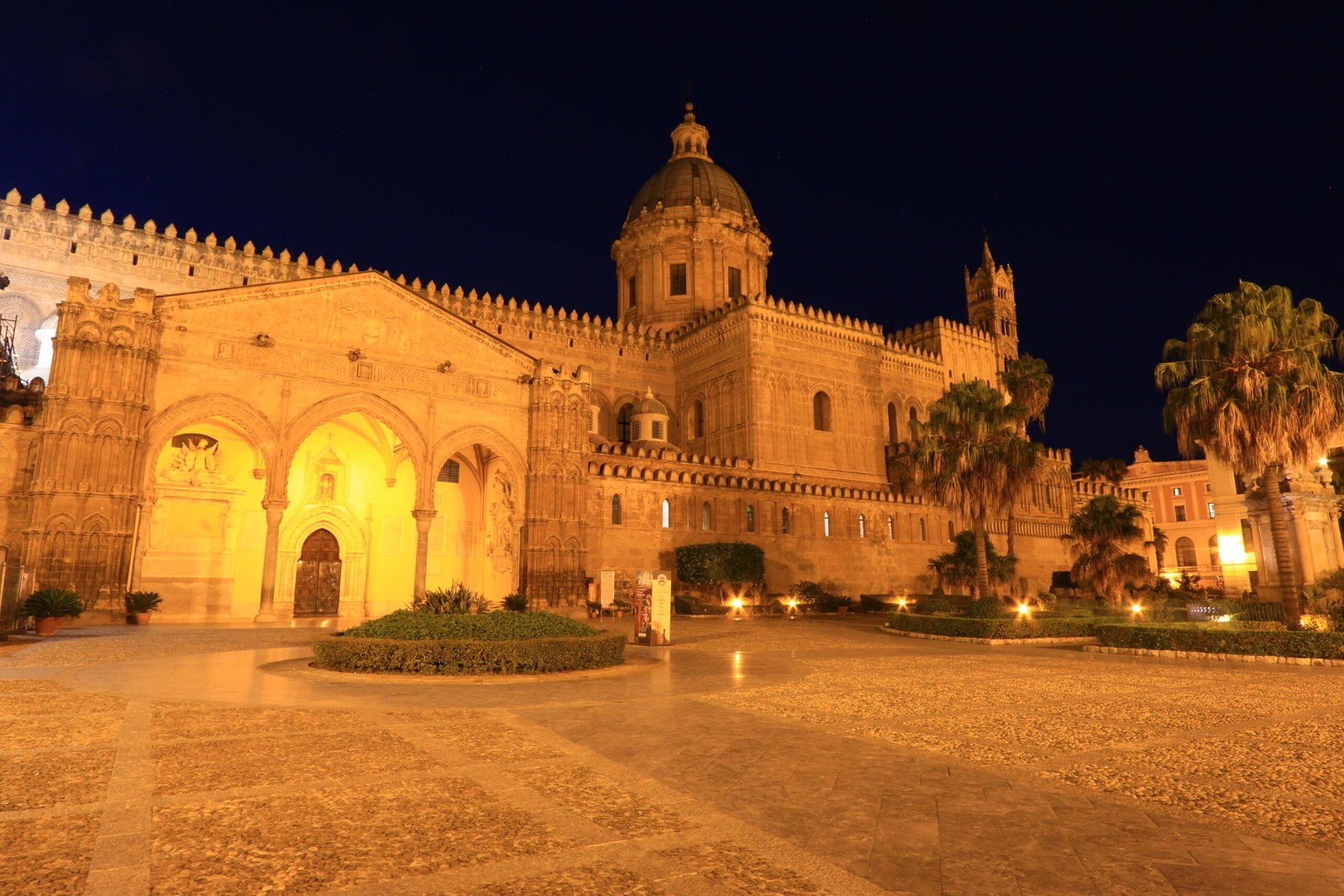
Benjamin Smith · CC BY-SA 4.0
- Location
- Via Bonanno Pietro, Palermo Maps
- Essential fact
- Palermo’s patronal festival since 1625 · processional route Cattedrale → Cassaro → Foro Italico · 210 km from Catania (2h by car via A19 or 2h30 by regional train)
- Price
- Free (public street procession)
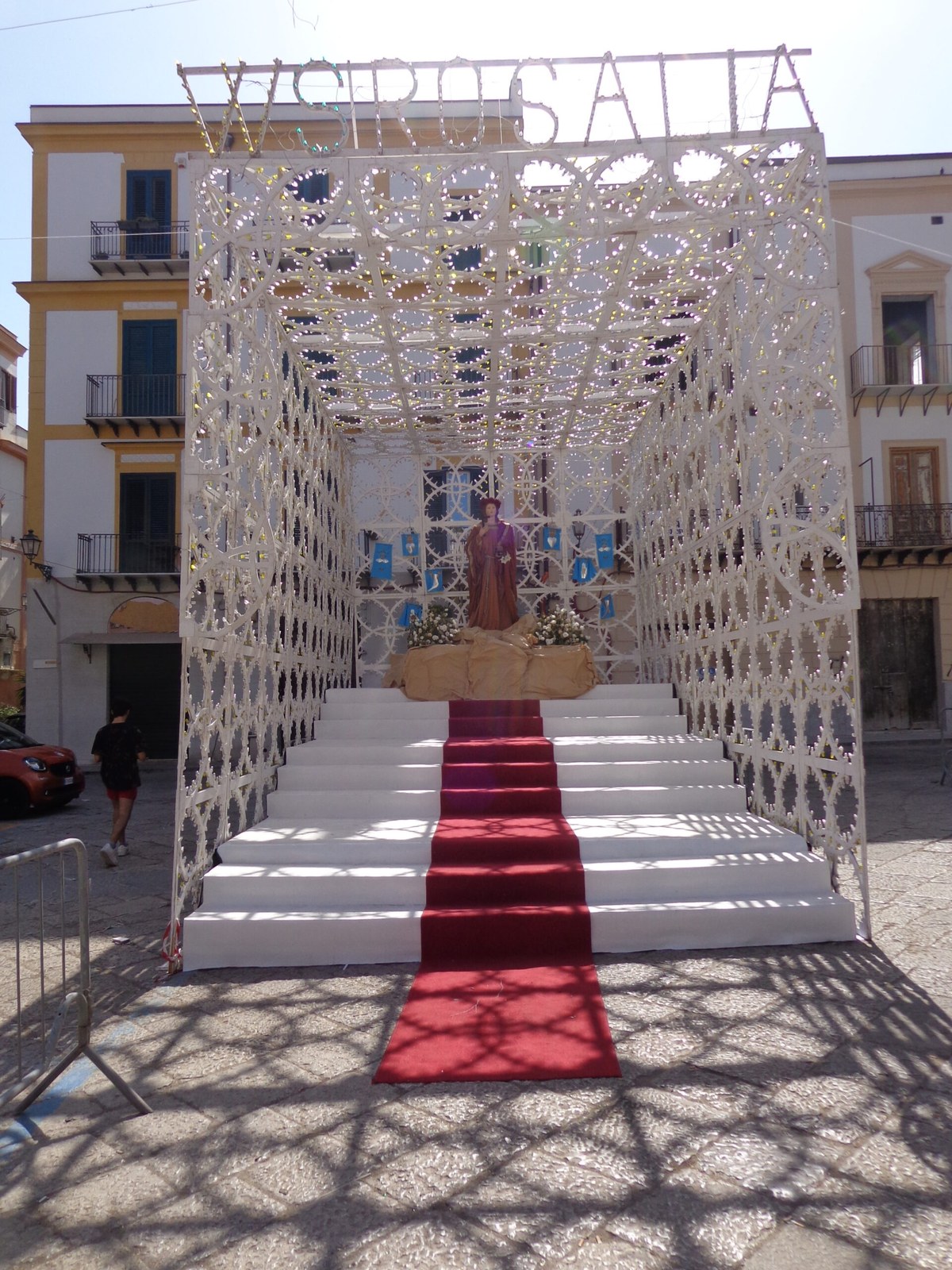
The Festino di Santa Rosalia on 14-15 July 2026 is the most spectacular urban street festival in Sicily — 300.000+ people fill Palermo’s 4-km processional route from the Cattedrale to the Foro Italico seafront behind the golden baroque carro trionfante (triumphal chariot, 11 metres high). The festival originates from 1625, when the discovery of Santa Rosalia’s relics allegedly ended Palermo’s catastrophic plague epidemic. From Catania, it is a 2-hour drive or 2h30 by train — feasible as a day-trip with an overnight stay to fully experience the night procession.
The Festino runs as a two-day arc. On the evening of 14 July, the carro trionfante — a baroque golden chariot bearing the statue of Santa Rosalia — is pulled through the Cassaro (the ancient Via Maqueda and Corso Vittorio Emanuele axis) from the Cattedrale area towards the sea, a 4-kilometre procession that takes several hours through packed streets. The call-and-response of the crowd — the devotional cry “Viva Palermo e Santa Rosalia!” — is audible from entire city blocks away. The chariot arrives at the Foro Italico seafront after midnight, followed by one of Sicily’s largest fireworks displays over the sea. On 15 July (the actual feast day), the focus moves to the Santuario di Santa Rosalia on Monte Pellegrino: Solemn Mass in the cave-sanctuary at the summit (bus from Palermo centre, or a 1-hour hike) and smaller street festivities through the afternoon.
The Festino di Santa Rosalia origin story matters for understanding Palermo’s emotional investment in the event. In 1624-1625, Palermo was devastated by a plague epidemic. According to tradition, a young shepherd woman named Girolama La Gattuta claimed to have a vision of Santa Rosalia — a 12th-century noblewoman who had retreated to live in a cave on Monte Pellegrino. Relics were found in the cave on Monte Pellegrino in 1624, and after their solemn procession through Palermo in 1625 the plague subsided. The u Fistinu (as it is called in Sicilian dialect) has been held on the same dates every year since 1625 — one of the longest-running continuous urban street festivals in the world. For practical logistics and the official programme, see the Comune di Palermo website.
Major July festivals and events 2026
July 2026 carries four major anchors beyond the Festino: the Taormina Arte Festival at the Greek Theatre (open July through early September), the Festa di San Calogero in Agrigento on 5 July (pane-throwing from balconies, combine with Valley of the Temples), and the Madonna delle Lacrime feast in Siracusa on 24-26 July. Prices, hours, and festival dates quoted here reflect summer 2026 information and may change — confirm with the official programme or operator before travel.
| Date 2026 | Event | Location | Distance from Catania |
|---|---|---|---|
| Jul 5 | Festa di San Calogero — pane-throwing from balconies | Agrigento city centre + Valle dei Templi | 165 km / 2h |
| Jul 1 – Sep | Taormina Arte Festival — Greek Theatre concerts, opera, ballet | Teatro Antico di Taormina | 50 km / 50 min |
| Jul 14-15 | Festino di Santa Rosalia — carro trionfante, fireworks | Palermo Cassaro → Foro Italico | 210 km / 2h |
| Jul 24-26 | Festa della Madonna delle Lacrime — torchlight procession | Siracusa, Santuario Madonna delle Lacrime | 65 km / 55 min |
Taormina Arte Festival 2026
- Location
- Via Teatro Greco 1, Taormina Maps
- Site
- parconaxostaormina.com/taormina/teatro-antico-taormina
- Essential fact
- Greek Theatre at 200 m elevation above the Ionian Sea · 50 km from Catania (50 min by car or 1h15 by train to Taormina-Giardini + 20 min taxi/bus)
- Price
- €25–120 (book at fondazionetaormina.it — headline concerts sell out 4-8 weeks ahead)
The Taormina Arte Festival is one of the most spectacular outdoor concert settings in the world: the 3rd-century-BC Greek Theatre of Taormina, perched 200 metres above the Ionian Sea with Mount Etna framed on the horizon. The July programme covers classical music, opera, ballet, and international performers — the festival has historically featured Andrea Bocelli, Ludovico Einaudi, and major opera productions. Tickets range from €25 to €120 depending on the event; headline concerts sell out 4-8 weeks ahead. The 200-metre elevation of Taormina means the theatre sits 4-5°C cooler than Catania’s coast on a summer evening — the most comfortable outdoor music experience in Sicily. Check the current programme and buy tickets at fondazionetaormina.it.
Madonna delle Lacrime Siracusa 2026
Simone Tinella · CC BY-SA 4.0
- Location
- Via del Santuario 33, Siracusa Maps
- Essential fact
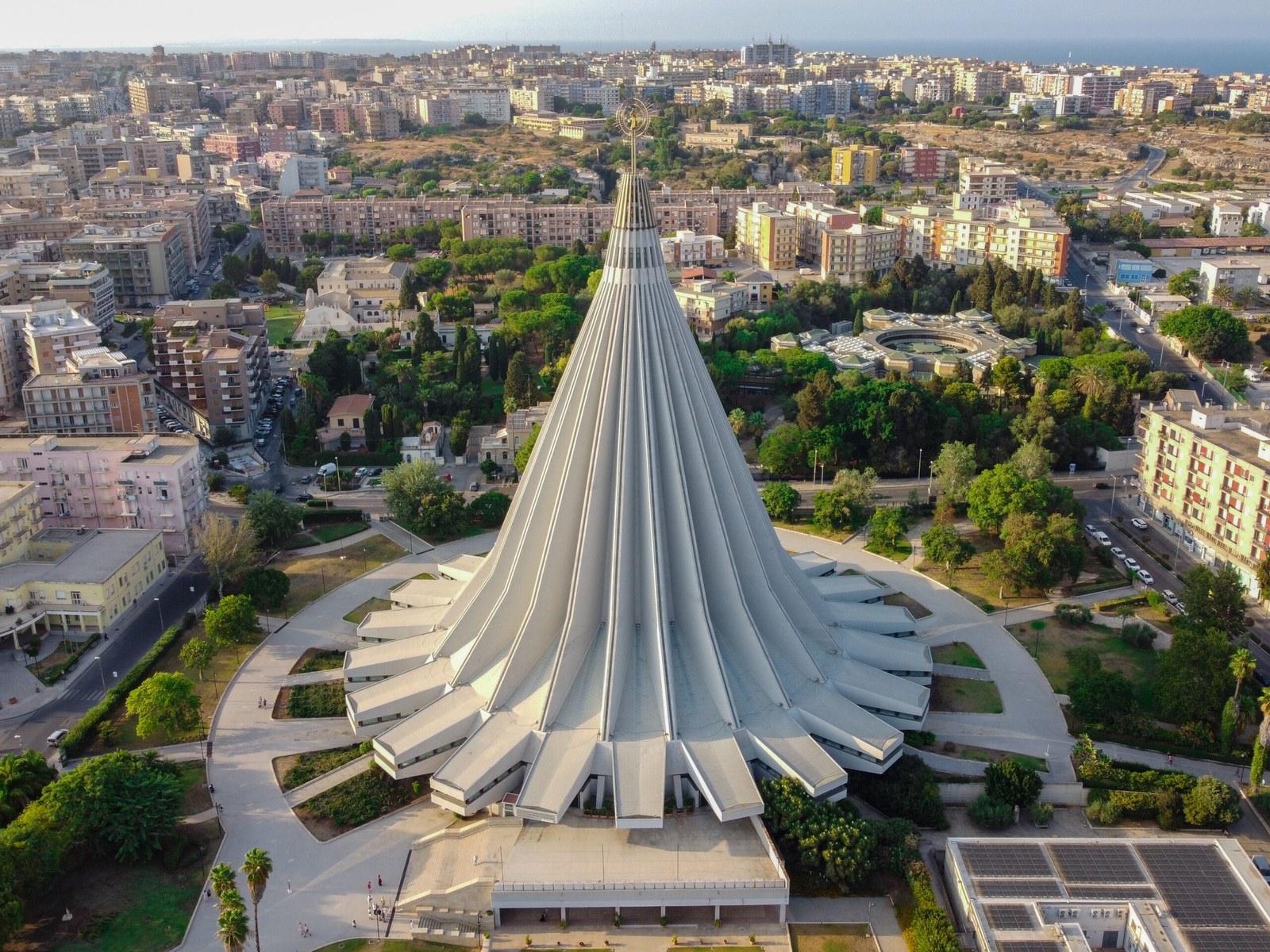
- Conical basilica 74 m high on Colle Temenite · 65 km from Catania (55 min by car via A18/SS114)
- Price
- Free (basilica entrance free; parking nearby paid)
The Santuario della Madonna delle Lacrime in Siracusa commemorates the 1953 miracle: a mass-produced plaster image of the Immaculate Heart of Mary wept for 5 days in the home of a Siracusa family, drawing crowds from across Sicily. The miracle was officially recognised by the Catholic Church in 1986. The purpose-built basilica — a striking 74-metre conical concrete structure rising over Colle Temenite — was completed in 1994 and is the largest church in Sicily by volume. The 3-day feast on 24-26 July 2026 includes outdoor Mass in front of the basilica, a torchlight procession through Siracusa’s old city and Ortigia, and a candlelight vigil. Combine the visit with a walk through Ortigia (15 minutes on foot from the basilica) and the Parco Archeologico Neapolis (Greek Theatre, Ear of Dionysius, Latomie del Paradiso — 10 minutes by car).
Festa di San Calogero Agrigento 2026
- Location
- Via Atenea, Agrigento Maps
- Essential fact
- Agrigento city centre festival · Via Atenea + Piazza Ravanusella; Valle dei Templi 7 km south · 165 km from Catania (2h by car via A19 + SS640)
- Price
- Free (procession); Valle dei Templi €14 (open from 07:00)
Agrigento’s patron saint feast on the first Sunday of July (2026: 5 July) is one of the most unusual in Sicily. The silver-encased simulacrum of San Calogero — a 5th-century hermit healer venerated across the western side of the island — is carried through the old town along Via Atenea and Piazza Ravanusella. The ancient tradition that accompanies the procession: decorated bread rings (pani di San Calò) are thrown from balconies and windows to the crowd below — a centuries-old fertility and abundance ritual. Combine with an early-morning visit to the Valle dei Templi archaeological park 7 km away (€14 entry, open from 07:00 — arrive before the heat builds).
Best things to do in Sicily in July
July’s optimal activities are front-loaded in the early morning and evening — beach until 10:00, culture until 13:00, siesta and sea 16:00-19:00, festival or outdoor dining from 20:00 onward. The complete list of July-specific experiences that no other month replicates: the Festino di Santa Rosalia, Etna summit (longest daylight window of the year), Pescheria Catania fish market before the August closure, and Taormina Arte Festival opening.
- Festino di Santa Rosalia Palermo (14-15 July). Sicily’s most spectacular urban night — plan an overnight in Palermo and position on the Cassaro by 17:00.
- Mount Etna summit trekking. July is arguably the best month: snow-zero, 14h30m daylight on 1 July, summit 8-18°C, sirocco rarer than August. Funivia cable-car from Rifugio Sapienza (09:00-16:15), jeep to 2.900 m, authorised guide to summit craters. See our Mount Etna hiking guide for route and booking detail.
- Taormina Arte Festival evening concert. The Greek Theatre at sunset with Etna on the horizon — one of the Mediterranean’s great outdoor stages. Book tickets early at fondazionetaormina.it.
- Pescheria Catania morning. 07:00-09:00 before the heat — swordfish, ricci di mare, abbanniate sellers in full voice. July is the last full month before the Ferragosto closure in August.
- Ortigia Syracuse at dusk. The Baroque island old city of Syracuse (1.2 × 0.7 km) at 19:00-21:00 when the stone cools and the cafes open on Piazza del Duomo. Pair with a boat trip around the island’s sea walls.
- Aeolian Islands day trip to Lipari or Stromboli. July hydrofoil schedule from Milazzo is full; the islands are less crowded than August. Stromboli evening eruption boat tours run daily.
- Cefalù Norman Cathedral + beach day. The 1131 AD Norman Cathedral with Christ Pantokrator mosaics, then the beach in front of the old town — manageable in July before the August peak.
- Valle dei Templi Agrigento at 07:00 opening. Eight Greek temples on 1.300 hectares — walk the ridge in cooler early-morning air before 10:00 when the summer heat becomes punishing.
- Granita di mandorla breakfast. The July ritual in Catania: almond granita with a fresh brioche at a historic pasticceria (Bar Mario on Via Etnea, Bar San Michele on Piazza del Duomo) at 08:00 — before the heat.
- Sicily 7-day itinerary. For a structured Catania-based week, see our Sicily 7-day itinerary guide and our Catania things to do guide.
Beaches and sea: where Sicilians swim in July
The sea reaches 24°C on 1 July and climbs to 26°C by 31 July — comfortably swimmable all month. July is less crowded than August at every major beach. Best swim windows: early morning (08:00-10:00) before UV peak, or evening (17:30-20:00) when the sea surface catches the breeze. The water is slightly cooler than August (26-28°C) — an advantage on hot days when the August Ionian feels like a warm bath.

Lost passenger · CC BY-SA 4.0
East coast (Catania base): La Plaja (4 km black-sand south of Catania, lidos + free beach sections) and Ognina seafront are the closest from the city centre — 20 minutes by bus. Aci Trezza (12 km north, 20 min drive) has rocky entries and the Faraglioni dei Ciclopi backdrop — boat rentals operate daily. Fontane Bianche (18 km south of Catania near Avola) is arguably the finest sandy beach on the Ionian coast, with lidos and a long free-beach section.
North coast: Cefalù beach (in front of the Norman Cathedral old town) is one of Sicily’s most photogenic in July — arrive before 10:00 for a lounger. San Vito Lo Capo (3 km Caribbean-blue crescent, north-west tip of Sicily) is busier in July than shoulder season but significantly less packed than August; the adjacent Riserva dello Zingaro hiking trail operates from 07:00. Mondello (12 km west of Palermo, Tyrrhenian) is Palermo’s classic lido beach — most manageable Monday-Thursday in July.
South coast: Eraclea Minoa white-chalk cliffs + sand near Agrigento, Scala dei Turchi white marl rock platform 15 km west of Agrigento (sea 24-25°C, arrive 08:00 before the crowds), and the wide sandy beaches of Marina di Ragusa are less discovered than the north coast and better value in July.
Can you swim in July in Sicily? Yes — from day one. At 24°C on 1 July the Ionian is fully comfortable; by 15 July at 25°C it is excellent for all-day swimming. Only the very first days of July (if the June sea was late to warm) can be on the edge of comfortable. The Tyrrhenian north coast runs 0.5-1°C warmer than the Ionian. The best free-beach tip: in Sicily, every lido must by law reserve a free public access strip (spiaggia libera) — usually at the end of the lido line. In July those stretches are easy to find; in August they fill by 09:00.
Beating the heat: Mount Etna, Madonie and inland escapes
Dror Feitelson · CC BY-SA 4.0
- Location
- Stazione Partenza Piazzale Funivia Etna Sud, Nicolosi Maps
- Site
- funiviaetna.com
- Essential fact
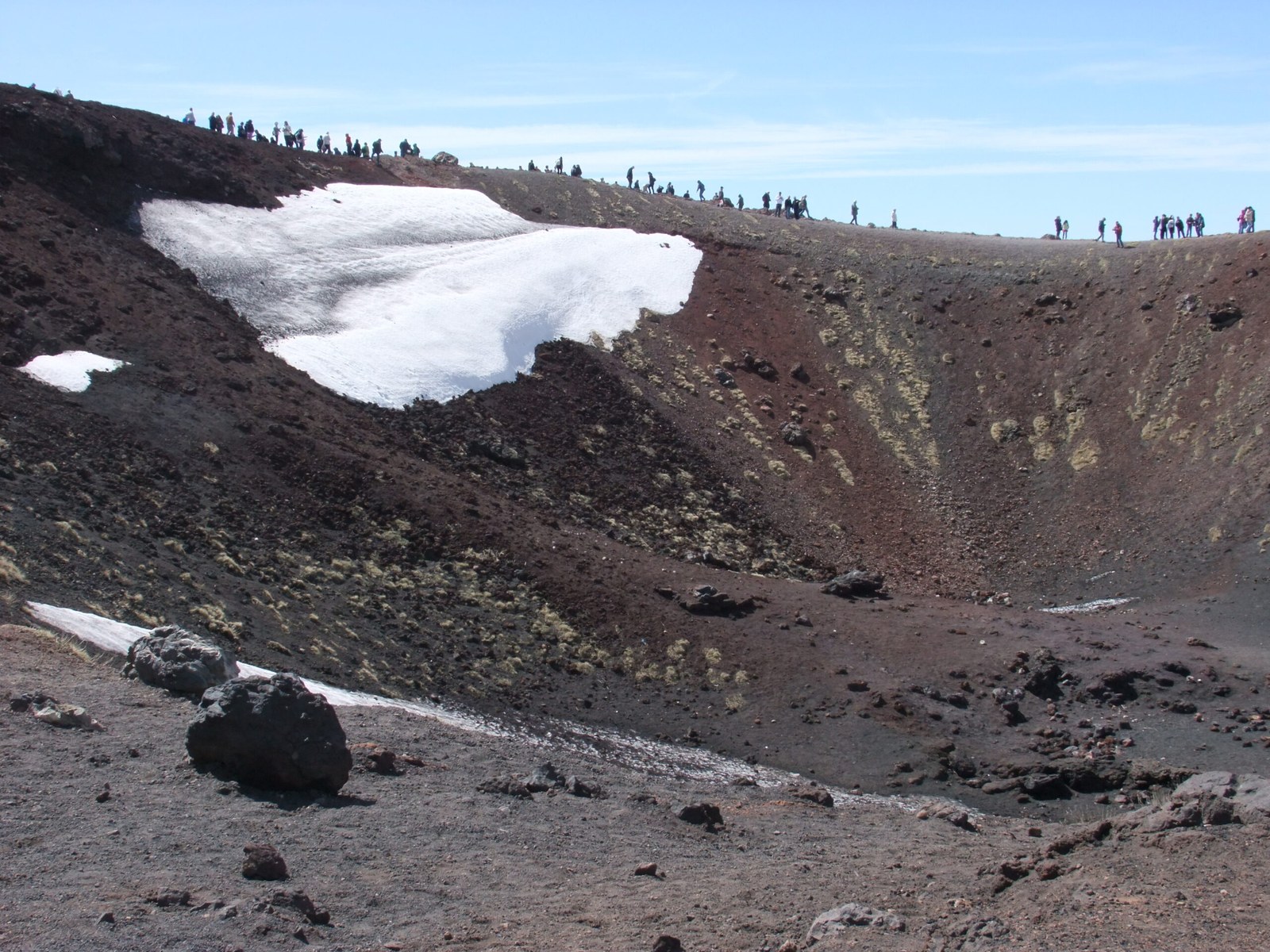
- Rifugio Sapienza, Mount Etna south flank, Nicolosi access road — 35 km / 60 min from Catania (SP92 from Nicolosi)
- Price
- €50 cable-car round-trip; jeep to 2.900 m €25; summit guide €20–30 (confirm at funiviaetna.com)
When coastal Sicily hits 33-34°C at midday, the altitude cure is immediate and accessible. Mount Etna’s Rifugio Sapienza at 1.910 m sits at 18-22°C — a 22-24°C temperature drop from the Catania coast 35 km below. The Madonie Mountains at 700-900 m altitude run 8-10°C cooler than the coast. Both are reachable in under 90 minutes from Catania.
July is arguably the single best month for high-altitude Etna summit trekking. The snow has been gone from all routes since late June — better footing than June, when patches can linger. The summit (3.357 m) sees 8-18°C by day and 2-8°C overnight. Sirocco events average 1-2 per month in July vs 2-3 in August, meaning clearer summit visibility. And crucially, 14h30m of daylight on 1 July (vs 12h50m on 31 August) gives more time for a full ascent before the afternoon heat builds at lower elevations. From Catania to Rifugio Sapienza is 35 km / 60 minutes by car.
Two access routes: Etna Sud (Nicolosi access, Rifugio Sapienza 1.910 m) is the main tourist route — cable car to 2.500 m, 4×4 jeep to 2.900 m, authorised mountain guide to near the active summit craters when conditions allow. Etna Nord (Linguaglossa access, Piano Provenzana 1.810 m) is less developed but preferable for serious hikers and gives access to the Etna DOC vineyards on the return. For trail maps, jeep booking, and the difference between the two flanks, see our Mount Etna hiking guide.
The Madonie Mountains are the inland alternative for those not interested in active volcano trekking. The Madonie Park towns — Petralia Sottana, Polizzi Generosa, Castelbuono — sit at 700-900 m altitude and average 23-27°C in July, a reliable 8-10°C below the coast. Castelbuono (90 km from Catania, 1h30 drive) has excellent local restaurants (mushrooms, ricotta, Sicilian mountain cheese), a 14th-century Ventimiglia castle, and the annual Ypsigrock indie music festival in August. In July the town is at its quietest and most genuine.
The Aeolian Islands in July: ferries, Stromboli and where to base
The seven-island Aeolian archipelago is fully operational in July with the Liberty Lines hydrofoil schedule at near-peak frequency. July is meaningfully less crowded than August — Lipari accommodation runs 20-30% below the August peak, and Stromboli evening eruption boat tours have available places without the August booking pressure of 3-4 weeks ahead.
Getting there: The primary gateway is Milazzo (145 km / 1h50 from Catania, or 40 min from Messina). Liberty Lines hydrofoils run Milazzo → Lipari in 60 min at approximately €23 one-way; the full Milazzo-Stromboli journey is ~3 hours. Check current schedules and book at libertylines.it. A seasonal direct hydrofoil from Catania port to Lipari also operates in July at approximately €40 / 2 hours — confirm the schedule as it varies year to year. From Messina, the crossing to Milazzo takes 40 minutes by hydrofoil or 1h by bus.
Wolfgang Beyer · CC BY-SA 3.0
Island by island:
- Lipari (largest island, main hub): museum, Obsidia pumice beaches, town nightlife. Best base for island-hopping. July sea 25-26°C, less packed than August.
- Vulcano (30 min hydrofoil from Lipari): sulphur mud baths + Gran Cratere hike (2h return from port, arrive 07:00 before midday heat on the exposed volcanic rim). Crater air cooler than sea level.
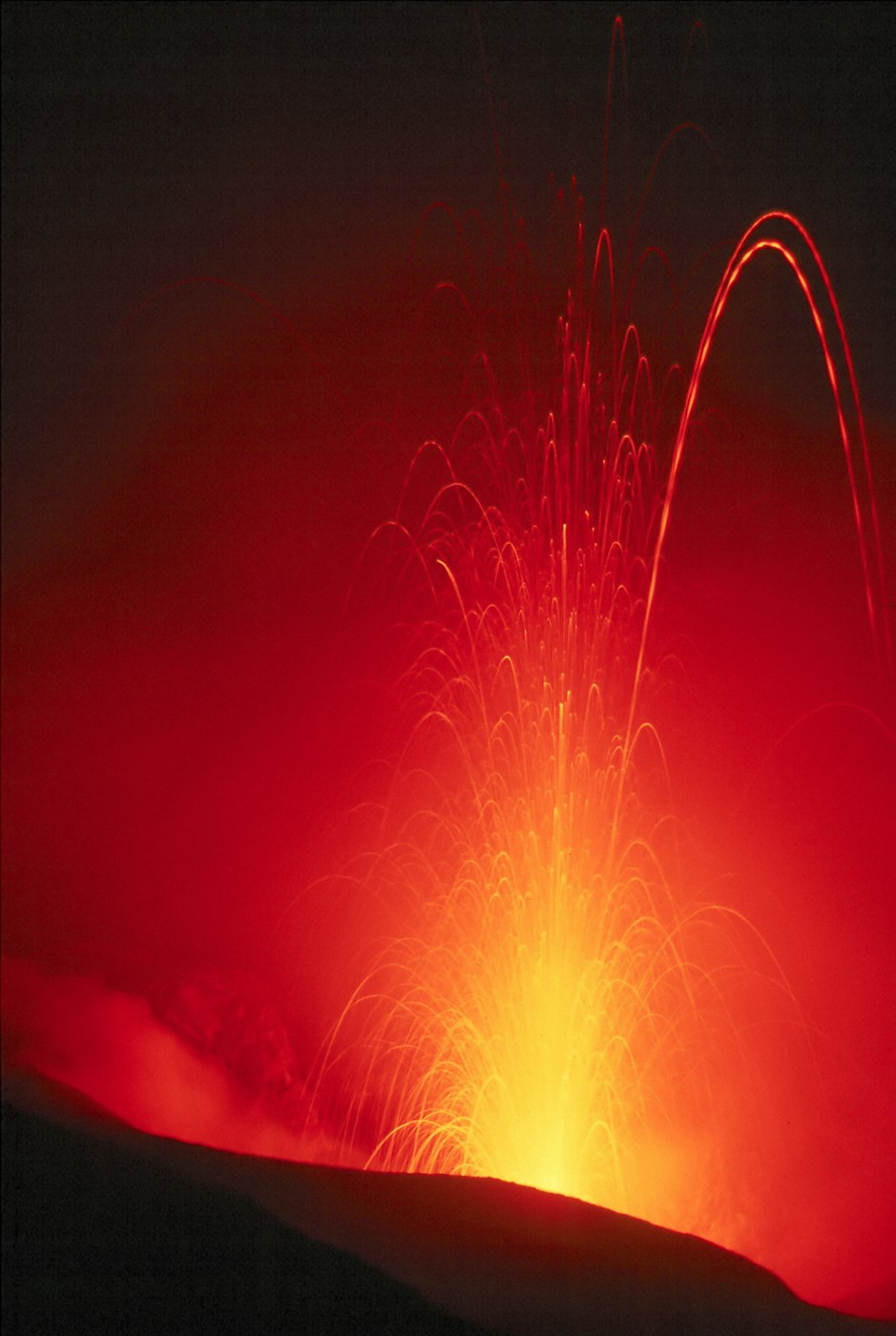
- Stromboli (2h from Lipari by hydrofoil): the active volcano — evening eruption boat tours run from Lipari and Salina nightly. Summit hike requires an authorised guide and is restricted to dusk departures; the crater view at last light with lava bursts is one of Europe’s most dramatic natural spectacles.
- Salina (1h from Lipari): the greenest and most fertile Aeolian island, famous for Malvasia delle Lipari DOC wine and the filming location of Il Postino (1994). Quieter than Lipari, excellent local restaurants.
- Panarea: the smallest and most exclusive Aeolian island — July is its best month (slightly less surreal prices than August).
Base strategy: 2-3 nights Lipari as the hub island, with day trips to Vulcano (mud baths morning, back by 14:00) and an evening Stromboli boat tour from Lipari port. If you want a quieter Aeolian stay, base on Salina and day-trip to Lipari. For practical detail on the Catania-based logistics, see our Catania guide for the city start and end of the trip.
Where to stay in Sicily in July (and where not to)
Catania makes the strongest single base for an east-coast July trip — Etna 60 minutes, Syracuse 55 minutes, Taormina 50 minutes, Pescheria fish market open all month. For island-wide coverage, split Catania (3-4 nights) with Palermo (1-2 nights, base for the Festino di Santa Rosalia weekend) and optionally a Lipari overnight for the Aeolian.
Accommodation prices in July run 30-60% above shoulder months — substantially below August’s 50-100% surge. Unlike August, you do not need to book 2-3 months ahead for most hotels and apartments: 4-6 weeks is sufficient for July, with the exception of the Santa Rosalia weekend in Palermo (14-15 July), where accommodation near the Cassaro fills 6-8 weeks ahead, and headline Taormina Arte Festival nights.
Decision tree by heat tolerance:
- Low heat tolerance: Base in Taormina (200 m elevation = 4-5°C cooler than coast, excellent sea breeze, 20-min drive to Isola Bella beach). Premium: 100% above Catania rates. Or base in a Madonie village (Castelbuono, Petralia Sottana) at 700-900 m — agriturismi, genuine rural Sicily, no tourist pressure.
- Good heat tolerance, culture-first: Catania — most connected base, Pescheria mornings, Etna day trips, day trips to Syracuse/Taormina/Aeolian from one address. Best value for a Catania-anchored July itinerary.
- West-coast focus (Santa Rosalia + San Vito + Agrigento): Palermo base. West-coast July averages 29-32°C, slightly cooler than east coast, and closer to the Festino di Santa Rosalia. Mondello beach 12 km.
From a single Catania apartment you can be at the Pescheria by 07:00, at Rifugio Sapienza Etna by 10:00, at Taormina by 12:00, and at the Fontane Bianche beach by 17:00. For couples, the Sicily honeymoon guide covers the July window with Taormina and Aeolian pairings; for families, the Sicily family holiday guide covers July-specific beach and activity logistics.
Sample 7-day Sicily itinerary in July (heat-aware, Catania-based)
This 7-day Catania-based itinerary for July 2026 is structured around the heat: cultural activities before 13:00 or after 18:00, beach mid-afternoon, evening events. It assumes the Festino di Santa Rosalia falls within the travel window (book travel for the 13-15 July window if possible). For a deeper structural itinerary, see our Sicily 7-day itinerary guide.
- Day 1 — Catania arrival + Pescheria morning. Arrive, settle into central Catania. Early morning (07:00-09:00): Pescheria fish market under Piazza del Duomo — swordfish from the Strait of Messina, sea urchins, abbanniate sellers. Granita di mandorla breakfast at Bar Mario. Afternoon: Liotru fountain, Via Etnea, Cattedrale di Sant’Agata. Evening: Lungomare seafront at La Plaja or Ognina. Day temperature: 30-34°C. Catania-base: apartments in Catania.
- Day 2 — Mount Etna summit. Depart 06:30. Rifugio Sapienza by 07:30. Cable-car (€50 round-trip) by 09:00 to 2.500 m. Jeep to 2.900 m or guided summit approach. Back at Sapienza by 13:00. Afternoon: Etna Nord vineyards (Linguaglossa, 40 min drive) or return to Catania for late swim. Summit air 8-18°C, bring fleece + windproof. See our Etna guide.
- Day 3 — Taormina Arte Festival evening. Taormina 50 km / 50 min. Morning: Greek Theatre visit (09:00-14:00), Corso Umberto pedestrian, Piazza IX Aprile Etna panorama. Afternoon: Isola Bella beach (sea 25°C) or Letojanni beach 5 km south. Evening: Taormina Arte Festival concert (21:00 start — book tickets ahead at fondazionetaormina.it). Return Catania by midnight.
- Day 4 — Palermo + Santa Rosalia weekend (14-15 July). Depart 08:00, reach Palermo by 10:00. Morning: Ballarò market, Cappella Palatina mosaics (stunning Byzantine gold). Afternoon: position on the Cassaro by 17:00 for the procession. The Festino di Santa Rosalia carro trionfante passes after sunset — find a spot on Corso Vittorio Emanuele with views to the sea. Fireworks Foro Italico after midnight. Stay overnight in Palermo.
- Day 5 — Monte Pellegrino + Cefalù beach. Morning: bus to Santuario di Santa Rosalia on Monte Pellegrino (feast day July 15). Afternoon drive to Cefalù 75 km east — Norman Cathedral + beach swim (sea 24-25°C). Return Catania evening.
- Day 6 — Siracusa Ortigia + Madonna delle Lacrime (24-26 July). Depart 08:00. Parco Archeologico Neapolis by 09:00 (Greek Theatre, Ear of Dionysius — visit before 12:00 heat). Lunch Ortigia island (Piazza del Duomo, Fonte Aretusa). Afternoon: Fontane Bianche beach 18 km south (sea 25°C). If dates align: Madonna delle Lacrime feast torchlight procession evening (24-26 July).
- Day 7 — Valle dei Templi Agrigento. Depart 06:30 (165 km / 2h). Arrive Valle dei Templi 07:00 opening — walk the ridge before the heat, Temple of Concordia, Temple of Hera (8 temples on 1.300 ha). Return via coastal SS115 and Scala dei Turchi (30 min detour, white marl cliff + blue sea). Back Catania by 17:00 for final Pescheria aperitivo area and dinner on the Lungomare.
Frequently asked questions
Is Sicily too hot in July?
Honest answer: July is hot but manageable with a heat-aware plan. Coastal cities average 30-34°C by day — genuinely warm, but 2-3°C cooler than August’s 31-35°C peaks, with 1-2 sirocco events per month vs August’s 2-3. The strategy that works: cultural sites and Etna before 13:00, siesta and sea from 16:00, outdoor dinner from 21:00 when the seafront drops 6-8°C from the midday peak. Archaeological sites like the Valley of the Temples (31-35°C in July at midday) and Selinunte reward a 07:00 opening visit or a 18:00-sunset visit. Taormina at 200 m elevation runs 4-5°C cooler than the Catania coast and is the most comfortable base if heat is your primary concern. Mount Etna at 3.357 m is 22-24°C cooler than coastal Catania — a genuine heat escape in 60 minutes from the city.
Is July or August better for Sicily?
July wins on: cooler temperatures (30-34°C vs 31-35°C coast), fewer crowds (Italian school holidays don’t peak until late July), prices 30-60% above shoulder vs 50-100% in August, the Festino di Santa Rosalia (Sicily’s most spectacular urban festival, with nothing equivalent in August), longer Etna daylight window (14h30m on 1 July vs 12h50m on 31 August), and the Pescheria Catania still fully operational. August wins on: sea warmer (27-28°C vs 24-26°C in July), Ferragosto national holiday beach atmosphere, La Vara di Messina and the Palio dei Normanni medieval pageant. Verdict: July for culture-first and heat-sensitive travellers; August for beach-peak and Italian national holiday immersion. See our Sicily in August guide for the full August case.
Is Sicily expensive in July?
July is expensive by shoulder-month standards — apartment rates in central Catania, Taormina, and Palermo run 30-60% above May or October. Flights from UK to Catania-Fontanarossa average 40% above autumn rates; car rentals 50% above. But July is consistently 20-30% below August’s 50-100% surge. A 7-night Catania-based July trip with mid-range comfort runs roughly €900-1.400 per person ex-flights — compared to €1.300-1.900 for the same trip in August. The cheapest window within July is 1-13 July (before the Santa Rosalia surge builds in Palermo and before Italian late-July holidays start). Book accommodation 4-6 weeks ahead for most locations; for Palermo hotels near the Cassaro on 13-16 July, book 6-8 weeks ahead.
Is the Amalfi Coast or Sicily better in July?
Sicily is the stronger choice for July in most categories. Scale: Sicily (25.711 km²) offers seven UNESCO sites, five major cities, an active volcano, the Aeolian Islands, and a two-week festival calendar that the Amalfi Coast — a 50-km coastal strip — cannot match. Budget: Sicily accommodation and dining runs 30-50% cheaper than the Amalfi in July. Crowds: the Amalfi is arguably more congested in July relative to its size. The one advantage of Amalfi in July: its cooler northern positioning (sea 24-25°C, air 26-30°C vs Sicily’s 30-34°C). Sicily uniquely offers the Festino di Santa Rosalia, Mount Etna, the Aeolian Islands, and genuine off-the-beaten-track pockets — none of which exist on the Amalfi. For families, couples, and anyone wanting more than a beach week, Sicily is the stronger proposition.
What is Sicily famous for drinking in July?
In July the Sicilian drink calendar is specific and delicious. Granita di mandorla (almond granita, served in a glass with a brioche col tuppo for dunking) is the canonical breakfast throughout July — the mandorle di Avola variety from south-east Sicily produces the most fragrant result. Granita di limone (lemon, especially from the Etna-slope Interdonato lemon variety, more aromatic than Amalfi) and granita di fico d’india (prickly pear, brilliant magenta, cooling) round out the granita canon. At aperitivo hour: Malvasia delle Lipari DOC — the oxidative amber dessert wine from Salina — is served ice-cold by the glass in Aeolian bars. Nero d’Avola rosé (chilled) and Etna Rosso at cellar temperature are the local wine choices for dinner. For non-alcoholic: fresh-pressed limonata (hand-squeezed, not concentrate) from the bar machines visible throughout Catania and Palermo streets.
What should you avoid in Sicily in July?
Avoid open-air archaeological sites between 12:00 and 16:00 — the Valley of the Temples, Segesta, Selinunte, Villa Romana del Casale all have zero shade and reach 32-35°C in July midday sun. Avoid driving long distances without reliable car A/C. Avoid expecting Taormina Arte Festival headline concerts to have last-minute availability — book 4-8 weeks ahead for top performers. Avoid the Palermo Santa Rosalia area without an overnight plan on July 14 — returning to Catania at 02:00 after the fireworks is doable but exhausting. Avoid the Aeolian Islands in the last week of July without accommodation booked 4 weeks ahead — the Italian holiday early wave begins. Avoid booking only beach time with no altitude backup plan: a sirocco day at 38°C on an exposed beach with UV 10 is unpleasant; Etna or the Madonie are the reliably cool alternatives.
Can you swim in Sicily in July?
Yes — fully, from 1 July. Sea temperature off the Ionian east coast (Catania, Taormina, Syracuse) runs 24°C on 1 July and reaches 26°C by 31 July — comfortable for all-day swimming from mid-July onward. The Tyrrhenian north coast (Cefalù, San Vito Lo Capo, Mondello) runs 0.5-1°C warmer. The south coast (Fontane Bianche near Avola, Eraclea Minoa, Marina di Ragusa) benefits from southerly currents and is similarly 24-25°C in early July. For the most comfortable swim: early morning 08:00-10:00 before UV peak, or evening 17:30-20:00 when the sea surface captures the evening breeze and the heat drops. The water in July is notably less stress-inducing than August’s 27-28°C — still warm, but with enough thermal difference to feel refreshing on a 32°C day.
Where to stay in Catania
From our base in central Catania, July unfolds with a rhythm that no other month quite replicates: Pescheria fish market at 07:00 (still fully open, unlike the August Ferragosto week), Mount Etna by 09:00 for the summit in long July daylight, the Taormina Arte Festival by evening, and the Santa Rosalia weekend in Palermo as the centrepiece of the trip. Catania-Fontanarossa airport connects direct to London (Gatwick, Stansted, Luton), Manchester, Edinburgh, Dublin, Amsterdam, Frankfurt, Munich, and Zurich throughout July — the shortest gateway to east Sicily. For three central units in the historic district — within walking distance of the Pescheria, the Baroque Cathedral, and the Lungomare — see our apartments in Catania.
The information in this guide was correct at the time of writing. Data can change from season to season without notice: before you travel, always check the official channels and websites for updates. We review this guide periodically, but the official channels are always the authoritative source. We also cannot guarantee that the suggested routes or the attractions described are always reachable or accessible: roads, trails and sites may be closed, damaged, altered or unsafe. Assessing the practicability and safety of itineraries and attractions always remains your own responsibility.