

Sicily in February 2026 is the month the island shows its most concentrated cultural face: Catania erupts for the Festa di Sant’Agata (3-5 February), Acireale and Sciacca run twin Mardi Gras carnivals, almond trees blossom across the Valley of the Temples, and Mount Etna reaches its peak ski season — all under coastal day temperatures around 14°C and accommodation prices 35-50% below the August peak. From our base in Catania we treat February as the year’s most theatrical four weeks: this guide covers weather by region, festival dates exact for 2026 and 2027, what to wear, what it costs, and how to plan a Catania-anchored trip that fits all three carnivals.
What is the weather like in Sicily in February?
Coastal Sicily averages 12-15°C by day and 5-9°C at night in February, with sea temperature around 15°C (too cold to swim for most), 50-65 mm of rainfall over 8-10 wet days, and 5-6 hours of sunshine per day. Inland and high-altitude areas are notably colder. Sirocco winds occasionally push afternoons to 17-18°C.
Pushing into spring? Three months on from the February festival peak, May runs warmer and dryer with four new headline events — see our Sicily in May guide for Sant’Alfio, Infiorata, Cantine Aperte and the INDA opening.
February sits in the wettest stretch of the Sicilian year alongside November, December, and January. Expect rain on roughly half the days you’re there — usually as short showers rather than all-day grey, with bright spells in between. Coastal areas (Palermo, Catania, Taormina, Syracuse) run noticeably milder than inland centres like Enna, Caltagirone, or the Madonie/Nebrodi mountains, where night temperatures regularly drop to 1-5°C and snow is normal at 1.000+ metres.
| Region | Day °C avg | Night °C avg | Rainfall mm / Wet days |
|---|---|---|---|
| Palermo (NW coast) | 15 | 9 | 65 / 9 |
| Catania (E coast) | 14 | 7 | 50 / 8 |
| Taormina (NE coast, 200 m) | 13 | 6 | 55 / 9 |
| Agrigento (S coast) | 14 | 8 | 55 / 8 |
Daylight lengthens noticeably through the month: Catania sees 10 hours 11 minutes of daylight on 1 February and 11 hours 26 minutes on 28 February — a gain of about 1 hour 15 minutes through the four weeks. By the last week of February, sunset is past 18:00, useful for late afternoon site visits.
On Mount Etna, conditions are full winter: at 2.000 m daytime temperatures range from -2°C to +2°C, with -5°C to -2°C overnight. The summit (3.357 m / 11.013 ft) is closed to standalone hikers; access is limited to authorised mountain guides for those with technical experience. The cable car from Rifugio Sapienza runs to 2.500 m weather-permitting.
How warm is Palermo in February?
Palermo in February averages 15°C by day and 9°C at night — the warmest of Sicily’s main cities. The northwest coast benefits from a slightly milder maritime climate than Catania’s east-coast position, which averages 14°C day and 7°C night. Rainfall in Palermo runs slightly higher (around 65 mm over 9 wet days). You’ll need a jacket for evenings, but afternoon sightseeing around the Cathedral, Ballarò market, or Cappella Palatina is entirely comfortable in a light layer.
Is February a good time to visit Sicily?
Yes, if your trip is anchored on culture, festivals, baroque towns, food, and Etna skiing rather than beaches. February delivers Sicily’s three most important winter festivals (Sant’Agata, Carnevale di Acireale, Carnevale di Sciacca), 35-50% savings on flights and accommodation versus August peak, and near-empty archaeological sites — at the cost of cold sea, occasional rain, and reduced ferry frequency to the smaller islands.
Why February works
- Triple festival peak. Sant’Agata in Catania (3-5 Feb), Carnevale di Acireale ending Mardi Gras (17 Feb 2026), Carnevale di Sciacca 400th anniversary edition (14-15, 20-22, 28 Feb plus 1 Mar 2026). No other month concentrates this much cultural intensity in 2-3 weeks.
- Etna ski peak. The most reliable snow base of the entire winter at Rifugio Sapienza (1.910 m) and Piano Provenzana (1.810 m), with both stations fully open.
- Off-season pricing. Flights from Northern Europe to Catania or Palermo run 35-50% below August levels. Accommodation in central Catania, Taormina, or Palermo can be 35-50% below summer peak.
- Quiet sites. The Valley of the Temples, Villa Romana del Casale, Ortigia archaeological park, Segesta, Selinunte — all near-empty, walkable in mild 14-15°C day temperatures.
- Almond blossom. First two weeks of February see the natural peak of almond trees (Prunus dulcis) blooming pink-white across the south coast countryside, particularly around the Valley of the Temples in Agrigento.
- Citrus season. Blood orange (arancia rossa di Sicilia IGP) reaches its deepest crimson in January-February when cold nights intensify the anthocyanin pigments. Markets in Catania, Palermo, and Lentini carry full crates.
Where February struggles
- Sea is cold (~15°C). Beach holidays don’t work. Reserve coastal swimming for May onward.
- 49% wet day chance. Plan rainproof activities (museums, Cappella Palatina mosaics, churches, chocolate tastings) for backup days.
- Reduced ferry schedule to the Aeolian Islands. Liberty Lines and Siremar still run daily Milazzo-Lipari weather-permitting, but service to outlying islands (Stromboli, Filicudi, Alicudi) is irregular.
- Some smaller museums and POIs run shorter hours. Always check official websites the day before.
Is Sicily worth visiting in winter?
Yes — Sicily in winter (December through February) rewards travellers who prioritise culture over beaches. Coastal daytime temperatures stay around 13-15°C, all the major archaeological sites and baroque town centres remain fully open, and prices run 35-50% below summer peak. February is the strongest winter month: three major festivals (Sant’Agata Catania, Carnevale di Acireale, Carnevale di Sciacca) run simultaneously, Etna ski season peaks, and almond trees begin their blossom in Agrigento province. The main trade-off is a roughly 49% chance of rain on any given day — pack a waterproof layer and plan one or two rainproof indoor activities as backup.
Sant’Agata in Catania (Feb 3-5): the centerpiece
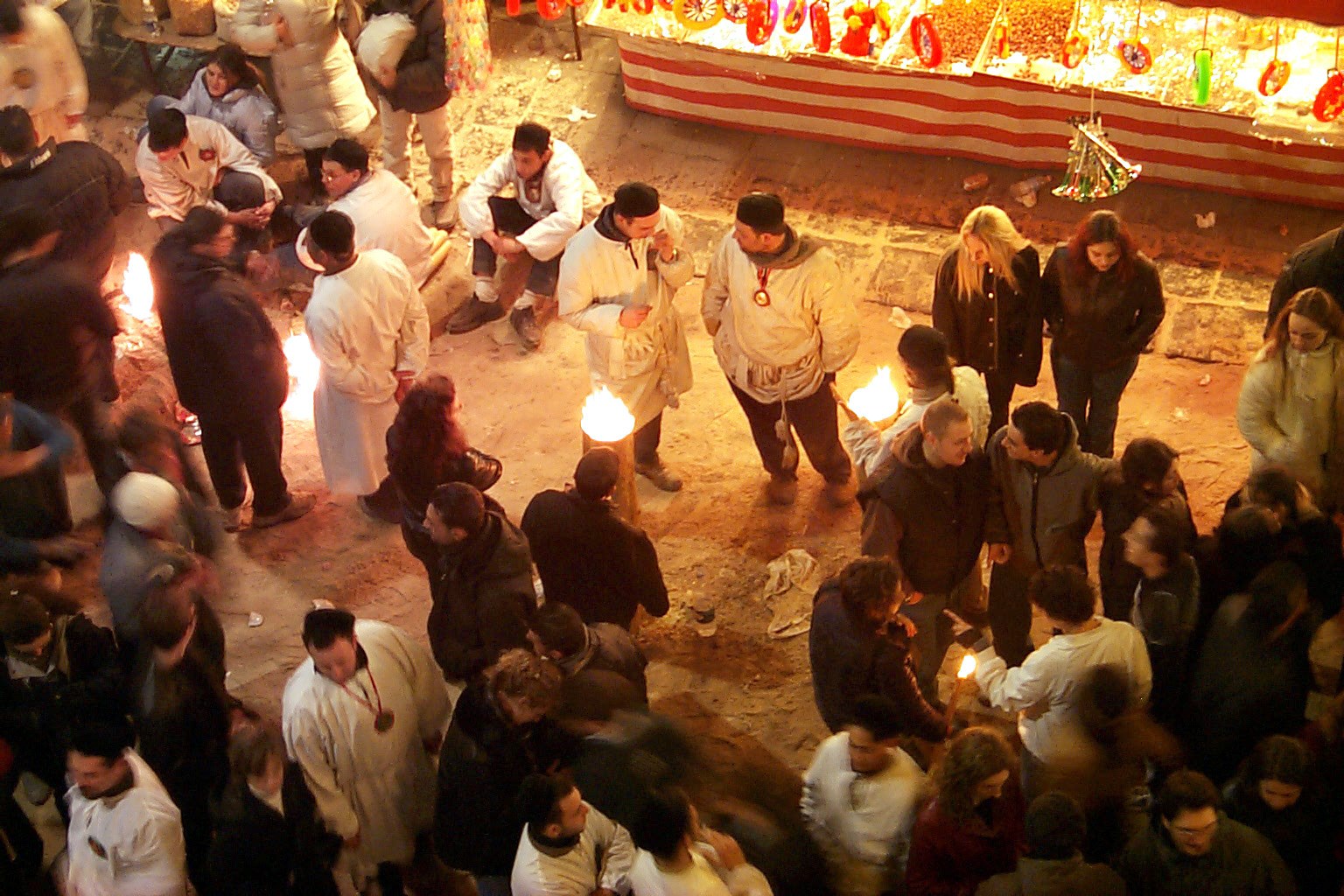
The Festa di Sant’Agata is the world’s third-largest Catholic celebration after Holy Week in Seville and Corpus Christi in Cuzco, drawing around one million devotees across three core days (3-5 February) plus a wider liturgical cycle from 30 January to 12 February. The fercolo — a silver reliquary bust — is paraded through Catania’s historic centre by white-sackcloth (‘saccu’) devotees, accompanied by eleven enormous candelore (carved wooden guild towers up to five metres tall).
Peppe64 · CC BY-SA 3.0
From our base in Catania, Sant’Agata is the most intense civic moment of the year. The city locks down its historic centre, schools and offices close, and the procession route along Via Etnea, Via Garibaldi, and Via San Giuliano fills with devotees from before dawn. The festival predates the modern city — Sant’Agata was martyred in 251 CE under emperor Decius, and the cult has run continuously in Catania since the early Middle Ages. Eleven trade-guild candelore (fishmongers, butchers, bakers, fruit-sellers, pasta-makers, and others) carry the towers in shifts, swaying them in characteristic pendulum movements as they navigate the narrow streets.
Sant’Agata at a glance
- Location
- Piazza del Duomo, Catania Maps
- Essential fact
- 11 candelore guild towers up to 5 m, silver fercolo of ~4 t, ~1 million devotees across three days — the heart of the festival runs 3–5 February.
- Price
- Free
Day-by-day:
- 3 February — Offering of the Wax. A procession of religious, civil, and military authorities, historic Senate carriages, and devotees with votive candles departs the Church of Sant’Agata alla Fornace at noon and proceeds to the Cathedral.
- 4 February — Candelore and morning procession. The eleven candelore towers are paraded through the historic centre, then the fercolo bearing the saint’s relics begins its long procession through the city.
- 5 February — Final procession. The fercolo continues its tour past the Church of Sant’Agata al Borgo, returning toward the Cathedral. The symbolic finale is the dawn sprint up Via San Giuliano at first light, where bearers cover the steep stretch at speed in tribute to the saint’s strength.
For official scheduling and route updates each year see Visit Sicily’s Sant’Agata page.
Carnevale di Acireale and Sciacca: Sicily’s twin Mardi Gras
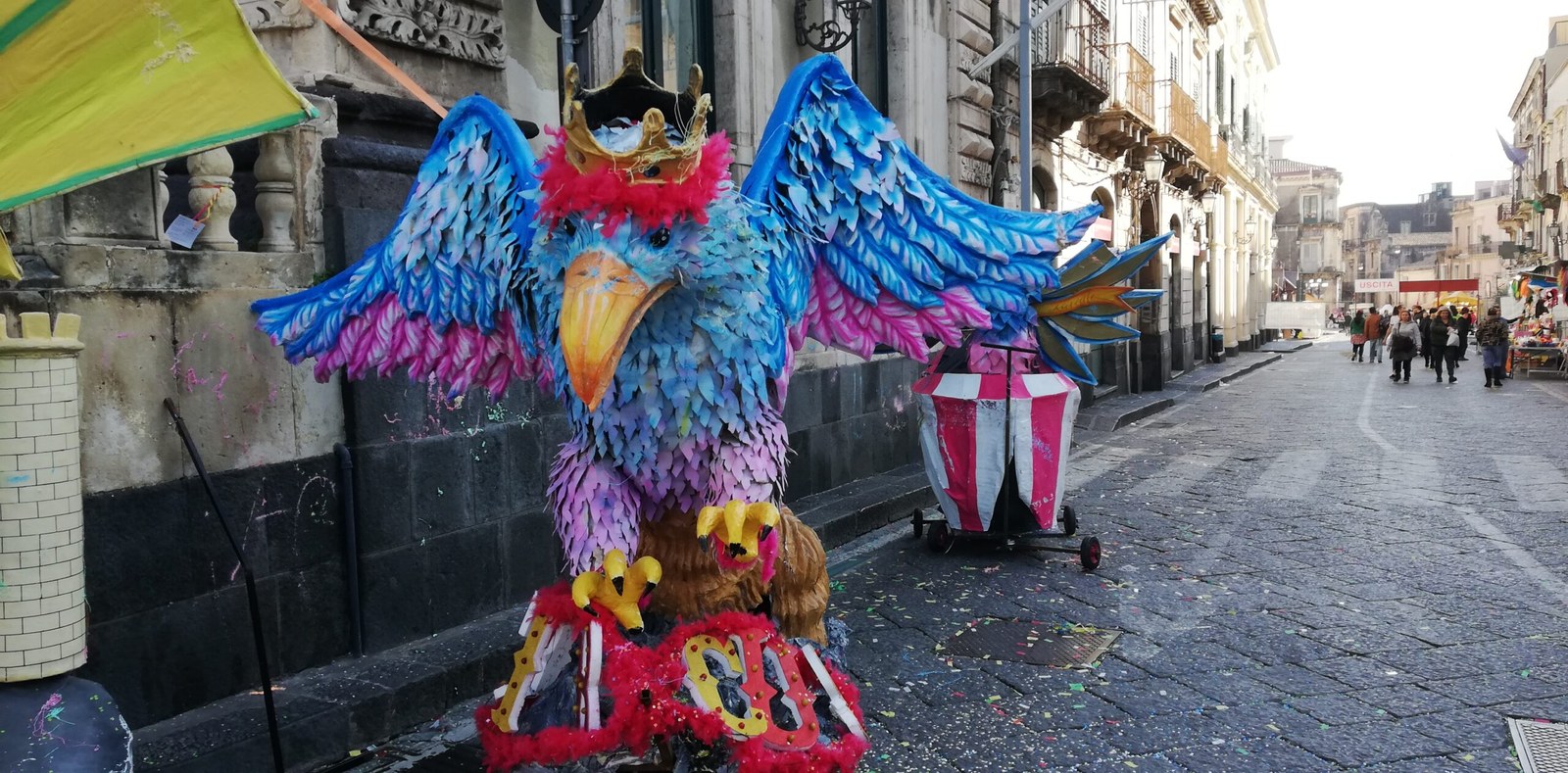
Sicily hosts two of Italy’s most important historic carnivals in February. Carnevale di Acireale, 17 km north of Catania, is officially the island’s most beautiful Carnival since 1594 — papier-mâché allegorical floats parade through a baroque historic centre, ending Mardi Gras (17 February in 2026). Carnevale di Sciacca on the south coast celebrates its 400th anniversary in 2026 with parades over two consecutive weekends plus the Mardi Gras finale, ending with the ritual burning of the Peppe Nappa mask.
Effems · CC BY-SA 4.0
Carnevale di Acireale 2026
- Location
- Via Ruggero Settimo 5, Acireale Maps
- Site
- fondazionecarnevaleacireale.it
- Essential fact
- 432nd edition (since 1594). Papier-mâché allegorical floats and flower floats parade every weekend on a closed ticketed circuit centred on Piazza del Duomo, with the Mardi Gras finale on 17 February.
- Price
- €6–10
The 2026 edition runs Saturday 31 January through Tuesday 17 February (Mardi Gras / Martedi Grasso). Parades of allegorical floats and flower-decorated floats take place every Saturday and Sunday on a closed, ticketed circuit centred on Piazza del Duomo, with the finale on Mardi Gras night. From Catania it’s a 25-minute drive or 30-minute regional train ride — fully day-trippable, no overnight needed.
2027 forecast: with Easter falling on 28 March 2027 (early), the carnival cycle shifts earlier — Mardi Gras 2027 falls on 9 February, so the Acireale 10-day cycle runs approximately 31 January to 9 February 2027, fully inside our pillar window. For the most current programme and tickets see the official Carnevale Acireale site.
Carnevale di Sciacca 2026 — 400th anniversary

Effems · CC BY-SA 4.0
- Location
- Via Salvatore Allende, Sciacca Maps
- Site
- sciaccarnevale.it
- Essential fact
- 400th anniversary edition. Four- to five-storey papier-mâché floats with mechanical movements; the signature ritual is the burning of the Peppe Nappa effigy on Mardi Gras night — a tradition unique among Italian carnivals.
- Price
- Free
Sciacca sits on the south coast in the province of Agrigento. The 2026 edition is the 400th anniversary, with the official programme spanning Saturday 14 and Sunday 15 February, then Friday 20 to Sunday 22 February, then the Mardi Gras finale on Saturday 28 February and Sunday 1 March. The signature ritual — unique among Italian carnivals — is the burning of the Peppe Nappa mask on Mardi Gras night, a wooden effigy character traceable to medieval commedia dell’arte. Floats run four to five stories tall, often with mechanical movements, and parade through the historic centre in repeated loops.
For schedules and ticketing see the official Carnevale di Sciacca page.
More February events: San Biagio, almond blossom, opera season
Beyond the three main festivals, February offers the smaller religious festa of San Biagio (3 Feb), the natural peak of almond blossoms across the south coast, the busiest opera season at Teatro Massimo Palermo, the deepest tier of Italy’s winter sales (Saldi Invernali), and the cold-process chocolate season in Modica. The Mandorlo in Fiore Festival itself moves to March 7-15 in 2026 — February visits catch the natural blossom without the festival crowds.
- Festa di San Biagio (3 Feb). Italian throat-blessing tradition (Saint Blaise is patron of throats). Most theatrical in Comiso (Ragusa province) and Salemi (Trapani province), where ‘cuddure di San Biagio’ — ring-shaped sweet breads — are blessed and distributed. Falls the same day as Sant’Agata’s wax-offering procession in Catania, but the two festivals don’t compete: Sant’Agata is the centerpiece for travellers, San Biagio is a strong day-trip option from a Ragusa or Modica base.
- Almond blossom (natural peak, first 2 weeks Feb). The Mandorlo in Fiore Festival in Agrigento — now at its 78th edition — runs 7-15 March 2026, with a special Mandorlo Express train from Palermo on the closing weekend (14-15 March). For February visitors, this means the natural bloom is at peak across the Valley of the Temples and the Caltanissetta countryside without festival visitors. Self-drive route: Etna foothills → Caltanissetta → Agrigento, via SS640.
- Teatro Massimo Palermo opera season. January-March is the peak window. The 1.300-seat house programmes a major opera per month — check teatromassimo.it for the February calendar.
- Saldi Invernali (winter sales). Started 7 January in Sicily under regional regulation. By February the discount tier drops to 50-70% off across Catania (Via Etnea, Corso Italia), Palermo (Via Maqueda, Via Libertà), Taormina (Corso Umberto). Final clearances run into early March before spring collections arrive.
- Blood-orange peak (arancia rossa). The IGP cultivars Tarocco, Moro, and Sanguinello reach maximum colour intensity in February (cold nights drive anthocyanin development). Pescheria fish market in Catania carries full bins; rural producers along the Lentini-Paternò belt sell direct from their own farms.
- Modica cold-process chocolate. The Aztec-style cold-extraction technique (no melted sugar) is at its busiest tasting season through February at Antica Dolceria Bonajuto, Sabadì, and smaller artisan shops. Easter-shaped chocolates begin appearing in shop windows in late February.
- Carnevale di Termini Imerese (PA). Sicily’s third-ranking carnival, smaller in scale but with strong local character. Runs Mardi Gras week.
- Carnevale di Taormina. Compact parade through Corso Umberto on Mardi Gras weekend — useful if you’re already based in Taormina, not worth a dedicated trip.
Etna skiing in February: peak snow season
February is the best month to ski Mount Etna, with both stations — Rifugio Sapienza on the south flank (1.910 m, Catania-side) and Piano Provenzana on the north flank (1.810 m, Linguaglossa-side) — at peak snow base. Day passes run €30-40, equipment rental on-site, and Etna remains the only place in Italy where you can ski with the Mediterranean in view.

Jeanne boleyn · Public Domain
The two ski areas are separated by 90 minutes of mountain road and serve different audiences. Rifugio Sapienza on the south is closer to Catania and easier for day-trippers; Piano Provenzana on the north is quieter, longer-running, and rewarded for the extra drive. Both run lifts only when snow base is sufficient — typically reliable mid-December through mid-March, with February the most consistent month.
Rifugio Sapienza (south flank)
- Location
- Piazzale Rifugio Sapienza, Nicolosi Maps
- Site
- rifugiosapienza.com
- Essential fact
- 1.910 m base, lifts to ~2.500 m, 4 lifts and 10 km of pistes — beginner-to-intermediate friendly, with the Funivia dell’Etna cable car running for non-skiers when conditions allow.
- Price
- €30–40
Piano Provenzana (north flank)
- Location
- Piano Provenzana – Etna nord,via Provenzana, Linguaglossa Maps
- Essential fact
- 1.810 m base, 5 lifts, 6 km of pistes — more advanced terrain than Sapienza, with quieter slopes and easy pairing with a long lunch in Linguaglossa or an Etna-Nord winery visit.
- Price
- €30–40
Yulka-lucia · CC BY-SA 4.0
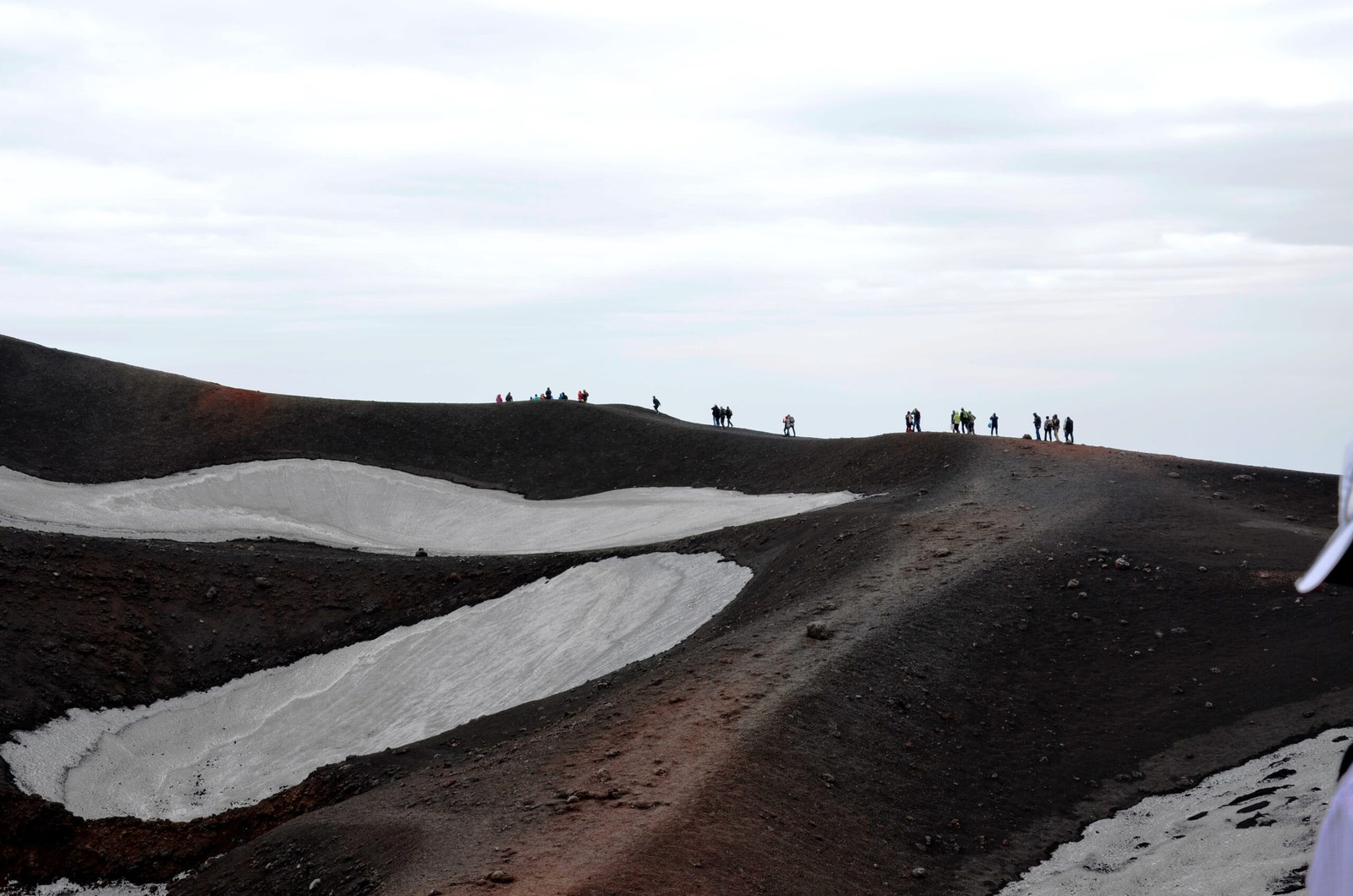
For non-skiers, the Funivia dell’Etna cable car from Rifugio Sapienza climbs to 2.500 m weather-permitting (around €50 round trip), reaching panoramic snow terrain without ski equipment. The summit zone above 2.900 m is closed to standalone access in winter; only authorised mountain guides take groups higher. For real-time lift status and winter conditions check funiviaetna.com and parks.it/parco.etna.
If Etna isn’t running, the inland alternative is the Madonie regional park (Piano Battaglia, 1.500-1.800 m), which has small-scale lifts and snowshoeing trails. From Catania it’s 2.5 hours by car via Cefalù.
Best places to visit in Sicily in February
A Catania-anchored February trip can reach all three carnivals plus Etna skiing, blood-orange country, and the Val di Noto baroque towns within a 2-hour radius. Below, our shortlist of February’s strongest destinations across the island.
Ed Yourdon · CC BY 2.0
- Catania. Mildest winter coast (avg day 14°C), Pescheria fish market open daily, Sant’Agata Feb 3-5 historic-centre lockdown, blood-orange peak at Pescheria. Etna ski day-trip and Acireale Carnevale both within 30 minutes.
- Acireale. Baroque town 17 km north of Catania, Carnevale stage venue. Cathedral Santa Maria Assunta, basilica San Sebastiano, papier-mâché float workshops visitable through January-February.
- Sciacca. South coast, 400th-anniversary Carnevale + thermal baths + ceramics + working fishing port. Combinable with Valle dei Templi or Selinunte for a 2-3 day west-coast loop.
- Mount Etna. Active volcano 3.357 m, snow-capped December-April. Both ski stations at full operation. Lower lava-flow trails (Silvestri Craters, 1.980 m) walkable on snow-free days.
- Palermo. Cathedral, Cappella Palatina mosaics (rainproof activity), Ballarò + Vucciria + Capo markets year-round, street food (arancina + sfincione + panino con la milza), Teatro Massimo opera season peak.
- Taormina. Greek Theatre quiet (no festival), Corso Umberto open with reduced crowds, Etna view from Piazza IX Aprile in winter air clarity. Hotels at deep-discount rates compared to summer.
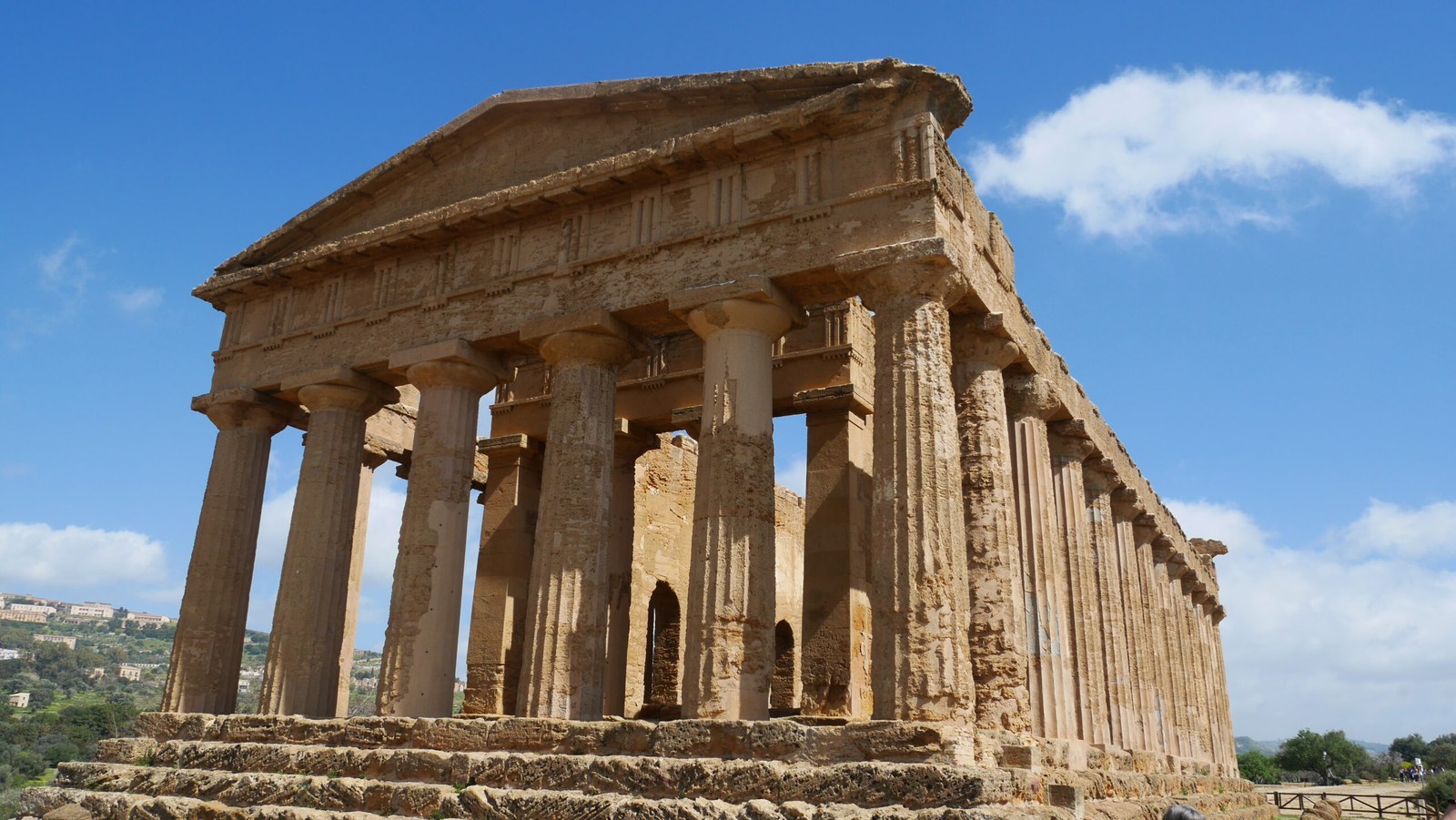
- Valley of the Temples (Agrigento). UNESCO 8 Greek temples on 1.300 hectares, near-empty in February, mild day temps 13-15°C make walking comfortable, almond trees in natural peak bloom.
- Syracuse / Ortigia. Ortigia island is 1.2 × 0.7 km — Apollo Temple, Duomo Piazza, Fonte Aretusa with papyrus, Cathedral built into a Greek temple of Athena. Restaurant scene quieter but open.
- Modica. UNESCO baroque town and home of Aztec-style cold-process chocolate. Antica Dolceria Bonajuto and Sabadì run busy February tasting tours.
- Ragusa Ibla. Lit baroque centrepiece visible from the upper town in clear winter air. Easy day-trip from Modica or Catania.

Effems · CC BY-SA 4.0
- Cefalù. Norman Cathedral with UNESCO mosaics, La Rocca hike feasible in cooler temperatures (~3-4 hours round trip), sweeping Tyrrhenian beach empty in winter.
- Madonie + Nebrodi mountains. Inland alternative for snow: Piano Battaglia ski station (Madonie, 1.500-1.800 m), snowshoeing routes, baroque village of Polizzi Generosa.
- Comiso (Ragusa province). San Biagio festival anchor (3 Feb), Casmene archaeological area, baroque centre. Combinable with Modica or Ragusa.
- Aeolian Islands. Ferries reduced — Liberty Lines and Siremar still run Milazzo-Lipari daily weather-permitting. Stromboli’s sciara visible after sunset, Vulcano mud baths year-round. Off-season prices lowest.
Things to do in Sicily in February
Anchor your trip on one of the three festival weekends, then build out by interest: indoor culture for rainy days, Etna skiing or snowshoeing for winter sport, Val di Noto baroque towns and chocolate tastings for slow travel, blood-orange tasting in Catania province for food focus.
- Festival weekend. Pin one of the three carnivals (Sant’Agata 3-5 Feb · Acireale Mardi Gras 17 Feb · Sciacca 400th anniversary 14-15, 20-22, 28 Feb-1 Mar 2026) and build the rest of your week around it.
- Etna skiing or snow walking. Half-day at Sapienza or Provenzana, return to Catania for evening. Cable car to 2.500 m for non-skiers.
- Val di Noto baroque circuit. Two-day loop Catania → Noto → Modica → Ragusa Ibla → Scicli, with a chocolate tasting in Modica and a long lunch in Ortigia.
- Valley of the Temples + Mandorlo preview. Day-trip Catania → Agrigento (~2.5 h drive) for the UNESCO archaeological park with almond blossom in natural peak. Pair with Scala dei Turchi for a coastal afternoon.
- Pescheria + cooking class Catania. The historic fish market opens at dawn — a hands-on cooking class around blood orange, tuna, swordfish, and arancini fits February perfectly. See our things to do in Catania guide for shortlists.
- Cappella Palatina + Palermo street food walk. Rainproof half-day inside Norman mosaics + Vucciria street food crawl.
- Teatro Massimo opera evening. Pair with a sit-down dinner in Palermo’s Politeama district.
- Self-drive almond country. SS640 Etna foothills → Caltanissetta → Agrigento, photographing pink-white drifts in countryside groves.
- Long weekend in Taormina. Greek Theatre quiet visit, Etna view from Piazza IX Aprile, day-trip to Castelmola, Mardi Gras parade if your dates align.
- Aeolian day-trip. Catania → Milazzo → Lipari ferry (weather-permitting), one full day, return to Catania same evening.
For a longer trip framework, our 7-day Sicily itinerary still works in February with light adjustments (skip the beach, add festival or ski day). For Etna in particular see our Mount Etna hiking and skiing guide.
What to wear and pack for Sicily in February
Layered approach — thermal base, mid-layer, waterproof shell — plus walking shoes that can handle wet cobblestones. Beach kit stays home; ski gear can be rented on Etna rather than carried.
Coastal day temperatures around 14°C feel mild in direct sun and chilly when overcast or wind-driven. Inland and at altitude, the gap is wider. The pragmatic kit:
- Waterproof rain shell. Non-negotiable — 49% wet-day chance. Hooded, breathable.
- Mid-weight insulation layer. Fleece or light down jacket for evenings and altitude.
- Thermal base layer. One set for ski day or any inland excursion above 1.000 m.
- Comfortable waterproof walking shoes. Cobblestones get slippery in rain; trainers with grip work well in cities.
- Light scarf + hat. Useful for windy coastal days and Sant’Agata pre-dawn waits.
- Compact umbrella. Backup for rain shell.
Nice-to-have: thermos for warm drinks during long Sant’Agata waits; gloves for ski day; sunglasses (UV index still hits 4 on clear days); a small day pack for layering management.
Skip: swimsuit (sea is 15°C), heavy summer dresses, sandals.
How much does a Sicily February trip cost?
February is one of Sicily’s two cheapest months (the other is November). Expect 35-50% savings on flights and accommodation versus the August peak, with car rental down ~40% and dining largely unchanged. A 7-night trip from Northern Europe with mid-range comfort runs roughly €700-1.000 per person, ex-flights.
| Item | February typical | August peak | Saving |
|---|---|---|---|
| Return flight UK/IE → Catania | €90-160 | €220-380 | ~50% |
| Apartment central Catania (per night) | €60-100 | €180-300 | ~50% |
| Hotel Taormina sea view (per night) | €110-180 | €280-450 | ~45% |
| Car rental compact (per day) | €25-35 | €55-85 | ~40% |
| Mid-range dinner per person | €25-35 | €30-40 | minimal |
| Etna ski day pass | €30-40 | n/a | — |
| Carnevale Acireale ticket | €6-10 | n/a | — |
Prices indicative — flight and accommodation rates fluctuate week-to-week and are sensitive to specific dates. Easter 2026 falls late (5 April), so February is fully clear of pre-Easter price ramps.
Where to stay in Sicily in February
Catania makes the strongest base for a February trip — all three carnivals (Sant’Agata in town, Acireale 25 minutes north, Sciacca 2.5 hours west), Etna skiing one hour away, blood-orange country at the doorstep, and the mildest winter coastal temperatures on the island.
From a single Catania apartment you can pin Sant’Agata Feb 3-5 in walking distance, day-trip to the Acireale Carnevale Saturdays and Sundays through the month, take a half-day on Etna whenever the weather opens, and weekend out to Sciacca or Agrigento for the 400th-anniversary parades and almond blossom. The historic centre’s mid-range apartment rates (€60-100 per night in February) compare favourably with Taormina or Palermo for the same week, and the airport is 7 km from the centre.
For three central units in the heart of the historic district, see our apartments in Catania.
For the early-summer months see our Sicily in June guide (Taormina Film Festival, swimming season opening, sea 21-24°C) and our Sicily in July guide (Festino di Santa Rosalia 14-15 July, Etna optimum summit, sea 24-26°C).
Frequently asked questions
Is Sicily warm in February?
Sicily in February is mild rather than warm. Coastal areas average 14°C by day and 5-9°C at night, with sea temperature around 15°C. It’s the wettest stretch of the year alongside November-December-January, with about 50-65 mm of rainfall over 8-10 wet days. Sirocco winds occasionally push afternoons to 17-18°C. Inland and high-altitude areas (Etna, Madonie, Nebrodi) are notably colder with reliable snow above 1.500 m.
Can you swim in Sicily in February?
Not realistically. Sea temperature averages 15°C — too cold for most non-cold-water swimmers. Beach holidays don’t work in February; reserve coastal swimming for May onward when the sea climbs through 18°C and into the 20s by June. Cold-water swimmers and divers in wetsuits can still enter, but the mainstream beach experience is May-October.
What is the cheapest month to visit Sicily?
February ties with November as Sicily’s cheapest month. Flights from Northern Europe to Catania or Palermo run 35-50% below August peak, and central-city apartment rates drop similarly. Car rental is around 40% cheaper. The two months differ in what’s open: November still has good produce and warm sea (~20°C), while February delivers the festival peak and Etna ski. February is the better off-season month for travellers who prioritise culture, festivals, and active winter sport over warm-weather activities.
Are flights cheap to Sicily in February?
Yes — February sits at the bottom of the annual price curve for flights to Catania (CTA) and Palermo (PMO). Return fares from London, Manchester, Dublin, Berlin, or Amsterdam typically land €90-160 in February versus €220-380 at August peak. Tuesday and Wednesday departures usually cheaper than weekends. Direct routes from the UK on Ryanair, easyJet, and Wizz Air run year-round to both airports.
Is Etna open for skiing in February?
Yes — February is the peak month for Etna skiing. Both stations operate when snow base is sufficient: Rifugio Sapienza on the south flank (1.910 m, 4 lifts, 10 km pistes, beginner-to-intermediate) and Piano Provenzana on the north (1.810 m, 5 lifts, 6 km pistes, more advanced). Day passes run €30-40, and equipment rental is available on-site. February typically delivers the deepest, most reliable snow base of the entire winter. The summit zone above 2.900 m remains closed to standalone access; authorised mountain guides take groups higher.
How crowded is Sicily in February?
Quiet outside the festival weekends. Archaeological sites (Valley of the Temples, Villa Romana del Casale, Segesta, Selinunte, Ortigia) are near-empty, and city centres in Palermo, Taormina, Syracuse, and Catania run at fraction of summer foot traffic. The exceptions are Catania during the Sant’Agata cycle (3-5 Feb, very crowded historic centre, hotel rates higher), Acireale on the four parade weekends ending Mardi Gras 17 February, and Sciacca on the 14-15, 20-22, and 28 February parade days.
What festivals are in Sicily in February?
Three major festivals plus several smaller ones. (1) Festa di Sant’Agata in Catania, 3-5 February — the world’s third-largest Catholic celebration, around one million devotees. (2) Carnevale di Acireale, 31 January-17 February in 2026, ending Mardi Gras — Sicily’s most beautiful carnival since 1594, papier-mâché floats parading through baroque centre. (3) Carnevale di Sciacca, 14-15, 20-22, and 28 February-1 March 2026 — 400th-anniversary edition with Peppe Nappa Mardi Gras burning. Plus: Festa di San Biagio (3 Feb, throat-blessing tradition, strongest in Comiso), Carnevale di Termini Imerese, Carnevale di Taormina, and the natural almond blossom season ahead of the Mandorlo in Fiore Festival in Agrigento (March 7-15 in 2026).
Is February a good time to go to Sicily?
Yes, if your priority is culture, festivals, baroque towns, food, or Etna skiing rather than beach time. February delivers the island’s three most important winter festivals in 2-3 weeks, the peak Etna ski season, 35-50% off-peak savings, and near-empty archaeological sites. The trade-offs are cold sea, ~49% wet-day chance, and reduced ferry frequency to outer islands. For travellers willing to pack a rain shell, February is one of Sicily’s most rewarding months.
The information in this guide was correct at the time of writing. Data can change from season to season without notice: before you travel, always check the official channels and websites for updates. We review this guide periodically, but the official channels are always the authoritative source. We also cannot guarantee that the suggested routes or the attractions described are always reachable or accessible: roads, trails and sites may be closed, damaged, altered or unsafe. Assessing the practicability and safety of itineraries and attractions always remains your own responsibility.