
Catania or Palermo: which Sicilian city should you choose for your vacation? It’s the question every first-time visitor asks, and there’s no universally right answer — just two very different versions of Sicily. Catania sits on the east coast at the foot of Mount Etna, with a black-lava baroque centre and one-hour rail access to Taormina and Syracuse. Palermo, on the north-west coast, is older, grander and more multilayered, with three thousand years of Arab-Norman, Spanish and Bourbon history compressed into one chaotic capital. We’re based in Catania centro and host travelers year-round, so we have a horse in this race — but this guide is an honest, side-by-side comparison written by La Redazione, our Catania-based editorial team.
Quick verdict: choose Catania if your Sicily trip centres on Mount Etna, Taormina and the east coast — the centro sits 45 km from the volcano and one hour by train from Syracuse. Choose Palermo for Arab-Norman UNESCO heritage and the most intense street-food scene in Europe. Both cities are valid first-trip bases. Still wondering if Catania is worth visiting at all? Our standalone verdict covers the pros, cons and who should pick somewhere else. Read on for the full breakdown.
Catania vs Palermo in a nutshell
Benjamin Smith (Benjism89) · CC BY-SA 4.0
If you only have ten seconds: Catania is the volcano-east base — baroque streets in black lava stone, gritty student energy, and one-hour rail to Taormina, Syracuse and Mount Etna. Palermo is the history-west capital — Arab-Norman UNESCO sites, Europe’s loudest street-food markets, and a launchpad for Cefalù, Monreale and the western coast. Both cities have international airports and walkable historic centres. Choose Catania for a first trip focused on Etna and eastern Sicily; choose Palermo for first-trip focused on culture, food markets and western Sicily.
Catania vs Palermo: the comparison table
Ten criteria, three columns, one winner per row. We bias only where the numbers force a clear call — the rest is genuinely close.
| Criterion | Catania | Palermo | Winner |
|---|---|---|---|
| Overall vibe | Gritty, student-loud, baroque-volcanic | Multilayered, market-chaos, monumental | Tie |
| Food scene | Sit-down trattoria depth, pasta alla Norma origin | World-top-five street food, Ballarò markets | Palermo (street food) |
| Beaches nearby | La Plaja sand + Aci Trezza lava coast | Mondello half-moon sand 11 km from centre | Palermo (city beach) |
| Nightlife | 50,000 students, late bars to 3 am | Vucciria after-dark aperitivo, theatre districts | Catania |
| Baroque architecture | Black-lava UNESCO Val di Noto, uniform 1693 rebuild | Arab-Norman UNESCO, 3,000 years stratified | Palermo (depth) |
| Etna access | 45 km / 1 h 15 by car to Rifugio Sapienza | 200 km / 2 h 30-3 h drive | Catania (decisive) |
| Day-trip base | Taormina, Syracuse, Noto, Ragusa all under 2 h | Cefalù, Monreale, Agrigento, Trapani under 2 h | Depends on side |
| Airport | CTA Fontanarossa, 7 km / 20 min to centre, ~12M pax/year | PMO Falcone-Borsellino, 32 km / 45 min by train | Catania (proximity) |
| Avg accommodation cost (high season) | €60–130 / night apartment | €80–160 / night apartment | Catania (15-25% cheaper) |
| Best for | Volcano + east-coast single base | Culture + west-coast single base | Tie (context-dependent) |
At-a-glance numbers
The numbers below give you a side-by-side snapshot before we dig into each category. Both cities work as a Sicily base, but the day-trip radius and the daily vibe are genuinely different. We’ve kept costs in euros and rounded to realistic 2026 ranges; expect a 5-10% swing depending on season and booking timing.
| Factor | Catania | Palermo |
|---|---|---|
| Population (city proper) | ~310,000 | ~640,000 |
| Airport (IATA) | CTA — Fontanarossa | PMO — Falcone-Borsellino |
| Airport-to-centre distance | 7 km / 20 min bus | 32 km / 45 min train |
| Distance between the two cities | ~210 km / 2 h 45 min car / 3 h train | |
| Old-town walkability (1–5) | 5 — compact, flat | 4 — larger, livelier |
| Beach inside city limits | La Plaja sand + Aci Trezza lava coast | Mondello half-moon sand |
| Top 3 day trips | Etna, Taormina, Syracuse | Cefalù, Monreale, Agrigento |
| Average apartment (high season) | €60–130 / night | €80–160 / night |
| Best for | volcano + east-coast base | history + west-coast base |
| Vibe descriptor | gritty, student-loud, baroque-volcanic | multilayered, market-chaos, monumental |
How far is Palermo from Catania?
Palermo is about 210 km north-west of Catania — roughly 2 h 45 min by car along the A19 motorway, 3 h to 3 h 30 by direct Trenitalia train, or 2 h 45 by SAIS / Etna Trasporti coach. The two cities sit on opposite coasts of Sicily, so you cross the entire island east-to-west whichever transport you pick. Driving is fastest if you don’t mind the toll (~€9) and the long autostrada stretches across the centre of the island.
Practical tips by traveler type:
- If you’re renting a car: take the A19, plan a stop at Enna or Caltanissetta to break the drive.
- If you’re going train-only: book the Trenitalia Intercity Catania–Palermo Centrale, ~3 h, €14–19 second class as of 2026.
- If you want the cheapest option: the SAIS bus runs ~hourly and costs about €13.50, with USB sockets and Wi-Fi.
- Flying between the two: not worth it. There’s no direct domestic flight; you’d connect through Rome, taking longer than the train.
If you’re flying into one and out of the other, both Catania-Fontanarossa (CTA) and Palermo-Falcone-Borsellino (PMO) have year-round US and UK direct flights, so an open-jaw itinerary works smoothly. For Catania airport transfers to the east coast see our Catania airport to Taormina guide.
Vibe and first impressions
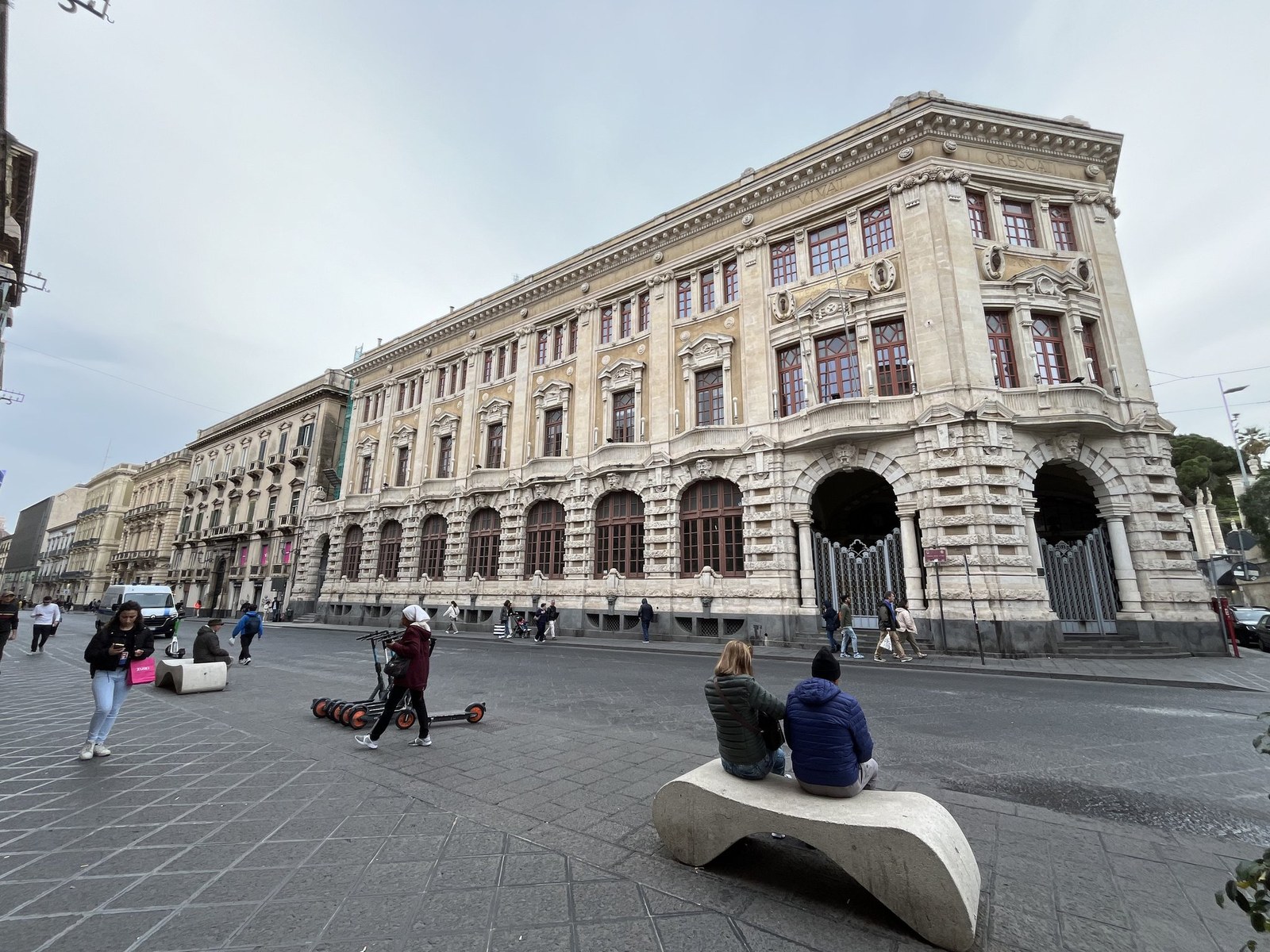
Catania hits you with the black lava stone first. Cobblestones, palace facades, the staircase of the Monastero dei Benedettini, the basalt elephant in Piazza Duomo — everything is carved from Etna’s eruptions. The volcano itself is a permanent presence on the skyline, often venting white steam. Add a 50,000-strong student population, a loud daily fish market, and you get a city that feels younger and rougher than its postcards suggest. It’s a baroque masterpiece with rolled-up sleeves.
Antony-22 · CC BY-SA 4.0
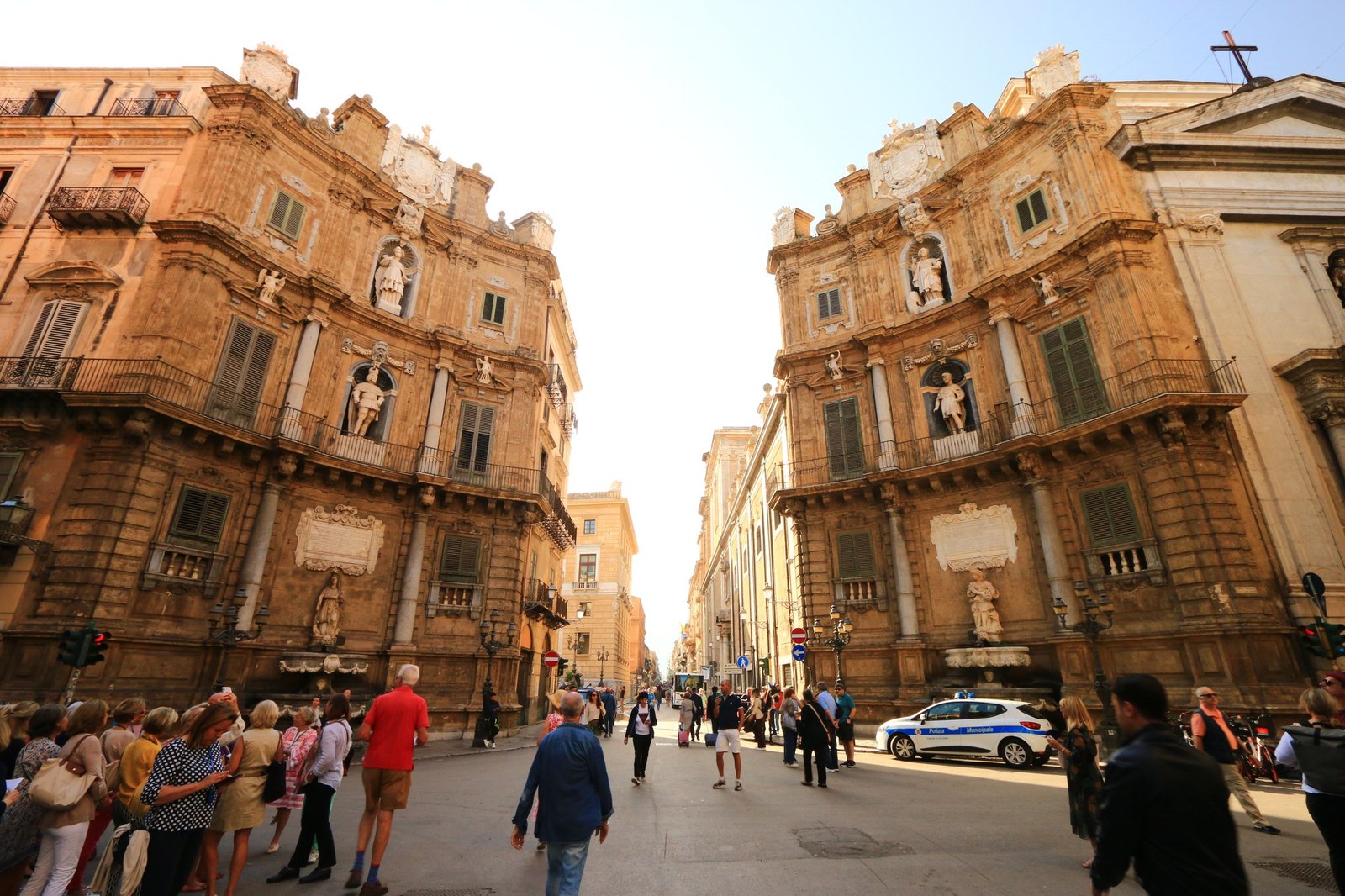
Palermo lands differently. The historic centre is denser and more layered — you’ll walk past Norman bell towers, Arab cupolas, Spanish baroque churches and Liberty-era cafes inside a single block. The four corners of Quattro Canti mark the old city’s heart, with Ballarò, Vucciria and Capo markets pulling you into different sensory chaos zones. Palermo is bigger (~640,000 vs ~310,000), which means more touristed pockets and more local everyday life happening side by side. First-time visitors often describe Palermo as overwhelming on day one, addictive by day three.
History and architecture
Palermo wins on raw historical depth. Founded by Phoenicians around 734 BCE, it’s been Greek, Roman, Byzantine, Arab, Norman, Swabian, Spanish and Bourbon — each layer left buildings still standing today. The headline sites are the Palazzo dei Normanni (Norman Palace) with the breathtaking Cappella Palatina, the Cattedrale di Palermo with its Arab-Norman geometric facade, and just outside the city the Cattedrale di Monreale — whose mosaics cover roughly 6,500 m² of glittering gold. Together they form the Arab-Norman Palermo UNESCO World Heritage site, listed in 2015.
Catania’s architecture is younger, more uniform and more dramatic in its origin story. On 11 January 1693 the Val di Noto earthquake levelled forty-five Sicilian towns and killed an estimated 60,000 people. Catania was rebuilt in under forty years using a contrast of black basalt from Etna’s lava and white limestone, producing the Baroque signature you see today on Cattedrale di Sant’Agata, Via Crociferi and Castello Ursino. UNESCO inscribed Catania’s centre as part of the Late Baroque Towns of Val di Noto in 2002. For more on this period our Catania old town walk maps the key buildings.
Verdict: Palermo gives you 3,000 years compressed into one city, Catania gives you a single coherent baroque masterpiece written in volcanic stone. If you’ve already seen Rome, Florence or Naples, Palermo’s stratification will feel familiar — Catania’s volcano-shaped story is genuinely unique in Italy.
Food and street food scene
Both cities are food destinations, and both will feed you better than most of Italy at honest prices. The styles are different. Palermo is widely cited as one of the world’s top street-food cities — you’ll find specialists in panelle (chickpea fritters), sfincione (thick-crust focaccia-pizza with onion and breadcrumb), arancine (yes, feminine in Palermo dialect), and the famously polarising pani ca’ meusa (spleen sandwich). Markets are the kitchen: Ballarò for the most authentic chaos, Vucciria for the after-dark drinking-and-eating scene, Capo for the photogenic produce piles.
Catania’s food culture is more sit-down and trattoria-driven, but the city has its own daily street-food theatre. The Pescheria fish market off Piazza Duomo is the centre of gravity: red-and-white awnings, swordfish on ice, octopus still twitching by 7 am. Catania invented pasta alla Norma (named after Bellini’s opera, with fried aubergine, ricotta salata and tomato), claims the most refined version of arancini (masculine here), and treats granita con brioche as breakfast. Cipolla cotta (whole baked onion sold from market stalls in winter) is a Catania street snack.
| Signature dish | City of origin | Typical price (2026) |
|---|---|---|
| Pasta alla Norma | Catania | €9–14 trattoria |
| Arancini / arancine | Both (different shape and gender) | €2.50–4 each |
| Granita con brioche | Catania | €3.50–5 |
| Cannoli siciliani | Both (claimed by Palermo) | €2.50–4 each |
| Sfincione | Palermo | €2–3 slice |
| Panelle e crocchè | Palermo | €2–3.50 |
| Pani ca’ meusa | Palermo | €3–4 |
| Pesce spada alla ghiotta | Catania | €14–22 |
Honest verdict: Palermo wins for variety and street-food spectacle, Catania wins for sit-down trattoria value and signature dishes you can’t find done as well anywhere else. Foodie travelers we host often report doing a “Palermo for the markets, Catania for the trattoria week” split.
Beaches and coast
Both cities give you sea access from the centre, but the coastline character is opposite. Palermo’s flagship beach is Mondello — a 1.5 km half-moon of fine white sand, calm shallow water and a string of stilted Liberty-era pavilions. It’s an 11 km bus ride from Palermo centre, and from June to September it’s busy with locals every weekend. Mondello is the Sicily-postcard beach you’ve seen on Instagram.
Catania’s coast is more varied and more volcanic. La Plaja is a ~3 km stretch of dark golden sand south of the airport, bus 538 from the centre, with both free public stretches and lidos charging €15–25 for a sun-bed-and-umbrella set. North of the city the coast turns sharply volcanic: Aci Trezza (with the famous Faraglioni sea stacks Homer placed in the Odyssey), Aci Castello (Norman castle on a black lava cliff) and the wider Riviera dei Ciclopi are 15-30 minute drives north. From the Catania port you also reach the Aeolian Islands via Milazzo — a longer day trip than from Palermo but doable.
Verdict: Palermo wins city-beach with Mondello’s sand-and-Liberty postcard. Catania wins coastal variety: sand at La Plaja, lava-rock swimming at Aci Castello, and the easiest base for Sicily’s beach holiday mix overall (see our beach holiday in Sicily guide). Sand-purists pick Palermo; coastal-explorers pick Catania.
Mount Etna and natural attractions
This is where Catania pulls clearly ahead. Mount Etna is roughly 3,357 m tall (it grows year by year) and Europe’s largest active volcano. From Piazza Duomo in Catania to the Rifugio Sapienza cable-car station is just 45 km / 1 h 15 by car. The volcano is genuinely a half-day trip if you’re tight on time, a full day if you want to take the cable-car (~€31 return as of 2026), the optional 4×4 minibus to 2,920 m (€25-35 extra), and a guided crater walk. From Palermo, Etna is a 2 h 30-3 h drive away — possible as a long day trip but not casual. Our hiking Mount Etna from Catania guide covers four route options.

Auregann · CC BY-SA 4.0
Palermo offers different nature, and it’s underrated. Monte Pellegrino (606 m) rises right behind the city with hiking trails and the Santuario di Santa Rosalia at the summit; the Riserva Naturale dello Zingaro on the Trapani coast (1 h 30 drive west) is one of Sicily’s most photogenic protected coastlines, with seven small coves accessible only on foot. The Aeolian Islands are also reachable from the Palermo side via Milazzo (1 h 45 drive). It’s not a substitute for Etna, but it’s a strong nature offer in its own right.
Verdict: Catania wins decisively on nature, mostly because of Etna’s proximity. If a volcano is on your bucket list, Catania is the practical choice.
Day trips: which city is the better base?
This is the most important comparison for trip-planning. Sicily is large, the coastlines are long, and your day-trip radius depends entirely on which side of the island you base. From Catania, in under 2 hours you reach Taormina (50 km / 1 h train), Syracuse and Ortigia (65 km / 1 h 15 train), Noto (90 km / 1 h 45 train), Modica and Ragusa (105 km / 2 h drive), the southern slopes of Mount Etna (45 km / 1 h 15 by car), and the Aeolian Islands via Milazzo (longer transfer but doable as a long day).
From Palermo, in under 2 hours you reach Cefalù (70 km / 1 h train), Monreale (8 km / 30 min city bus), Segesta ancient theatre (75 km / 1 h drive), Trapani and Erice (100 km / 2 h train), Agrigento and the Valley of the Temples (130 km / 2 h train), and the western beach reserves around San Vito Lo Capo (110 km / 2 h drive).
| Destination | From Catania | From Palermo |
|---|---|---|
| Taormina | 1 h train | 3 h 30 train |
| Syracuse / Ortigia | 1 h 15 train | 3 h 30 train |
| Mount Etna (Sapienza) | 1 h 15 car | 2 h 45 car |
| Cefalù | 3 h train | 1 h train |
| Monreale | 3 h 15 transit | 30 min bus |
| Agrigento (Temples) | 3 h 30 transit | 2 h train |
| Trapani / Erice | 4 h transit | 2 h train |
| Noto | 1 h 45 train | 4 h transit |
If your must-see Sicily list looks like {Taormina, Syracuse, Etna, Noto, Ragusa}, Catania is the obvious base. If your list reads {Cefalù, Monreale mosaics, Valley of the Temples, San Vito Lo Capo, Trapani salt pans}, Palermo wins. Most travelers we host on a 7-10 day trip end up wanting both halves — see how to combine Palermo and Catania below. For a deeper dive into the eastern radius see our day trips from Catania guide.
Nightlife and student energy
Catania is one of the loudest small cities in Italy after dark. The university enrolls roughly 50,000 students, and from Thursday to Saturday they fill the historic centre. The two main zones are Piazza Università + Via Etnea (cocktail bars, aperitivo crowds) and the San Berillo Vecchio grid behind Via Etnea (small bars, live music, loud until 3 am). In summer the action moves to the Lungomare seaside clubs and to La Plaja beach lidos with DJ sets after sunset.
Palermo’s nightlife is more spread out and slightly more refined. Vucciria market transforms after 10 pm into an open-air bar and aperitivo zone — tables on the cobblestones, cheap wine, the same fishmongers’ counters now serving spritz. Champagneria wine-bar culture is well established around Piazza Sant’Anna. The Politeama and Massimo theatre districts give you a more dressed-up evening option. Big clubs are fewer than in Catania.
Verdict: Catania wins decisively for late-night party-seekers and student travelers. Palermo wins for evening strollers who want piazza-table aperitivo and theatre-district atmosphere.
Airports: Fontanarossa (CTA) vs Falcone-Borsellino (PMO)
Both cities have international airports with year-round direct flights from the UK, Ireland and major EU hubs, but the practical experience of arriving is genuinely different. Catania-Fontanarossa (CTA) handles around 12 million passengers a year and sits just 7 km south of the historic centre — the AMT Alibus runs every 25 minutes to Piazza Stesicoro in 20-25 min for €4 one-way. Palermo-Falcone-Borsellino (PMO) is further out, 32 km west of the centre at Punta Raisi, but the airport-to-centre rail link (Trinacria Express) is one of the best in southern Italy.
- Direct flights from the UK: CTA has year-round Ryanair, Wizz Air and easyJet from London (Stansted, Luton, Gatwick), Manchester, Edinburgh, Bristol; PMO has Ryanair and easyJet from London (Stansted, Gatwick), Manchester, Birmingham. Both add seasonal Dublin routes.
- Transfer to centre — cost and time: CTA Alibus €4 / 20-25 min, taxi flat €25-35 / 15 min. PMO Trinacria Express train €6.90 / 60 min to Palermo Centrale every 30 min, Prestia e Comandè bus €6.30 / 45 min, taxi flat €45-55 / 40 min.
- Ground transport options onward: from CTA, Interbus and Etna Trasporti coaches run direct to Taormina, Siracusa and Ragusa from the terminal — useful if you’re skipping Catania centre. From PMO, the Trinacria Express continues to the central station with onward connections to Cefalù and Agrigento.
- Open-jaw itineraries: flying into PMO and out of CTA (or vice-versa) is the smartest combined-trip booking. Skyscanner multi-city searches usually return the same total fare as a round-trip into one airport, and you save the 3-hour cross-island train at the end of the holiday.
Practical note: CTA is famously vulnerable to Etna ash closures (handful of days per year, usually 24-48 h disruption); PMO closes occasionally for high winds at Punta Raisi. Travel insurance with flight-delay cover is sensible for either side.
Is Palermo safer than Catania?
Both cities are safe by EU standards, with crime patterns similar to Naples or Marseille — petty pickpocketing in market crowds, occasional car break-ins on parked rental cars, very rare violent crime against tourists. Neither city should make you nervous about evening walks in the historic centre. The differences are pattern-specific rather than overall: Palermo has higher pickpocket density in Ballarò, Vucciria and around the central station; Catania sees more parked-car break-ins in unguarded outer-ring lots and occasional bag-snatching at the Pescheria when tourists hold cameras out.
Four practical rules that work in both cities:
- Cross-body bag, never back-pocket wallet — especially in market crowds.
- Park in guarded lots (~€10-15/day) rather than free street spots if you have luggage in the car.
- Take a registered taxi or Free Now app from airports rather than informal touts.
- Trust your street sense: if a back street feels deserted at 2 am, take the next major artery instead.
Verdict: roughly equivalent. The “Palermo is more dangerous” reputation is largely outdated — both cities have invested heavily in tourist-zone policing in the last decade. The biggest practical difference is that Palermo’s market areas concentrate pickpocket activity more visibly, which makes them easier to be cautious about.
Is Catania or Palermo warmer?
The two cities are almost identical in temperature, with a marginal edge to Palermo in summer. Average July daytime highs run ~30 °C in Catania and ~31 °C in Palermo, with January lows around 9-10 °C in both. Palermo’s coast catches more sea breeze, while Catania sits in a sun-trap bowl below Etna — you may feel Catania hotter in heatwaves even when the thermometer disagrees. Both are squarely Mediterranean climate.
Is Palermo dirtier than Catania?
Both cities show the lived-in patina common to southern-Italian capitals — graffiti, occasional uncollected bins, scooter-parking chaos. Palermo feels grittier and more chaotic at first glance because it’s larger and its market areas (Ballarò, Vucciria) compress sensory mess into tight streets. Catania centro is cleaner on Via Etnea and Via Crociferi but the side streets and station perimeter show the same southern-city wear. “Dirty” usually reads as authenticity once you’ve been there 48 hours.
Which is the most beautiful, Catania or Palermo?
It depends on the kind of beauty you’re after. Palermo wins for layered grandeur — Cappella Palatina’s golden mosaics, the Norman Palace, Monreale’s 6,500 m² of gilt tile, all part of UNESCO’s Arab-Norman Palermo (2015). Catania wins for monochrome drama — a uniform black-lava and white-limestone baroque rebuild after 1693, also UNESCO-listed (Val di Noto, 2002). Different aesthetics, both heritage-protected; neither is objectively prettier.
Is it better to stay in Catania or Palermo?
If your trip is built around Mount Etna, Taormina, Syracuse or the Val di Noto baroque towns, Catania is the better base — the centro storico puts the volcano 45 km away and every east-coast classic within a one-hour train ride. If your priority is Arab-Norman heritage, the Ballarò-Vucciria market scene, Cefalù and the Valley of the Temples, base in Palermo. For more on neighbourhoods and pricing in our home city see apartments in Catania.
Which is better for families and kids?
Palermo has a slight edge for families with younger children, mostly because of Mondello beach. Calm shallow water, fine sand, lifeguard service in summer and a string of family-friendly lidos make it the easier beach base for under-10s. Add Foro Italico seaside walk for buggies, larger green spaces, and the famous Museo delle Marionette puppet museum, and you get a city with more low-effort kid amenities.
Catania works better for families with teens. Mount Etna is genuinely exciting for older kids — the cable-car, the lava fields, the active craters. Villa Bellini park is a clean green-space close to the centre. La Plaja is a wide sandy beach (less photogenic than Mondello but with more space for ball games), and the volcanic Aci Trezza coast is good for swim-and-snorkel. Day trips to Taormina’s Greek theatre or Syracuse’s Ortigia are easier from Catania — both are kid-friendly destinations.
Family-of-four daily budget runs similar in both cities: expect €180-260/day for accommodation, eating out twice, and one paid activity, as of 2026. Apartments tend to be more practical than hotels for families — a kitchenette saves both money and toddler-meltdown.
Which is better for first-time Sicily visitors?
If your trip is 3 days or fewer, base in one city only and pick the version of Sicily you most want to see. Palermo gives you the densest possible 72 hours of “classic Sicily clichés”: Cathedral, Quattro Canti, Vucciria evening aperitivo, Mondello beach, Monreale mosaics, Norman Palace, Cappella Palatina — all walkable or one bus away. It’s the most concentrated city break Sicily offers. Catania gives you a different first-trip pitch: the baroque centre on day one, Mount Etna on day two, Taormina or Syracuse on day three. Less city-density, more landscape variety.
Sample 3-day itineraries:
- 3 days in Palermo: Day 1 historic centre walk (Quattro Canti, Cathedral, Norman Palace, Cappella Palatina) + Vucciria evening. Day 2 Monreale mosaics + Mondello beach afternoon. Day 3 Ballarò market breakfast + Capuchin Catacombs + Politeama district.
- 3 days in Catania: Day 1 Catania old town walk (Piazza Duomo, Pescheria, Via Etnea) + Catania nightlife. Day 2 Mount Etna day trip (cable-car + crater walk + lava field). Day 3 Taormina by train (Greek theatre, Corso Umberto, Isola Bella).
If you’ve got 5-7 days, the optimal first-trip strategy is to combine both — see the section below. For a fuller week-long plan see our Sicily itinerary 7 days guide.
Where to stay: areas and price ranges
In Catania, the smartest base is the centro storico around Via Etnea, Piazza Duomo and Via Crociferi. You’re walking distance from the Pescheria, the cathedral, the main museums and the night-life zones. Apartments in this area run €60-130/night in high season, with three-bedroom options for families around €150-200. Outside the historic centre, Borgo-Sanzio is quieter and a 15-min walk from Via Etnea (slightly cheaper); the Civita sea-edge zone gives you port views. We cover the full neighborhood breakdown in our where to stay in Catania guide.
In Palermo, the centro storico spreads across four historic mandamenti — Albergheria (Ballarò side), Capo, Vucciria and Kalsa. Each has a distinct character: Vucciria for nightlife and after-dark food, Kalsa for art-museums and quieter streets, Albergheria for the most authentic-chaotic Palermo, Capo for market-edge stays. Apartment prices run €80-160/night high season. Politeama and Libertà are the modern shopping districts, more polished but further from the historic action. Mondello beach base is a separate option if your trip is beach-led, with its own Liberty-villa apartment stock.
Verdict: Catania historic centre is the more compact, walkable, and lower-priced base. Palermo gives you more neighborhood variety but at a higher entry price.
How to combine Palermo and Catania in one trip
If you have 7 nights or more, doing both cities is the optimal Sicily first-trip. The classic split is 3 nights Palermo + 4 nights Catania, flying open-jaw into PMO and out of CTA (or vice-versa — both airports have year-round US/UK direct flights). The 4-night side gets the longer stay because Etna and Taormina-Syracuse are full-day trips, while Palermo’s must-see list (Cathedral, Norman Palace, Monreale, Mondello) compresses into 3 days well.
Sample 7-day combined itinerary:
- Days 1-3 Palermo: city centre + Cappella Palatina + Vucciria + Monreale + Cefalù day trip + Mondello afternoon.
- Day 4: train or rental car Palermo → Catania (3 h train, €14-19; or A19 drive 2 h 45 with Enna stop).
- Days 4-7 Catania: city centre + Pescheria + Mount Etna day trip + Taormina day trip + Syracuse and Ortigia day trip.
For a longer 10-day version that fits both cities plus the Val di Noto baroque towns and Etna wine tasting, see our Sicily 7-day itinerary with extension notes. Most travelers we host find the combined trip more rewarding than picking one city; the contrast between Palermo’s stratified chaos and Catania’s volcanic baroque is genuinely a feature, not a tourist box-tick.
Verdict: choose Catania or Palermo?
There’s no objectively better Sicilian capital — just two different fits for different traveler types. After hosting hundreds of guests in Catania centro and recommending the alternative when it’s the right answer, here’s our honest tally.
Choose Catania for:
- Mount Etna access — volcano day trip from the centro is the easiest in Italy.
- Eastern Sicily day trips — Taormina, Syracuse-Ortigia, Noto, Ragusa all under 2 h.
- Baroque-volcanic architecture — UNESCO Val di Noto in black lava stone.
- Student-energy nightlife — loudest Italian small city after dark.
- Lower base costs — apartments and trattoria meals run 15-25% cheaper than Palermo.
- Pasta alla Norma and granita-con-brioche — both Catania inventions, done best here.
- First-time Sicily focused on Etna and the east coast.
Choose Palermo for:
- Arab-Norman heritage — Cappella Palatina, Monreale mosaics, Norman Palace, UNESCO 2015.
- Street food capital scene — Ballarò, Vucciria, Capo plus pani ca’ meusa and sfincione.
- Mondello beach — Sicily’s most postcard-classic city beach.
- Western Sicily exploration — Cefalù, Segesta, Trapani-Erice, Agrigento.
- Larger city amenities — bigger museum offer, more nightly cultural events, broader hotel stock.
- Maximum 3-day cliché density — the most “classic Sicily” punch in 72 hours.
- First-time Sicily focused on culture, mosaics and west coast.
If you’re still genuinely torn after reading this guide, our advice is: pick Catania if Etna is on your must-see list, pick Palermo if the Cappella Palatina mosaics are. There’s no wrong answer — you’ll fall for whichever Sicily you meet first.
Where to stay in Catania
If you’re leaning Catania for your Sicilian vacation, browse our centro-storico stays on the apartments in Catania homepage — a five-minute walk from Piazza Duomo, Via Etnea and the Pescheria fish market, with Mount Etna views from the rooftop terrace. Rates start at €60/night in shoulder season.
The information in this guide was correct at the time of writing. Data can change from season to season without notice: before you travel, always check the official channels and websites for updates. We review this guide periodically, but the official channels are always the authoritative source. We also cannot guarantee that the suggested routes or the attractions described are always reachable or accessible: roads, trails and sites may be closed, damaged, altered or unsafe. Assessing the practicability and safety of itineraries and attractions always remains your own responsibility.