
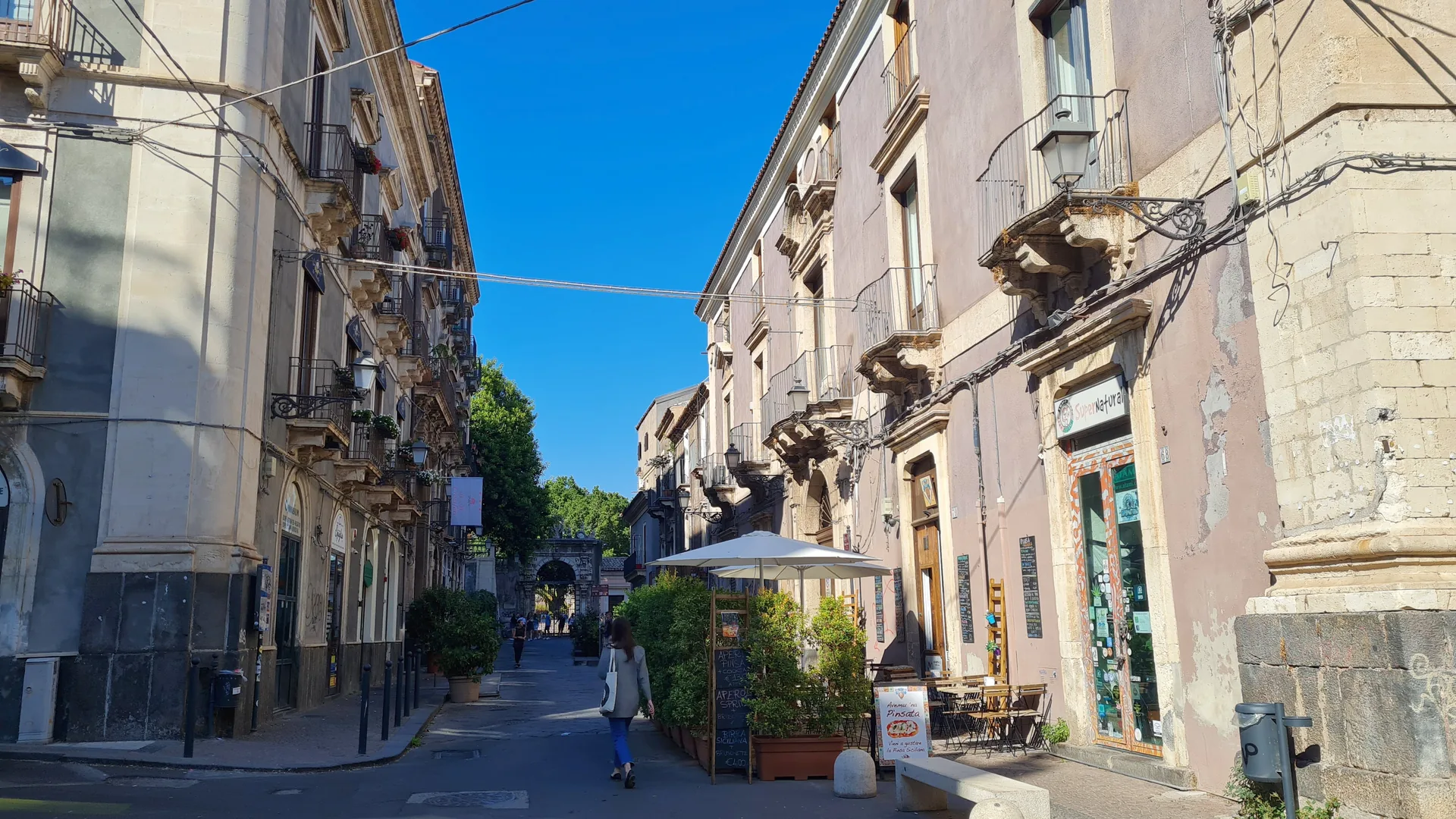
Is Catania worth visiting? Yes — if you want authentic Sicily, not a polished postcard. We live in central Catania and answer this question several times a week, usually from a cousin or friend who has read a sceptical Reddit thread or watched a clickbait YouTube short. Our honest take: the city earns its place on any first Sicily trip for travellers who care about food, Baroque architecture, Mount Etna access and value-for-money, and disappoints those expecting a polished resort town. The Pescheria fish market, the four-church axis of Via dei Crociferi, the Roman ruins woven through modern streets, the granita-and-brioche breakfast, and the 30 km proximity to Europe’s tallest active volcano are all real. So is the graffiti, the traffic, the gritty stretch behind the station, and the July heat. This guide gives you the honest case for and against, the seven concrete reasons we’d send you here, the cons we won’t whitewash, who genuinely should skip Catania, how many nights to plan, what it costs, and how it compares to Taormina and Palermo. No over-selling, no defensive boosterism.
So is Catania actually worth visiting?
Yes — Catania is worth visiting if you want authentic Sicilian street life, world-class street food, Baroque architecture and direct access to Mount Etna. It is not worth visiting if you expect a polished postcard town or a beach resort. Two nights is the sweet spot for most travellers; 3-4 nights make sense if you use Catania as a base for Etna and day-trips to Taormina or Syracuse.
The honest framing first. Catania is a working port city of about 300,000 people on the eastern coast of Sicily, rebuilt in spectacular black-and-white Baroque after the 1693 earthquake, with the smoking summit of Mount Etna visible from most streets in the historic centre. It is loud, sometimes scruffy, deeply alive, and the food alone justifies the flight for most travellers from northern Europe or North America. The grit is real, but so is the substance underneath it — a UNESCO-context Baroque grid, two ancient amphitheatres, a daily fish market that Stanley Tucci filmed for CNN, and the cheapest aperitivo of any major Sicilian tourist destination.
The pushback you read on Reddit and the Rick Steves forum is half-true. The r/sicily consensus is broadly positive («Catania is absolutely worth a visit») but qualifies it with comfort caveats: you have to accept urban texture and stop comparing it to Florence. The contrarian Rick Steves thread «shall we skip Catania?» reaches a similar conclusion in reverse — that there are no single must-see sights in the Roman ruins sense, but that the experience as a whole is the point. We agree with both. Read on for the concrete reasons, the cons we won’t soften, and the specific traveller profiles we’d tell to skip and go to somewhere else in Sicily instead.
Seven reasons Catania is worth visiting
Baroque rebuilt city, Mount Etna at the doorstep, La Pescheria fish market, value-for-money that beats Taormina by 40-50%, a walkable historic core, an authentic atmosphere with daily local life, and unbeatable day-trip access to the rest of eastern Sicily. Each holds up on its own; together they make the case.

Effems · CC0
1. The black-and-white Baroque rebuild. Catania was flattened by the 1693 earthquake and rebuilt over the next century in a coordinated Late Baroque style using black lava stone from Etna contrasted with white limestone from Syracuse. The result — visible along Via dei Crociferi, around Piazza del Duomo and through the Via Etnea axis — is unlike any other Sicilian city, including Noto. The UNESCO World Heritage listing for the «Late Baroque Towns of the Val di Noto» centres on the smaller towns south of Catania, but the same architects and vocabulary built the Catania centre.
2. Mount Etna at 30 km. Europe’s tallest active volcano sits half an hour north of the city, with cable cars from Rifugio Sapienza reaching 2,500 m and guided summit access above. From Catania you can be at the lava-flow trailheads by mid-morning, hike through Sciara del Fuoco, lunch in Zafferana Etnea and be back for aperitivo. No other Sicilian city gives you this access. The pillar hiking Mount Etna covers the four ways up.
3. La Pescheria fish market. Catania’s daily fish market runs from roughly 06:00 to 14:00 in the lanes below Piazza del Duomo, packing swordfish, prawns, octopus, sea urchins and the morning catch into a wedge of streets behind the Amenano fountain. Stanley Tucci filmed an episode of CNN’s «Searching for Italy» here. Our guide to the Catania fish market covers the etiquette and the surrounding seafood trattorie. Visit between 08:30 and 11:30 for the full theatre.
4. Value-for-money that beats Taormina by 40-50%. A two-person dinner with wine in a good Catania trattoria runs €40-55; the same dinner in Taormina runs €80-110. Aperitivo in central Catania is €5-8 (cocktail + sicilian-tapas spread); in Taormina it’s €12-15. A central two-bed apartment in low season starts around €70-110 a night; in Taormina, €180+. For travellers on any budget the maths is decisive. The pillar best restaurants in Catania has the concrete options.
5. A historic centre you walk in three days. Catania’s tourist core is roughly 1.2 km long by 800 m wide, anchored by Piazza del Duomo at the south and Villa Bellini at the north, with Via Etnea as the central spine. You don’t need taxis, you don’t need a car, you don’t really need a map after the second day. Most main sights — Duomo, Castello Ursino, Pescheria, Roman Amphitheatre, Teatro Massimo Bellini, the Benedictine monastery — sit within fifteen minutes’ walk of any central accommodation. Our things to do in Catania pillar maps the lot.
6. An atmosphere that hasn’t been laundered for tourists. Catania is a university town and a port: locals do their daily life on the same streets you walk. Aperitivo on Via Santa Filomena, granita-and-brioche breakfast at Prestipino on Piazza del Duomo, the football crowd spilling out of the Stadio Cibali, the church procession that closes Via Etnea on a Saturday morning — these aren’t staged. If you’ve found Florence or Venice too curated, Catania reads as a corrective. The trade-off is the grit; we cover that further down.
7. The best day-trip launching pad in Sicily. Taormina is a 60-minute train ride. Syracuse and Ortygia are 75 minutes by train. Mount Etna is 45 minutes by car. Noto, Modica and Ragusa — the UNESCO Val di Noto trio — are 1-2 hours away. Aci Trezza and Aci Castello on the lava-rock coast are twenty minutes by bus. No other Sicilian base lets you do as many one-day excursions without moving hotels. The pillar day trips from Catania walks through every option.
The honest cons: what Catania is not
Catania is not polished, not quiet, not a beach destination, not Tuscany. The historic centre carries visible graffiti and crumbling stucco on many palazzi, traffic and horn-culture are loud, the strip immediately around Catania Centrale railway station is grimy after dark, summer afternoons hit 35-40°C, and the urban beaches at La Plaia and San Giovanni Li Cuti are workmanlike rather than postcard.
The visual texture is the first thing to flag. Catania’s centre has graffiti on roughly a third of the ground-floor surfaces, peeling stucco on many of the lesser palazzi, and a baseline of motorbikes weaving through pedestrian streets that startles visitors coming from northern Europe. We’ve watched first-time arrivals lose their initial enthusiasm in the walk between Catania Centrale and Piazza del Duomo — that fifteen-minute corridor is the city at its scruffiest, and unfortunately it’s the introduction many travellers get. The fix is to keep walking: by the time you reach the Duomo, the proportions, the lava-stone facades and the rhythm of the place start to register. But if you expected Lucca or Bologna’s level of polish, the first hour is jarring.
The noise is the second honest issue. Catania is not a quiet city. Cars use the horn as a directional turn signal, mopeds substitute exhaust for muffler, and aperitivo lasts until midnight on weekends with the sound spilling out of the bars onto Via Coppola and Via Santa Filomena. Light sleepers should target accommodation on a courtyard rather than a main street. Summer adds the heat: July and August average 30-34°C, peaking at 40°C, with a humidity that the locals nickname «africano» when the sirocco wind blows. Plan for siesta hours indoors between 14:00 and 17:00 if you visit in August.
The third thing to flag is the beach situation. The urban beach at La Plaia, south of the city, is a long stretch of sand backed by a slightly tired lido strip; the rocky coves at San Giovanni Li Cuti and northwards toward Aci Castello are atmospheric but small and crowded in July-August. For genuinely postcard Sicilian beaches you need to drive to Cefalù, San Vito Lo Capo on the west coast, or the Aeolian Islands. If beaches are the reason for your Sicily trip, Catania is the wrong base — pick the west coast instead. Safety we cover separately in is Catania safe: short version, the grit is more visual than statistical.
Who should skip Catania and visit elsewhere
Skip Catania if you want a resort pool and uninterrupted beach time (go to Taormina or San Vito Lo Capo), if you want a perfectly polished postcard town for photography (go to Noto, Ragusa Ibla or Cefalù), if your total Sicily trip is under five days and you’ve never been before (prioritise Taormina + one Baroque town), or if urban grit reliably ruins your mood (Sicily has gentler choices).
Concretely. Resort and pool travellers are happier in Taormina, Giardini Naxos or the west coast around San Vito Lo Capo; Catania has no resort-and-pool inventory in the historic centre, and the city is not built around that experience. Postcard photographers after immaculate Baroque should head south to Savoca, Noto, Modica or Ragusa Ibla — the Late Baroque towns of Val di Noto deliver the symmetry and the clean stucco that Catania’s bigger working-city centre does not.
Short Sicily trips of under five days with no prior visit to the island are usually better split between Taormina (2-3 nights, Etna day-trip from there) and one inland town (Ragusa or Syracuse, 2 nights). The reason isn’t that Catania isn’t worth it — it’s that the first-time-Sicily impression matters, and Taormina delivers a faster, easier version of «wow» for travellers who haven’t bought into the country yet. Add Catania on the second trip or as a 2-night extension if you’re staying a week or more. Finally, travellers who genuinely lose sleep over visible urban decay — the kind who left Naples mid-trip — will not enjoy Catania even with our caveats. There is no shame in skipping; the city stays here either way.
Is Catania nicer than Palermo?
It is not strictly nicer — it is different. Catania is more compact, more Baroque, more food-and-Etna-focused, and easier to navigate in two days. Palermo is larger, more monumental, more multicultural (Arab, Norman, Spanish layers), and needs at least three days. Both are worth visiting on a long Sicily trip. For a single Sicilian city visit, Catania is the lower-effort choice and Palermo the more ambitious one.
The texture differs in specific ways. Catania is built on a Baroque grid plan after 1693, so the streets are straight and short distances stay walkable. Palermo‘s historic core is a medieval maze with Norman cathedrals and Arab-Sicilian markets in Ballarò and Vucciria, denser and louder than anything in Catania, with longer distances and worse pickpocket risk. The food cultures diverge too: Catania leans on Pescheria seafood, granita-and-brioche, pasta alla Norma and arancini «maschi» (cone-shaped); Palermo on street-food gold like sfincione, pane con la milza, panelle and crocchè.
Which to choose if you can only do one. Catania for a 4-5 day Sicily trip with Etna and Taormina day-trips; Palermo for a 5-7 day trip with Monreale, Cefalù and the western beaches as your day-trips. Catania wins on value-for-money and on Etna access. Palermo wins on monumental Norman-Arab architecture and on street-food density. The deep comparison — cost, food, walkability, day-trip options, where to stay — sits in our pillar Catania vs Palermo.
Should I go to Taormina or Catania?
If you must choose one for a first Sicily trip, choose Taormina for views, polish and a clifftop ancient theatre, and Catania for food, Etna access, urban authenticity and value. The best answer for any trip longer than four days is to base in Catania and day-trip to Taormina by train (60 minutes, €4.30 one-way). You get Catania’s lower cost of living plus Taormina’s photogenic scenery without paying Taormina prices for accommodation.
Taormina is the postcard: hilltop perched between sea and Etna, the Greek-Roman theatre with the volcano framed in the arches, manicured Corso Umberto, designer shops, terrace restaurants. It is also expensive, smaller, easier to exhaust in a day, and absolutely packed in July-August. Catania is louder, grittier, deeper, cheaper, and the food is genuinely better. The two cities are 50 km apart, both stops on the same coastal train line.
Our concrete recommendation. If your trip is 3-5 nights total and it’s your first Sicily, stay in Taormina and day-trip to Catania. If your trip is 5+ nights or it’s not your first Sicily, stay in Catania and day-trip to Taormina, Syracuse and Etna. The transport piece is in Catania airport to Taormina. Day-trip options from the Catania base are mapped in day trips from Catania.
Is Catania expensive?
No — Catania is among the cheapest major Italian tourist destinations and roughly 40-50% cheaper than Taormina or Florence on day-to-day spend. A granita-and-brioche breakfast costs €3-4. Pizza or pasta primo costs €10-14. Dinner for two with wine in a good trattoria costs €40-55. Aperitivo with sicilian-tapas costs €5-8 per person. A central two-bed apartment in low season starts around €70-110 a night, less than half of equivalent Taormina inventory.
| Item | Catania price | Taormina equivalent | Notes |
|---|---|---|---|
| Granita with brioche | €2–4 | €5–7 | Breakfast staple, almond or pistachio |
| Arancino (rice ball) | €2–4 | €4–6 | Savory Cassola or Bedda chains, larger sit-down |
| Pizza or pasta primo | €10–14 | €16–22 | Trattoria, not tourist menu |
| Aperitivo (cocktail + tapas) | €5–8 | €12–15 | Per person, central bars |
| Dinner for two with wine | €40–55 | €80–110 | Good trattoria, mid-tier wine |
| 2-bed central apartment | €70–110/night | €180–260/night | Low season, walkable centre |
| Airport taxi to centre | €25 day / €30 night | €90–120 to Taormina | Fixed-tariff rank only |
| Etna cable car return | €50 | same | From Rifugio Sapienza, 2,500 m |
Two practical notes. First, the spread between the «tourist» restaurants on the immediate Piazza del Duomo perimeter and the trattorie one block away can be 30-40% — Catania has very little tourist-trap markup compared to Taormina, but it still pays to walk fifty metres. Second, low-season pricing (November-March, excluding Christmas and Carnevale) is significantly softer than the headline numbers above; April-June and September-October sit in the middle; July-August is the peak. Booking 2-3 months out gets you the lower band of every range.
How long should I spend in Catania?
Two nights is the sweet spot for most travellers visiting Catania for itself. One night works for a quick taste built around the Pescheria and a dinner. Three to four nights are ideal if you treat Catania as a base and day-trip to Etna, Taormina, Syracuse and the Val di Noto. The AI Overview’s «1 to 2 days» estimate is fair for the city in isolation; for travellers using it as a hub the answer roughly doubles.
| Traveller profile | Suggested nights | Verdict | Pair with |
|---|---|---|---|
| First-time Sicily, food-and-culture focused | 2 nights | Yes, go | Add 2 nights Taormina or Syracuse |
| First-time Sicily, beach-and-resort focused | 0 nights | Pass | Go straight to Taormina or San Vito Lo Capo |
| Cruise stopover, 8–12 hours | Day visit | Yes | Pescheria + Crociferi + Roman Amphitheatre |
| Etna hiker or Sicily multi-stop base | 3–4 nights | Yes, use as hub | Etna + Syracuse + Taormina day-trips |
| Polished-postcard photographer | 0–1 night | Maybe, low priority | Noto + Modica + Ragusa Ibla instead |
The maths is honestly simple. Day one in Catania is the historic-centre walk (Pescheria 09:00-11:30, Duomo and Crociferi 12:00-14:00, Roman Amphitheatre and Via Etnea 16:00-19:00, aperitivo and dinner). Day two is either a half-day for the Benedictine monastery and Castello Ursino plus a city lunch, then an afternoon Etna trip, or a full Etna day with cable car and trekking. Add day three for Taormina, day four for Syracuse and Ortygia. Most travellers find Catania-itself is «done» in 36 hours; the magic is the base-and-day-trip layer that comes after.
When is the best time to visit Catania?
Shoulder seasons April-May and September-October are ideal — 18-26°C, the Baroque centre is walkable all day, the festival calendar is lively, and accommodation prices sit in the middle band. Summer is hot and busy; winter is mild (10-16°C) and the food scene is at its best with fewer tourists. The single best fortnight for first-time visitors is late September.

andrea · CC BY-SA 2.0
Season by season. April-May: 18-24°C, occasional rain, Easter processions in early April, almond blossom around Etna, very pleasant. June: 25-30°C, the city fills up, Etna trekking conditions excellent. July-August: 30-40°C with sirocco spikes, prices peak, beaches packed, locals leave Catania for the islands — visit only if your schedule forces it. September: still 25-30°C in early month, dropping by month-end, possibly the best fortnight of the year for first-timers, sea still warm. October: 20-26°C, harvest season on Etna’s wine slopes, festival of Sant’Agata-Salonia in early month. November-March: 10-16°C, mild for European winter, occasional Etna ash on cars, food culture at peak, hotel rates lowest.
The single biggest annual event is the Festa di Sant’Agata from 3 to 5 February — one of the world’s largest Catholic processions, drawing over a million people to the centre, with the city’s patron saint silver bust paraded for 24 hours straight. Worth planning around if dates work; book accommodation 4-6 months ahead if you target the festival.
What to combine Catania with: day-trips and longer routes
Catania is the strongest day-trip base in eastern Sicily. From here you reach Taormina in 60 minutes by train, Syracuse and Ortygia in 75 minutes, Mount Etna in 45 minutes by car, and the Val di Noto Baroque towns (Noto, Modica, Ragusa) in 90-120 minutes. The most common five-day route uses Catania for three nights as the hub and adds two more nights in either Taormina or a Val di Noto town.
The five excursions worth singling out. Mount Etna — cable car up from Rifugio Sapienza or guided trek above 2,500 m, ideally a full day, our hiking Mount Etna pillar has the four routes. Taormina — the Greek theatre with Etna in the frame plus Corso Umberto, a half-day on the train. Syracuse and Ortygia — the Greek archaeological park plus the island old town, a full day, the train is straightforward. Val di Noto — UNESCO-listed Baroque trio of Noto, Modica and Ragusa Ibla, ideally a full day with a rental car or organised tour. Aci Trezza and Aci Castello — 20 minutes by bus, lava coast and Cyclops legend, a relaxed half-day.
Two practical seven-day route templates we recommend. Route A — Eastern Sicily classic: Catania 3n + Taormina 2n + Syracuse 2n. Route B — Etna and Baroque: Catania 3n (with Etna full day + Aci Trezza half day) + Noto 2n (Val di Noto) + Taormina 2n. Both keep Catania as the food-and-Baroque anchor; Route A leans coastal, Route B leans cultural. For more permutations see our day trips from Catania deep-dive.
Three Catania sights that settle the «worth it?» question
If we had to win the argument with three sights, these are the ones. Walk these in order on day one and you’ll know whether Catania is for you by lunchtime.
Via dei Crociferi
- Location
- Via Crociferi, Catania Maps
- Hours
- Open street, walk anytime; church interiors typically 09:00–13:00 / 16:00–19:00
- Essential fact
- Four Baroque churches in 200 m, rebuilt after the 1693 earthquake in lava-stone Baroque. UNESCO World Heritage.
- Price
- Free
The single most photogenic stretch of central Catania, a 200-metre lane that runs from Piazza San Francesco d’Assisi north to the Benedictine monastery. Four churches sit on it in a row — San Benedetto, San Francesco Borgia, San Giuliano and the convent of the Crocifero — all rebuilt in coordinated Late Baroque after the 1693 earthquake. The street is closed to most traffic, the proportions are deliberate, and at golden hour the lava-stone facades against white limestone read as definitively Sicilian. If you only have three hours in Catania, walk Via dei Crociferi twice.
La Pescheria fish market
- Location
- Piazza Alonzo di Benedetto, Catania Maps
- Hours
- Mon–Sat 06:00–14:00 (peak 08:30–11:30); closed Sundays
- Essential fact
- Daily fish market since the 19th century, filmed by Stanley Tucci for CNN’s Searching for Italy. Seafood lunch €25–40 pp at adjacent trattorie.
- Price
- Free to walk
The soul of Catania for many visitors, a chaotic wedge of streets where fishmongers shout swordfish and sea-urchin prices to a crowd of cooks, locals and tourists wedged between marble counters and water-streaked floors. Stanley Tucci put the Pescheria on the global map in 2021; the locals had known forever. Go between 08:30 and 11:30 to see it at full intensity; arrive after 12:30 and you’ll mostly see the cleanup. Several seafood trattorie sit at the edges — we cover the picks in our Catania fish market pillar. The market itself is free to walk through; bring a wide stance and good shoes.
Roman Amphitheatre, Piazza Stesicoro
- Location
- Piazza Stesicoro, Catania Maps
- Hours
- Open viewing from railings 24/7; descent by appointment with Parco Archeologico
- Essential fact
- 2nd-century AD amphitheatre, originally seated 15,000, lava-stone construction still visible from Piazza Stesicoro.
- Price
- Free to view from street level
A Roman amphitheatre embedded in the middle of a working modern square, half-excavated below the level of Piazza Stesicoro, the trams of Via Etnea running past it. It’s not the most spectacular Roman ruin in Italy — the bigger arenas at Verona, Pula or even Catania’s own Greek-Roman Theatre on Via Vittorio Emanuele outdo it — but the way it sits inside the everyday street grid, with locals walking past on their way to the shops, captures what makes Catania different: layered, lived-in, casual about its own millennia.
Local-expert verdict: who’ll love Catania and who won’t
We’ve hosted hundreds of visitors over a decade in central Catania, mostly arriving with the same Reddit-induced scepticism that brought you here. The pattern is consistent enough that we can call it. Travellers who arrive curious about food, Baroque architecture and Etna — and who can accept that an Italian city of 300,000 working people will look a little rough at the edges — leave fans. They write to us months later about a granita they still think about. Travellers who arrive expecting a Tuscan-village level of polish, or who really wanted Taormina but settled for Catania because the flight was cheaper, leave underwhelmed. The city doesn’t change to meet them, and pretending it should is not helpful to the next reader.
The deciding question, honestly: when you imagine your Sicily trip, what’s in the foreground? If it’s a food market full of swordfish, an aperitivo on a chaotic piazza, the smell of granita in the morning and Etna smoking on the horizon — book Catania. If it’s a perfectly framed clifftop view, a hotel with a sea-pool, and dinner under a pergola where everyone speaks English — book Taormina or Cefalù instead. Both choices are reasonable. The mistake is showing up in Catania expecting the second answer.
Where to stay in Catania to make it worth it
The single biggest determinant of whether Catania «works» for a first-time visitor is the accommodation location. Stay within the central perimeter — on or one block off Via Etnea, around Piazza Università, in Borgo or Antico Corso — and you walk everywhere, the gritty stretch around the station never enters your experience, and the city reads as the place we describe in this guide. Look at apartments in Catania in this perimeter rather than further out: the centre is small enough that location does most of the work. Our deep pillar on where to stay in Catania walks through the four central micro-areas. The honest case for Catania starts with the right address.
Disclaimer
Prices cited (granita €2–4, primo €10–14, dinner for two €40–55, aperitivo €5–8, 2-bed apartment €70–110/night, airport taxi €25 day / €30 night, Etna cable car €50 return) reflect averages observed in central Catania in early 2026 and fluctuate with season, demand and operator — verify current rates directly with the venue or transport provider before relying on them. Opening hours for the Pescheria fish market, church interiors and the Roman Amphitheatre may vary on Sundays and public holidays; confirm with the Comune di Catania tourism desk if a tight schedule depends on a specific time. Train and bus times between Catania, Taormina and Syracuse are subject to Trenitalia and AST scheduling changes — check current timetables before travelling.
The information in this guide was correct at the time of writing. Data can change from season to season without notice: before you travel, always check the official channels and websites for updates. We review this guide periodically, but the official channels are always the authoritative source. We also cannot guarantee that the suggested routes or the attractions described are always reachable or accessible: roads, trails and sites may be closed, damaged, altered or unsafe. Assessing the practicability and safety of itineraries and attractions always remains your own responsibility.