
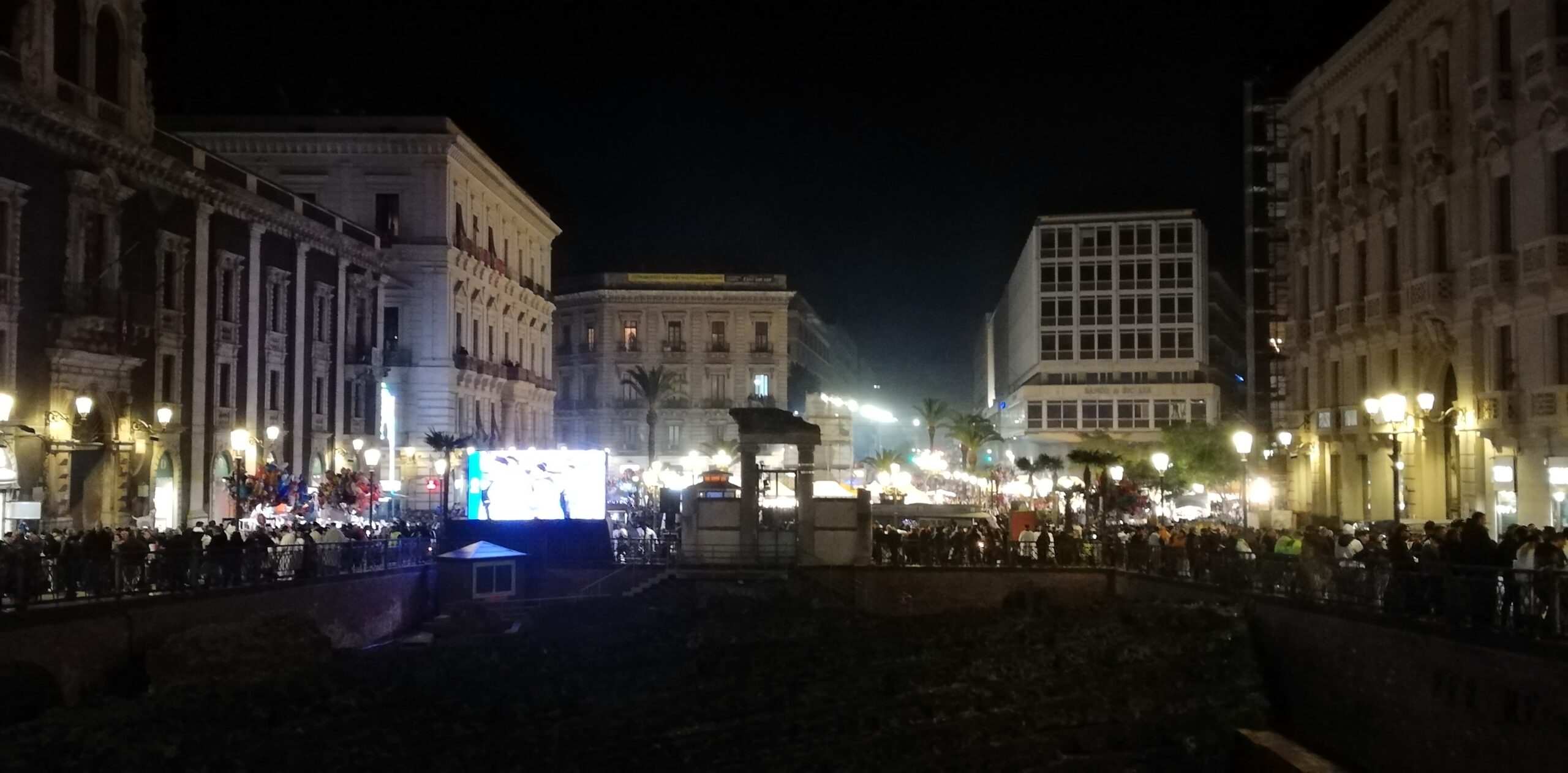
You land at Catania airport, step outside into the Sicilian sun, and the first question hits you: how do I get around Catania without a car? The good news is that you absolutely can , and thousands of visitors do it every year. Catania’s public transport system, while not perfect, covers everything you need: a single-line metro that cuts through the city from west to east, an extensive AMTS bus network, a dedicated airport shuttle (ALIBUS), and a highly walkable historic centre where you will spend most of your time anyway.
I live in Catania and I use these services regularly. This guide is the one I wish existed when I first moved here: practical, local, and honest about what works and what does not. No car rental needed , here is exactly how to navigate Catania like a local, using only public transport and your own two feet.
Catania Metro (M1 Line)
The Catania Metro , officially the FCE Metropolitana , is a single light-metro line (M1) that runs roughly west to east, connecting the suburban district of Monte Po to the historic centre at Stesicoro. It is the fastest way to cross the city and the backbone of Catania’s public transport system.
Stations in the City Centre
The metro has 11 stations along the M1 line. The ones most useful for visitors are: Stesicoro (eastern terminus, right on Via Etnea in the heart of the historic centre), Giovanni XXIII (interchange with Catania Centrale train station , walk outside and across the square to reach FS platforms), Italia (near the courthouse, a short walk from Via Etnea’s upper section), Galatea (close to the Villa Bellini gardens), and Borgo (transfer point for the Circumetnea scenic railway around Mount Etna). The full list, west to east: Monte Po, Nesima, San Nullo, Cibali, Milo, Borgo, Giuffrida, Italia, Galatea, Giovanni XXIII, Stesicoro.
Hours and Frequency
The metro runs Monday to Saturday from approximately 6:00 AM to 10:30 PM (last departure around 10:00 PM from Stesicoro). On Sundays and public holidays, service is reduced, typically starting later (around 8:00 AM) and ending earlier. Frequency is roughly every 10-15 minutes during peak hours and every 15-20 minutes off-peak. It is not the London Underground , but for a city of Catania’s size, it does the job.
Fares
Metro tickets are fully integrated with the AMTS bus network. A single ride ticket costs €1.00 and is valid for 90 minutes on all urban buses and the metro. You can buy tickets at automatic machines in every metro station, at tabacchi (tobacco shops) displaying the AMTS logo, or via the Drop Ticket app (more on tickets in the dedicated section below). Make sure to validate your ticket at the platform entrance , ticket inspections are frequent and fines start at around €50.
AMTS Urban Buses
AMTS (Azienda Metropolitana Trasporti e Sosta) operates Catania’s urban bus network. The buses cover the entire city, from the historic centre to peripheral districts like Librino, Ognina, and the Città Universitaria area. For tourists, a handful of key routes are all you really need to know.
How the AMTS Bus System Works
AMTS buses are orange or white with blue stripes, marked with a line number and destination on the front display. Most routes radiate outward from the area around Catania Centrale train station and Piazza Borsellino (just off Piazza Duomo), making it easy to connect from the metro or ALIBUS. Buses generally run from about 5:30 AM to 11:00 PM, though frequency drops significantly in the evening. Working hours (8 AM–2 PM and 3 PM–8 PM) see the best service; Sunday service is sparse.
Useful Bus Routes for Tourists
The following AMTS routes are the ones you are most likely to use as a visitor:
- Line 431 / 432 (Circolare) : Circular routes looping through the city centre, linking Piazza Stesicoro, Piazza Duomo, and the train station area. The easiest way to hop on and off in the centre.
- Line 534 : Connects the city centre to the coast at Aci Castello and Aci Trezza (the Cyclops Riviera). Takes about 30 minutes. Departs from the area near Piazza Borsellino.
- Line 439 : Runs from the centre towards Ognina and the rocky coast east of the city. Useful for reaching seaside restaurants and the Porticciolo area.
- Line 241 : Connects the centre to Città Universitaria (the university campus) and the hospital district. Less touristy but useful if your accommodation is in that direction.
- Line 607 / L-EX : Seasonal summer line connecting the centre to La Playa, Catania’s main sandy beach. Runs roughly June through September.
Important: AMTS bus routes and timetables can change, and real-time tracking is not always reliable. The official AMTS Smart Parking app (yes, the name is misleading , it covers bus schedules and real-time arrivals under the main AMTS brand) is your best bet for current info. Google Maps also works reasonably well for route planning in Catania.
ALIBUS : Airport to City Centre
The ALIBUS is the dedicated express shuttle connecting Catania Fontanarossa Airport (CTA) to the city centre. It is the cheapest and most straightforward way to get from the airport into Catania, and the one I recommend to anyone not carrying a month’s worth of luggage.
Route and Stops
The ALIBUS runs from the airport terminal (bus stop just outside Arrivals) to the centre with three main stops: Catania Centrale train station (Piazza Papa Giovanni XXIII), Piazza Borsellino (a 2-minute walk from Piazza Duomo and the fish market), and the terminus at Piazza Stesicoro (right on Via Etnea, also a metro station). The journey takes about 20-30 minutes depending on traffic.
Schedule and Frequency
The ALIBUS runs every 25-30 minutes from approximately 5:00 AM to midnight, seven days a week. First departures from the airport start around 5:00 AM; last bus from the centre to the airport is around midnight. During peak summer months, frequency sometimes improves. Tip: do not rely on the ALIBUS for very early morning flights (before 6:30 AM) , book a taxi instead.
Tickets and Price
A single ALIBUS ticket costs €4.00 and is valid for 90 minutes on the entire AMTS network (buses + metro). You can buy tickets on board from the driver (cash, small bills appreciated), at the AMTS ticket office at the airport (just outside Arrivals), at tabacchi, or via the Drop Ticket app. There is no need to book in advance , the ALIBUS is a turn-up-and-go service.
Taxis in Catania
Taxis in Catania are white, metered, and readily available at official ranks. They are useful for airport transfers at odd hours, evening returns when buses are infrequent, or if you are carrying heavy luggage. Catania is not a city where you hail taxis on the street , use a taxi rank or call ahead.
Radio Taxi and Booking
The main taxi service in Catania is Radio Taxi Catania. To book, call +39 095 330 966. Operators generally speak basic English, but having your address or a landmark name written down helps. Taxis can also be booked via the FreeNow and Uber apps, though availability is limited compared to larger European cities , you will mostly get regular taxis through the Uber app (Uber Black), not private drivers.
Typical Fares
Catania taxis operate on a metered system with some fixed-rate routes. Here is what you can expect to pay (2026 prices):
- Catania Airport to city centre: €25-30 (fixed tariff, displayed at the airport taxi rank)
- Short trip within the city centre: €8-12 (e.g., Piazza Duomo to Stesicoro)
- City centre to Ognina / coast: €15-20
- Airport to Taormina: €80-100
Night-time surcharges (10:00 PM to 6:00 AM) and Sunday/holiday surcharges apply and are built into the meter. Always confirm the approximate fare before departing, especially for longer trips. Official taxi ranks are located at the airport terminal, Catania Centrale station, Piazza Stesicoro, and near Piazza Duomo.
Walking Around Catania
Is Catania a Walkable City?
Yes, absolutely. Catania’s historic centre is compact, flat, and highly walkable. The main axis , Via Etnea , stretches about 3 km from Piazza Duomo at the southern end up to Piazza Cavour (the Borgo area) at the northern end. Walking the full length takes about 35-40 minutes at a relaxed pace. Most of the sights, restaurants, and bars you will want to visit are concentrated along this axis or within a 10-15 minute walk of it. If your accommodation is in the historic centre, you can realistically spend your entire stay without ever using public transport for daily sightseeing.
Pedestrian Areas and Where to Walk
The lower section of Via Etnea, from Piazza Duomo to Piazza Stesicoro, is largely pedestrianised and lined with baroque churches, shops, and cafés. This is Catania’s living room , the evening passeggiata here is a must-experience. Piazza Duomo itself is a fully pedestrian square with the Elephant Fountain and the Cathedral of Sant’Agata. Via Crociferi, a narrow baroque street just off Piazza San Francesco, is a UNESCO-listed gem with three stunning churches in a row , and barely any cars. The Pescheria (fish market) area behind Piazza Duomo is a warren of pedestrian alleys where you will find the city’s best street food.
One caveat: drivers in Catania are assertive and pedestrian crossings are more “suggestions” than guarantees. Make eye contact with drivers before crossing , even on marked crossings. The ZTL (Zona a Traffico Limitato) covers the core historic centre with camera-enforced access restrictions, so the pedestrian experience inside the ZTL is significantly better than outside it. For a detailed walking route through the baroque old town, see our Catania Old Town walking guide.
Tickets, Passes and How to Pay
Ticket Types
The AMTS ticketing system is straightforward. Here are the options relevant to visitors:
- Single ride (Corsa Semplice): €1.00, valid for 90 minutes on all urban buses and the metro. One validation per ride : you cannot reuse it on a return trip.
- ALIBUS ticket: €4.00, valid for 90 minutes on the ALIBUS plus all urban buses and metro. Essentially a single ride with airport access included.
- Daily pass (Biglietto Giornaliero): €2.50, unlimited rides on urban buses and metro for 24 hours from first validation. Not valid on ALIBUS.
- Weekly pass (Abbonamento Settimanale): approximately €9.00, unlimited rides for 7 days. Good value if you plan to use buses and metro frequently.
Where to Buy Tickets
Tickets are sold at tabacchi (look for the large “T” sign , tobacco shops doubling as ticket vendors), automatic ticket machines in metro stations, and AMTS ticket offices at the airport, Catania Centrale station, and Piazza Stesicoro. ALIBUS tickets can also be bought on board from the driver (cash only, small bills). Important: you cannot buy ordinary bus tickets on board city buses , you must purchase them before boarding.
Apps for Tickets and Timetables
The official mobile ticketing app is Drop Ticket (available for iOS and Android). It lets you buy single rides and passes directly on your phone , the ticket displays as a QR code that you validate by scanning at the metro gate or showing to the bus driver. No need for paper tickets. For route planning, Google Maps works well in Catania for buses and metro. The Moovit app also has good Catania coverage and real-time arrival estimates (take these with a grain of salt , Sicilian bus punctuality is an art, not a science).
Where Can You Go from Catania Without a Car?
Once you have figured out how to get around Catania itself, the next question is: where can I go from here without a car? Catania is the best base in eastern Sicily for car-free exploration. Here is what you can reach, and where to find detailed transport instructions.
- Mount Etna : Take the AST bus from Catania Centrale station to Rifugio Sapienza (south side, Etna Sud) or the Circumetnea train from Borgo metro station to the northern slope. Full details in our guide to reaching Mount Etna from Catania.
- Taormina : Direct trains from Catania Centrale (about 40 minutes, €4.60) or Interbus coaches. Once there, everything is walkable. Transport options in our day trips from Catania guide.
- Siracusa / Ortigia : Trains from Catania Centrale (about 1 hour 10 minutes, €7.30) or Interbus coaches (slightly faster). Ortigia is entirely pedestrian. Route details in the day trips guide.
- The Circumetnea Railway : A narrow-gauge scenic train that circles the base of Mount Etna, departing from Borgo metro station. One of Sicily’s most underrated experiences. Full guide: Circumetnea Railway.
- Catania’s best beaches : Several reachable by AMTS bus (La Playa, San Giovanni Li Cuti) or AST bus (Aci Trezza, Aci Castello). See our best beaches near Catania guide.
- Day trips further afield : Noto, Ragusa, Modica, Agrigento, and even Palermo are reachable by bus or train from Catania. Browse all options in our complete day trips guide.
If you are planning a multi-day Sicily itinerary without a car, our Sicily Travel Guide covers island-wide transport strategies. And if you change your mind and decide to rent after all, here is our driving in Sicily guide so you know what you are getting into.
Getting Around Catania: Practical Tips
- Always validate your ticket. On buses, insert the paper ticket into the yellow machine near the driver. On the metro, tap at the platform gate. An unvalidated ticket = fine, even if you bought it 2 minutes earlier.
- Sunday service is limited. Buses run on reduced schedules (some lines stop entirely), the metro operates shorter hours, and the ALIBUS is roughly the same. Plan around this.
- Google Maps is your friend : but not always right. Bus arrival times in Google Maps are estimated from schedules, not real-time data (except for a few lines). Leave a buffer, especially for important connections.
- Carry small change. Tabacchi and bus drivers appreciate coins and small notes. A €20 note for a €1 ticket at 7 AM will earn you the look.
- Catania Centrale is the transport hub. The train station, ALIBUS stop, AST bus terminal, and AMTS urban bus hub are all within 100 metres of each other. If you get lost, head to the station and recalibrate.
- Midday closures are real. From roughly 1:30 PM to 4:00 PM, some tabacchi close and bus frequency drops. Buy your tickets in the morning if you plan afternoon travel.
- The historic centre is ZTL. The Limited Traffic Zone covers the core with cameras. If you do end up in a car, avoid driving into the ZTL entirely. See where to park in Catania for safe parking options.
- Free Wi-Fi is available at the airport, in some city squares (Piazza Duomo, Piazza Università), and at most cafés. Useful for pulling up bus times or calling a taxi.
Frequently Asked Questions
Is it easy to get around Catania?
Yes, for most visitors staying in or near the historic centre, Catania is very easy to navigate. The city centre is compact and walkable, the metro covers the main east-west axis, and the ALIBUS connects the airport directly. The bus network takes some getting used to , routes are not always intuitive , but Google Maps handles the complexity for you. Most tourists only need the metro, the ALIBUS, and their feet.
How much is a taxi from Catania airport to the city centre?
A taxi from Catania Airport to the city centre costs a fixed €25-30 (daytime rate, 2026). The journey takes about 15-20 minutes. The fare is displayed on a board at the official taxi rank outside Arrivals. If you prefer a cheaper option, the ALIBUS costs €4.00 and takes 20-30 minutes.
Is Catania a walkable city?
Yes. The historic centre is flat, compact, and largely pedestrianised along Via Etnea. You can walk from Piazza Duomo to the top of Via Etnea in about 35 minutes. Most major sights , the Duomo, Teatro Massimo Bellini, Ursino Castle, the fish market, Villa Bellini , are within a 15-20 minute walk of each other. For a detailed walking route through the baroque old town, see our Catania Old Town walking guide.
Does Catania have Uber?
The Uber app works in Catania, but it only offers Uber Black , which dispatches licensed private drivers (NCC) at a premium price, typically 30-50% more than a regular taxi. For standard taxis, use the FreeNow app or call Radio Taxi Catania (+39 095 330 966). There is no UberX or equivalent ride-sharing service in Catania.
Do I need cash for public transport in Catania?
It helps. While the Drop Ticket app lets you pay digitally for metro and bus tickets, many tabacchi only accept cash for ticket purchases, and on-board ALIBUS tickets from the driver are cash only. Carry €20-30 in small bills and coins for transport , you will use it.
Does the Catania metro connect to the airport?
No. The Catania metro does not extend to Fontanarossa Airport. The ALIBUS shuttle (€4.00) is the dedicated public transport link between the airport and the city centre. The nearest metro station to the airport is Stesicoro (the ALIBUS terminus), about 20-30 minutes by bus from the terminal.
Where to Stay in Catania
If you are visiting Catania without a car, where you stay matters enormously. Pick accommodation in the historic centre , the area between Piazza Duomo, Via Etnea, and Piazza Stesicoro , and you can walk to virtually everything. Pick a place in the outskirts and you will spend a lot of time waiting for buses.
Our holiday apartments in Catania are all located in the heart of the historic centre, between the Duomo and Via Etnea. From any of them, you are a 2-minute walk from the ALIBUS stop at Piazza Borsellino, a 5-minute walk from Stesicoro metro station, and steps from the fish market, the cathedral, and the best restaurants in town. Browse our apartments in Catania centre , no car needed.
The information in this guide was correct at the time of writing. Data can change from season to season without notice: before you travel, always check the official channels and websites for updates. We review this guide periodically, but the official channels are always the authoritative source. We also cannot guarantee that the suggested routes or the attractions described are always reachable or accessible: roads, trails and sites may be closed, damaged, altered or unsafe. Assessing the practicability and safety of itineraries and attractions always remains your own responsibility.