
Ask about driving in Sicily on any travel forum and you will get the same nervous replies: the traffic is chaos, the locals are insane, you will be terrified. Most of that is exaggerated. The driving itself is rarely the problem.
What actually catches visitors out is smaller and quieter: a ZTL camera in a historic centre, a parking line in the wrong colour, a rental contract with a hidden deposit. Get those right and Sicily becomes one of the easiest places in Italy to explore by car, especially the eastern side around Catania.
We run apartments in Catania and watch guests do this every week, so this guide is built around a Catania base: where to rent, what the rules really are, and how far the good day trips actually are. By the end you will know exactly what to plan for and what to ignore.
Is It Easy to Drive in Sicily? The Honest Answer
For most visitors, driving in Sicily is easier than it looks online. On motorways and open country roads it feels much like the rest of Italy, with good surfaces and light traffic. The stress is concentrated in two places: the centre of big cities and the narrow lanes of old hilltop towns.
Sicilian driving is assertive, not aggressive. Cars edge forward at junctions, overtaking is enthusiastic, and the horn is used to communicate rather than to insult. Once you stop expecting British or American lane discipline, the flow makes sense and you relax into it.
The genuinely hard parts are Palermo and Catania city centres, where you should avoid driving altogether, and tight mountain villages like Ragusa Ibla or the lanes of Noto and Ortigia. Everywhere else, an average driver copes within a day.
Do You Actually Need a Car in Sicily?
You need a car for freedom in the countryside, not for the cities. If your plan is beaches, small towns, wineries and the slopes of Etna, a car saves hours and reaches places buses ignore. If you are staying in central Catania and taking day trips, you may not need one at all.
From a Catania base, several of the best outings work fine without driving. You can reach the volcano on the Circumetnea railway or by shuttle, as we explain in our guide on how to get to Mount Etna from Catania, and Taormina and Siracusa are easy by train.
A practical middle path works best for many guests: base yourself in Catania without a car for the city days, then rent for two or three days of road trips. Our roundup of day trips from Catania shows which ones are worth the wheels and which are better by rail.
Renting a Car in Sicily
Most visitors collect a rental car in Sicily at the airport, and from a Catania base that means Catania Fontanarossa. Airport desks are simple, but the cheapest headline price is rarely the price you pay, so it pays to read the contract before you book.
Where to pick up your car
Picking up at Catania Fontanarossa airport keeps you out of the city traffic entirely, since the motorway slip road is right there. If you are flying into a city stay first and renting later, you can also collect a car as you leave town rather than parking it unused for days at central rates.
Manual, automatic and car size
Most Sicilian rentals are manual, and automatics cost more and sell out early, so book ahead if you need one. Choose the smallest car that fits your luggage. Narrow lanes, tight parking and mountain bends are all far easier in a compact than in an SUV.
Insurance, deposits and extra drivers
Take full coverage rather than gamble on the basic excess, because Sicilian kerbs and tight streets produce a lot of minor scrapes. Expect the company to hold a deposit on a credit card in the main driver’s name, and to charge a daily fee for a second driver. Photograph the car, the fuel gauge and any existing damage before you leave the lot.
Documents and Licence: What You Need
What you need to drive depends on where your licence was issued. EU and UK licences are accepted for tourist stays, while most non-EU visitors, including Americans, must carry an International Driving Permit alongside the home licence.
For Americans, an International Driving Permit (IDP) is required by Italian law and the rental desk or police can ask for it. It is cheap and issued at home before you travel, never on arrival, so sort it out in advance. The IDP is only a translation, so carry your normal US licence with it.
UK drivers do not need an IDP for Sicily after Brexit and can drive on a full UK photocard licence. Whatever your country, the rental company will want a credit card in the driver’s name, and most set a minimum age of 21 to 25 with a young-driver surcharge below 25.
ZTL Zones: The Mistake That Costs Tourists Money

Alain Rouiller · CC BY-SA 2.0
A ZTL (Zona a Traffico Limitato) is a limited-traffic zone in a town’s historic centre, open only to residents and permit holders. It is enforced by cameras, not police, so you can drive through one feeling fine and receive a fine in the post months later, often forwarded by the rental company with an admin fee on top.
The penalty is real money. A single ZTL violation typically runs from around €50 to €320, and you can collect several in one wrong turn through an old town. This, not the traffic, is the most expensive mistake visitors make when driving in Sicily.
The sign is a plain white circle with a red border, sometimes with times when the restriction applies. The safe rule is simple: if your route points into a historic centre, stop and park outside. Catania, Taormina, Siracusa and Noto all have active ZTLs around their old quarters.
If your accommodation is inside a ZTL, ask the host before you arrive. Many can register your plate for temporary access or tell you exactly where to stop and unload. Never assume a hotel address means you are allowed to drive to the door.
Parking in Sicily (and in Catania)
Eleassar · CC BY-SA 4.0
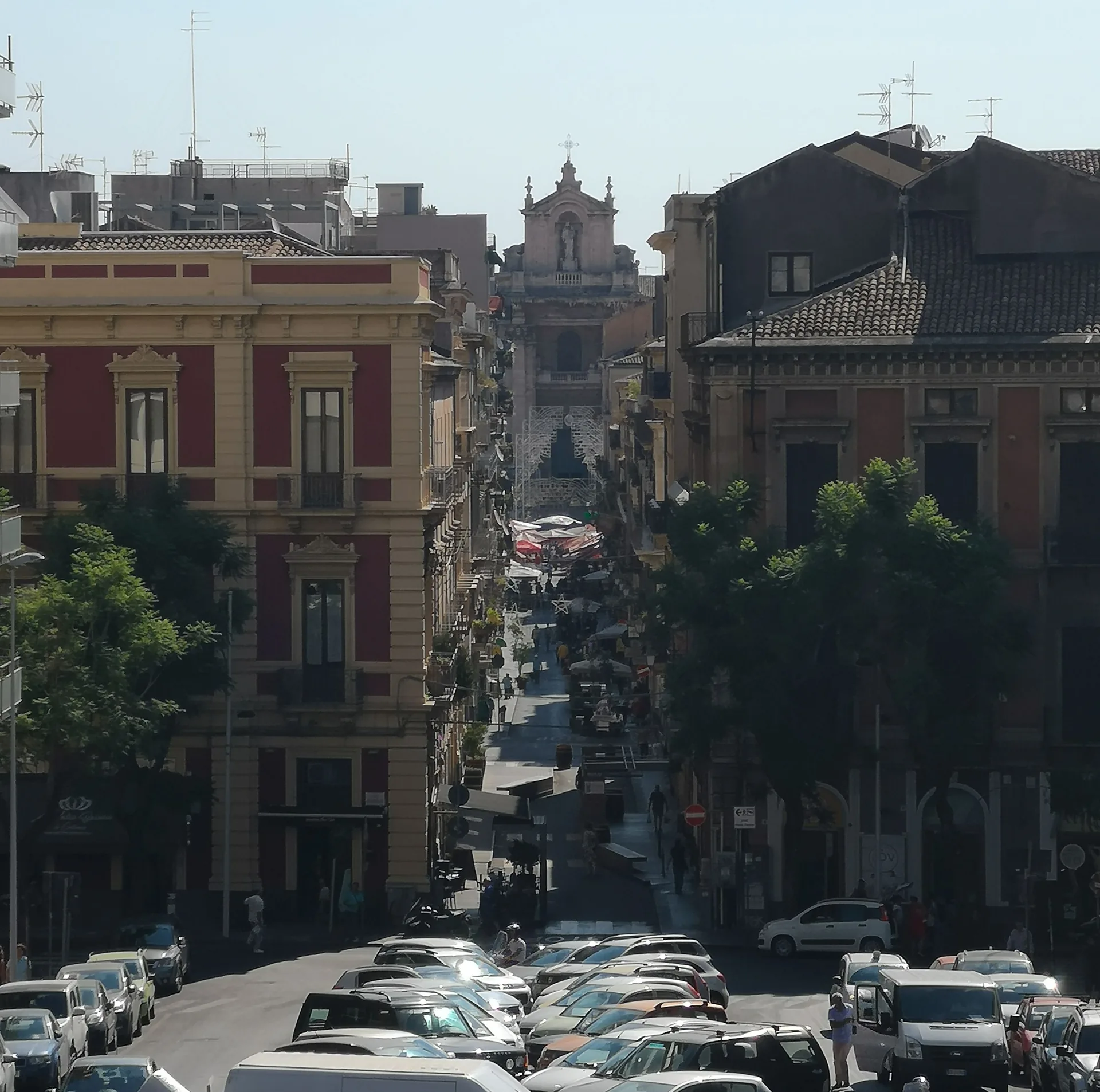
Street parking in Sicily runs on a colour code painted on the road. Blue lines mean paid parking, white lines mean free, and yellow lines are reserved for residents, loading or disabled drivers. Learn those three colours and most of the confusion disappears.
For blue-line spaces you pay at a nearby parcometro machine or through a parking app, then display or register the ticket. Free white-line spaces fill up fast in the centre, so in busy towns a guarded garage or paid car park is usually worth the few euros for peace of mind.
In Catania the simplest plan is to leave the car in a garage and walk, since the centre is compact and ZTL-protected. We cover the specific options, including overnight rates, in our guide to where to park in Catania. Wherever you stop, never leave bags or valuables visible in the car.
Sicilian Roads, Tolls and Driving Style
Sal73x · CC BY-SA 3.0
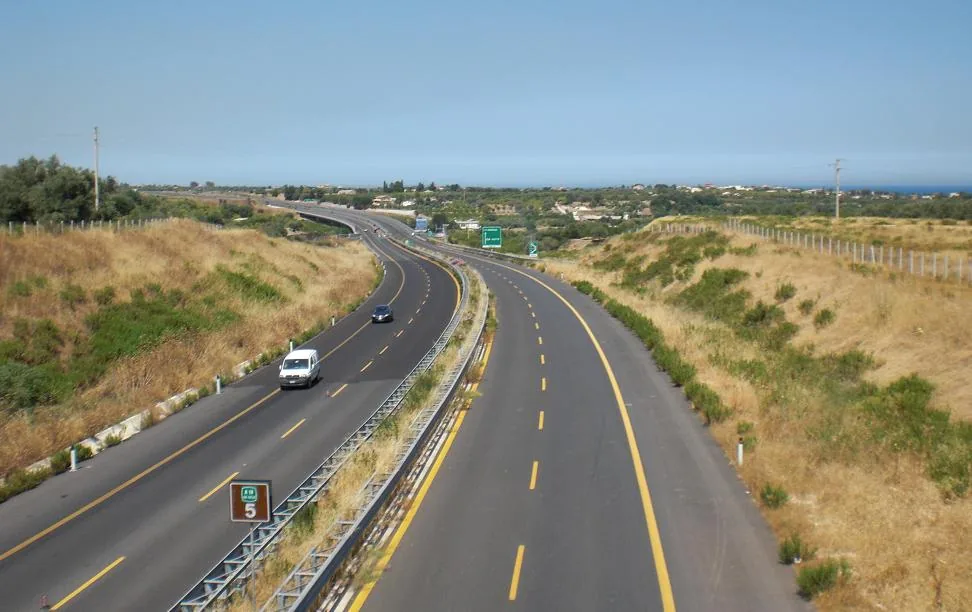
Sicily’s main roads are better than their reputation. The autostrade (motorways) are fast and mostly quiet, secondary roads are scenic if slower, and the only regular hazards are potholes on minor routes and the odd unfinished stretch.
Tolls on Sicilian motorways
Only two motorways charge tolls: the A18 Messina to Catania and the A20 Messina to Palermo. You take a ticket at the entry barrier and pay at the exit, by cash or card, and the cost is low compared with mainland Italy. Usefully, the A19 Catania to Palermo is free, so the cross-island drive costs nothing in tolls.
Fuel stations: servito and fai-da-te
Petrol stations confuse first-timers because many have two prices. Servito means an attendant fills the tank at a higher price, while fai-da-te (self-service) is cheaper and you pay at the pump or a machine. On country roads, fill up before you run low, since small-town stations close at lunch and on Sundays and some take cash only.
Speed limits and rules
Speed limits are 130 km/h on motorways, 110 on main dual carriageways, 90 on ordinary roads and 50 in towns. The drink-drive limit is 0.5 g/l, lower for new drivers, seatbelts are required front and back, and dipped headlights must be on in tunnels. Using a handheld phone while driving is illegal.
Reading the local driving style
Drive calmly and predictably and you will be fine. At unmarked junctions cars nudge forward to claim the gap rather than waiting for a perfect opening, and a quick horn means “I am here”, not anger. Let the assertive drivers past, do not block the flow, and watch constantly for scooters filtering on both sides.
Mountain and small-town roads
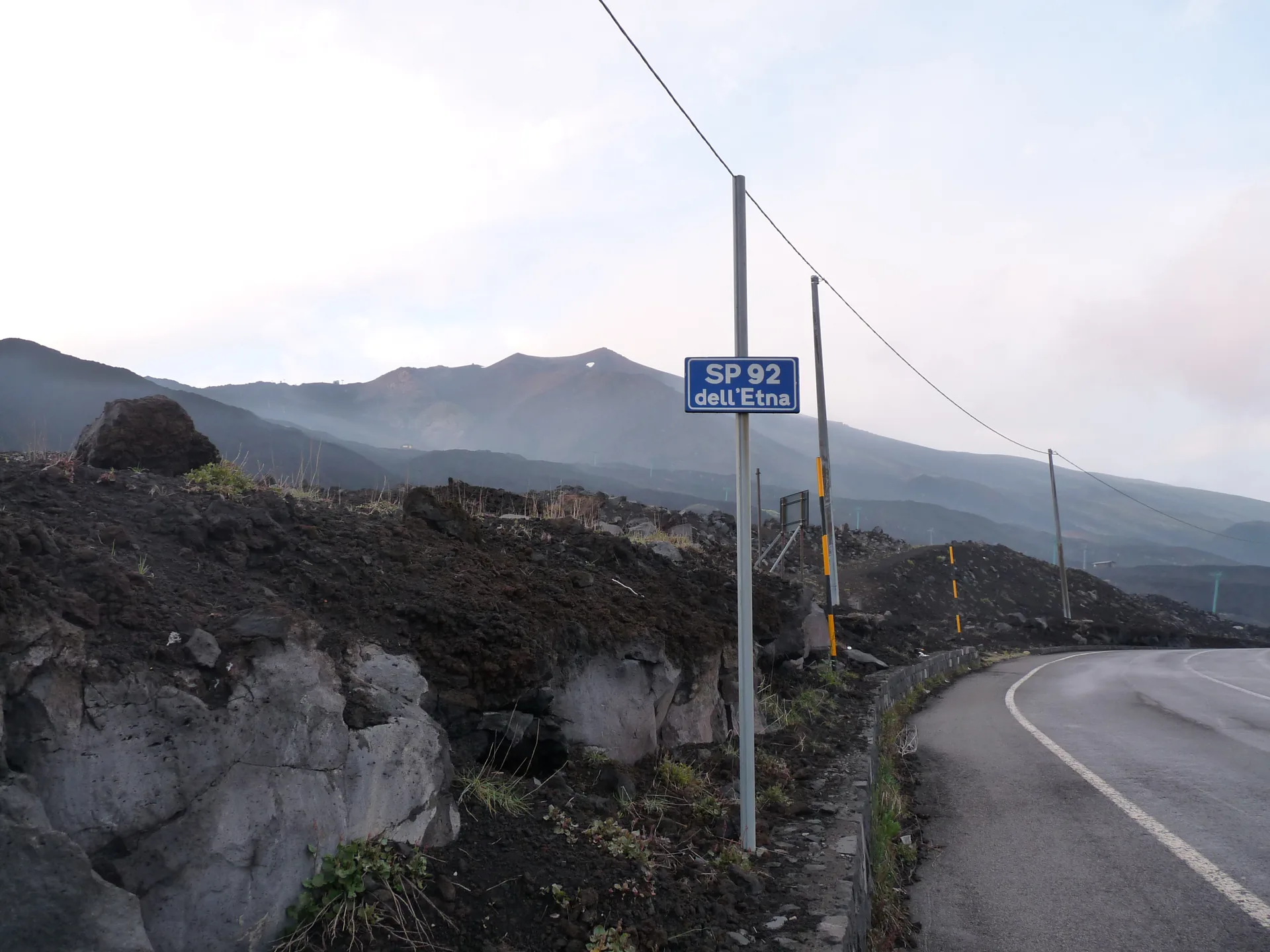
The roads around Etna and the Val di Noto are narrow, steep and full of blind bends. Take them slowly, use the horn before tight corners, and be ready to reverse to a passing point on single-track lanes. This is the main reason to rent a small car. So no, driving in Sicily is not dangerous if you slow down where it matters.
Driving Distances and Times from Catania
One thing the forums rarely give you is real driving times, and they matter more than distance because Sicilian roads slow you down. From a Catania base, most of the east coast highlights sit within a comfortable day’s reach, which is exactly why the city works so well as a hub.
| From Catania to | Distance | Driving time |
|---|---|---|
| Taormina | 50 km | about 50 min |
| Etna (Rifugio Sapienza) | 45 km | about 1 h |
| Siracusa and Ortigia | 65 km | about 1 h |
| Noto | 90 km | about 1 h 10 |
| Ragusa Ibla | 105 km | about 1 h 40 |
| Agrigento | 165 km | about 2 h |
| Palermo | 200 km | about 2 h 30 |
Treat these as realistic minimums rather than promises. Google’s estimate assumes empty roads, so add time for parking, the final crawl through narrow streets and a coffee stop. As a rule, anything up to about 90 minutes makes an easy day trip from Catania and gets you home for dinner.
For longer drives, keep water in the car, especially from May to September. Municipal tap water in Sicily is generally drinkable, but taste and building systems vary, so check our guide to drinking tap water in Sicily before relying on refills during a road trip.
A Simple East Sicily Road Trip from Catania
If you want a proper Sicily road trip without crossing the whole island, the east packs the best of it into short hops. A loop of three or four days from Catania covers the volcano, a Greek city and the baroque towns with very little time behind the wheel.
Day one heads north to Taormina and Etna. Drive up to the Silvestri Craters in the morning, then down to Taormina for the afternoon. Our guide on Taormina to Mount Etna shows how to link the two without backtracking.
Day two runs south to Siracusa and Noto. Park outside Ortigia and walk the island, then drive twenty minutes to Noto for the baroque honey-stone streets at golden hour. Day three loops through the Val di Noto, adding Ragusa Ibla and Modica before returning to Catania. Sleep in the city and you keep one easy, ZTL-free base for the whole trip.
Frequently Asked Questions (FAQ)
Is driving in Sicily difficult?
Not for most visitors. Motorways and country roads are straightforward, and the only hard parts are big-city centres and narrow old towns, which you can avoid by parking outside and walking in. An average driver is comfortable within a day.
Can tourists drive in Sicily?
Yes. Tourists can drive in Sicily on an EU or UK licence, while non-EU visitors including Americans need an International Driving Permit carried with their home licence. Rental companies also require a credit card and a minimum age of 21 to 25.
Is it worth renting a car in Sicily?
It is worth it if you want beaches, small towns, wineries and Etna at your own pace. If you are staying in central Catania and visiting Taormina, Siracusa or the volcano on day trips, trains and shuttles often do the job without the cost and parking hassle of a car.
Do Americans need an International Driving Permit in Sicily?
Yes. Italian law requires US drivers to hold an International Driving Permit alongside their state licence. Get it at home before you travel, since it cannot be issued in Italy, and keep both documents in the car.
Can you drive to Sicily from mainland Italy?
Yes, but not over a bridge. Cars cross the Strait of Messina on a ferry from Villa San Giovanni to Messina, a short crossing of about 20 to 40 minutes that runs frequently day and night. Many visitors driving down from the UK or northern Italy take this route, then pick up the A18 motorway south to Catania.
Is driving in Sicily dangerous?
No, not if you drive calmly and slow down on mountain and old-town roads. The traffic looks worse than it is, and the biggest real risk is an expensive ZTL fine, not a crash. Watch for scooters and keep to the speed limits.
Where to Stay in Catania
Catania is the most practical base for driving in eastern Sicily. You can rent at the airport, leave the car in a garage for the city days, and reach Taormina, Etna and Siracusa in under 90 minutes when you want to roam. It keeps you in one ZTL-free home instead of repacking every night.
Staying central also means you can skip the car entirely on rest days and walk to the market, the fish stalls and the baroque streets. For neighbourhoods and trade-offs, see our guide on where to stay in Catania.
If you want a comfortable home base with room to spread out, our apartments in Catania sit in the centre, close to garages and the motorway out of town, so the road trip starts the moment you collect the keys.
The information in this guide was correct at the time of writing. Data can change from season to season without notice: before you travel, always check the official channels and websites for updates. We review this guide periodically, but the official channels are always the authoritative source. We also cannot guarantee that the suggested routes or the attractions described are always reachable or accessible: roads, trails and sites may be closed, damaged, altered or unsafe. Assessing the practicability and safety of itineraries and attractions always remains your own responsibility.