

Catania sits at the foot of Mount Etna, Sicily’s 3.357-metre active volcano, and carries the volcano’s shadow through every lava-stone street. After the 1693 earthquake, the city was rebuilt entirely in Sicilian Baroque — a pale limestone and black lava composition recognised by UNESCO as part of the Val di Noto World Heritage Site. The must-see sights cluster around Piazza del Duomo, the Cathedral of Sant’Agata, and the Liotru, the basalt elephant that has been the city’s symbol since 1736.
This guide is the opposite of a numbered listicle. It is a catalog by type: baroque squares, churches and monasteries, castles and theatres, markets and streets, views and gardens, and a short section on what lies beyond the city walls. For activities, day tours and food you want to eat, see our companion guide on things to do in Catania. Here, we stick to what you can look at — the physical must-see of the city.
Below: what Catania is best known for, what to see if you only have a day, the twenty must-see sights grouped by category, and four honest questions we get asked by guests week after week.
What is Catania best known for?
Catania is best known for its UNESCO baroque historic centre, rebuilt in lava stone after the 1693 earthquake; for being the gateway to Mount Etna, Europe’s most active volcano; and for Sant’Agata, its patron saint, celebrated in early February with one of Europe’s largest religious festivals. The Liotru — a basalt elephant topped with an Egyptian obelisk — is the civic symbol since Vaccarini placed it on Piazza del Duomo in 1736. For a broader overview of the city — where it is, its history and how to get there — see our Where is Catania guide, or our Catania tourism overview for a full visiting plan.
- UNESCO Baroque architecture — the historic centre is part of the Val di Noto World Heritage Site, eight towns rebuilt after the 1693 earthquake in a coordinated Baroque style unique to south-east Sicily.
- Mount Etna — 3.357 m and constantly active. Visible from most streets, reachable by car or bus in ~30 minutes, a core part of why people come.
- Sant’Agata festival — 3-5 February, estimated one million participants. The Duomo and the surrounding streets are the physical theatre of the celebration.
- Lava stone & the Liotru — almost every facade, pavement and doorframe in the old centre is black basalt from Etna. The elephant fountain in Piazza del Duomo (1736, Giovanni Battista Vaccarini) is the best-loved symbol of the city.
What to see in Catania for a day?
For one day in Catania, six sights cover the must-see in a single walking loop: start at Piazza del Duomo, cross to La Pescheria fish market, walk up Via Etnea to Piazza Stesicoro and the Roman amphitheatre, detour to Teatro Massimo Bellini, climb the Monastero dei Benedettini of San Nicolò l’Arena, and end at Castello Ursino. Total distance: ~3 km. Total time with stops: 5-6 hours including lunch at the market.
| Time available | Must-see priority | Notes |
|---|---|---|
| Half-day (3-4 h) | Piazza del Duomo · La Pescheria · Via Etnea | Cruise stopover, early flight arrival |
| Full day (~8 h) | + Monastero dei Benedettini · Teatro Massimo Bellini · Castello Ursino | The classic first visit |
| 2 days | + Chiesa della Badia rooftop · Giardino Bellini · Via dei Crociferi | Baroque depth, no rush |
| Weekend (3 days) | + Mount Etna half-day · Aci Trezza / Aci Castello | City + natural sights in one trip |
Most guests who give Catania one rushed day regret not seeing the Monastero or the Badia rooftop — both are among the top sights and neither takes more than forty minutes. If you’re short on time, skip Castello Ursino (the museum inside is uneven) and keep the rooftop.
Catania must-see sights by category
The nineteen must-see sights below are grouped by type, not by walking order. The point is to let you choose what interests you — baroque architecture, church interiors, civic history, daily life — and build your own route. Every entry lists location, opening hours and one essential fact. All of them are inside the historic centre except the three in the final section, which require a car or a bus.
- Baroque squares & streets — 4 sights, Piazza del Duomo and the ceremonial axis of the old city
- Churches & monasteries — 4 sights, UNESCO-level religious architecture
- Castles, theatres & historic palaces — 3 sights, civic and aristocratic buildings
- Markets & streets of daily life — 3 sights, the city as it lives
- Views & green spaces — 2 sights, where Catania looks back at Etna
- Beyond the centre — 3 sights, natural and archaeological must-see outside the city walls
Baroque squares & streets
Four sights that define Catania as a Baroque city: the ceremonial main square, the university plaza, the religious street of the Val di Noto, and the square where the Roman amphitheatre breaks through the modern pavement.
Piazza del Duomo & Fontana dell’Elefante
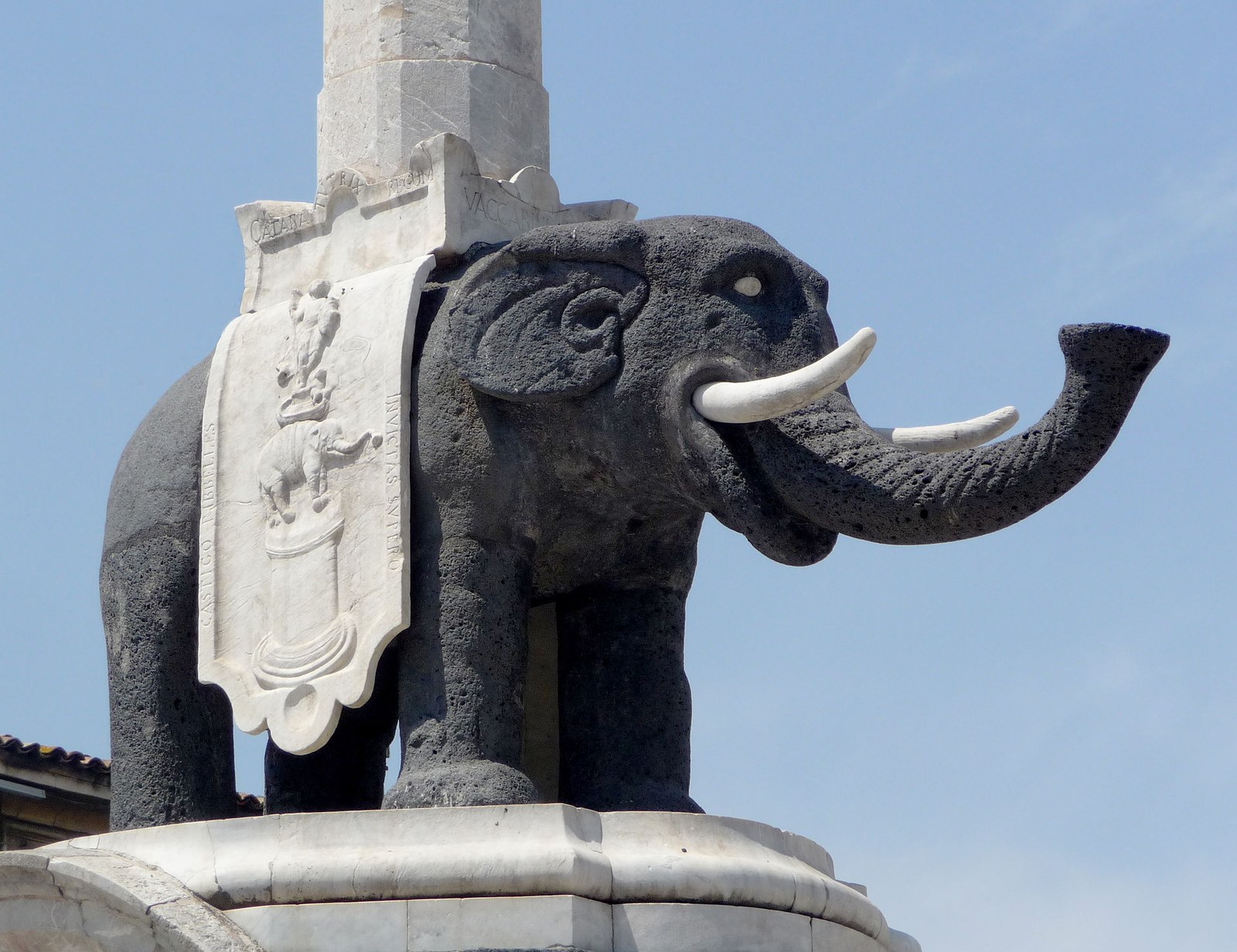
Lucarelli · CC BY-SA 3.0
- Location
- Piazza del Duomo, Catania Maps
- Essential fact
- Vaccarini, 1736 — the elephant itself is Roman, re-used
- Price
- Free
Piazza del Duomo is the civic heart of Catania and the first sight most visitors see. In the centre stands the Fontana dell’Elefante, the basalt elephant — known locally as u Liotru — carrying an Egyptian granite obelisk on its back. Giovanni Battista Vaccarini designed the fountain in 1736 using a Roman-era elephant already present in the city. The square is enclosed by the Cathedral, the Palazzo degli Elefanti (town hall), the Porta Uzeda, and the Fontana dell’Amenano, which drains the underground Amenano river under a single arch of carrara marble. The square is free and open 24/7 — golden hour light on the white-and-black facades is the single best photograph in Catania.
Piazza Università & Palazzo dell’Università
- Location
- Piazza Università 2, Catania Maps
- Essential fact
- University founded 1434, oldest in Sicily
- Price
- Free
Two minutes up Via Etnea from Piazza del Duomo, Piazza Università is a quieter square bordered by four Baroque candelabra-shaped lamp posts cast in 1957 with episodes from Catanese legends. The Palazzo dell’Università on the east side houses the seat of the University of Catania, founded in 1434 — Sicily’s oldest university. The courtyard with its two-order colonnade is open on weekdays and worth five minutes. The Palazzo San Giuliano, opposite, completes the symmetry of the square.
Via dei Crociferi (UNESCO)
- Location
- Via Crociferi, Catania Maps
- Essential fact
- UNESCO World Heritage, Val di Noto inscription 2002
- Price
- Free
Via dei Crociferi is the most concentrated stretch of Baroque architecture in Catania: a 200-metre pedestrian street with four churches within sight of each other — San Benedetto, San Francesco Borgia, San Giuliano, and the Jesuit Collegio. The street passes under the Arco di San Benedetto, the small arch that opens the axis. UNESCO lists Catania’s historic centre on this street as part of the Val di Noto inscription (2002). Enter from Piazza San Francesco d’Assisi and walk north to Via Antonino di Sangiuliano — the whole visit takes thirty minutes at a slow pace.
Piazza Stesicoro & Anfiteatro Romano
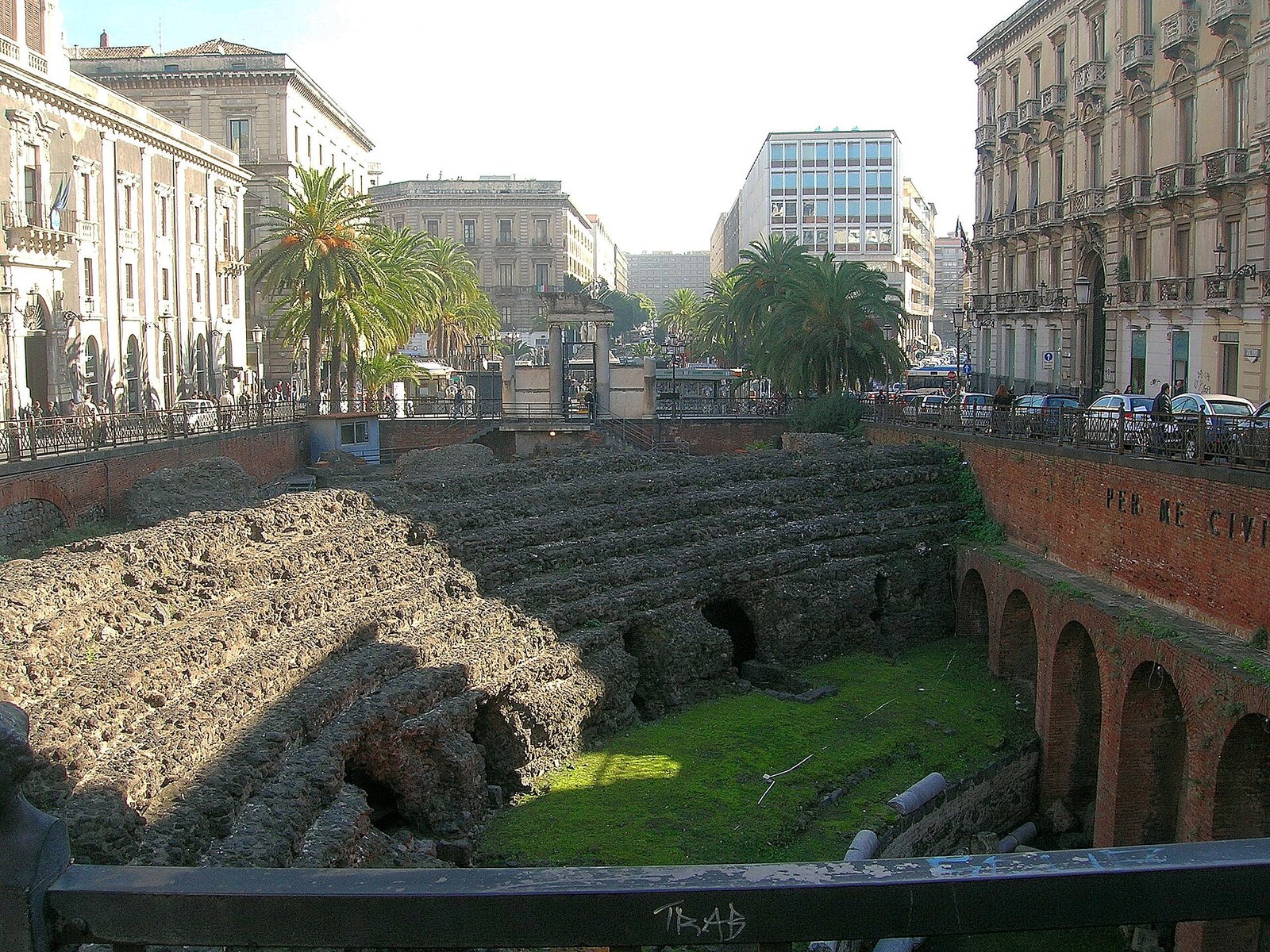
Triquetra · CC BY-SA 3.0
- Location
- Piazza Stesicoro, Catania Maps
- Essential fact
- 2nd century AD, capacity ~15,000 — second largest in Sicily
- Price
- Free (view from street level)
At the top of Via Etnea, Piazza Stesicoro contains the single most unexpected sight in Catania: the partially excavated Roman amphitheatre, visible from street level in a sunken pit at the north end of the square. Built in the 2nd century AD, the amphitheatre was originally the second largest in Sicily after Syracuse, with seats for about 15,000 spectators. Most of it still lies under the modern city — only a section of the cavea and the arena floor has been exposed. Access inside is usually closed, but the street-level view is free and continuous.
Churches & monasteries
Four religious buildings that anchor the UNESCO Baroque centre: the cathedral of the patron saint, the small church with the best rooftop view, the second-largest Benedictine monastery in Europe, and its unfinished church.
Cathedral of Sant’Agata (Duomo)

Effems · CC BY-SA 4.0
- Location
- Piazza del Duomo, Catania Maps
- Site
- cattedralecatania.it
- Essential fact
- Built 1078 under Roger I, current facade Vaccarini 1733-1761
- Price
- Free
The Cathedral of Sant’Agata was built in 1078 by the Norman count Roger I over the ruins of a Roman bath complex. After repeated earthquakes and volcanic damage, the current facade was designed by Vaccarini between 1733 and 1761 in a Sicilian Baroque that combines white limestone and black basalt from Etna. Inside, the relics of Saint Agatha are kept in a silver bust behind the altar; the composer Vincenzo Bellini (1801-1835) is buried in the right transept. The Cappella Cappellone on the south side holds the Roman baths still visible below the floor level. Free entry.
Chiesa della Badia di Sant’Agata & the best rooftop view
- Location
- Via Vittorio Emanuele II 182, Catania Maps
- Essential fact
- Vaccarini 1735-1767; the rooftop is the single best view in the historic centre
- Price
- €5
Directly behind the Cathedral, the small Chiesa della Badia di Sant’Agata was designed by Vaccarini in 1735-1767 on an elongated octagonal plan. The church itself is a refined example of late Sicilian Baroque, but the reason most people come is the rooftop terrace, reached by a narrow stone staircase that climbs through the dome structure. From the terrace you see the entire centre of Catania, Piazza del Duomo directly below, the Ionian sea, and — on clear days — Mount Etna framed behind the historic rooftops. Best light: late afternoon.
Monastero dei Benedettini di San Nicolò l’Arena

The Cosmonaut · CC BY-SA 2.5 ca
- Location
- Piazza Dante Alighieri 32, Catania Maps
- Site
- monasterodeibenedettini.it
- Essential fact
- Second-largest Benedictine complex in Europe, UNESCO 2002
- Price
- €10 (guided tour)
The Monastero dei Benedettini di San Nicolò l’Arena is the second-largest Benedictine monastery in Europe, after Mafra in Portugal. Founded in 1558 and rebuilt after the 1669 lava flow and the 1693 earthquake, the complex is now part of the University of Catania (Department of Humanities). It is included in the UNESCO Val di Noto inscription (2002). Guided tours walk through the two cloisters, the hanging garden, the Baroque library, and the archaeological basement where a Roman domus is preserved under the monastic kitchens. Tours last ~75 minutes and are available in English on request.
Chiesa di San Nicolò l’Arena
- Location
- Esedra di Piazza Dante, Piazza Dante Alighieri 12, Catania Maps
- Essential fact
- Largest church in Sicily by volume; 1841 meridian sundial still in use
- Price
- Free
Adjoining the Monastero, the Chiesa di San Nicolò l’Arena is the largest church in Sicily by volume. Construction began in 1687; the facade was never finished, which is why the eight massive columns at the entrance stand as unfinished shafts of masonry. The interior is essentially a single unbroken nave, almost spartan compared to most Sicilian Baroque churches. The meridian sundial set in the floor in 1841 by astronomer Cristoforo Sartorius still marks solar noon through a small hole in the dome. The church is often open outside Mass hours as part of the monastery tour.
Castles, theatres & historic palaces
Three civic must-see that pre-date the Baroque reconstruction or crown it: the 13th-century Norman castle, the opera theatre dedicated to Catania’s favourite son, and the most important aristocratic palace of the 18th century.
Castello Ursino
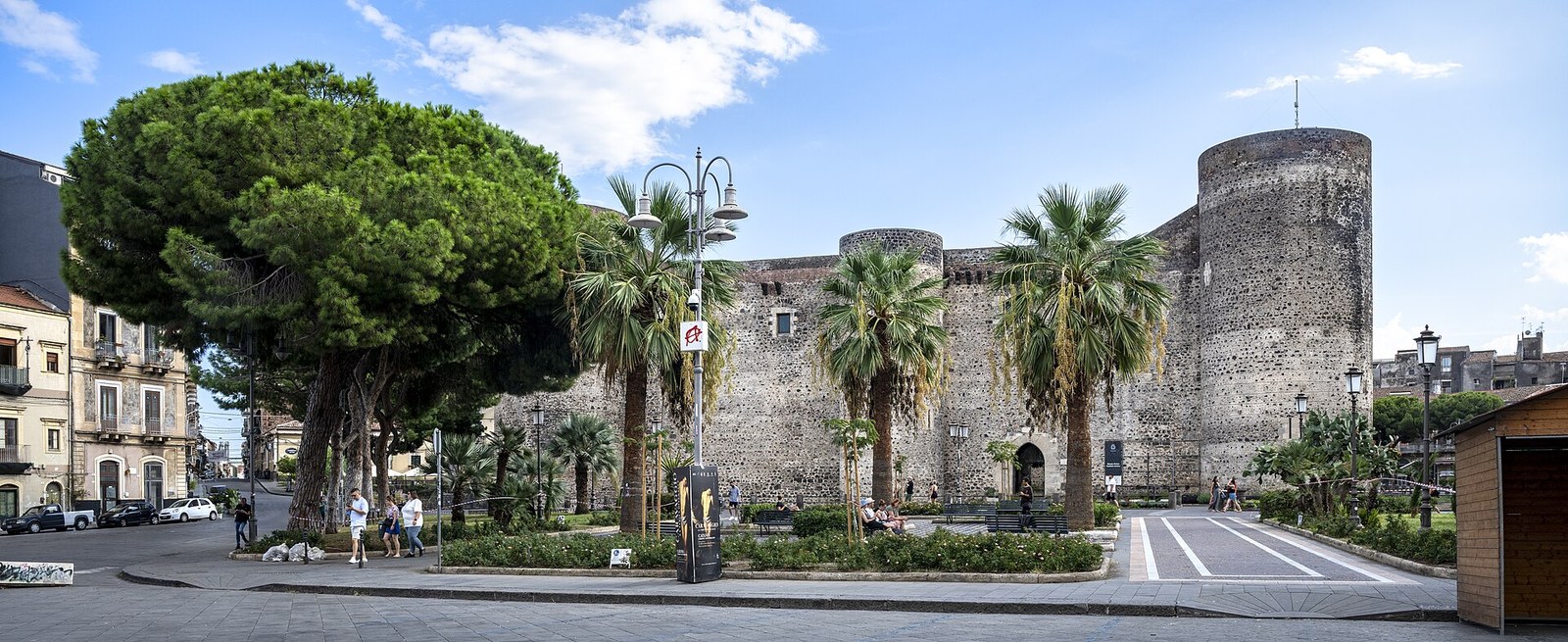
Cayambe · CC BY-SA 4.0
- Location
- Piazza Federico di Svevia 21, Catania Maps
- Site
- comune.catania.it/la-citta/culture/monumenti-e-siti-archeologici/musei/museo-civico-castello-ursino
- Essential fact
- Built 1239-1250 under Frederick II; the 1669 lava flow moved the coastline inland
- Price
- €10 (museum)
Castello Ursino was built between 1239 and 1250 by order of Frederick II of Hohenstaufen as part of a defensive ring along the Sicilian coast. Originally on a sea cliff, the castle stands inland today because the 1669 lava flow extended the coastline by hundreds of metres — an extraordinary piece of volcanic geography you can still trace in the surrounding streets. The castle houses the Museo Civico (civic museum), with an eclectic collection spanning antiquity to 19th-century painting. The museum itself is uneven; the external architecture is the main sight. Just across Piazza Federico di Svevia stand two easy add-ons — the churches near Castello Ursino: San Sebastiano directly opposite the castle and Santa Chiara 80 m up Via Castello Ursino.
Teatro Massimo Bellini

Berthold Werner · CC BY-SA 3.0
- Location
- Via Giuseppe Perrotta 12, Catania Maps
- Site
- teatromassimobellini.it
- Essential fact
- Inaugurated 31 May 1890 with Bellini’s Norma
- Price
- Free exterior — €8 guided tour
The Teatro Massimo Bellini opened on 31 May 1890 with a performance of Bellini’s Norma. Designed by Andrea Scala and Carlo Sada, the horseshoe-plan theatre has four tiers of boxes, a capacity of around 1.200, and a ceiling fresco by Ernesto Bellandi depicting the apotheosis of Bellini. Outside opera season (typically October to June), the theatre offers daytime guided tours in English and Italian — including the stage, the royal box, and the main foyer. The square outside is named after Vincenzo Bellini, who was born a few streets away in 1801.
Palazzo Biscari
- Location
- Via Museo Biscari 10, Catania Maps
- Site
- palazzobiscari.it
- Essential fact
- Built 1702-1763; Goethe stayed here in 1787
- Price
- €10 (guided tour)
Palazzo Biscari is the most important Baroque residence in Catania, built between 1702 and 1763 by the Paternò Castello family, princes of Biscari. The sea-facing facade, with its ornate balcony windows, sits on the old city walls and faces what was originally the port. Inside, the Ballroom (Salone delle Feste) is a Rococo fantasy of stucco, mirrors and a trompe-l’oeil sky on the vault, with a small orchestra balcony carved from the wall itself. Goethe stayed here during his Italian journey in 1787. The palace is still privately owned and opens for guided tours most weeks.
Markets & streets of daily life
Three sights where Catania stops being architecture and becomes a city: the fish market under the Duomo, the main pedestrian axis looking at Etna, and the Monday flea market in front of the Roman amphitheatre.
La Pescheria (the fish market)

Lucarelli · CC BY-SA 3.0
- Location
- Piazza Alonzo di Benedetto, Catania Maps
- Essential fact
- Running since the 19th century; best between 8:00 and 11:00
- Price
- Free
La Pescheria is Catania’s historic fish market, running since the 19th century under the arches behind Piazza del Duomo. Fish, meat, fruit, vegetables, cheese and street food spill across Piazza Alonzo di Benedetto and the alleys around it. The scene is loud, theatrical, and uncompromisingly local. Go early: the market opens around 7:00 and begins to close from 14:00, with the freshest display between 8:00 and 11:00. A cone of raw seafood, a glass of Nero d’Avola, pasta alla Norma or arancini can all be eaten standing in the market without a restaurant.
Via Etnea
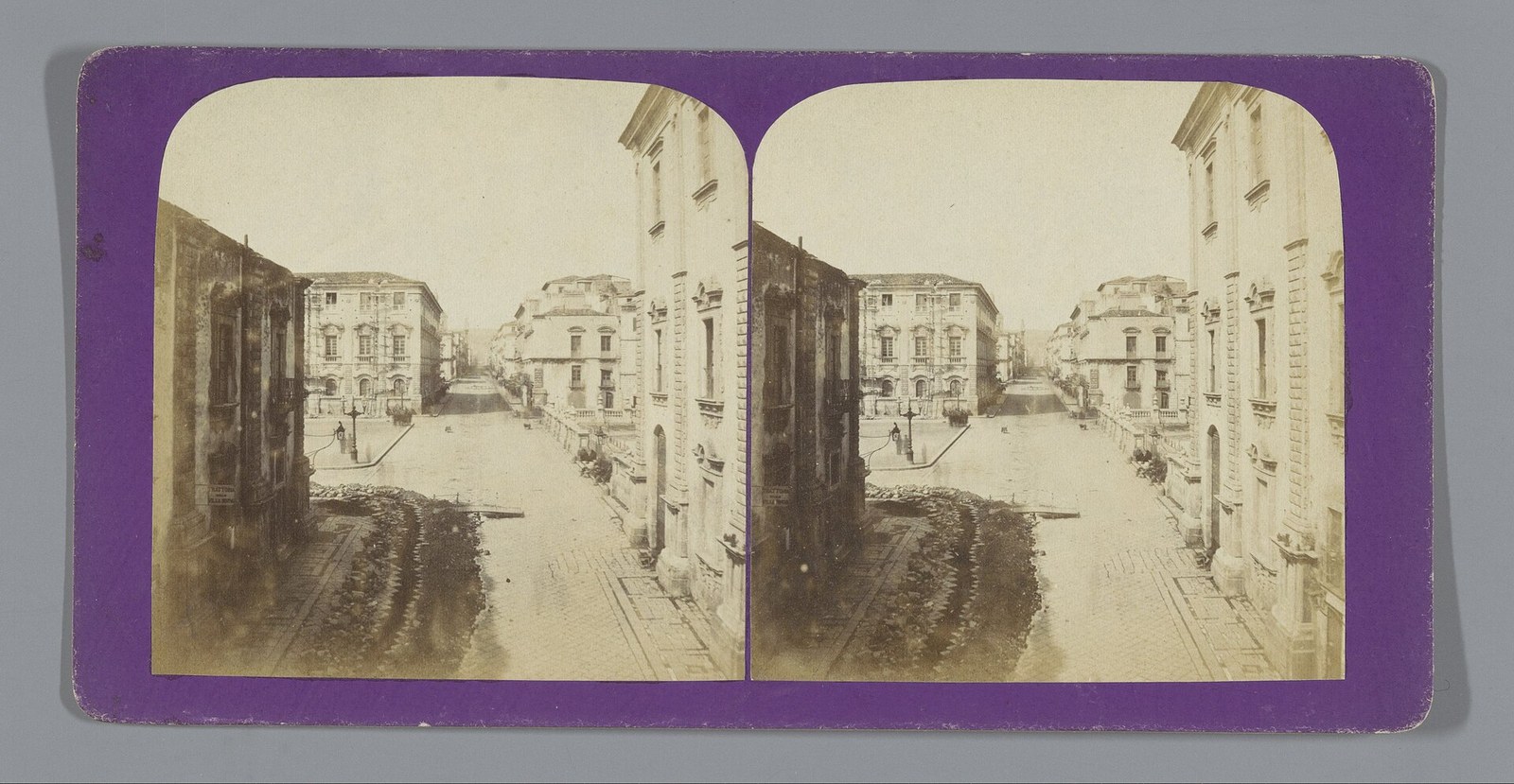
Rijksmuseum · CC0
- Location
- Via Etnea, Catania Maps
- Essential fact
- 1.7 km axis with a straight line of sight to Mount Etna
- Price
- Free
Via Etnea is the main pedestrian axis of Catania, running 1.7 km from Piazza del Duomo to the Giardino Bellini. The street is lined with Baroque palazzi, 19th-century shops, cafes, bookshops and the city’s main fashion stores. Its defining feature is the sightline to Mount Etna: on a clear day the volcano sits exactly at the end of the street, centred in the composition. Walk up in the morning, down at sunset. The strongest stretches visually are between Piazza Università and Piazza Stesicoro. Cars are banned from a large portion of the street during afternoon and weekend hours.
Fera ’o Luni (Piazza Carlo Alberto)
- Location
- Piazza Carlo Alberto, Catania Maps
- Essential fact
- Name “Fera ’o Luni” = Monday fair; now runs six mornings a week
- Price
- Free
Fera ’o Luni — literally “Monday fair” in Catanese dialect — is a sprawling flea market filling Piazza Carlo Alberto di Savoia and the surrounding streets. The name is archaic: today the market runs every morning except Sunday, with the largest version on Monday. Stalls sell fresh produce, cheap clothing, kitchenware, counterfeit bags, books, tools — an anthropological snapshot of the city with almost no tourism dressing. It faces the apse of San Biagio, the church built on the spot where Saint Agatha is said to have been martyred.
Views & green spaces
Two sights where you step out of the dense lava-stone fabric of the city to look at it from outside: the 19th-century public garden, and the best rooftop in the centre.
Giardino Bellini
- Location
- Via Etnea 292, Catania Maps
- Essential fact
- Opened 1883, ~70.000 m²; Etna view and flower-clock tradition
- Price
- Free
Giardino Bellini is Catania’s main public garden, opened in 1883 at the top of Via Etnea. The park covers about 70.000 m² of terraces, paths and belvederes, with a central rotunda and a large flowerbed that displays the current day and month in blooming flowers — a gardening tradition since the late 19th century. Several viewpoints inside the garden look toward Mount Etna across the city rooftops. Locals call the park Villa Bellini. Open from dawn to dusk, free entry.
Villa Bellini is also the city’s most useful central pause for parents. Our guide to visiting Catania with a baby connects the garden to an easy pushchair route, feeds, naps and realistic return times.
Terrazza della Badia di Sant’Agata
- Location
- Via Vittorio Emanuele II 182, Catania Maps
- Essential fact
- Best rooftop view of the historic centre
- Price
- €5
Covered above as a sight of its own (see the Badia entry under Churches & monasteries), the rooftop terrace is worth listing separately as a view: Catania’s best rooftop panorama. From a compact balcony on the dome structure you see Piazza del Duomo straight down, the lava-stone roofs of the centre, the Ionian sea on one side, and Mount Etna on the horizon on a clear day. The visit takes fifteen minutes including the climb. Late afternoon light flatters the Baroque facades best.
Beyond the centre: natural & archaeological sights
For Mount Etna specifically — routes by difficulty, cable car prices, the 2,800 m self-guided limit — see our dedicated hiking Etna guide.
Beyond sights: for couples and food lovers, consider a full day at an Etna winery on a Sicily wine tour — our complete 2026 guide covers the top 10 producers and logistics from Catania.
Three must-see sights outside the historic walls: the volcano that made Catania, the Ionian coast basalt islands, and the Roman theatre hidden between apartment blocks. For the full activity guide to Mount Etna and the Ionian coast — tours, hikes, cycling, wine, beaches — see our companion guide on things to do in Catania.
Mount Etna
- Location
- Mt Etna, Castiglione di Sicilia, Metropolitan city of Catania Maps
- Essential fact
- 3.357 m active volcano, UNESCO World Heritage Site 2013
- Price
- Free to drive — €50–100 guided tour or cable car
Mount Etna is Europe’s most active stratovolcano, at 3.357 m (the summit height changes with eruptive activity), and a UNESCO World Heritage Site since 2013. As a sight, you can experience it on three levels: from Catania itself (visible from Via Etnea and any rooftop), from Etna Sud at Rifugio Sapienza (~1.900 m, reached by car or AST bus, cable car continues to ~2.500 m), and from Etna Nord at Piano Provenzana (north side, fewer crowds). For tour logistics — how to choose between AST bus, shared 4×4, private guide, wine tour — see the Etna section in our companion guide.
Aci Trezza & Aci Castello
gnuckx · CC BY 2.0
- Location
- Aci Castello, Metropolitan city of Catania Maps
- Essential fact
- Basalt stacks ~500.000 years old; Aci Castello built 1076 on a lava outcrop
- Price
- Free town — €4 castle museum
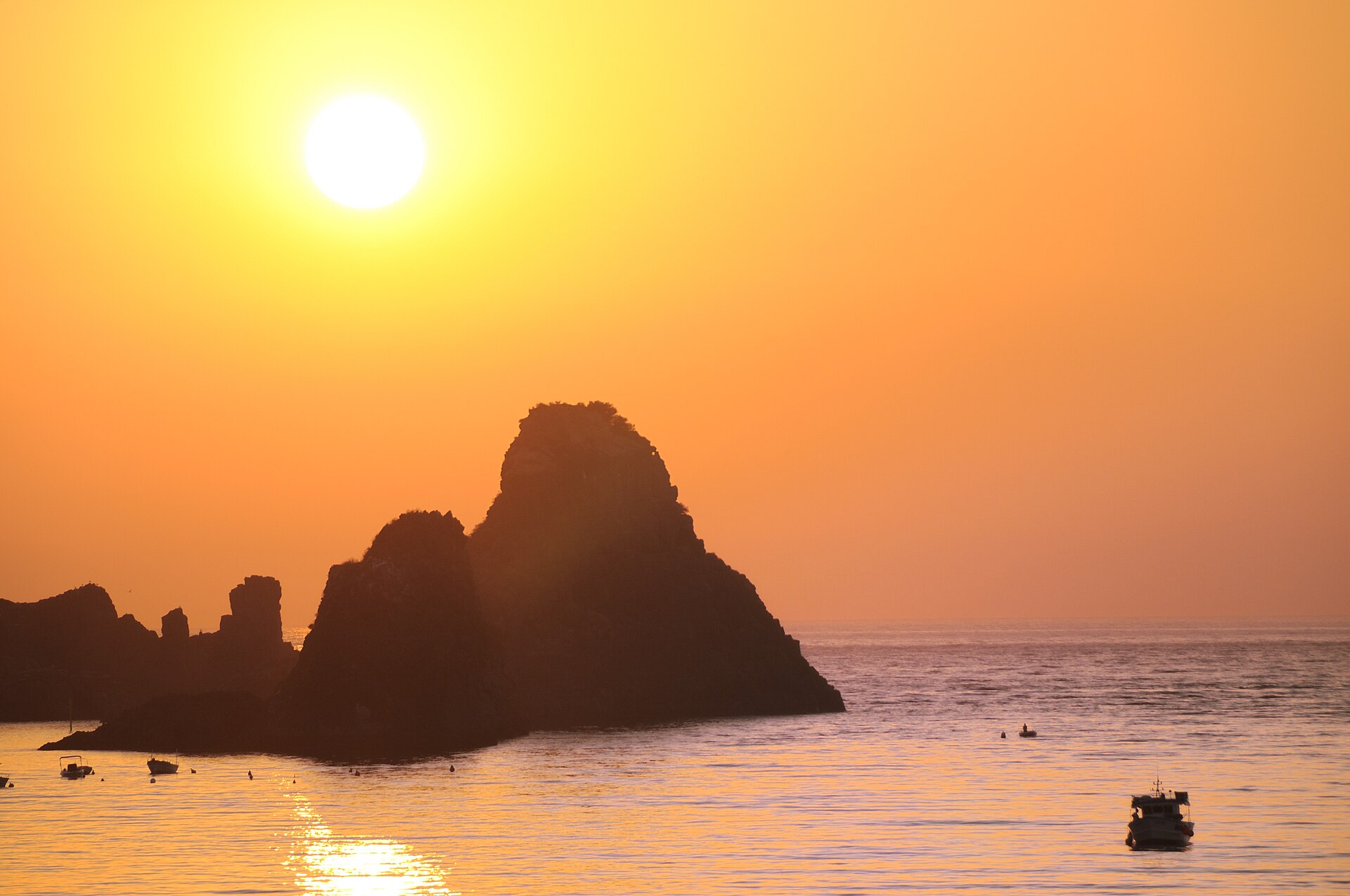
Fifteen minutes north of Catania by car or AMT bus, the fishing village of Aci Trezza sits in front of the Isole dei Ciclopi — seven basalt stacks that rise out of the Ionian sea. Greek mythology places here the rocks Polyphemus threw at Odysseus; geology explains them as columnar basalt from a ~500.000-year-old submarine eruption. One kilometre south, Aci Castello is a smaller village with a Norman castle of black lava stone built in 1076 on a basalt outcrop overlooking the sea. Both are walkable, visible, and essentially free to see.
Teatro Romano di Catania
- Location
- Via Vittorio Emanuele II 266, Catania Maps
- Essential fact
- Roman 2nd century AD on Greek 5th century BC foundations, ~7.000 capacity
- Price
- €6
The Teatro Romano is the second archaeological layer of Catania, together with the amphitheatre in Piazza Stesicoro. Partially excavated in the 19th and 20th centuries, the theatre dates to the Roman period (2nd century AD) but stands on Greek foundations from the 5th century BC. Capacity was around 7.000 spectators. The adjacent Odeon, a smaller semicircular building, was used for musical performances. Both are surrounded by later apartment blocks that crowd the excavation — which is precisely what makes the visit memorable: ancient stonework threaded through a living city.
Must-see attractions in Catania: the shortlist
What not to miss in Catania?
Catania’s absolute non-negotiables are: Piazza del Duomo (the city’s lava-stone heart, crowned by the Fontana dell’Elefante), La Pescheria fish market (open 7:00–13:00 except Sundays), Via dei Crociferi and its four UNESCO Baroque churches, the Monastero dei Benedettini di San Nicolò l’Arena (second-largest monastery in Europe, guided tour required), and a view of Mount Etna from the rooftop of Chiesa della Badia di Sant’Agata. These five cover Catania’s identity as a volcanic, Baroque, and Mediterranean city in a single half-day walk.
If your time is limited to one day, walk them in this order: Piazza del Duomo at 8:00, La Pescheria by 9:00, Via dei Crociferi mid-morning, Monastero dei Benedettini at 10:30, and the Badia rooftop at sunset for €3.
If you only remember five must-see attractions in Catania, make them these: Piazza del Duomo with the Liotru elephant fountain; the Cathedral of Sant’Agata; the Monastero dei Benedettini; the fish market La Pescheria; and the rooftop of the Chiesa della Badia di Sant’Agata. Together they give you civic, religious, domestic and visual Catania in a single half-day loop.
- Piazza del Duomo & Fontana dell’Elefante — civic heart, Vaccarini 1736, the single image of the city
- Cathedral of Sant’Agata — Norman 1078, Baroque facade, Bellini’s tomb
- Monastero dei Benedettini — second-largest in Europe, UNESCO, guided tour
- La Pescheria — fish market, 7:00-14:00, lunch without a restaurant
- Terrazza della Badia di Sant’Agata — best rooftop view of the centre
How many days do you need to see Catania?
To walk these landmarks in a single route rather than browse them by category, see our walking guide to Catania’s old town: ten stops from Piazza del Duomo to Villa Bellini with distances between each and a dedicated map.
Two days are the sensible minimum to see Catania properly: one day for the historic centre and its must-see sights, one day for Mount Etna. Add a third day if you want to see the Ionian coast (Aci Trezza, Aci Castello) or a half-day trip to Taormina. One day is possible for a cruise stopover but you will miss either the Monastero tour or the volcano.
The breakdown by day is already given in the mini-table under What to see in Catania for a day? at the top of this guide. For a structured East Sicily week that uses Catania as the base, see our 7-day Sicily itinerary.
FAQ: Catania sights & attractions
Is Catania worth visiting just for the sights?
Yes for two full days. The Baroque centre, the Monastero dei Benedettini, La Pescheria, and a half-day up Mount Etna are individually strong enough to justify the trip. For the broader argument — food, day trips, experiences — see our longer answer in the things to do in Catania guide.
Are Catania attractions free?
Most of the must-see sights in this guide are free: Piazza del Duomo, Via dei Crociferi, the Cathedral interior, La Pescheria, Via Etnea, Piazza Stesicoro, Giardino Bellini, and the views of Mount Etna. Paid: the Monastero Benedettini guided tour, the Badia rooftop, Castello Ursino museum, Teatro Bellini tours, Palazzo Biscari, and the Teatro Romano. Budget €20-30 per person if you pay for all of them.
What is the best time of day to visit the Cathedral?
Mid-morning or late afternoon, outside Mass. The Cathedral closes between 12:00 and 16:00 on most days. Early morning (7:00-9:00) light on the facade is the best for photographs; late afternoon (17:00-19:00) is best for the interior when the side chapels get direct light.
Can you see Mount Etna from Catania city centre?
Yes, from several places. Via Etnea gives the most celebrated sightline, with the volcano framed at the northern end of the street. Giardino Bellini belvederes and the Terrazza della Badia rooftop are the two best elevated viewpoints. On cloudy days Etna often hides the summit and reveals only the lower flanks — perfectly normal, not a missed opportunity.
Are Baroque churches open every day?
Most are open six days a week with a midday closure (roughly 12:00-16:00). Sundays are partially dedicated to Mass, and photographs are usually asked to be taken outside service times. Via dei Crociferi churches have more variable hours — some open only in the morning, some only by appointment. Check the same day or ask at the Cathedral sacristy for a current schedule.
Do you need tickets for the Monastero dei Benedettini?
Yes. Access is by guided tour only. Tickets are booked at the ticket office inside Piazza Dante 32 or through monasterodeibenedettini.it. English-language tours run most days on request; Italian tours are more frequent. Tours last about 75 minutes.
Beyond sights: things to do in Catania
Beyond the must-see shortlist, Catania hides smaller museums, rooftop terraces and lava-stone vaults that most first-timers walk past. For a curated round-up see our hidden gems in Catania guide — nine unusual places within 15 minutes of Piazza del Duomo.
This guide covers what to look at. For what to do — Etna tours, cooking classes, wine tastings, beaches, food to eat, the fish market as a lunch ritual, the five mistakes tourists keep making — read our companion piece on things to do in Catania. If you are planning logistics, see also parking in Catania and getting from Catania airport to Taormina.
Where to stay in Catania
Our three apartments in Catania sit in Via Santissima Trinità 71, a three-minute walk from Piazza del Duomo and directly behind La Pescheria — the geography of this guide is also your front door. For the wider argument on which area suits which traveller — families, couples, business, budget — see our neighbourhood guide. For a place to stay, see our apartments in Catania.
Catania is one of those cities that only gives its best to people who linger. Two nights and most of the must-see sights remain photographs. Three or four, and the Baroque centre starts to feel like somewhere you know. We live here; it still surprises us.
The information in this guide was correct at the time of writing. Data can change from season to season without notice: before you travel, always check the official channels and websites for updates. We review this guide periodically, but the official channels are always the authoritative source. We also cannot guarantee that the suggested routes or the attractions described are always reachable or accessible: roads, trails and sites may be closed, damaged, altered or unsafe. Assessing the practicability and safety of itineraries and attractions always remains your own responsibility.