
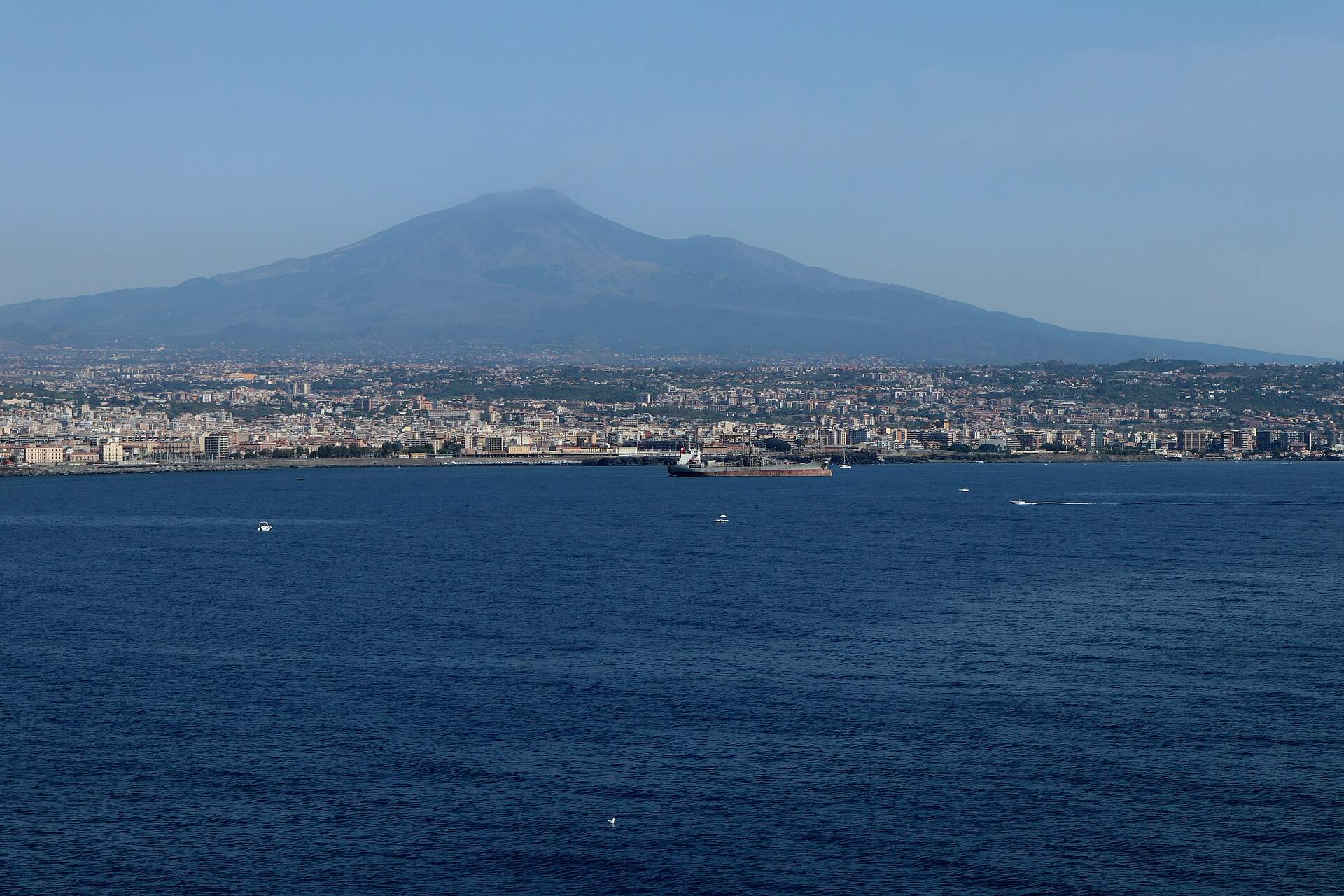
Catania, Sicily’s second-largest city, sits on the Ionian Sea at the foot of Mount Etna — Europe’s tallest active volcano at 3,357 metres. Rebuilt in baroque style after the devastating 1693 earthquake, its historic centre earned UNESCO World Heritage status and is unlike anywhere else in Italy: black lava stone meets white limestone in a city that feels authentically gritty, unpolished, and full of life. As locals who live here, we put together this Catania tourism guide to help you plan a visit that goes beyond the obvious — from what to see and eat to how to get around without a car.
Planning a full trip rather than a city break? Our Catania holiday guide covers itinerary length, UK flights, where to stay and the day-trip radius around the city.
Catania at a Glance
Catania is a compact, walkable city with an international airport, mild winters, and a cost of living well below northern Italy. Most visitors spend 2–3 days here, though the city works brilliantly as a base for exploring eastern Sicily for a week or more. Here are the essential numbers.
| Detail | Info |
|---|---|
| Population | ~311,000 (metro ~750,000) |
| Language | Italian (Sicilian dialect widely spoken) |
| Currency | Euro (€) |
| Time zone | CET (UTC+1) / CEST (UTC+2 summer) |
| Airport | Catania-Fontanarossa (CTA), 7 km from centre |
| Best months | April–June, September–October |
| Average temp (summer) | 28–33 °C |
| Average temp (winter) | 10–15 °C |
| Sea temperature (Jul–Sep) | 25–27 °C |
What Is Catania Best Known For?
Catania is best known for its UNESCO-listed baroque architecture built from volcanic lava stone, the monumental Piazza del Duomo with the iconic Elephant Fountain, and its proximity to Mount Etna. The city was almost entirely destroyed by the 1693 earthquake and rebuilt in a distinctive black-and-white baroque style — basalt stone from Etna paired with pale limestone — that earned the historic centre a place on the UNESCO World Heritage list as part of the Late Baroque Towns of the Val di Noto.
Beyond architecture, Catania is famous for La Pescheria, the chaotic open-air fish market that spills out behind the cathedral every morning except Sunday. The city gave the world composer Vincenzo Bellini (1801–1835), whose name graces the opera house, a park, a pasta dish, and even a type of pizza. Street food here is its own religion: arancini (fried rice balls), pasta alla Norma (aubergine, tomato, ricotta salata), and granita con brioche for breakfast are experiences no guide should leave out. For a deeper look at sights, see our guide to Catania’s must-see attractions.

Xaby · CC BY-SA 4.0
What Is Catania Like for Tourists?
Catania feels like the opposite of a tourist trap — it is a loud, authentic, working city where most visitors are Italian and Catania Italy tourism is still catching up to Palermo or Taormina. The centre is compact enough to walk everywhere: Piazza del Duomo to Villa Bellini is about 15 minutes on foot along Via Etnea, the main shopping street. You will not find souvenir shops on every corner. Instead, expect fruit vendors shouting prices, motorini weaving through pedestrian zones, and espresso that costs €1 at the bar.
The city is grittier than the polished image of Sicily you see in travel magazines. Walls are sometimes tagged, pavements uneven, and traffic unapologetic. That rawness is exactly what many visitors love about it — Catania has soul, a youthful energy fuelled by one of the largest universities in southern Italy (founded 1434), and an esoteric nightlife concentrated around Via Gemmellaro and Piazza Teatro Massimo. If you want a curated, sanitised Italy, Catania is not that. If you want the real thing, it absolutely is.

Panek · CC BY-SA 4.0
Best Time to Visit Catania
The best time to visit Catania is April to June or September to October, when temperatures sit between 18 °C and 28 °C, crowds are thin, and hotel prices drop 20–40% compared to peak summer. July and August bring scorching heat (often above 35 °C), packed beaches, and higher prices. Winter is mild — rarely below 8 °C — but some beach facilities close and rain is more frequent.
| Season | Months | Temp range | Crowds | Price level |
|---|---|---|---|---|
| Spring (shoulder) | Apr–Jun | 18–28 °C | Low–moderate | €€ |
| Summer (peak) | Jul–Aug | 28–35 °C | High | €€€ |
| Autumn (shoulder) | Sep–Oct | 20–28 °C | Moderate | €€ |
| Winter (low) | Nov–Mar | 8–16 °C | Low | € |
For a detailed look at what an autumn visit looks like, check our guide to visiting Sicily in October.
How to Get to Catania
Catania-Fontanarossa Airport (CTA) is Sicily’s busiest, handling over 10 million passengers per year with direct flights from most European capitals, making the city one of the easiest in southern Italy to reach.
By air
Fontanarossa Airport sits just 7 km south of the city centre. The Alibus shuttle runs every 25 minutes to Catania Centrale train station and Piazza Stesicoro (tickets €4, journey ~20 min). Taxis are fixed-rate at approximately €25 to the centre. For connections onward to Taormina, see our Catania airport to Taormina transfer guide.
By train
Catania Centrale is on the Trenitalia and Italo long-distance network. Direct trains run from Palermo (~3 h), Syracuse (~1 h 10 min), and Messina (~1 h 30 min). High-speed service from mainland Italy requires a change at Messina or Villa San Giovanni.
By ferry
Grimaldi Lines operates overnight ferries from Salerno and Civitavecchia (near Rome) to Catania port, roughly 12–14 hours. A convenient option if you are bringing a car.
Getting Around the City
The historic centre of Catania is best explored on foot — the main sights sit within a 1.5 km radius of Piazza del Duomo, and walking is by far the fastest way to get between them. For longer trips, the AMT public bus network covers the entire city (single ticket €1, 90-minute validity). A single metro line (Ferrovia Circumetnea, FCE) connects the northern suburbs to the centre at Stesicoro, useful for reaching Villa Bellini from the outskirts.
We do not recommend renting a car for the city itself. Catania has an active ZTL (limited traffic zone) in the centre enforced by cameras, blue-stripe paid parking that fills quickly, and local driving habits that are, let us say, expressive. If you do arrive by car, see our guide to parking in Catania for the best options. For day trips to Etna, Taormina, or the Val di Noto, a rental or organised tour is practical.

Cosal · CC BY-SA 4.0
Top 10 Things to See in Catania
From baroque piazzas and a working fish market to Roman ruins hidden underground, Catania packs more history and character per square kilometre than almost any city in Sicily. Here are the 10 sights we always recommend to first-time visitors. For an action-led overview with one-hour routes and half-day plans, see our things to do in Catania (full guide).
- Piazza del Duomo & Fontana dell’Elefante — The heart of the city. The elephant carved from lava stone (u Liotru) has been Catania’s symbol since the 18th century. Walking guide stop A →
- La Pescheria (Fish Market) — Open every morning except Sunday behind the cathedral. Arrive before 10:00 for the full theatre of vendors, seafood, and colour. More →
- Via Crociferi — A 300-metre baroque street lined with churches and monasteries, considered one of the finest in Sicily. Walking guide stop E →
- Monastero dei Benedettini di San Nicolò l’Arena — One of the largest Benedictine monasteries in Europe and a UNESCO site. The cloister and rooftop terrace are worth the €10 entry. Walking guide stop G →
- Castello Ursino — A 13th-century fortress built by Emperor Frederick II, now housing the Museo Civico. Entry ~€8. Walking guide stop C →
- Teatro Massimo Bellini — Catania’s 1,200-seat opera house, inaugurated in 1890. Guided tours run on most mornings; evening performances from October to June. Walking guide stop F →
- Villa Bellini — A 6-hectare public garden on a hillside with panoramic views over the city and Mount Etna. Free entry. Walking guide stop J →
- Anfiteatro Romano (Piazza Stesicoro) — The remains of a 2nd-century Roman amphitheatre, partially visible below street level in the middle of the city. Free. Walking guide stop I →
- Via Etnea — Catania’s main street, running straight from Piazza del Duomo towards Etna. Lined with shops, cafés, Liberty-style buildings, and the best views of the volcano at sunset.
- Mount Etna (day trip) — Europe’s most active volcano is just 1 hour from the centre. You can reach Rifugio Sapienza (1,900 m) by car or bus, then take the cable car + 4×4 to the crater zone (~3,300 m). Budget €60–90 for cable car + guide. More →
For a complete sight-by-sight walking route, see our Catania Old Town walking guide. For all activities including tours, markets, and day trips, check things to do in Catania.

Urban · CC BY-SA 3.0
Catania Food Essentials
Catania’s food scene is one of the most vibrant in Sicily, built around street markets, volcanic-soil produce, and a culture where breakfast means granita with brioche — not toast. Here is what to eat and roughly what to budget. For travellers planning a food-led trip we’ve broken down the Bib Gourmand and trattoria picks for Catania — one Michelin star, four Bib Gourmand, plus the family-run trattorias locals actually book.
Arancini (€1.50–3) — Fried rice balls stuffed with ragù, or butter and ham, or spinach. Every bar, bakery, and corner shop has them. In Catania, the correct name is arancino (masculine), never arancina as in Palermo — locals take this seriously.
Pasta alla Norma (€8–12 in a trattoria) — Catania’s signature dish: penne or rigatoni with fried aubergine, tomato sauce, and a snowfall of ricotta salata. Named after Bellini’s opera Norma.
Granita con brioche (€3–5) — The Sicilian breakfast, especially in summer. Almond, pistachio, or mulberry granita scooped into a warm brioche bun. Try it at any bar before 10:00.
Pesce fresco — Walk through La Pescheria and then eat at one of the small trattorias surrounding it. Expect to pay €12–20 for a seafood primo. The freshness is guaranteed by the market two metres away.
Catanese pizza (scacciata, pizzolo) — Less famous than Neapolitan pizza but just as good. The local variant is thicker, often stuffed, and baked in wood-fired ovens.

Andy Li · CC0
Is Catania Safe for Tourists?
Catania is generally safe for tourists, with the same precautions you would take in any large Mediterranean city — watch for pickpockets in crowded areas, keep valuables close, and stay aware at night. The historic centre, Via Etnea, and the areas around Piazza del Duomo and Villa Bellini are well-lit and busy until late. San Berillo and some streets behind the train station can feel rough after dark — use normal caution.
Violent crime against tourists is extremely rare. The most common issues are petty theft in crowded places (markets, buses) and aggressive driving. A cross-body bag and common sense go a long way. The local emergency number is 112 (EU-wide). Pharmacies are marked with a green cross and rotate 24-hour shifts. For the deep dive see our is Catania safe guide.
Is Catania Too Touristy?
No — Catania is one of the least touristy major cities in Sicily, and that is precisely part of its appeal. While nearby Taormina can feel overwhelmed by cruise-ship passengers in summer, and Palermo has firmly entered the mainstream travel circuit, Catania remains a city where locals far outnumber tourists in most neighbourhoods. You can eat at the fish market without a queue, walk Via Crociferi without dodging selfie sticks, and find a seat at any café on Via Etnea at any time of year.
Sicily as a whole has seen debates about overtourism — particularly in Taormina, the Aeolian Islands, and Scala dei Turchi near Agrigento. Catania, however, has been largely unaffected. The city’s infrastructure (airport, train station, port) makes it a natural gateway, but most visitors pass through rather than stay. That is changing slowly, and it is one reason we think visiting now, while the city still feels authentic and unpackaged, is a smart move. For a fuller breakdown of whether Catania is worth visiting, see our verdict on the pros, cons and who should skip it.

Eleassar · CC BY-SA 4.0
Which City Is Nicer, Palermo or Catania?
Neither city is objectively “nicer” — Palermo is grander and more monumental, while Catania is more compact, younger in energy, and better positioned for eastern Sicily day trips including Mount Etna, Taormina, and the Val di Noto. The choice depends on what kind of trip you want. Here is a head-to-head comparison.
| Category | Catania | Palermo |
|---|---|---|
| Architecture | Baroque, lava-stone, UNESCO Val di Noto | Arab-Norman, mosaic-heavy, UNESCO |
| Food highlight | Arancini, Norma, Pescheria fish market | Street food: panelle, sfincione, stigghiola |
| Nightlife | Stronger: university city, Via Gemmellaro, clubs | Good but more spread out |
| Beaches | La Plaja (city), Aci Trezza (20 min) | Mondello (30 min by bus) |
| Day trips | Etna, Taormina, Syracuse, Val di Noto | Cefalù, Monreale, Segesta, Erice |
| Airport connections | More low-cost flights to/from Europe | Good, slightly fewer routes |
If you have 10 days or more, the ideal plan is to split your time: start in Catania to explore the east, then move to Palermo for the west. For a shorter trip of 3–5 days, pick the coast that suits your priorities. Our 7-day Sicily itinerary covers both.

Castielli · CC BY-SA 3.0
Where to Stay in Catania
Catania is the perfect base for exploring eastern Sicily. The historic centre puts you within walking distance of every major sight, the fish market, and the best restaurants — and just a short bus ride from the airport or the road to Etna. Whether you are here for a city break weekend or a full week with day trips, staying central makes everything easier.
We rent apartments in Catania right in the heart of the old town, ideal for couples, families, and anyone who wants to live the city like a local rather than pass through it like a tourist.
The information in this guide was correct at the time of writing. Data can change from season to season without notice: before you travel, always check the official channels and websites for updates. We review this guide periodically, but the official channels are always the authoritative source. We also cannot guarantee that the suggested routes or the attractions described are always reachable or accessible: roads, trails and sites may be closed, damaged, altered or unsafe. Assessing the practicability and safety of itineraries and attractions always remains your own responsibility.