
Catania’s old town is a compact 1 km² of UNESCO-listed Baroque architecture rebuilt after the 1693 earthquake, where black lava stone from Mount Etna meets white limestone across grand piazzas and four-church streets. It is walkable end to end in 2-3 hours, opera-quiet at dawn and market-loud by 10 am. We live in Catania, and this is the route we walk with first-time visitors: ten stops from Piazza del Duomo to the Roman Amphitheatre, with exact distances, honest timings and the small detours locals actually take. For the full story of Catania’s location, 2,700-year timeline and how to reach the city, read our Where is Catania introduction; for a full action-led overview, see our guide on things to do in Catania.
Is there an old town in Catania?
Yes. Catania’s old town is the UNESCO-listed Baroque historic centre rebuilt after the 1693 earthquake, roughly 1 km² around Piazza del Duomo and walkable in 2-3 hours. Locals call it centro storico; English guides usually translate it as old town, historic centre or city centre, and all three refer to the same compact grid bounded by Piazza del Duomo to the south, Piazza Stesicoro to the north, Castello Ursino to the west and the Ionian seafront to the east.
Four features set it apart from the newer city that spread across the plain in the 19th and 20th centuries:
- UNESCO Val di Noto inscription (2002) — Catania shares the recognition with Noto, Modica, Ragusa Ibla, Caltagirone, Militello Val di Catania, Palazzolo Acreide and Scicli, all rebuilt in late Sicilian Baroque after 1693.
- Black lava-stone architecture — palazzi, churches and paving all use basalt quarried from past Etna eruptions, giving the city the nickname città nera (Black City).
- Two monumental spines — Via Etnea runs roughly 1 km north-south through the old town toward Etna; Via dei Crociferi crosses east-west with four Baroque churches in 200 metres.
- A single walking loop — the ten must-see sights cluster tight enough for a single 2-3 hour route on foot, no transport needed.
What is the nicest part of Catania?
The nicest part of Catania is the UNESCO old town around Piazza del Duomo and Via dei Crociferi, where black lava stone meets baroque limestone in a compact walking zone. If you only have half a day, these three micro-areas repay every minute:
- Piazza del Duomo & La Pescheria — the baroque square with the Fontana dell’Elefante (1736, by Giovanni Battista Vaccarini) and, one staircase below, Catania’s 700-year-old fish market opening at 7 am on weekday mornings.
- Via dei Crociferi — a 200-metre stretch with four Baroque churches, one religious college and three former monasteries, plus the ceremonial Arco di San Benedetto crossing the street.
- Via Etnea & Villa Bellini — the main shopping artery, framed by Etna in the distance on clear days, ending at the 1883 public gardens dedicated to Vincenzo Bellini.
If you have time for a fourth layer, add the Monastero dei Benedettini di San Nicolò on the western edge: it is the second-largest monastery in Europe, now part of the University of Catania, and its two cloisters are among the quietest spaces inside the old town.
Catania’s baroque history in 90 seconds
Catania has been reinvented three times by forces that destroyed it: Greek colonists, Roman administrators, and — above all — Mount Etna and the 1693 earthquake. The old town you walk today is the third city on the same site.
Greek and Roman foundations (8th century BC – 5th century AD)
Greeks from Chalcis founded Katane around 729 BC. Romans took it in 263 BC and built an amphitheatre for roughly 15,000 spectators, whose curve is still visible at ground level in Piazza Stesicoro. Layers from both periods survive beneath later streets — the Terme Achilliane, a 3rd-century Roman bath complex of about 1,600 m², sits directly under Piazza del Duomo.
Volcanic interruption (1669)
The largest Mount Etna eruption in recorded history sent lava through the western edge of the city in 1669, burying Castello Ursino’s original moat and extending the coastline by nearly two kilometres. The town rebuilt. Twenty-four years later it had to start over.
The 1693 earthquake and the Baroque rebuild
On 11 January 1693 a magnitude-7.4 earthquake levelled most of south-east Sicily. Catania’s death toll ran into the tens of thousands. The reconstruction, led by architects Giovanni Battista Vaccarini, Alonzo Di Benedetto and Francesco Battaglia, followed a grid of wide, straight streets designed to release seismic shock — the first intentional earthquake-resistant urban plan in Italy. The result was the late Sicilian Baroque recognised by UNESCO in 2002 as part of the Val di Noto World Heritage serial site.
The walking route at a glance
Ten stops, roughly 3 km end to end, no backtracking. Start at Piazza del Duomo (nearest to Catania Centrale station and the Alibus airport bus), finish at Villa Bellini two blocks off Via Etnea. Allow 2-3 hours on foot; add two more for interior visits to Castello Ursino and the Benedettini cloisters.
| Scenario | Time | Stops covered | Best for |
|---|---|---|---|
| Evening loop | 1.5 h | Piazza Duomo → Via Etnea → Via Crociferi → Teatro Bellini (exteriors only) | Arrival evenings; lava-stone glows gold at sunset |
| Half-day walk | 3 h | Stops A-F + 10 (skip Benedettini interiors and Stesicoro) | Cruise days, layover travellers |
| Full day | 6 h | All 10 stops + museum of Castello Ursino + Benedettini guided tour | First-timers with a single day in the city |
| Weekend | 2 days | Full walking loop + La Pescheria at 8 am + opera at Teatro Bellini | Couples and culture travellers |
Catania old town map (walking route)
The interactive map below numbers the ten stops in walking order with approximate distances between each, plus a second layer with four car parks for drivers arriving from outside the ZTL. Click any pin for opening hours and a one-line tip.
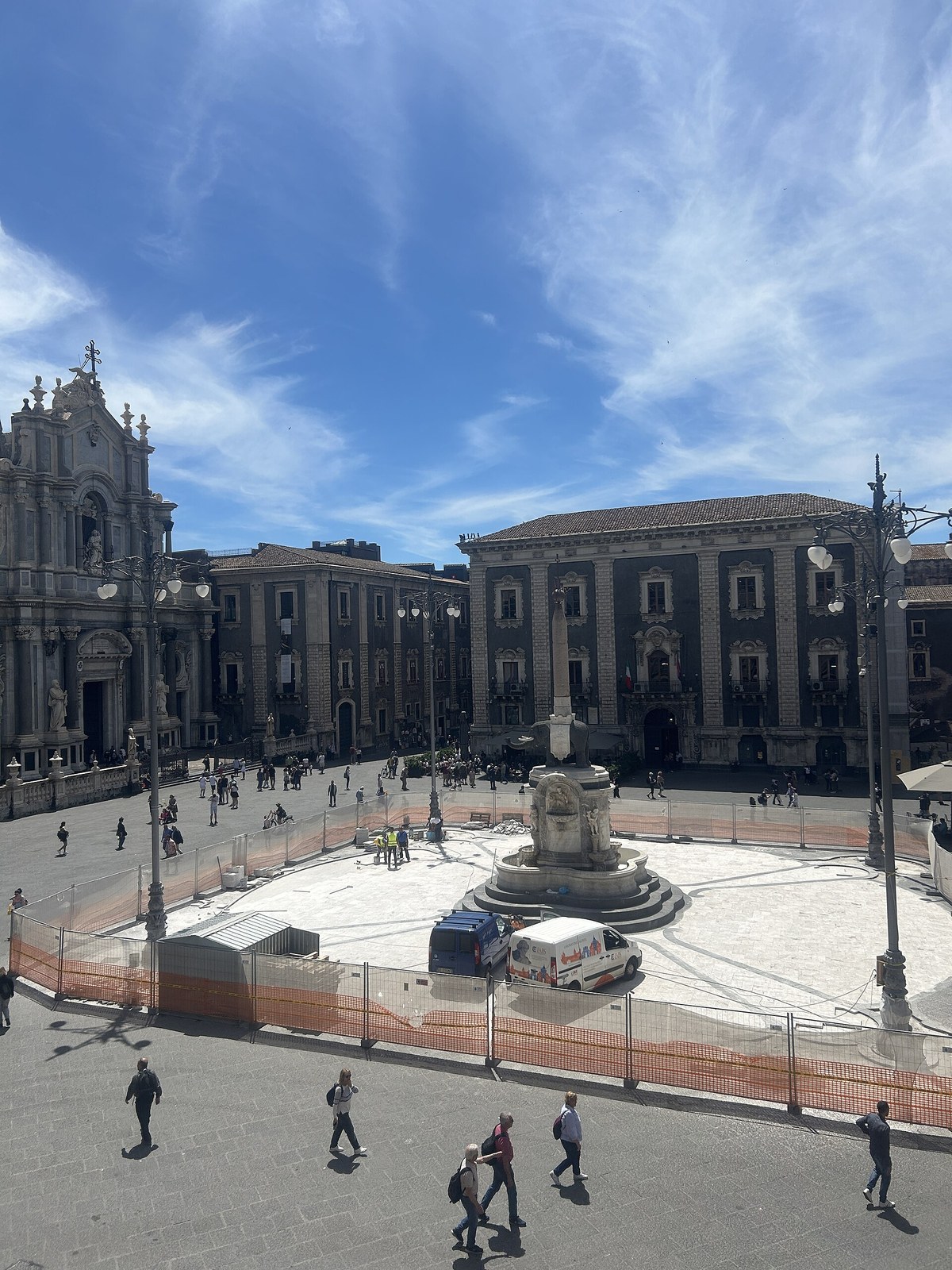
Stop A — Piazza del Duomo: the baroque heart
GiovanniPen · CC BY-SA 4.0
- Location
- Piazza del Duomo, Catania Maps
- Essential fact
- the cathedral stands on Roman baths (Terme Achilliane) still partially visible through a grate in the square. → 50 m down the steps behind the Amenano fountain to Stop B.
- Price
- Free
You start where every Catanian and every guidebook start: the square Vaccarini designed as the city’s baroque living room after 1693. Three landmarks face each other across a diagonal piece of paving so sloped it drains rain in minutes.
Cattedrale di Sant’Agata
The cathedral is dedicated to Catania’s patron saint, martyred in 251 AD and celebrated every 3-5 February with a procession that draws over a million people. The building was founded in 1078 by Count Roger the Norman on the ruins of Roman baths, collapsed in 1693, and rebuilt by Vaccarini with the façade of white limestone and black lava stone you see today. Inside: Bellini’s tomb (the composer is buried in his home town), a Norman apse, and the chapel of Sant’Agata with the silver reliquary bust paraded during the festival.
Fontana dell’Elefante (the Liotru)
The elephant in the middle of the square is Roman — carved from black lava stone in the late imperial period — topped with an Egyptian obelisk and framed by Vaccarini in 1736. Catanians call it the Liotru (a local corruption of Eliodoro, a medieval wizard said to ride the statue) and it is the city’s heraldic symbol, the Sicilian equivalent of Rome’s she-wolf.
Palazzo degli Elefanti
The yellow-and-grey palazzo on the north side is the city hall. You cannot go inside without an appointment, but the porch shelters a 17th-century Senate carriage visible through a glass door — ask the security guard politely and they will usually let you glance in.
Stop B — La Pescheria: the fish market beneath the square
Effems · CC0
- Location
- Piazza Alonzo di Benedetto, Catania Maps
- Essential fact
- the underground Amenano river runs beneath the whole market and surfaces at the fountain — you can see it from the grate beside the Piazza Duomo steps. → 150 m south-west to Castello Ursino through Via Auteri.
- Price
- Free
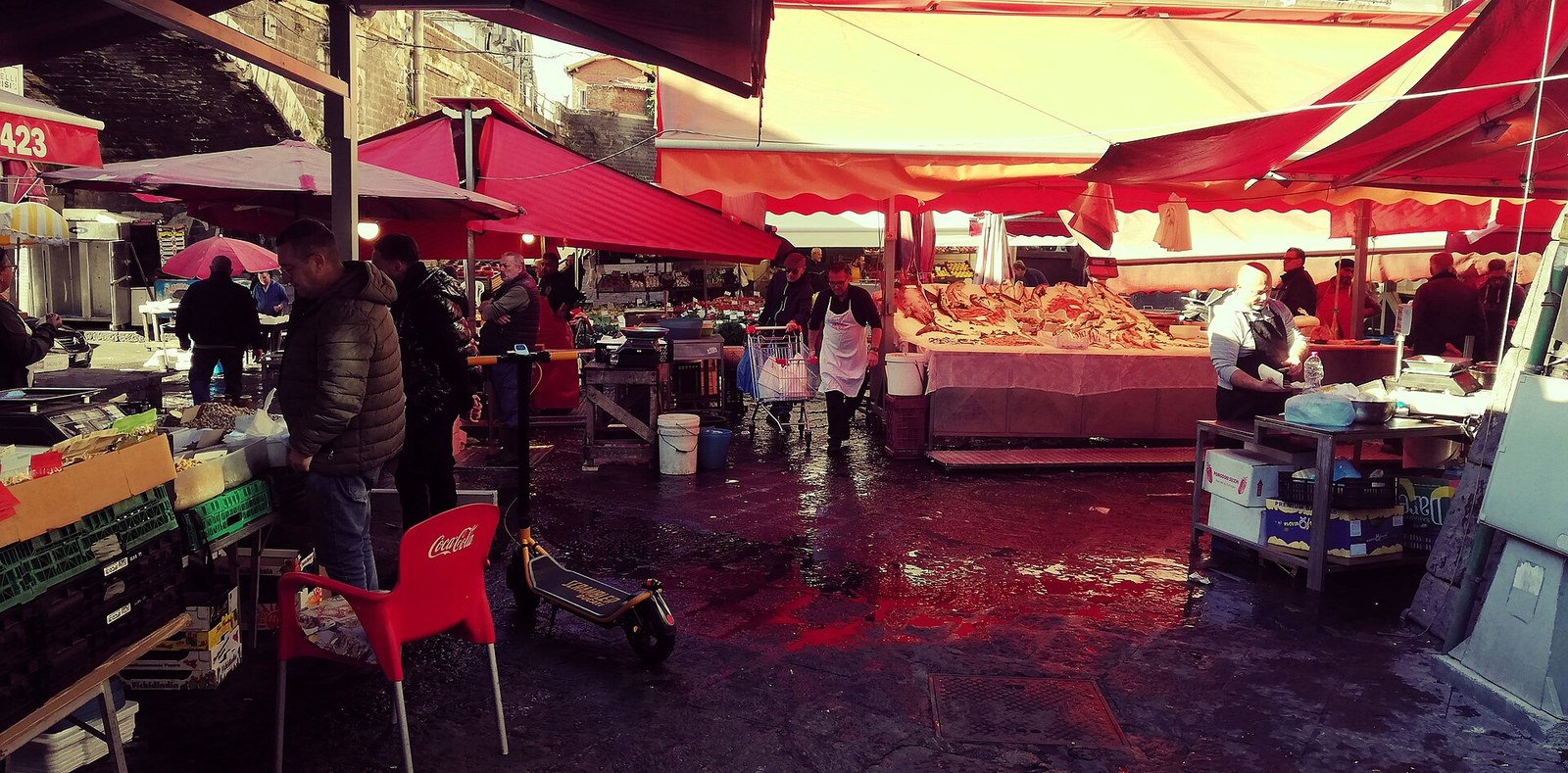
Down a flight of steps at the rear of Piazza del Duomo, past the Amenano fountain (the one bit of the old Roman river still visible in open air), you find one of Italy’s loudest and oldest fish markets. La Pescheria has operated from this site since at least the 14th century. The current stalls spread under a semi-ruined arch and spill into Piazza di Alonzo Di Benedetto. Three sit-down spots and one stand-up fish counter sit inside a five-minute walk — the full shortlist of where to eat near the Pescheria is on a separate page.
Even if you are not buying swordfish, the market is a half-hour of pure theatre: vendors shouting the day’s catch in Catanese dialect, knives thudding on wood, crates of red prawns from the Gulf of Catania on ice. Arrive before 10 am for peak action; by midday stalls pack up. For a full opening-times walkthrough, the Sunday-closure question, photo etiquette and the Stanley Tucci backstory, see our deep guide to the Catania fish market.
Stop C — Castello Ursino: Frederick II’s black fortress
Cayambe · CC BY-SA 4.0
- Location
- Piazza Federico di Svevia 21, Catania Maps
- Essential fact
- the castle survived the 1693 earthquake nearly intact — the thickness of the walls (4 m at the base) is the only reason. → 400 m north-east back up to Via Etnea through Via Garibaldi and Piazza Mazzini.
- Price
- €10 (museum)
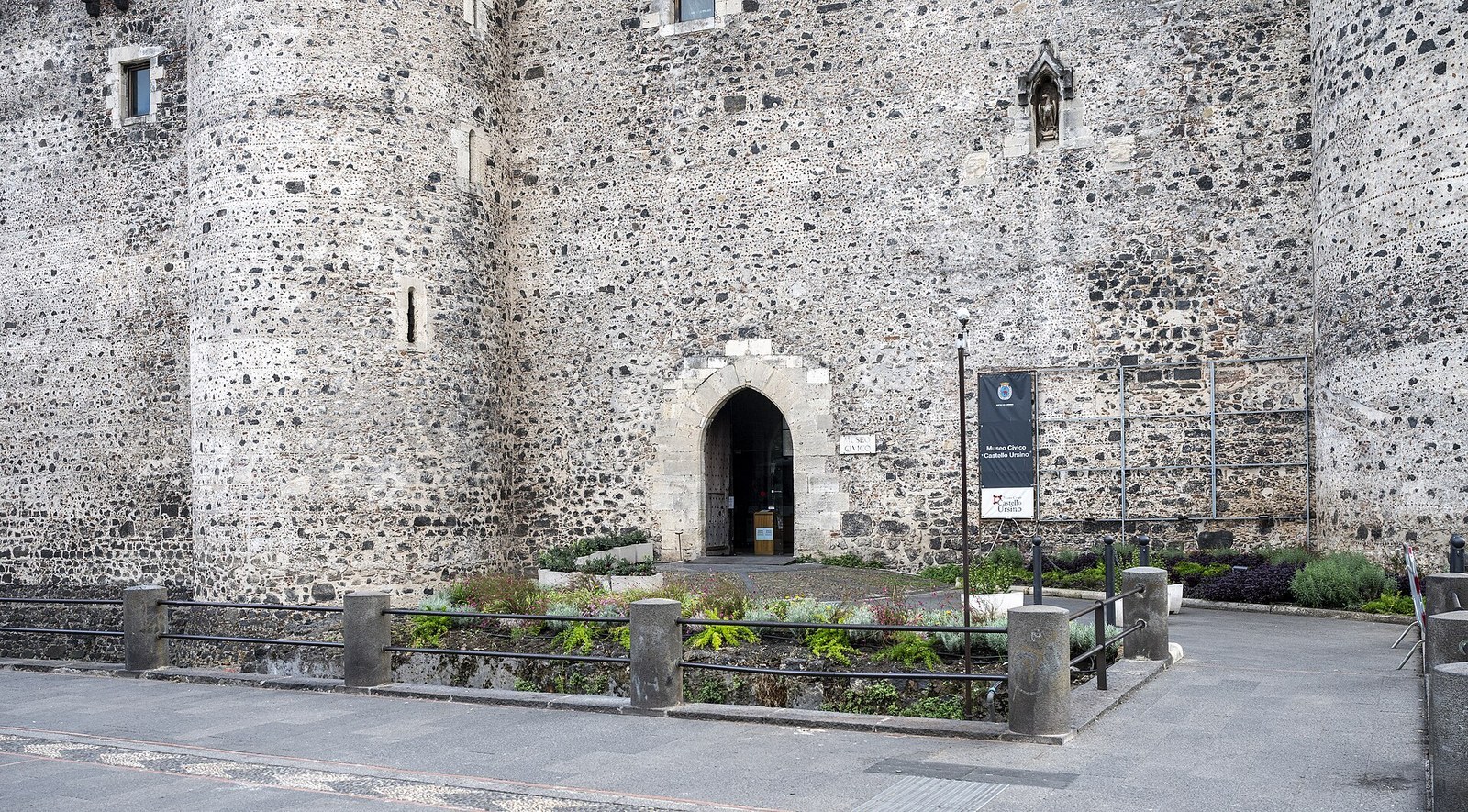
A square of black lava stone with four round corner towers, the castle was built between 1239 and 1250 for Frederick II of Swabia as part of the imperial defence line along the Sicilian coast. Originally it stood right on the seafront; the 1669 eruption buried the moat and pushed the shoreline nearly 2 km east, which is why the castle now sits inland.
Today it houses the Museo Civico: Greek and Roman statuary, medieval ceramics, a decent collection of 17th-century Sicilian painting and — incongruously — a few Etruscan pieces. The courtyard alone is worth the ticket; the black stone walls against the sky are photogenic at any hour.
On the northern edge of Piazza Federico di Svevia, two churches close off the view from the castle gate: the Chiesa di San Sebastiano and, one block further up Via Castello Ursino, Santa Chiara. For history, opening notes and walking distances, see our guide to the churches near Castello Ursino.
Stop D — Via Etnea & Piazza Università: the baroque spine
Jeanne Griffin · CC BY-SA 4.0
- Location
- Via Etnea, Catania Maps
- Essential fact
- the university is the second-oldest in Sicily, founded in 1434. → 100 m east, turn right into Via dei Crociferi.
- Price
- Free
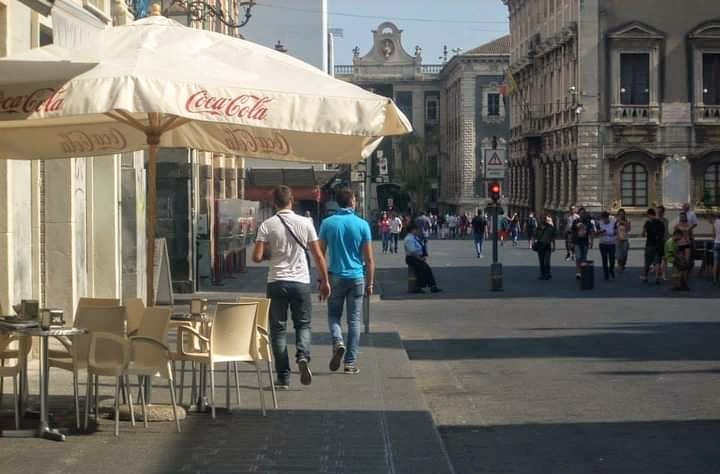
Back at ground level you join Catania’s main thoroughfare. Via Etnea runs roughly 3 km from Piazza del Duomo up to the Borgo district; the old-town segment is the first 1 km, largely pedestrianised, and on clear days ends in a perfect framing of Mount Etna smoking quietly in the distance.
The first block delivers three Baroque palazzi around Piazza Università: the main Palazzo dell’Università (18th century, with a courtyard whose cloister is one of the city’s most elegant quiet spaces), Palazzo San Giuliano opposite, and the Collegiata church — a small jewel by Angelo Italia with a concave façade that bends the street.
Shopping, arancini and the Etna view
Further up Via Etnea you pass Catania’s big-name stores and the city’s best arancini bars (look for the ones with queues of locals, not tourists). At the crossroad with Via Antonino di Sangiuliano, stop and look back south: you see the cathedral façade; look north and, when the weather allows, Etna. Catanians navigate by this sightline every day.
Stop E — Via dei Crociferi: four churches in 200 metres
The original uploader was Triquetra at Italian Wikipedia. · CC BY-SA 2.5
- Location
- Via Crociferi, Catania Maps
- Essential fact
- the Arco di San Benedetto was built in four nights to let nuns cross without touching public ground — a papal dispensation from 1704. → 200 m north-east to Teatro Massimo Bellini through Via Teatro Massimo.
- Price
- Free
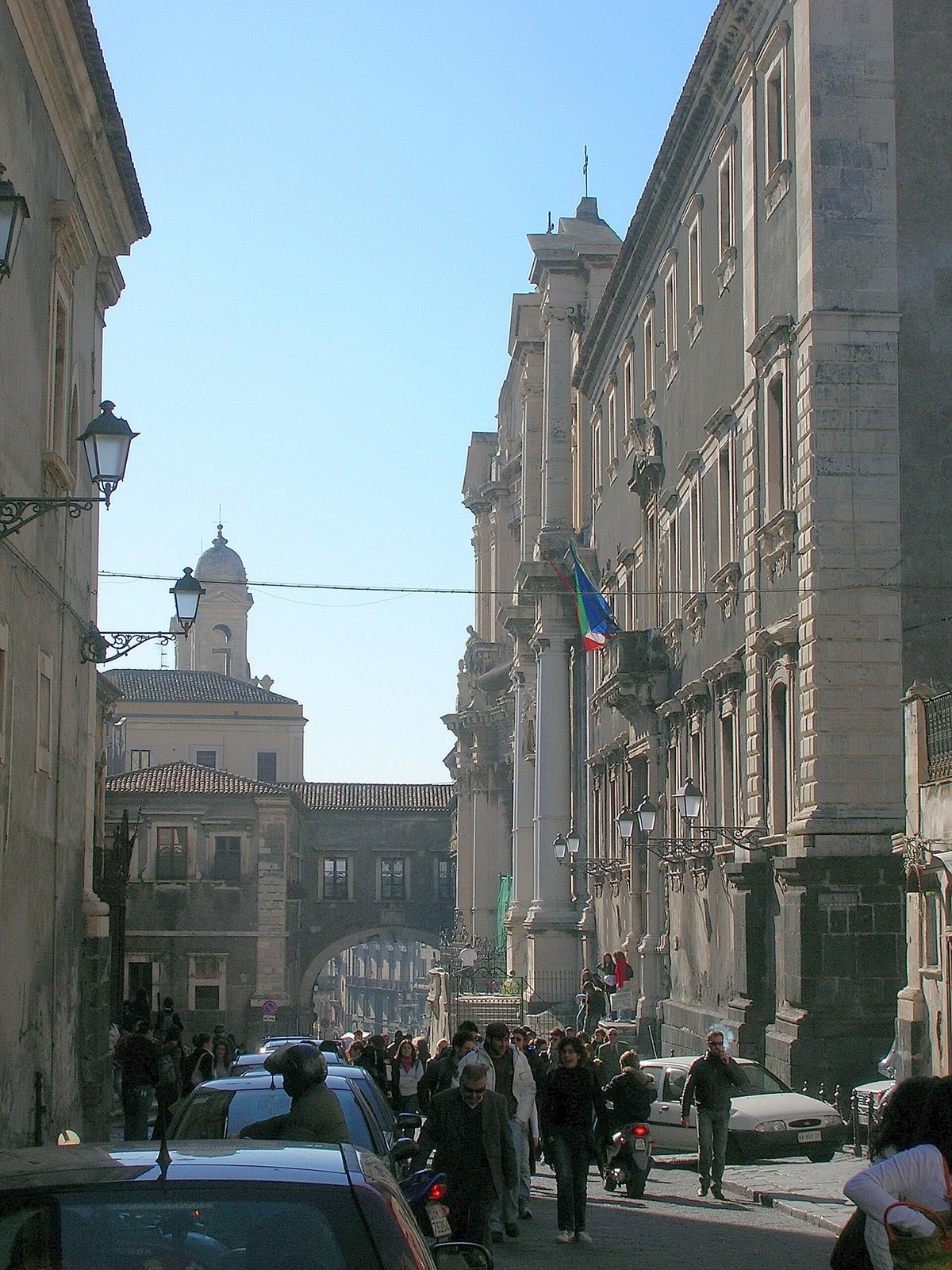
The densest baroque street in Sicily. Five hundred metres of processional road with four churches, one religious college and three former monasteries, begun after 1693 and finished by Vaccarini and Stefano Ittar. An 18th-century ceremonial arch, the Arco di San Benedetto, crosses the street at ankle-snapping pace, built in only four nights in 1704 to connect the monastery on one side to the church on the other.
The four churches in walking order
- San Francesco Borgia — Jesuit façade by Angelo Italia, 1692, with a double staircase.
- San Benedetto — the monastery church, with a cloistered courtyard open to visitors on certain weekdays.
- San Giuliano — unfinished dome by Vaccarini; the one to look at from across the street for the full baroque effect.
- San Camillo — smaller, at the top of the street, with an 18th-century crypt.
The street is UNESCO-listed within the Val di Noto perimeter. Go on Sunday morning, before 11 am, to hear the bells from the three open churches overlap for about ninety seconds.
Stop F — Teatro Massimo Bellini: opera house in lava stone
Phyrexian · CC BY-SA 4.0
- Location
- Via Giuseppe Perrotta 12, Catania Maps
- Site
- teatromassimobellini.it
- Essential fact
- Bellini died at 33 in Paris and was reburied in Catania cathedral in 1876 — his tomb is the first chapel on the right of Stop A. → 600 m west to Monastero dei Benedettini through Via di Sangiuliano and Via Gesuiti.
- Price
- Free exterior — €8 guided tour
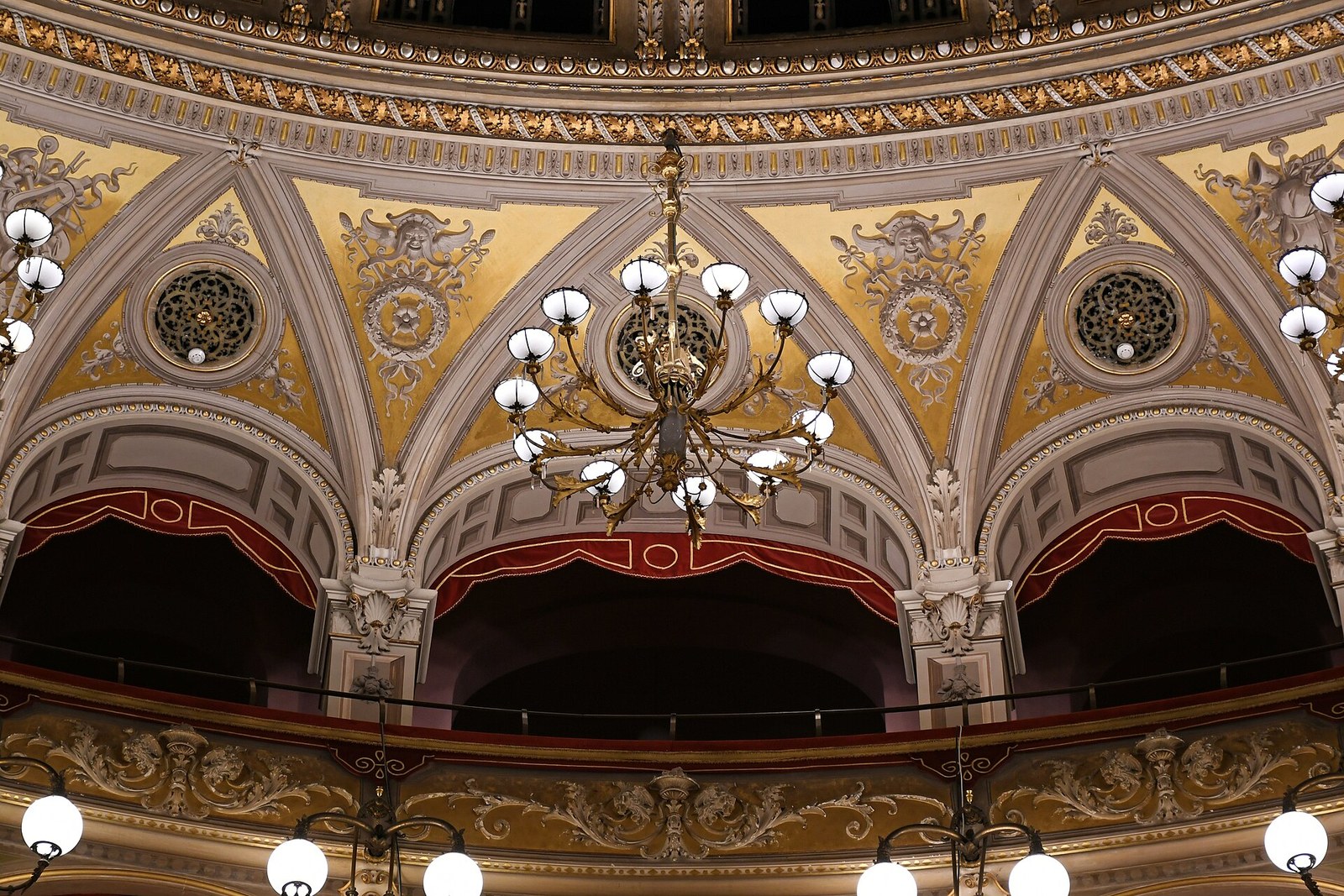
Named after Catania’s most famous son — Vincenzo Bellini, composer of Norma and La Sonnambula, born in the city on 3 November 1801 — the theatre opened on 31 May 1890 with a performance of his Norma. The façade is neoclassical rather than baroque, a century later than most of the old town, but the honey-coloured stone holds its own against the surrounding black basalt.
The 1,200-seat horseshoe auditorium inside is extravagant red and gold with a ceiling frescoed by Ernesto Bellandi. Guided tours run most mornings when no rehearsal is on (check the box office the day before); evening opera tickets start from about €15 in the loggione.
Stop G — Monastero dei Benedettini di San Nicolò: UNESCO monastery and university
Carmelovunque · CC0
- Location
- Piazza Dante Alighieri 32, Catania Maps
- Site
- monasterodeibenedettini.it
- Essential fact
- the 1669 lava flow stopped just outside the west wall — you can still see where it froze, now a garden bed. → 400 m south-east to the Teatro Greco-Romano through Via Teatro Greco.
- Price
- €10 (guided tour)
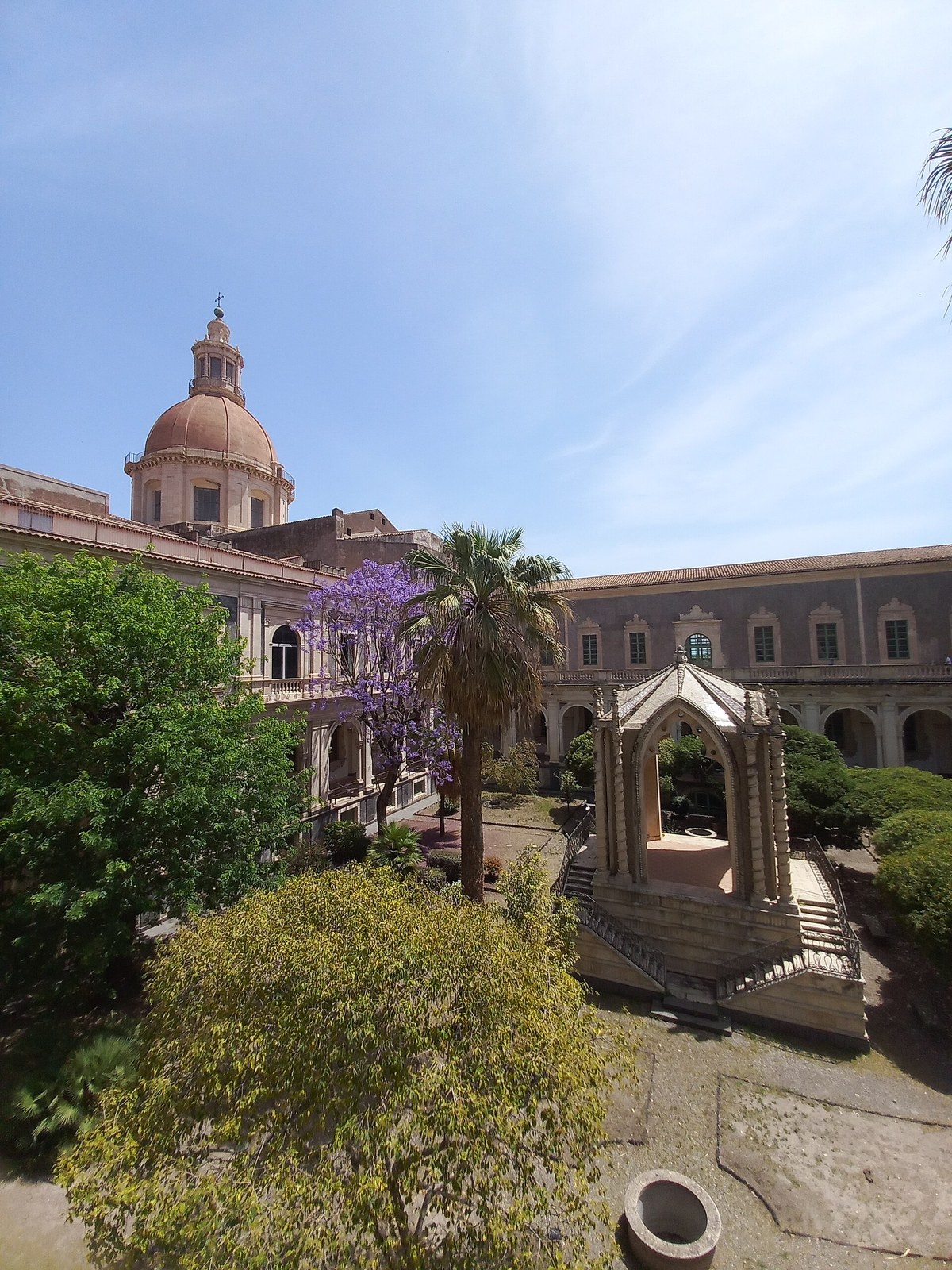
Second-largest monastery in Europe by footprint, UNESCO-listed as part of the Val di Noto since 2002, and now the home of the Humanities Department of the University of Catania. The complex covers nearly 22,000 m² and has survived lava, earthquake and wartime occupation almost intact.
The two cloisters
The west cloister (Chiostro di Levante) is the one you enter first: a green square with a seventeenth-century fountain at the centre, palm trees and jasmine, surrounded by an arched portico. The east cloister is austerer, with no garden; this is where the students study. Both are free to enter during university opening hours.
The guided tour (recommended)
The only way to see the refectory, the monks’ kitchen with its 18th-century oven, and the Biblioteche Riunite Civica e Ursino Recupero (75,000 volumes under painted vaults) is on a guided tour run by the non-profit Officine Culturali. Tours run Wednesday to Sunday, about €10, roughly an hour.
Stop H — Teatro Greco-Romano & Casa Verga
Cayambe · CC BY-SA 4.0
- Location
- Via Vittorio Emanuele II 266, Catania Maps
- Essential fact
- the theatre seats about 7,000 — half the size of the Anfiteatro at Stop I. → 350 m north-west back onto Via Etnea and up to Piazza Stesicoro.
- Price
- €6
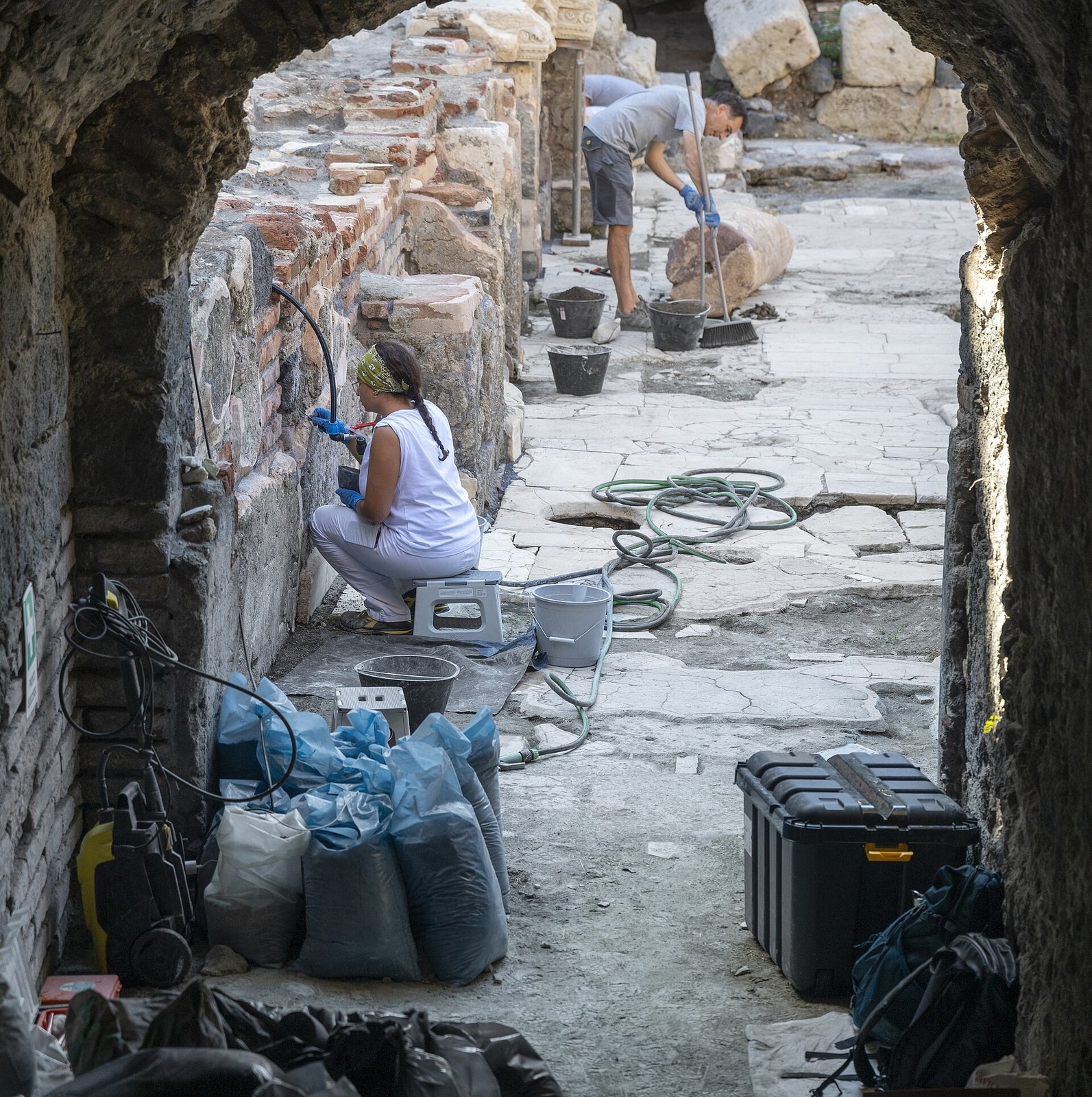
Tucked between apartment blocks on Via Vittorio Emanuele, the Greco-Roman theatre is a second-century AD Roman rebuild of a Greek original, partly excavated, with an underground cavea flooded by a tiny spring that once supplied the Terme Achilliane. You step down from street level and enter what used to be the orchestra — a bit of preserved marble flooring still visible.
Next door is Casa Museo Verga, the apartment where novelist Giovanni Verga (1840-1922) lived and wrote I Malavoglia. Five rooms of original furniture, manuscripts and photographs; entrance about €5.
Stop I — Anfiteatro Romano (Piazza Stesicoro)
Luca Aless · CC BY-SA 4.0
- Location
- Piazza Stesicoro, Catania Maps
- Site
- parchiarcheologici.regione.sicilia.it/catania-valle-aci/biglietti/anfiteatro-romano-catania
- Essential fact
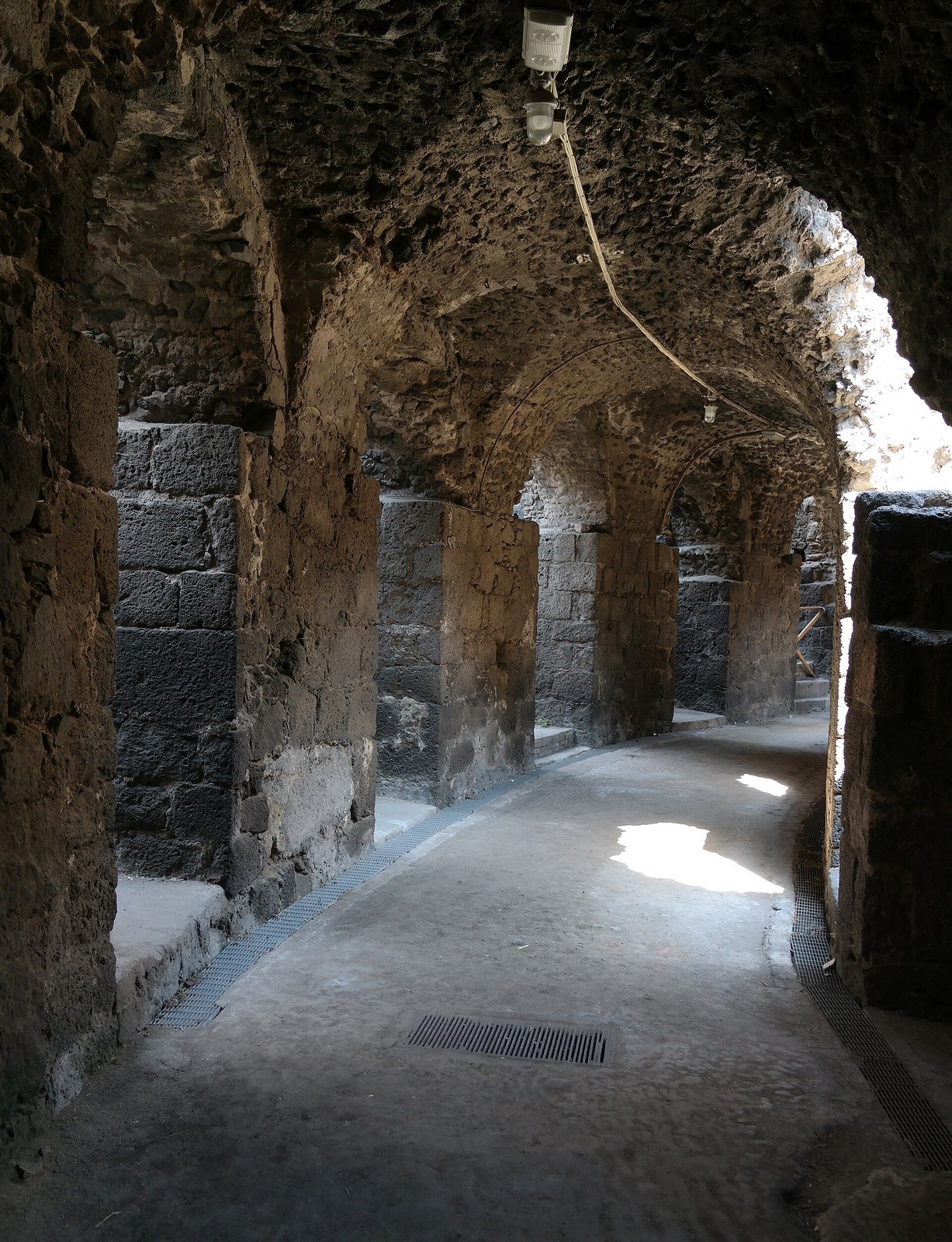
- the amphitheatre was dismantled in the 5th century AD to build the city walls; much of the Basilica della Collegiata (Stop D) is made of its recycled blocks. → 200 m south on Via Etnea to Villa Bellini gardens.
- Price
- Free
The Roman amphitheatre is one of the largest in Italy after the Colosseum and the Capua amphitheatre — excavations suggest an original capacity of about 15,000 spectators, built in the 2nd century AD under the Flavian emperors. Only a fraction has been excavated, the rest sleeping under the houses of Via Penninello and Via Neve, but the exposed curve in Piazza Stesicoro gives a clear sense of the scale.
You see it from street level — no ticket needed for the aerial view — with a short descent into the arena free of charge during opening hours.
Stop J — Villa Bellini gardens: a baroque breather
Cayambe · CC BY-SA 4.0
- Location
- Via Etnea 292, Catania Maps
- Essential fact
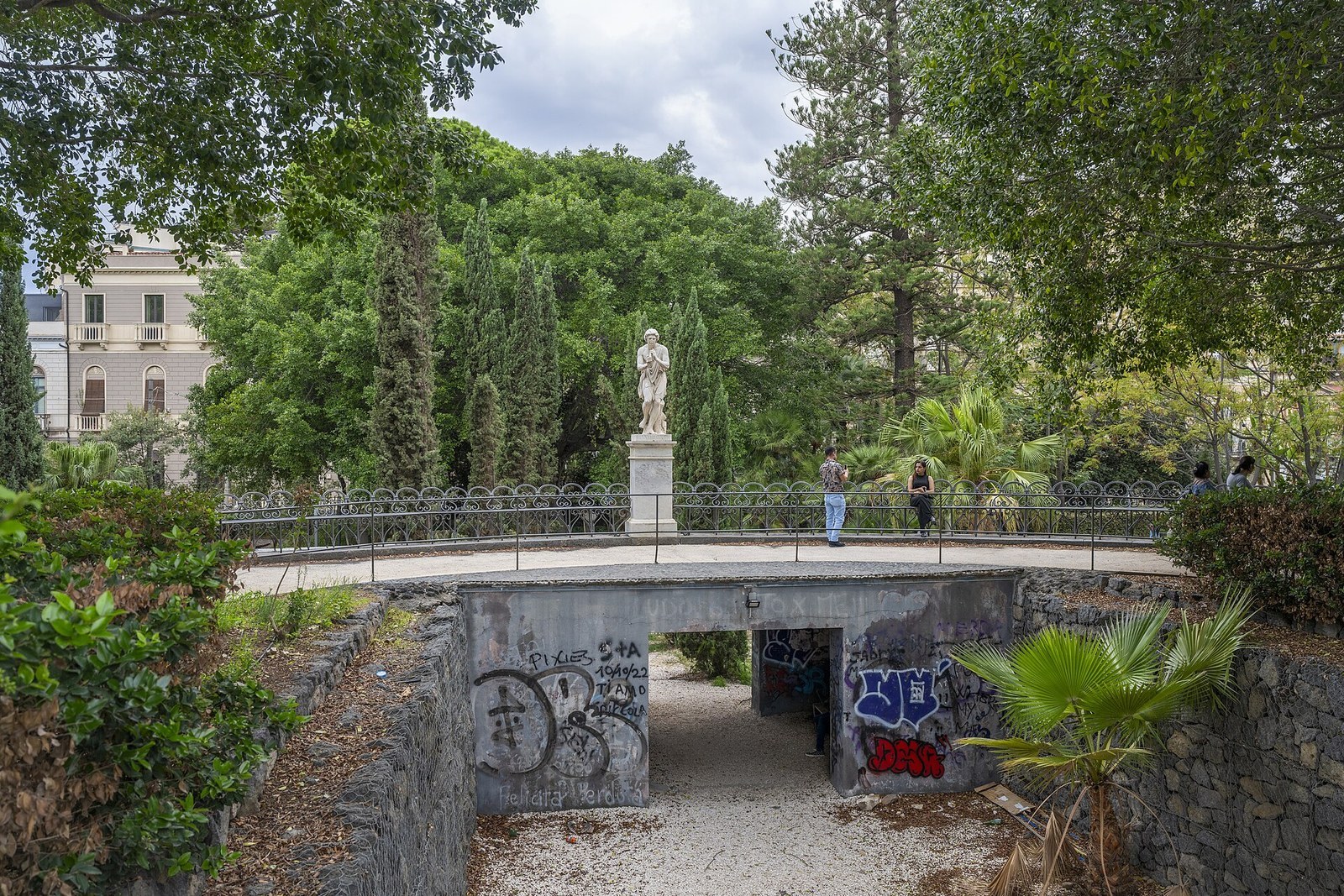
- the hill at the centre of the park is artificial — built from rubble cleared after the 1693 earthquake, one of the few uses the old city found for its own ruins.
- Price
- Free
Opened as a public garden in 1883 and dedicated to Bellini, the villa is the old town’s green lung: about 7 hectares of ficus trees, palms, fountains, a bandstand, and the flower clock that shows the date spelt out in bedding plants (refreshed every fortnight). Sit on a bench, drink water, finish your walk.
From here you can exit east onto Via Etnea and roll back down toward Piazza del Duomo, or west toward the Monastero dei Benedettini if you saved it for last. The loop is complete.
What to do in Catania in a day?
Walk the old town in the morning, stop for lunch at the fish market, and spend the afternoon on an activity that doesn’t fit the walking route: an Etna tour, a boat trip to Aci Trezza, or a cooking class. The walking route above covers the sights; the afternoon is where you layer experiences on top.
If you want the full activity catalogue (Etna tours, cooking classes, boat trips, street-food walks, Aci Trezza day-trip) see our complete things-to-do guide. If you prefer a by-category list of monuments, churches and museums (sorted by typology rather than walking sequence), our must-see catalogue groups the same old-town landmarks with three more sights beyond the historic centre.
Catania old town food stops (where locals eat)
We are not going to name specific restaurants — places change hands, standards drift, and Catania has enough solid neighbourhood kitchens that you will do well with any of them. What we can tell you is where and when locals eat, and what to order.
- Breakfast (7:00-10:00): granita with brioche col tuppo, not a coffee-and-pastry. The bar matters less than the granita flavour — mandorla (almond), pistacchio, or gelsi (mulberry) in summer. Pescheria bars open earliest.
- Mid-morning (10:00-12:00): arancino. Pointed for meat ragù, round for butter-and-ham or spinach-and-mozzarella. Any bar on Via Etnea with a queue of schoolchildren will be fine.
- Lunch (12:30-15:00): pasta alla Norma — the local pasta, with tomato, fried aubergine, basil and salted ricotta. Named after Bellini’s opera. Small trattorias around Via dei Crociferi and Via Collegiata.
- Aperitivo (18:00-20:00): spritz or a local Etna wine on Piazza Università; the tables spill out from around 19:00 in summer.
- Dinner (20:30 onward): raw fish at the Pescheria end of the old town; pasta and secondi in the grid around Via Gemmellaro; pizza in the blocks north of Villa Bellini.
Getting to the old town (and parking)
Catania’s old town is small, flat and entirely walkable, but getting to it depends on how you arrived.
- By air: the Alibus runs from Catania-Fontanarossa airport to Piazza Stesicoro (Stop I) roughly every 25 minutes, 5:00-24:00, €4 one-way, journey about 25 minutes. Taxi €25-30 fixed fare.
- By train: from Catania Centrale station walk 600 m north-west up Via VI Aprile to Piazza del Duomo (Stop A). Ten-minute walk, level ground.
- By car: the old town sits inside a restricted-traffic zone (ZTL) active 7:00-20:00 Mon-Sat. Camera-enforced — do not drive in unless your accommodation has a permit. Leave the car outside the ZTL and walk in.
Drivers: we have a dedicated parking guide for Catania with the four large car parks near the old town (Parcheggio Europa, Villa Bellini, Piazza Lupo, Borsellino), current rates, and which one suits which arrival scenario. In short: Parcheggio Europa for Stop A-2 arrivals, Piazza Lupo for drivers from the north who want to end at Villa Bellini.
Frequently asked questions
Are there hidden gems beyond the old-town walking loop?
Yes — if you have a second day, walk five extra minutes off the loop and you reach the rooftop of Chiesa della Badia, the underground Terme Achilliane, the converted refinery at Le Ciminiere, and a handful of contemporary-art foundations inside baroque palazzi. We list nine of them in Catania’s hidden gems, all within 15 minutes of Piazza del Duomo.
Is Catania old town safe at night?
The walking-loop blocks (Piazza del Duomo, Via Etnea, Via dei Crociferi, Piazza Università, Villa Bellini) are well-lit and busy until 1-2 am on weekends. The couple of side streets around Castello Ursino and the fish-market perimeter go quieter after 22:00; use the usual common-sense precautions (no flashing phone/camera, stick to lit streets). The old town has normal Italian big-city petty-crime levels, lower than Naples or Palermo.
Can you see Mount Etna from the old town?
Yes, on clear days — the best two sightlines are from Via Etnea (looking north from Piazza Università or the crossroads with Via Antonino di Sangiuliano) and from the roof terrace of the Benedettini monastery cloister. At about 3,300 m, Etna is roughly 30 km north-west of the city and visible any morning with no haze.
How far is the old town from the airport?
About 7 km, 25 minutes by Alibus or taxi. The airport is south of the city; the bus drops you at Piazza Stesicoro (Stop I of this walking route), so you can leave your luggage at the accommodation and start the walk immediately.
What is the most beautiful street in Catania?
Via dei Crociferi is consistently named Catania’s most beautiful street — a 200-metre stretch lined with four Baroque churches, the Arco di San Benedetto, a Jesuit seminary, and two Benedictine cloisters, all built from black lava stone after the 1693 earthquake. Architects consider it one of the finest Baroque streetscapes in Europe. Early morning is best: the low light catches the stone, the cobbles are quiet, and the scent of orange blossom drifts from the monastery garden. You walk it at Stop 5 of this route.
Is Catania old town walkable?
Yes — the Catania old town is one of the most walkable historic centres in Sicily. The compact 1 km² grid has flat basalt-paved streets and no significant gradient. The entire ten-stop walking route in this guide covers about 3 km end to end and requires no public transport. Most visitors with comfortable shoes complete it in 2-3 hours; families with young children typically allow 4 hours including the two museum stops at Castello Ursino and the Benedettini cloister. The main entry streets (Via Etnea and Via dei Crociferi) are pedestrianised or traffic-light controlled.
How big is Catania historic centre?
The Catania historic centre (locally: centro storico) covers roughly 1 km² — a compact grid running about 1.5 km north to south along Via Etnea and roughly 800 m east to west. The perimeter that UNESCO recognised as part of the Val di Noto serial site in 2002 is bounded by Piazza del Duomo to the south, Piazza Stesicoro to the north, Castello Ursino to the west and the Ionian seafront to the east. Arriving from Catania Centrale station, you reach the southern edge of the city centre in a 10-minute walk. End to end, the whole historic district is smaller than many visitors expect — even at a relaxed tourist pace you can cross it entirely in 20 minutes on foot.
Where should I stay near Catania old town?
Staying inside the walking loop you just read about changes the pace of a Catania trip entirely: you step out of your apartment at 7 am into La Pescheria, finish the day at 23:00 with an arancino on Via Etnea, and never see a taxi. The best blocks for first-time visitors are the ones between Piazza del Duomo, Via dei Crociferi and Piazza Università — every stop in this guide is within a 10-minute walk.
We’re Francesco and family, and we run apartments in Catania — three self-catering flats two blocks from Via Etnea, inside the old-town walking loop. If you’d like the short-term-rental version of this walk, with the front door already inside the UNESCO perimeter, that’s where to start.
The old town after dark
The piazzas and streets on this walking route — Piazza del Duomo, Via Teatro Massimo, Piazza Università and the San Berillo streets — are the same spine that carries Catania’s movida from around 22:00 onwards. If you want the evening plan to match this daytime walking guide, our Catania nightlife guide maps the bars, clubs and getting-home logistics.
The information in this guide was correct at the time of writing. Data can change from season to season without notice: before you travel, always check the official channels and websites for updates. We review this guide periodically, but the official channels are always the authoritative source. We also cannot guarantee that the suggested routes or the attractions described are always reachable or accessible: roads, trails and sites may be closed, damaged, altered or unsafe. Assessing the practicability and safety of itineraries and attractions always remains your own responsibility.