

Two churches sit just north of Castello Ursino in Catania, and both turn up when travellers search “church northeast of Castello Ursino”. The one directly opposite the castle, on Piazza Federico di Svevia, is the Chiesa di San Sebastiano. A second, slightly further northeast at the corner of Via Castello Ursino and Via Garibaldi, is the Chiesa di Santa Chiara, rebuilt in the 18th century by Giuseppe Palazzotto. Both are an easy add-on to any visit of the castle — we live in Catania and walk past that corner almost daily.
Which church is northeast of Castello Ursino?
Two churches stand immediately north-northeast of the castle. The Chiesa di San Sebastiano sits directly opposite the main entrance, on the same square (Piazza Federico di Svevia), roughly 20 m from the castle wall. About 80 m further northeast, at the corner of Via Castello Ursino and Via Garibaldi, is the Chiesa di Santa Chiara. If a single church is what you are looking for, the answer is San Sebastiano; Santa Chiara is the second one — the one Google’s AI overview usually pairs with it.
The confusion comes from the castle’s own orientation. Castello Ursino faces almost exactly cardinal north, so everything on the far side of Piazza Federico di Svevia reads as north or “northeast” depending on the phone compass. In practice both churches are downhill-left if you exit the castle through its north gate. For the broader route that ties them into the old town, see our Catania old town walking guide.
The castle’s main entrance and its orientation
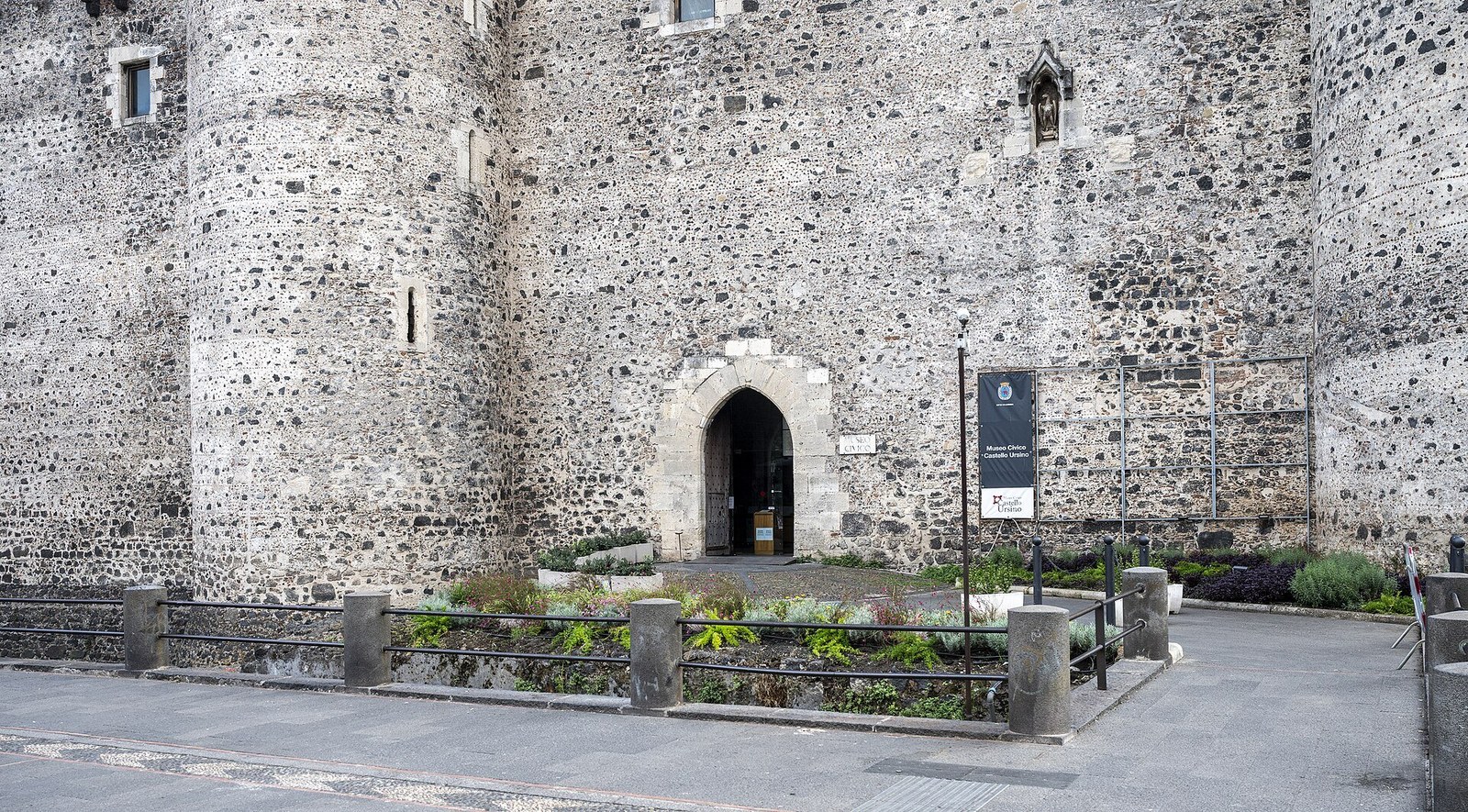
The Castello Ursino main entrance is on the north facade, under a pointed arch set between the middle tower and the northeast tower. Above the arch, in a small niche, you’ll see a sculpted Swabian eagle grabbing a hare — the symbol of Frederick II of Swabia, who commissioned the castle between 1239 and 1250. The north side is the only wall that survived largely intact after the 1693 earthquake and the 1669 lava flow that reshaped the coast.
Cayambe · CC BY-SA
Stand at the entrance with your back to the portal and you are looking almost exactly north. The square in front of you is Piazza Federico di Svevia; the church on the opposite side is San Sebastiano. Turn slightly right (east-northeast) and you see Via Castello Ursino climbing toward Via Garibaldi, where Santa Chiara’s three-story facade closes the perspective. That one spin of the head is the whole “churches near Castello Ursino” map in miniature.
Chiesa di San Sebastiano

Effems · CC BY-SA
- Location
- Via Buscemi 6, Catania Maps
- Essential fact
- Facade rebuilt in 1700 after the 1693 earthquake; reuses the portal of the demolished San Nicola dei Trixini
- Price
- Free
The Chiesa di San Sebastiano is the closest church to Castello Ursino — in fact, it is the one most people mean when they ask about a church “north” or “northeast” of the castle. A Dominican convent stood on the site from 1420, after King Martino donated the land following the demolition of an earlier chapel in 1405. The present facade and dedication to Saint Sebastian date from 1700, a full rebuild after the 1693 Sicilian earthquake. The Baroque portal with broken pediment and paired columns looks grander than the modest single-nave interior behind it.
The church is the focus of the Festa di San Sebastiano on 20 January, when the neighbourhood lights candles around the square and a short procession loops around the castle. Outside of the feast day, the interior opens irregularly for liturgy only — the facade is the reliable sight. If the church reads as part of a wider baroque agenda for you, pair it with the stops in our Catania must-see sights list.
Chiesa di Santa Chiara
Iopensa · CC BY-SA
- Location
- Via Giuseppe Garibaldi 89, Catania Maps
- Essential fact
- Octagonal gallery by Giuseppe Palazzotto, completed 1760; oval nave with 1766 fresco by Olivio Sozzi
- Price
- Free
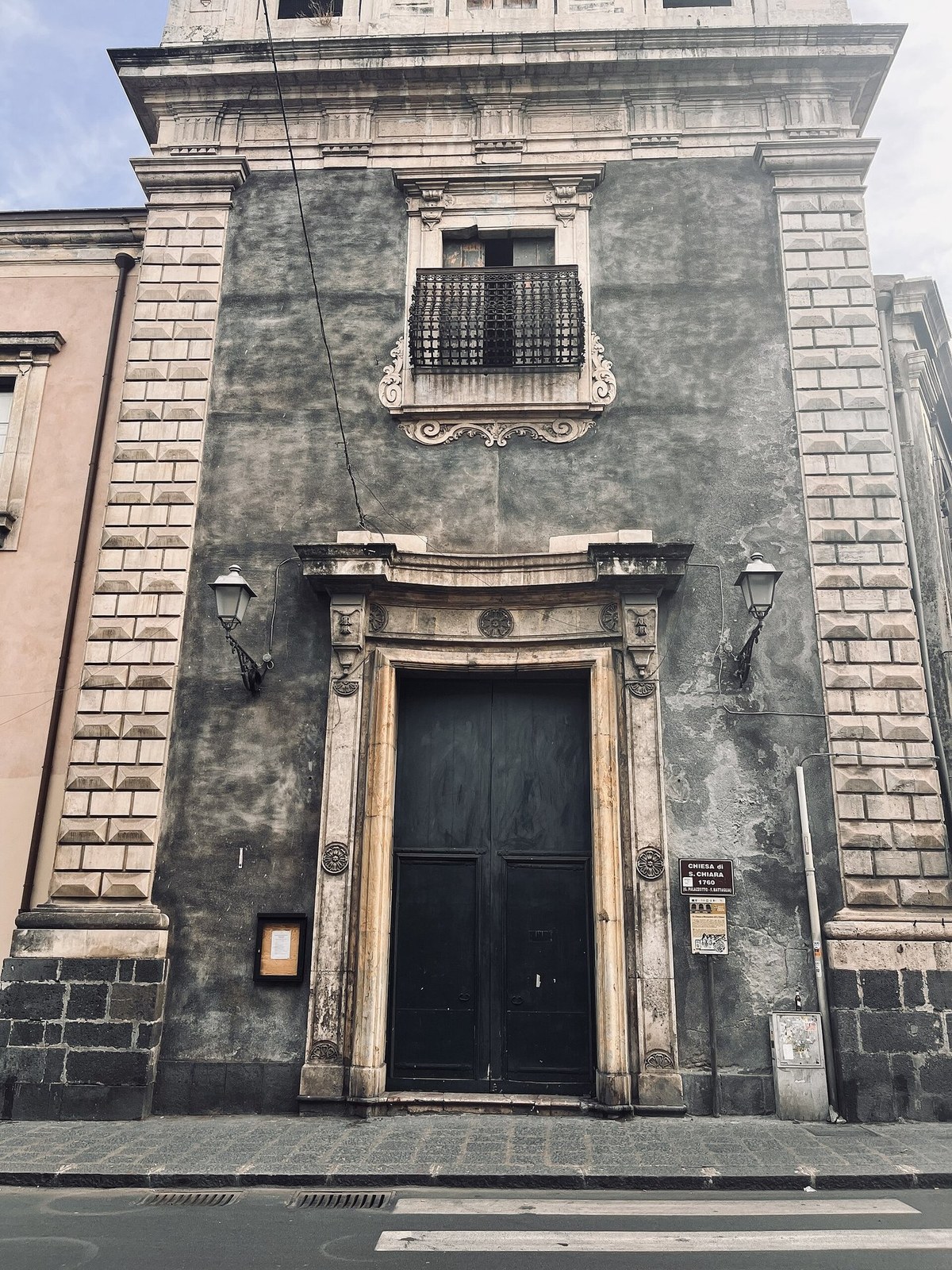
The Chiesa di Santa Chiara is the second church of the cluster and, architecturally, the more ambitious of the two. Built for the Poor Clares, who founded a convent here in 1563, the complex was flattened by the 1693 earthquake and rebuilt to a design by the Catanese architect Giuseppe Palazzotto. Works wrapped up in 1760. The most distinctive feature is the octagonal open gallery that almost encircles the dome — a hint of the oval nave behind the three-story facade on Via Garibaldi.
Inside, when you manage to catch the church open, the payoff is the dome fresco Trionfo delle Clarisse (“Triumph of the Poor Clares”), painted in 1766 by Olivio Sozzi. The gilded wooden choir on the counter-facade, with an effigy of Saint Clare, is the other element worth the detour. For photography the best angle on the octagonal gallery is from the Via Castello Ursino corner, where you also catch the castle wall in the same frame.
Walking distances from Castello Ursino
Everything around Castello Ursino is walkable in minutes — the castle sits at the southwest edge of the UNESCO baroque old town, and the main monuments line up along a single axis from Via Auteri through Via Garibaldi and back up Via Etnea. The table below collects the distances we check most often when we send guests this way.
| From Castello Ursino to… | Distance | Walking time | Route hint |
|---|---|---|---|
| Chiesa di San Sebastiano | ~20 m | <1 min | Cross Piazza Federico di Svevia |
| Chiesa di Santa Chiara | ~80 m | 1 min | Up Via Castello Ursino to Via Garibaldi |
| Pescheria (fish market) | ~220 m | 3 min | Via Auteri, then Via Garibaldi right |
| Catania Cathedral (Piazza del Duomo) | ~300 m | 4 min | Via Auteri to Via Garibaldi, then right |
| Fontana dell’Elefante (Liotru) | ~310 m | 4 min | Piazza del Duomo, centre of the square |
| Monastero dei Benedettini | ~650 m | 9 min | Via Garibaldi uphill west |
The quickest loop — castle, San Sebastiano, Santa Chiara, Cathedral — is roughly 700 m round trip and easy in 15 minutes without stops. If you want to stretch it into an afternoon there are more things to do in Catania within the same 1-km radius, from the Pescheria market to Teatro Bellini and the Anfiteatro Romano.
How long does it take to visit both churches?
Plan on 20 to 45 minutes for the two churches and the square between them. The low end assumes facades-only (both exteriors plus a lap of Piazza Federico di Svevia). Forty-five minutes gives you time to step inside San Sebastiano if it is open, read the information panels on Santa Chiara’s corner, and take photographs from the Via Castello Ursino viewpoint. Bundle the two churches with a full castle visit and you reach roughly 90 minutes total — a sensible morning block before lunch at the Pescheria.
A faster scenario is the drive-by: exit the castle from the north portal, cross the square to read San Sebastiano’s facade, walk 80 m up Via Castello Ursino for Santa Chiara, then continue to Via Garibaldi and join the main axis toward the Duomo. That version runs 10 minutes flat and still nets you both churches in photos.
Visiting tips: hours, access, photography
Both churches are free. Neither runs regular visitor hours in the museum sense — they are active parish buildings whose doors follow liturgy. Rule of thumb: weekday mornings around 8:00–9:00 and pre-evening 18:00–19:00 are the slots when you are most likely to find a church open in Catania. For San Sebastiano the one guaranteed day is 20 January, the Saint’s feast. Santa Chiara’s interior is the harder catch because the adjoining monastery is now municipal offices; facade and gallery are the reliable visit.
Photography-wise, morning light after 9:00 hits San Sebastiano’s facade head-on from the castle side of the square, while Santa Chiara’s three-story front is better in the mid-afternoon when the sun swings west along Via Garibaldi. Dress code is lenient but the usual rules apply if you step inside (covered shoulders, no flash during services). The square itself is flat, basalt-paved and wheelchair-accessible; the churches have one or two steps at the threshold. Catania sits at 15 m above sea level and all of this lies inside the compact old town — if you are wondering where Catania sits in eastern Sicily, the castle is the southwest anchor of the historic centre. If you are arriving by car, the closest garages sit a short walk west of the square — see our guide to parking in Catania for ZTL boundaries and rates.
Where to stay in Catania
The Castello Ursino quarter is the quiet flank of Catania’s old town: basalt streets, small trattorias, sea breeze from Piazza dei Martiri, and a five-minute walk to the Duomo and Pescheria. We run three apartments in Catania in a single palazzo a short walk from here — the same corner where we send guests who want the churches, the castle and the cathedral within a single morning stroll.
The information in this guide was correct at the time of writing. Data can change from season to season without notice: before you travel, always check the official channels and websites for updates. We review this guide periodically, but the official channels are always the authoritative source. We also cannot guarantee that the suggested routes or the attractions described are always reachable or accessible: roads, trails and sites may be closed, damaged, altered or unsafe. Assessing the practicability and safety of itineraries and attractions always remains your own responsibility.