
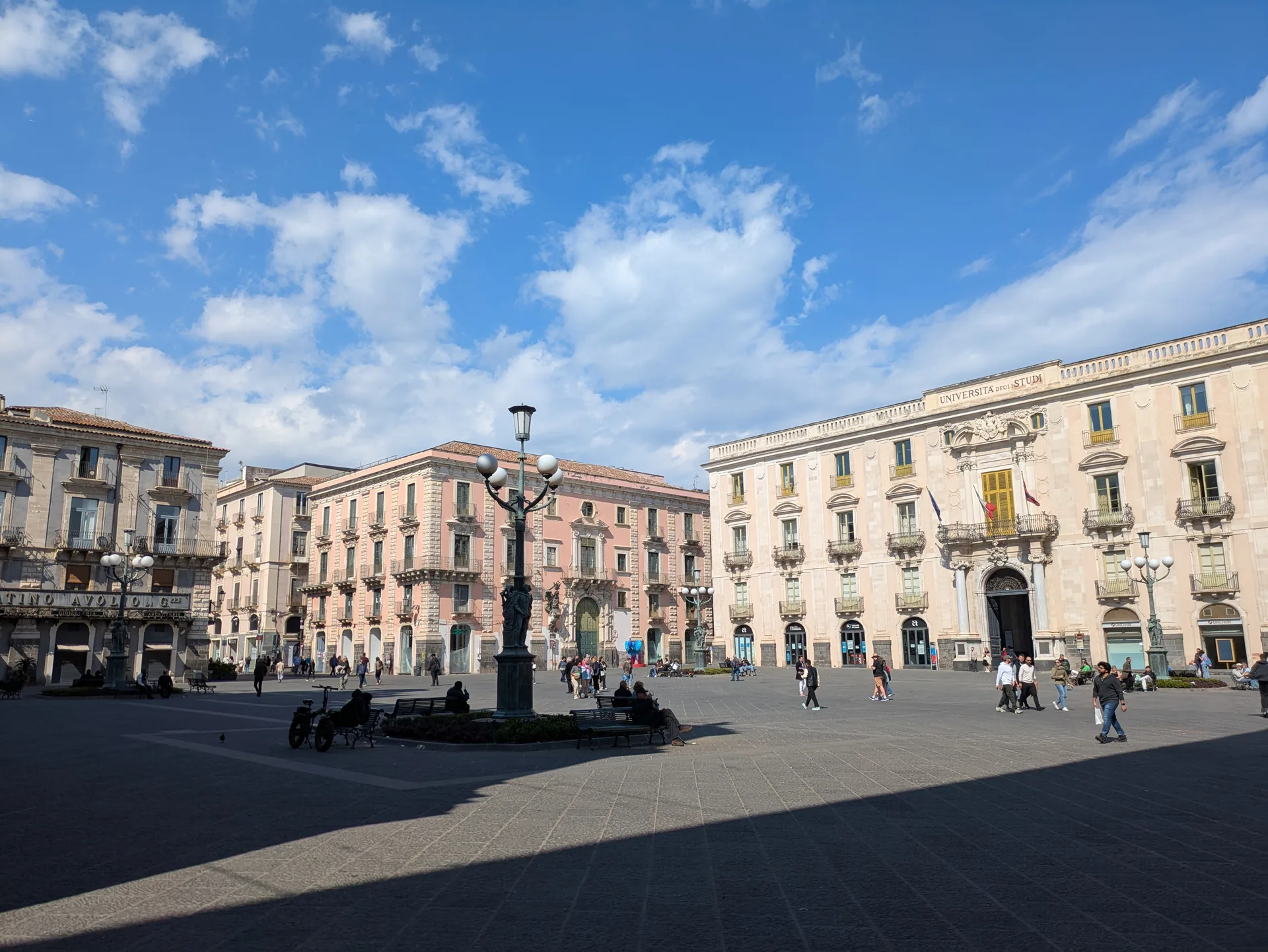
What to do in Catania in one day, three days, or just a four-hour cruise stop? We live in central Catania, ten minutes from Piazza del Duomo, and the honest answer is that the city has more to offer than the typical «list of fifty monuments» suggests — but only if you plan it as a sequence of actions rather than a checklist. The historic centre is compact, walkable, dominated by the black lava-stone Baroque rebuilt after the 1693 earthquake, and shadowed by Mount Etna, Europe most active volcano, just 30 km north. Around an action-led day you can walk into La Pescheria fish market at sunrise, climb the Cathedral cupola for the rooftop view, eat pasta alla Norma where it was named, descend into the Teatro Romano archaeological site, sip aperitivo on Via Etnea, and finish dinner past 22:00 with locals. Below: a one-day timeline, twelve essential things to do ranked by how often we actually do them, a one-hour old-town walking route, what to do at night, what to do for free, the Etna day-trip, and direct answers to the four questions Google People Also Ask keeps surfacing — worth visiting? in a day? better than Taormina? walkable? Short answers up top, expanded below.
What to do in Catania in one day?
Start at La Pescheria fish market by 09:00, walk to Piazza del Duomo and into the Cathedral of Sant’Agata by 10:30, head up Via Crociferi by 12:00, lunch on pasta alla Norma at 13:30, descend the Teatro Romano at 15:30, climb the Cathedral cupola at 17:00, aperitivo on Via Santa Filomena at 19:30, dinner past 21:00. That single loop covers 80% of what Catania does best.
The reason that timeline works is geography: every stop above is within a fifteen-minute walk of the next. Catania historic core is roughly 1.2 km across, mostly flat (unlike Taormina, which is a hillside town), and built on black volcanic stone that absorbs morning heat and releases it back well into the evening, which is why locals do their serious walking before 11:00 and after 18:30. If you arrive by cruise ship at the port, the same loop adapts to a four-hour window by skipping the climb and shortening the Teatro Romano visit; if you have two days, you keep the Day 1 loop and add the Benedictine Monastery tour and an Etna day-trip on Day 2.
One adjustment worth making for July and August: the loop shifts later by two hours. Pescheria still opens at 07:00 but quietens by 11:00 from the heat; the Cathedral cupola is brutal in midday sun, so move that to 18:00 just before sunset; aperitivo extends past 22:00 because nobody dines before then. We do this version ourselves in summer and would not recommend the midday tourist attack pattern at all between mid-June and mid-September. For the rest of the year, the timeline above stands.
The 12 essential things to do in Catania
What follows is not a list of 50 monuments — it is twelve actions we do ourselves, ranked by what locals actually recommend to visiting relatives. Each one fits in 30 to 90 minutes; together they cover the real Catania in two well-spent days. For an exhaustive listicle, see our companion guide on things to do in Catania; here, we are strictly action-led.
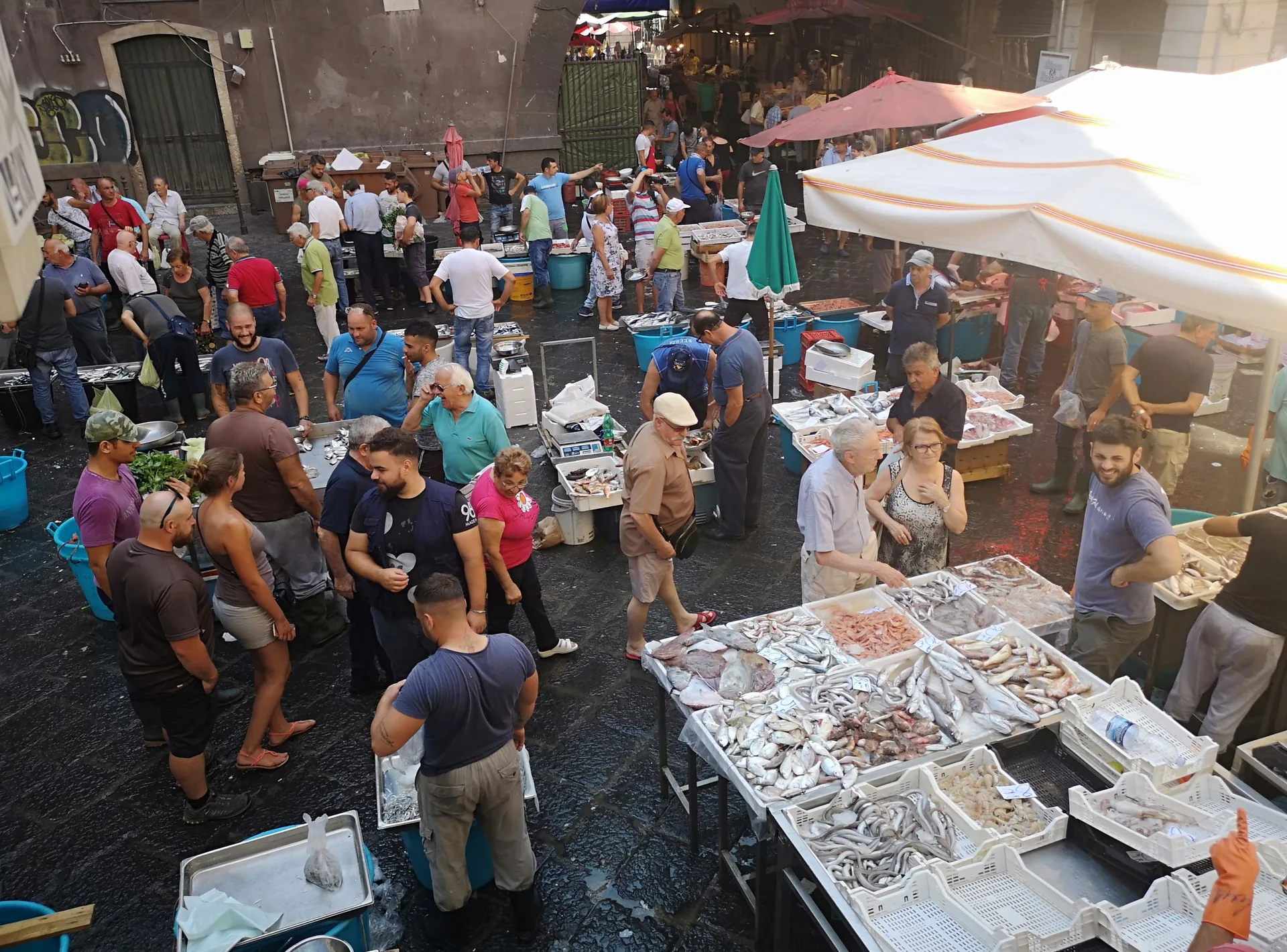
1. Walk into La Pescheria fish market at 8 AM
Eleassar · CC BY-SA 4.0
- Location
- Piazza Alonzo di Benedetto, Catania Maps
- Essential fact
- The largest open-air fish market in Sicily, working since the 19th century in the lava-rock arches.
- Price
- Free
The Pescheria is loud, wet, theatrical, and the most authentic morning hour you can spend in Catania. Vendors auction pesce spada, octopus and red prawns under the arches at Piazza Alonzo di Benedetto; the smell is bracing, the marble counters are mosaic-tiled, and the surrounding side streets fill with butcher and produce stalls. Buy nothing if you are a tourist; just walk through. Our deeper guide to the Catania fish market covers the etiquette and what to taste.
2. Stand under the lava elephant in Piazza del Duomo
- Location
- Piazza del Duomo, Catania Maps
- Essential fact
- The Fontana dell’Elefante (1736) is Catania symbol, carved from black lava stone with a Roman-era elephant.
- Price
- Free
The square is the centre of gravity of the whole city. The lava elephant — nicknamed U Liotru by the locals — sits on a baroque fountain looking up at the Cathedral of Sant’Agata, with the Amenano fountain spilling water from an underground river to its left and the Palazzo dei Chierici closing the south side. Stand there for ten minutes; it is the photo shot every visitor takes, but also the orientation point for the rest of the day. Sant’Agata February festival passes through this square every 3–5 February with a million pilgrims.
3. Climb the Cathedral cupola for the rooftop view
- Location
- Piazza del Duomo, Catania Maps
- Site
- cattedralecatania.it
- Essential fact
- The rooftop climb (~95 steps) gives a 360 view from Etna to the Ionian Sea, missed by 90% of visitors.
- Price
- €5 pp
This is Catania best secret. Most tourists visit the Cathedral nave (which is free) and skip the rooftop, which costs five euros and rewards with a 360-degree view: Mount Etna to the north, the Ionian sea to the east, the Pescheria roofs immediately below, and the whole Baroque grid laid out at your feet. Sunset slot is the most magical. The climb is 95 steps inside a relatively comfortable spiral. The ticket office is just inside the main entrance, on the right.
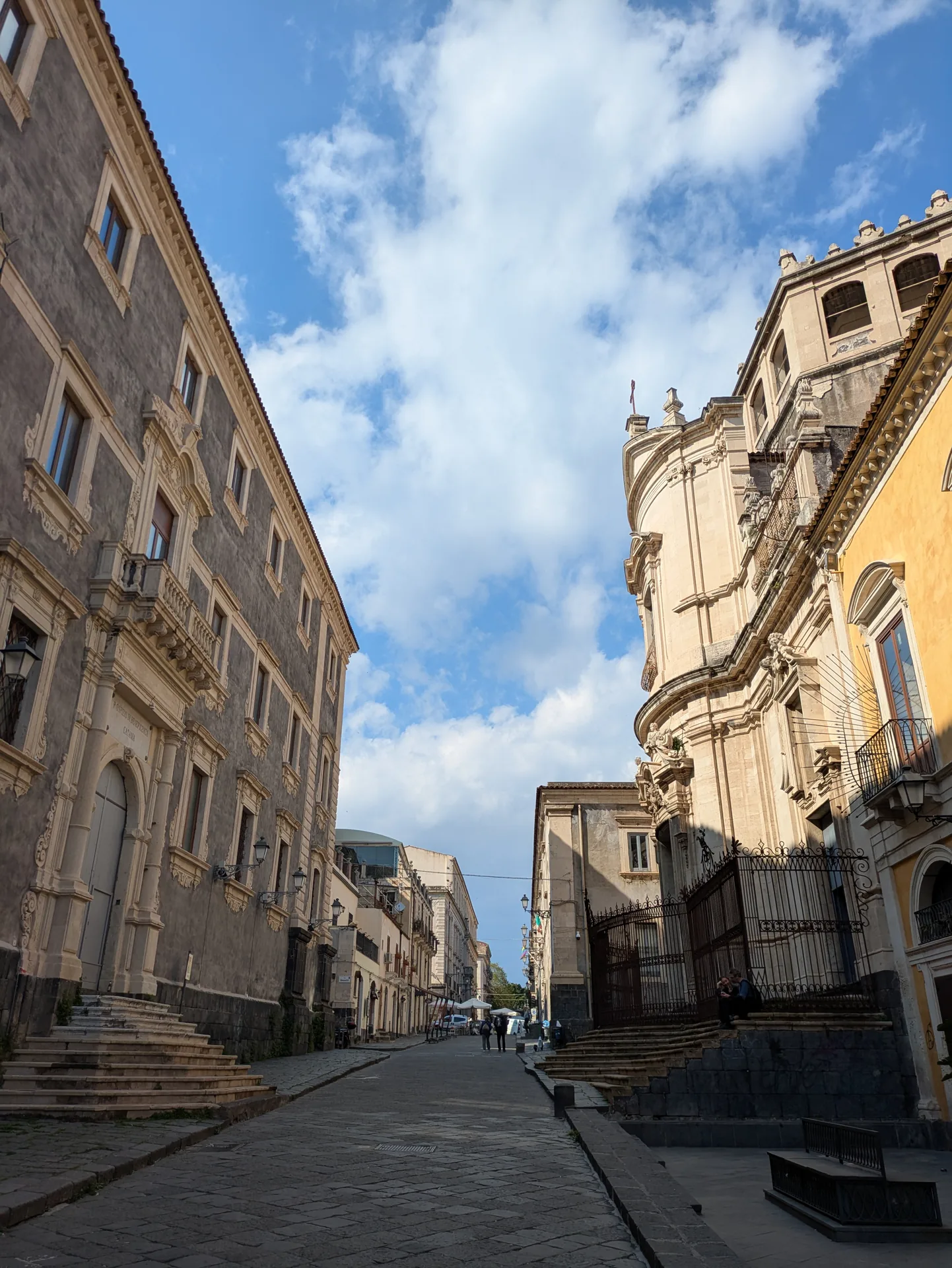
4. Walk Via Crociferi between five baroque churches
Auregann · CC BY-SA 4.0
- Location
- Benedettine, Via Crociferi 16, Catania Maps
- Essential fact
- UNESCO Late Baroque World Heritage corridor with five churches in 200 m.
- Price
- Free
Two hundred metres long, five churches lined up: San Francesco Borgia, San Giuliano (with the curved facade), San Benedetto, Cappuccini, and the gate of the Crociferi convent. Walk it in the morning shadow or at sunset when the lava-stone facades turn dark gold. The street features prominently in UNESCO Late Baroque of the Val di Noto inscription; it is also the only stretch in central Catania entirely pedestrian and entirely silent. For a deeper old-town walk, jump to our route at the old town section below.
5. Eat pasta alla Norma where it was named
- Location
- Via Giuseppe De Felice 14, Catania Maps
- Essential fact
- Named after Bellini opera Norma (1831); fried aubergine, salted ricotta, basil, tomato.
- Signature dish
- Pasta alla Norma with fried aubergine and salted ricotta
- Price
- €9–14 pp
Pasta alla Norma was named in Catania, in honour of the composer Vincenzo Bellini, who was born here. Order it at any trattoria around Piazza Bellini — the dish should arrive with crisp slices of fried aubergine, salted ricotta grated on top, basil leaves, and a tomato base that tastes more of summer than of red sauce. Pair with a glass of Etna Rosso or a Nerello Mascalese from the volcano slopes. Our companion piece on best restaurants in Catania has the operator-by-operator detail.
6. Tour the Benedictine Monastery of San Nicolo
- Location
- Piazza Dante Alighieri 32, Catania Maps
- Site
- monasterodeibenedettini.it
- Essential fact
- One of the largest monastic complexes in Europe (~50,000 sq m), now the university Faculty of Humanities.
- Price
- €10 pp
One of Europe largest monastic complexes, partially destroyed in the 1693 earthquake and rebuilt with two cloisters, a basilica, and an enormous library on lava-stone foundations. Today it houses the University of Catania Faculty of Humanities, and the only way in is by guided tour (about ninety minutes, runs hourly, book a day ahead in high season). The Roman house found beneath the kitchens during the rebuild is exposed under glass — one of the more unexpected things to see in the city. Take the 09:00 or 10:00 slot to avoid afternoon school groups.
7. Descend into the Teatro Romano archaeological site

Cayambe · CC BY-SA 4.0
- Location
- Via Vittorio Emanuele II 266, Catania Maps
- Essential fact
- Roman theatre + Odeon, partially buried under medieval houses; capacity 7,000 in the 2nd century AD.
- Price
- €6 pp
One of the most surreal sights in Catania: a Roman theatre sunk five metres below street level, partially absorbed by medieval and Baroque buildings that grew on top of it. You enter from an unassuming side door on Via Vittorio Emanuele II, walk down a ramp, and find yourself in the cavea where 7,000 spectators once watched. The small adjacent Odeon is even more atmospheric. Allow 45 minutes, and bring a hat for summer afternoons (the site is unshaded).
8. Visit Castello Ursino and the Museo Civico

Cayambe · CC BY-SA 4.0
- Location
- Piazza Federico di Svevia 21, Catania Maps
- Essential fact
- 13th-century Swabian fortress built by Frederick II; now houses the Museo Civico with the Biscari collection.
- Price
- €6 pp
The black-stone fortress was originally seaside; the 1669 Etna eruption pushed the coast 400 metres east, leaving the castle landlocked. Today the courtyard hosts open-air concerts in summer and the interior holds the Museo Civico, with classical sculpture, medieval ceramics, and the eccentric Biscari collection of Greek vases. Forty-five minutes is enough unless you are an archaeology obsessive. Combine with a walk through the adjacent San Cristoforo neighbourhood by daylight only.
9. Take an Etna day-trip from Catania
- Location
- Piazzale Rifugio Sapienza, Nicolosi Maps
- Essential fact
- Europe most active volcano; summit craters 3,357 m, guided access required above 2,500 m.
- Price
- €80–110 pp (jeep tour all-in)
If you only do one thing outside Catania, do Mount Etna. The cheapest option is the AST public bus from Catania Centrale at 08:15, returning at 16:30, depositing you at Rifugio Sapienza (1,900 m) where the cable car takes you to 2,500 m. Above that, guided 4×4 tours run by the volcano cooperatives reach 2,900 m on the south flank. Operator-led jeep+lunch tours from town typically cost €80–110 per person all-in. Our pillar on hiking Mount Etna covers the full operator landscape.
10. Shop the Fiera del Lunedi flea market
- Location
- Piazza Carlo Alberto di Savoia, Catania Maps
- Essential fact
- Monday is the historic Fiera o Luni day — the biggest open-air market in eastern Sicily.
- Price
- Free
The Monday flea market spreads across Piazza Carlo Alberto di Savoia and into the surrounding streets: housewares, clothing, vintage records, religious paraphernalia, knock-off football shirts, antique coins, and the occasional genuine Sicilian ceramic. Sunday morning hosts the smaller antiques edition with serious dealers. The square is two minutes north of Via Etnea at Piazza Stesicoro; walk Etnea from Piazza Duomo, turn right at Sant’Agata la Vetere church.
11. Watch sunset from Chiesa della Badia di Sant’Agata terrace
- Location
- Via Vittorio Emanuele II 182, Catania Maps
- Essential fact
- Baroque church (1735–1767) by Vaccarini; rooftop dome terrace gives a 360 view rivalling the Cathedral.
- Price
- €3 pp
Catania has two best-view rooftops: the Cathedral cupola (item 3) and the Badia di Sant’Agata dome, right next door. The Badia is cheaper, less crowded, and built by Giovanni Battista Vaccarini — the architect who shaped most of Catania post-1693. From the dome terrace you see the Cathedral facade in profile, Piazza del Duomo straight down, and the dark line of the Ionian sea on the eastern horizon. Best ten minutes before sunset; the climb is shorter than the Cathedral (about 70 steps).
12. End the day at aperitivo in Via Santa Filomena
- Location
- Via Santa Filomena 20, Catania Maps
- Essential fact
- Pedestrian street with table-strewn aperitivo bars; the local pre-dinner ritual is here.
- Price
- €6–10 pp (spritz + nibbles)
The Catania pre-dinner ritual happens on a small pedestrian street between Via Etnea and Via Coppola, where seven or eight wine bars and aperitivo spots put tables out as soon as the temperature drops. Order a Spritz, an Etna Bianco, or a Negroni; a small plate of Sicilian olives, taralli, and salami usually comes with the drink. The crowd is local, university-age plus older. From here, dinner is anywhere from 21:00 onwards. For the wider movida footprint, see our Catania nightlife guide.
Walk Catania old town: a one-hour route
A single-hour walking route through the old town hits six stops — Piazza Universita, Via Etnea south, Piazza del Duomo, the Pescheria arches, Via Vittorio Emanuele II east and back via Via Crociferi. Total walking distance ~1.5 km on flat lava stone, no admission required; allow 90 minutes if you stop into churches.
The Catania old town is compact by design. The 1693 earthquake destroyed almost everything, and the 18th-century rebuild laid out a regular grid centred on the present Piazza del Duomo, with Via Etnea as the main north-south spine and Via Vittorio Emanuele II as the east-west cross. Most of what is worth seeing in central Catania sits within 300 metres of this intersection — which means a methodical one-hour loop catches everything important.
The route, stop by stop. Start at Piazza Universita: the colonnaded square with the four lampposts (the 1731 Vaccarini-designed bronzes telling Catania foundation myths). Walk south on Via Etnea, pass the entrance to the Cathedral and stop in Piazza del Duomo for the lava elephant. Turn into the Pescheria arches (skip the market itself if it is past 14:00 and closed). Come back to Piazza del Duomo and head east on Via Vittorio Emanuele II for two blocks to Piazza Mazzini, with its arcaded square. Finally, loop back through Via Crociferi for the UNESCO baroque corridor and exit at Piazza San Francesco d’Assisi. For a sister pillar covering the old town in detail (history, palaces, side-streets), our Catania old town deep-dive is the next read.
What to do in Catania at night
The Catania movida concentrates in three streets — Via Santa Filomena, Via Coppola and Piazza Teatro Massimo — with aperitivo from 18:30, dinner 21:00–23:00 and bar service until 02:00 on weekends. The historic centre stays busy with locals, well-lit, and walkable late. Avoid solo-walking the alleys behind Catania Centrale station after 22:00.
The night follows a rhythm. From 18:30 to about 20:30 it is aperitivo, mostly on the pedestrian streets we mentioned in item 12 above. From 21:00 the trattorie around Piazza Bellini, Piazza Spirito Santo and the side streets off Via Etnea fill with locals dining late; tourists eating at 19:30 in summer get the empty restaurant treatment, which feels less authentic and is also hotter. After 22:30 the wine bars and craft-beer spots in the Piazza Teatro Massimo area take over — live music in two or three venues most weekends.
Specific safety note: the Catania historic centre is statistically safer than it looks, but the alleys immediately around Catania Centrale railway station (Via Cosentino, Via Archimede) get isolated after 22:00. Take a taxi or stay on the main streets. The walk back from the movida to a central apartment is fine; we do it weekly. For the wider safety breakdown including women travelling solo, see our is Catania safe guide.
What to do in Catania for free
Seven free things to do in Catania — walk Via Etnea at sunset, sit in Piazza del Duomo, browse the Pescheria fish market, walk through Villa Bellini gardens, enter the Cathedral nave, attend the Sant’Agata February festival, and follow the Via Crociferi UNESCO baroque corridor. Together they fill a half-day with no admission tickets.
- Walk Via Etnea at sunset — the central 1.5 km between Piazza del Duomo and Piazza Stesicoro is pedestrianised and turns gold an hour before sunset.
- Sit in Piazza del Duomo — benches under the lava elephant; people-watching is free.
- Browse the Pescheria fish market — Mon–Sat morning, no admission, only buy if you want to.
- Walk Villa Bellini gardens — the 19th-century public park on the eastern side of Via Etnea, with the bandstand and panoramic terrace; open daily 6:00 to sunset.
- Enter the Cathedral of Sant’Agata — the nave is free; only the rooftop cupola has a ticket.
- Attend the Sant’Agata February festival — if you are in Catania around 3–5 February, this is one of the largest Catholic festivals in Europe (1 million pilgrims) and entirely free to watch from the streets.
- Walk Via Crociferi — the UNESCO baroque corridor; the churches charge nothing if you go in during open hours.
A few more free actions worth adding for the budget traveller. The Amenano fountain waterfall on Piazza del Duomo. The Sunday morning passeggiata down Via Etnea. The view from the rooftop terrace of Piazza Stesicoro overlooking the Roman amphitheatre ruins (visible from the square through the railings). The free entry to the Santo Carcere chapel where Sant’Agata was supposedly held. And the lava-stone harbour walk from Porto Vecchio south to San Giovanni Li Cuti, a working fishermen black-pebble beach just north of the port.
Take a day-trip to Mount Etna
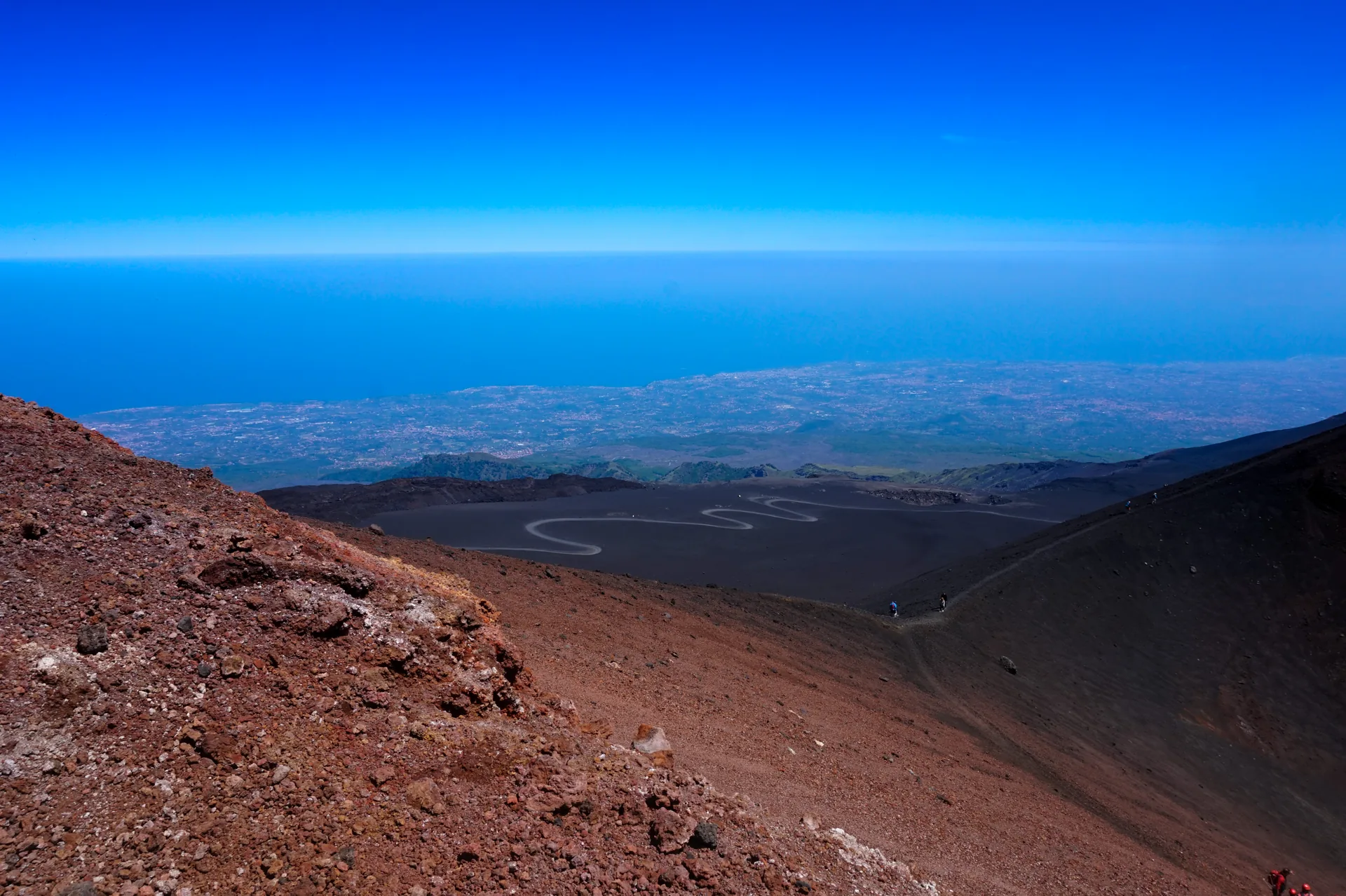
The easiest Mount Etna day from Catania is the AST bus at 08:15 from Catania Centrale (single €6.60), 90 minutes to Rifugio Sapienza (1,900 m). From there, the cable car (Funivia dell’Etna, €30 return) climbs to 2,500 m, and authorised guides take you up the south flank to 2,900 m. Return bus 16:30. Operator jeep+lunch tours from town typically cost €80–110 per person and bring you back by 18:00.
Two ways to do Etna in a day. The independent option is the public AST bus from Piazza Giovanni XXIII next to Catania Centrale; the ticket is sold on board and the return is the same vehicle at 16:30. You arrive at Rifugio Sapienza with about six hours on the mountain: enough time for the cable car + a guided jeep up the south slope + a walk around the 2002 crater bocche on the way down. Pack a fleece even in August (summit zone 5–15°C).
The operator-led option is more comfortable and slightly more expensive. You get picked up at your accommodation around 08:30, driven up by 4WD, given a guided trek and a wine-or-honey tasting at an Etna vineyard or farm on the way down. Tour duration about 8–9 hours, return by 18:00. For the full operator landscape, north vs south flank trade-off, and the safety protocols when the volcano is in eruption phase, our dedicated hiking Mount Etna guide is the deep-dive.
lewispb · CC0
Other day-trips from Catania
Beyond Etna, three day-trips are the standard. Taormina (hilltop resort + Greek theatre, 55 min by train, €5 each way). Syracuse / Ortigia (Greek-era island, 75 min by train, €7 each way). Aci Trezza / Aci Castello (fishing villages on the Cyclops coast, 25 min by bus, €1.30 each way). Each one fits in a day; pick the one your appetite suggests, not all three.
Taormina is the obvious choice for a first-time visitor — hilltop town, Greek theatre, postcard view of Etna across the bay. Get there by Trenitalia regional train from Catania Centrale to Taormina-Giardini station, then a 10-minute bus or cable car uphill. Allow a full day, prefer weekdays in summer to dodge cruise crowds. Our guide on getting from Catania airport to Taormina covers train + bus + taxi pricing. Syracuse / Ortigia is the historian pick — the Greek-era island core, the Cathedral built into a Doric temple, the Fonte Aretusa with papyrus and freshwater. Aci Trezza and Aci Castello, fifteen kilometres up the coast, are the budget+local pick: fishing-village atmosphere, the Cyclops basalt stacks, a Norman castle on a cliff, all reachable by AMT bus 534. For the full inventory plus Catania-as-base logistics, our day trips from Catania guide covers ten more options.
Catania food: 6 things to taste, not just eat
Six things to taste in Catania — arancino, pasta alla Norma, granita and brioche, horse meat (carne di cavallo), seltz al limone and almond-paste sweets. Each is specifically Catanese in origin or local preparation, and each costs under €15 even at the better spots. The deeper restaurant list is in our companion best restaurants in Catania.
- Arancino — fried rice ball, pointed shape (Catania style, masculine: arancino; Palermo style is round and feminine, arancina). Classic fillings: meat ragu, butter+ham, spinach. €2–3 each.
- Pasta alla Norma — covered above in item 5. The local lunch.
- Granita con brioche col tuppo — semi-frozen flavoured ice (almond, lemon, coffee, pistachio) with a soft brioche bun for dunking. Catania breakfast, year-round but iconic in summer. €3–5.
- Horse meat (carne di cavallo) — grilled in the side streets near the Pescheria; the smoke is unmistakable. Eat it once even if you usually do not; it is leaner than beef, slightly sweet. €10–14.
- Seltz al limone — the Catania street drink, made at corner kiosks (chioschetti) on Via Etnea and around Piazza Bellini: fresh lemon juice, salt, sparkling water, optionally a syrup. €1.50.
- Almond paste sweets — from frutta martorana (marzipan fruit) to granita di mandorla; the local pasticcerie do them better than the airport souvenir shops.
Where to find each: arancino at any cafe near Piazza del Duomo; pasta alla Norma at trattorie around Piazza Bellini; granita at Prestipino on Via Etnea or any cafe near the Pescheria entrance; horse meat in the focacceria stands along Via Plebiscito; seltz al limone at the historic Chioschetto Costa on Piazza Vincenzo Bellini; almond pastries at Savia opposite Villa Bellini. Want a deeper food tour? Walk the morning Pescheria first (item 1) for context.
Is Catania worth visiting for tourists?
Yes, Catania is worth visiting — especially as a base for two to four nights to explore eastern Sicily. The historic centre is compact and walkable, the lava-stone Baroque is UNESCO-listed, Mount Etna is a 90-minute day-trip, Taormina and Syracuse are easy train trips, food costs are roughly 30% lower than Taormina, and the city feels lived-in rather than touristic. Skip Catania only if your itinerary already includes Palermo or Noto and you have under three days in Sicily total.
The reservations worth knowing. Catania is gritty visually — graffiti on baroque facades, peeling stucco, occasional rubbish in side-streets. First impressions can put visitors off in the ten-minute walk from Catania Centrale station to the historic centre. Push through; the city rewards a second look. Restaurants in the Pescheria tourist circle (especially after 13:00) can be tourist traps with inflated fish-by-weight pricing; eat in the streets behind Piazza Bellini instead. July and August are uncomfortably hot (35–38°C); shoulder seasons are objectively better. Our Catania holiday overview and Catania tourism pillar both expand on these points.
Is Catania better than Taormina?
Catania and Taormina are different products. Taormina is a hilltop resort town built for tourism — iconic Greek theatre, postcard view, expensive hotels and restaurants, packed with cruise day-trippers. Catania is a lived-in working city — bigger, grittier, cheaper, with deeper food, real nightlife, and Etna in the backyard. The conventional itinerary is to base in Catania for 2–4 nights and day-trip up to Taormina (55 min by train); that gets you the best of both without paying the Taormina hotel premium.
If you only get one, the answer depends on traveller type. Honeymoon, anniversary, retreat-style: Taormina, no question. First city stop in Sicily, food-led trip, base for eastern Sicily, budget-aware traveller: Catania. The two are 35 km apart and a half-day apart in atmosphere; doing both is the standard choice and the one we recommend, with Catania as the base because eastern-Sicily transport hubs (airport + train station) are here. Our pillar on things to do in Taormina covers the Taormina-as-day-trip plan in detail.
Is Catania a walkable city?
Yes, Catania is one of the most walkable cities in southern Italy. The historic core is roughly 1.2 km in diameter and almost entirely flat, with the pedestrianised Via Etnea axis from Piazza del Duomo north to Piazza Stesicoro forming the spine. From a central apartment around Via Etnea or Piazza Universita, 80% of the things to do in this guide are within a 15-minute walk. Outlying neighbourhoods (Picanello, Librino, San Cristoforo) are not walking distance and have no reason to visit.
Two practical notes. The lava-stone sidewalks are uneven and reflective; bring comfortable walking shoes with grip. Some streets are shared with mopeds — especially around Pescheria and Via Etnea south of Stesicoro — so stay on the left side of the pedestrian space when walking. Public transport (AMT buses, AMTS Alibus airport bus) is fine as backup, but you will not need it inside the historic centre. For driving and parking matters when leaving the city, our pillar on where to park in Catania covers the zone-by-zone breakdown.
Decision table: what to do based on your time
How long you have changes the plan, not just the number of items you tick off. The matrix below maps four common windows to the actions you should do, what to skip without regret, and what to eat for that window.
| Time available | Top must-do | Skip without regret | Eat |
|---|---|---|---|
| 4-hour cruise stop | Pescheria + Piazza del Duomo + Via Etnea passeggiata + Badia rooftop | Cathedral cupola climb, Teatro Romano, Castello Ursino, Etna | Arancino + granita at a Via Etnea cafe |
| 1 day | The full one-day timeline (item H2.1): Pescheria 09:00, Cathedral 10:30, Via Crociferi 12:00, pasta alla Norma 13:30, Teatro Romano 15:30, cupola 17:00, aperitivo 19:30 | Etna day-trip, day-trips out of city | Pasta alla Norma lunch + Sicilian aperitivo |
| 2 days | Day 1 = 1-day timeline above. Day 2 = Etna day-trip (08:15–18:00) + dinner Piazza Bellini | Other day-trips (Taormina/Syracuse) | Add horse meat focaccia + seltz al limone |
| 3+ days | Add Castello Ursino + Flea market (if Monday) + Taormina day-trip + Syracuse-Ortigia day-trip + Aci Trezza/Aci Castello afternoon | Nothing — you have time | Full Catania food tour + one fine-dining dinner |
One nuance for cruise stops. The Catania cruise port is a 15-minute walk from Piazza del Duomo, but in high season taxis are recommended (the port walkway can be hot and dusty). For the cruise-specific logistics, including port-to-centre transfers and the four-hour itinerary, see our Catania cruise port pillar.
Where to stay in Catania
For everything in this guide to work, base yourself inside the central walkable perimeter: Via Etnea axis between Piazza del Duomo and Villa Bellini, the Borgo just north, or Antico Corso west of the Cathedral. From that perimeter, every item in our 12-essentials list is a 15-minute walk; aperitivo runs back home are safe and short; the AMTS Alibus to the airport is a five-minute walk from Via Etnea. Look at apartments in Catania in this perimeter rather than further-out neighbourhoods. The full neighbourhood-by-neighbourhood breakdown is in our where to stay in Catania guide.
The information in this guide was correct at the time of writing. Data can change from season to season without notice: before you travel, always check the official channels and websites for updates. We review this guide periodically, but the official channels are always the authoritative source. We also cannot guarantee that the suggested routes or the attractions described are always reachable or accessible: roads, trails and sites may be closed, damaged, altered or unsafe. Assessing the practicability and safety of itineraries and attractions always remains your own responsibility.