
Sicily has over 1,000 kilometres of coastline, and not all of it is equal. Some beaches are wide stretches of golden sand packed with lidos; others are rocky coves you reach after a 20-minute walk through a nature reserve. We live on the east coast, in Catania, and over the years we’ve explored beaches on every side of the island. This guide covers the ones worth your time — with an honest focus on the eastern coast, where a Catania apartment puts you within day-trip distance of the best swimming spots in Sicily.
For trip planning beyond beaches — when to visit, regions, food and transport — see our Sicily travel guide.
Why Sicily for a beach holiday
Planning around the water rather than a single beach? Our month guide to swimming in Sicily explains when the sea is warm enough from May to October, while the Sicily in September guide covers the warmest shoulder season month with Cous Cous Fest, Etna vendemmia and lower prices.
Three reasons locals would give you. First, variety: volcanic black sand near Catania, white Caribbean-style beaches in the south-east, dramatic cliffs on the west coast. Second, the water. The Ionian and Tyrrhenian seas around Sicily are consistently clean, warm from June to October, and remarkably clear — especially along the east coast where the seabed drops fast. Third, the cost. A full day at a lido (sunbed, umbrella, shower access) runs €15–25 per person, roughly half what you’d pay on the Amalfi Coast or Sardinia. Free beaches are everywhere, and they’re genuinely good.
Add to that direct flights from most European airports to Catania (Fontanarossa, the island’s busiest airport) and Palermo, and you start to see why Sicily is becoming the beach destination for travellers who want substance alongside their sunbathing.

Lost passenger · CC BY-SA 2.0
Types of Sicilian beaches
Before you plan, it helps to understand the three categories of Sicilian beaches — because they’re quite different from what you might be used to in the UK or northern Europe.
Lido (stabilimento balneare) — A managed beach with sunbeds, umbrellas, showers, changing rooms, and usually a bar or restaurant. You pay a daily fee (€15–30 for two sunbeds and an umbrella in most of eastern Sicily) and get a full-service day. Lidos are the default choice for Italian families. They’re clean, organised, and social. No need to bring anything except yourself and a towel.
Spiaggia libera (free beach) — Public access, no charge, bring your own gear. Quality varies wildly: some free beaches are gorgeous stretches of sand with basic facilities (showers, a bin); others are narrow strips between lidos. The east coast between Catania and Syracuse has excellent free beaches. Always check for a lifeguard tower before setting up with children.
Riserva naturale (nature reserve) — Protected coastline managed by the region. Vendicari, Calamosche, and the Riserva dello Zingaro fall into this category. No lidos, no bars, limited or no facilities. You walk in (sometimes 15–30 minutes on a trail), and what you find is untouched coast. Worth the effort, but bring water, food, and shade.

Andrea Calcagno · CC BY-SA 2.0
Best beaches in eastern Sicily
This is the coastline we know best — it’s where we live. The eastern Ionian coast runs from Taormina in the north to the tip of the Val di Noto in the south, with Catania roughly in the middle. It’s the most diverse stretch of coastline in Sicily: volcanic rock, sandy beaches, nature reserves, and resort towns, all within 90 minutes of Catania.
La Playa and Plaia Grande, Catania
Catania’s city beach is a 5-kilometre stretch of dark volcanic sand that starts just south of the port and runs towards the airport. Locals call it simply “La Playa”. It’s lined with lidos on one side and has generous free-access sections between them. The sand is dark — almost grey — because it’s ground-up lava from Etna. If you’ve never walked on volcanic sand before, it’s noticeably finer than regular sand, and it gets scorchingly hot under the midday sun (flip-flops are essential, not optional). The water is shallow for the first 30 metres, the seabed is sandy, and in July–August it gets busy — families arrive at 8 am to claim spots on the free sections.
The honest assessment: La Playa isn’t the prettiest beach in Sicily, but it’s the most convenient if you’re staying in Catania. You can reach it by bus (line D from the city centre, 15 minutes) or on foot from the southern end of the centre. The lidos here charge €12–18 per person for a sunbed and umbrella — among the cheapest on the island. For a quick swim after sightseeing, it’s ideal.

andrea · CC BY 3.0
Aci Trezza and the Riviera dei Ciclopi
Fifteen kilometres north of Catania, the fishing village of Aci Trezza sits in front of the Faraglioni dei Ciclopi — a row of dramatic basalt sea stacks that, according to Homer, Polyphemus threw at Odysseus. The “beach” here is volcanic rock platforms rather than sand, so bring water shoes. The swimming is excellent: deep, clear water right from the shore.
What makes Aci Trezza worth the trip is everything around the swimming. It’s still a working fishing village — painted wooden boats pulled up on the shore, nets drying in the sun, old men playing cards by the harbour. Giovanni Verga set I Malavoglia here, and not much has changed since. The seafood restaurants along the waterfront serve the freshest fish you’ll eat in Sicily (try the raw sea urchin at the harbour-side stalls if you’re feeling brave). Swim out 50 metres and look back at the Faraglioni from the water — that’s the image that stays with you. Reachable from Catania by BRT bus in about 25 minutes; the last bus back leaves around 22:30 in summer, so an evening swim followed by dinner is perfectly doable.

Giovanni.grasso · CC0
Giardini Naxos and Isola Bella (Taormina area)
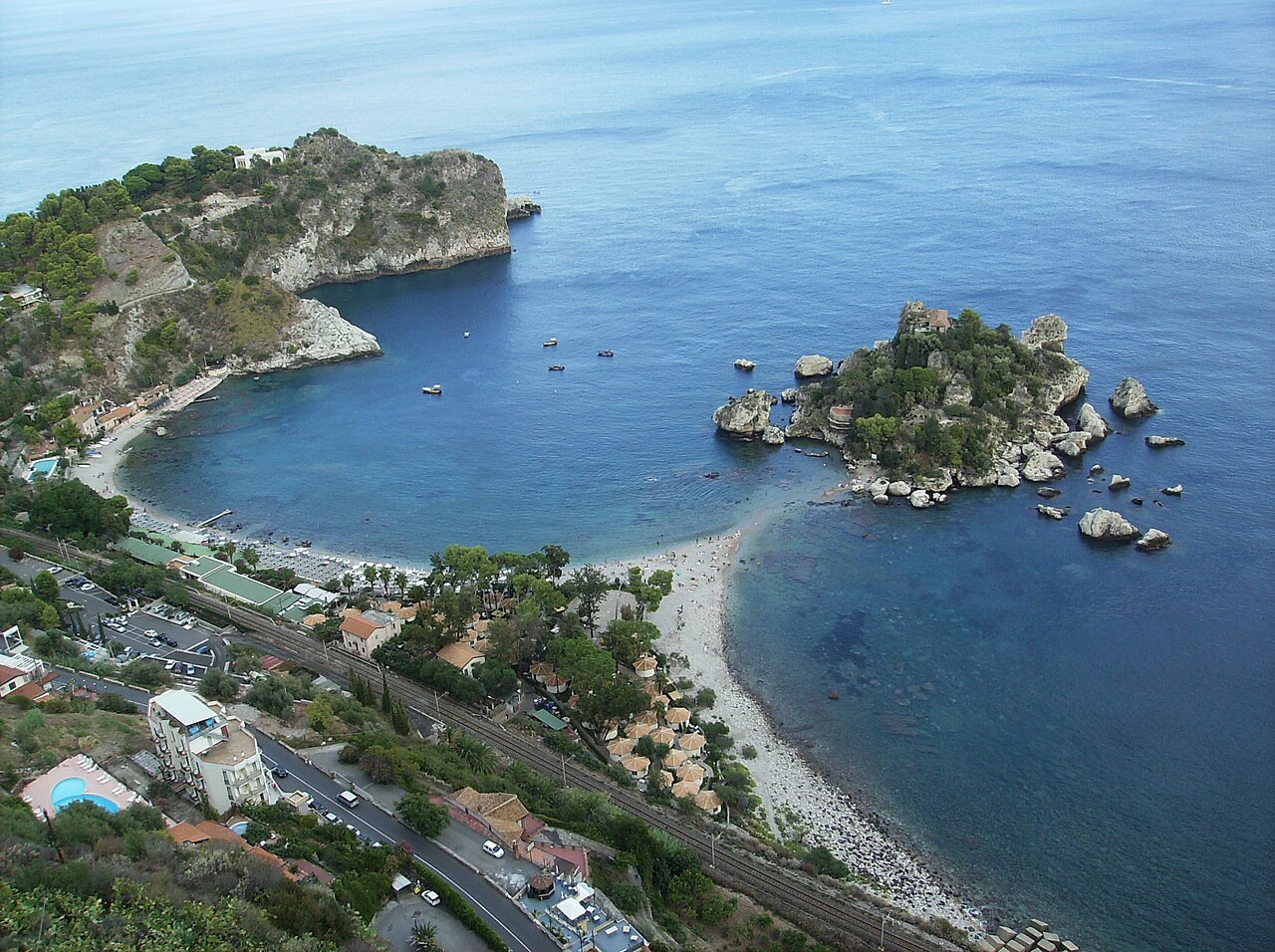
Taormina is famous worldwide, but the actual beaches are below the town, down at sea level. Two options: Giardini Naxos, a wide crescent of sand with lidos and free sections, family-friendly and well-served; and Isola Bella, a tiny pebble beach in a sheltered cove with a small island connected by a sandbar at low tide. Isola Bella is a nature reserve — entry is free, and the snorkelling is the best you’ll find on the east coast without a boat.
Getting there from Catania: train to Taormina-Giardini station (40 minutes, €4.50), then a 10-minute walk to Giardini Naxos or the cable car up to Taormina followed by a bus down to Isola Bella. If you’re planning a day in Taormina, combining the town with a swim at Isola Bella is the natural move — we cover the full itinerary in our 7-day Sicily itinerary.
Abxbay · CC BY-SA 4.0
Fontane Bianche and Arenella (Syracuse area)
About 15 km south of Syracuse, Fontane Bianche is the beach that makes first-time visitors say “this doesn’t look like Italy”. Fine white sand (the name means “white springs” — fresh water seeps through the limestone), shallow turquoise water that stays knee-deep for 20 metres out, a gentle curve of coast sheltered from the wind. When we have friends visiting from northern Europe and they want one perfect beach day, Fontane Bianche is where we send them.
Fontane Bianche has both lido sections (€18–25 per couple) and a good-sized free area on the southern end. The village behind the beach has a few restaurants and a minimarket. From Catania, it’s about 80 minutes by car or train to Syracuse plus a local bus. Combine it with a morning exploring Ortigia, Syracuse’s island old town, for a perfect day trip.

Davide Mauro · CC BY 2.0
Vendicari and Calamosche (nature reserves)
If the lido scene isn’t for you, these two nature reserves between Noto and Pachino are the antidote. Vendicari is a wetland and coastal reserve with several access points leading to different beaches — the main one (Spiaggia di Vendicari) involves a 15-minute walk from the car park through low scrubland fragrant with rosemary and thyme. You emerge onto a crescent of golden sand backed by the crumbling walls of an abandoned tonnara (tuna processing plant). Between November and March, flamingos feed in the lagoons behind the beach — a surreal contrast to the summer seaside scene.
Calamosche, accessible from the southern entrance of Vendicari, is a sheltered cove tucked between two rocky headlands. The 20-minute walk from the car park — flat, easy, through coastal scrub — filters out anyone who isn’t serious about their beach day. What you find at the end is a pocket of sand maybe 200 metres wide, water so clear you can count the pebbles at 3-metre depth, and near-total silence. No facilities at all — bring water, food, an umbrella, and everything you’ll need. In August it can still get busy by midday, but in June or September you might share it with a dozen people. Both reserves are about 2 hours from Catania by car, or reachable by train to Noto plus a taxi (€15–20).

isabella · CC BY 3.0
Plemmirio (south of Syracuse)
The Plemmirio marine reserve, on the Maddalena peninsula just south of Syracuse, is one of the best snorkelling spots on the Sicilian coast. The coastline here is rocky rather than sandy, with natural pools carved into the limestone and underwater caves visible just below the surface. The water clarity is exceptional — on calm days you can see 15 metres down.
Access is via several small inlets along the coast road. There is a modest entrance fee to the reserve (€3–5 per person), and the facilities are basic — just a small seasonal bar at the main entrance. The trade-off is that you are swimming in a genuine marine protected area. From Catania, it is about 75 minutes by car or a train to Syracuse plus a bus to Plemmirio.
Best beaches in western Sicily
The west coast is a different character entirely: more African in feel, with long sandy beaches, lagoon-like shallows, and ancient ruins nearby. It’s a 3-hour drive from Catania or a short transfer from Palermo airport.
San Vito Lo Capo and Riserva dello Zingaro
San Vito Lo Capo consistently tops “best beach in Sicily” lists, and the reputation is earned. A wide arc of white sand curves beneath Monte Monaco — a sheer limestone cliff that turns gold in the evening light. The water is Caribbean-blue and stays shallow for a good distance, making it excellent for families. The town behind the beach is small, pedestrianised in summer, and entirely geared towards seaside life: gelaterias, fish restaurants, and couscous joints (the Arab-Norman influence runs deep in western Sicily, and San Vito’s couscous is the real thing — not a tourist adaptation). In September, the town hosts the Cous Cous Fest, a week-long international festival where chefs from across the Mediterranean compete.
Next door, the Riserva dello Zingaro is Sicily’s first nature reserve: 7 km of protected coastline with a series of coves accessible only on foot (the main trail from the north entrance takes about 20 minutes to the first cove). No roads, no lidos, no buildings. Just sea, macchia, and rock. If you value quiet and don’t mind walking, Zingaro is unmissable.

Mboesch · CC BY-SA 4.0
Mondello and Scala dei Turchi
Mondello is Palermo’s beach, a 15-minute drive from the city centre. It’s a proper seaside resort with Art Nouveau bathing houses, lidos, street food stalls, and families from Palermo who’ve been coming here for generations. The water is clean and the setting — a bay between two headlands — is lovely. If you’re flying into Palermo, this is your easiest beach day.
Further south, near Agrigento, Scala dei Turchi is a white marl cliff that steps down into the sea like a natural staircase. It’s as photogenic as it looks in pictures, and the small beach at its base is swimmable. Visit in the late afternoon for the best light. Note: access to the cliff itself is sometimes restricted for conservation reasons — check locally before going.

Anna Pujol · CC BY 3.0
Best beaches in northern Sicily
The Tyrrhenian north coast is less visited by international tourists but has some excellent spots. Cefalù, about 70 km east of Palermo, is the star: a long sandy beach directly below the town’s Norman cathedral and Arab-Norman old town. The combination of a proper historic town and a walkable beach is rare in Sicily. The downside is that Cefalù gets very crowded in August.
Further east towards Messina, the beaches at Tindari (below the ancient Greek theatre and the sanctuary) are unusual: a series of lagoon-like pools formed by shifting sandbars. The landscape is unlike anything else in Sicily. Reachable by car or by train on the Palermo–Messina line.
Using Catania as your beach base
From Catania you can also reach the Aeolian Islands — start with Lipari, the largest on a long day out — Vulcano has a 300-metre black-sand beach (see our Vulcano Sicily guide) reachable via a direct bus to Milazzo plus a 45-minute hydrofoil.
If you’re planning a beach holiday in Sicily and want flexibility without moving accommodation every two days, Catania is the most practical base on the east coast. Here’s why we’re biased — and why the bias happens to be justified.
Airport access: Catania Fontanarossa is Sicily’s main airport with direct flights from London, Manchester, Dublin, Berlin, Munich, Amsterdam, and most European cities. You’re on the beach within 30 minutes of landing.
Day-trip reach: from a Catania apartment, every beach in this guide’s eastern section is within 90 minutes. Even Fontane Bianche (the furthest) is a comfortable day trip. Taormina and Aci Trezza are under 30 minutes. For a ranked breakdown of every option with travel times, see our dedicated guide to the best beaches near Catania.
Evening life: unlike pure beach towns that shut down at sunset, Catania has a proper food and nightlife scene year-round. After a day at the beach, you come back to a real city with excellent neighbourhoods to explore.
Cost: Catania apartments run €60–120/night for a well-located two-bedroom — significantly less than Taormina (€120–250) or Syracuse’s Ortigia (€90–180). The savings add up over a week.
| Beach | Type | From Catania | Lido cost (2 pax) |
|---|---|---|---|
| La Playa, Catania | Sand / lido + free | 15 min bus | €25–35 |
| Aci Trezza | Volcanic rock | 25 min bus | Free (no lido) |
| Giardini Naxos | Sand / lido + free | 50 min train | €30–45 |
| Isola Bella | Pebble / reserve | 50 min train | Free (reserve) |
| Fontane Bianche | White sand / lido + free | 80 min car | €35–50 |
| Vendicari | Nature reserve | 2 hr car | Free (reserve) |
| San Vito Lo Capo | White sand / lido + free | 3 hr car | €30–40 |
| Cefalù | Sand / lido + free | 2.5 hr car | €25–35 |
When to visit
Shoulder season (October-November) is the value sweet spot if your priority is mixing some swim-friendly days with cheaper accommodation and crowd-free archaeology. October still allows full beach days through about 20 October; November pivots into cultural travel with the occasional warm-day dip. See our Sicily in November guide for the November-specific weather, events and packing detail.
June and September are the sweet spot. Water temperatures are comfortable (22–25°C), the beaches aren’t yet packed, lido prices are lower, and flights are cheaper than in peak season. June mornings on the east coast are genuinely perfect — warm sun, calm sea, empty beaches before 10 am.
If your beach holiday is also a wedding trip, see our Sicily honeymoon guide for a 10-day plan that pairs honeymoon beach days at La Plaja and Fontane Bianche with Taormina, Etna wine and Ortigia from a single Catania apartment.
July and August are peak season. Everything is open, the water is at its warmest (26–28°C), but beaches — especially free ones near cities — get crowded from mid-morning. Lidos are the practical choice in high season because they guarantee your spot. Book popular lidos in advance for weekends.
May and October are shoulder months. You can swim (water around 19–22°C), some lidos are open, and you’ll have nature reserves almost to yourself. Not every day will be beach weather, but the warm ones are special. Locals swim well into October on the east coast.
Practical tips
Lido booking: most lidos take walk-ins, but in August weekends, popular spots sell out by 10 am. Some accept bookings via phone or WhatsApp — look for the lido’s Instagram page, which usually has contact details and pricing.
Getting around: a car gives you the most flexibility, especially for nature reserves and western Sicily. For east coast beaches only, public transport works: Catania’s urban buses reach La Playa and Aci Trezza, and Trenitalia regional trains run to Giardini Naxos, Syracuse, and beyond (€4–8 per journey). Buy train tickets on the Trenitalia app to avoid queues.
What to bring: if you’re going to free beaches or reserves, bring: water shoes (volcanic rock is sharp), a beach umbrella or shade sail, a cooler bag with water and snacks, reef-safe sunscreen (SPF 50 — the Sicilian sun is serious), and a dry bag for valuables. Lido-goers need far less — just a towel and sunscreen.
Safety: currents are generally mild on the east coast, but the Strait of Messina (north-east tip) can be tricky. On free beaches without lifeguards, don’t swim alone or in rough conditions. The sea around volcanic platforms (Aci Trezza, Aci Castello) can be deep right from the edge — supervise children closely.
Food and drink at the beach
One of the genuinely good things about beach culture in Sicily is the food. Lidos almost always have a bar serving granita (the Sicilian iced drink — try lemon or almond), arancini, panini, and cold beer. Some of the larger lidos near Catania and Giardini Naxos have full kitchens serving pasta and grilled fish at lunch.
At free beaches, bring a cooler with water, fruit, and sandwiches — and perhaps a bottle of local white wine for the afternoon. The tradition of the beach picnic is alive and well in Sicily, and nobody will look at you strangely for unpacking a three-course lunch on your towel. If anything, your neighbours will offer you some of theirs.
Beaches on the map
Every beach in this guide is marked on our interactive map. The blue pins are east coast beaches (reachable from Catania as day trips), the orange pins are western and northern Sicily.
Travelling with kids? Cefalù, San Vito Lo Capo and Mondello are the textbook family beach choices in Sicily — sandy, shallow-entry water, walkable old towns or city access. The audience-specific guide is our Sicily family holiday guide.
FAQ
What is the best month for a beach holiday in Sicily?
June and September offer the best balance of warm sea (22–25°C), uncrowded beaches, and reasonable prices. July and August are hotter and busier but guarantee the warmest water (26–28°C). May and October are possible but less reliable.
Is the east or west coast of Sicily better for beaches?
Both are excellent but different. The east coast (Catania to Syracuse) has more variety — volcanic rock, sandy beaches, and nature reserves — plus better transport links. The west coast (Trapani, San Vito Lo Capo) has wider sandy beaches and more of a Caribbean feel. If you only have a week and want to combine beach with culture and city life, the east coast from a Catania base is more practical.
How much does a day at a Sicilian lido cost?
A typical lido charges €15–25 per person for a sunbed and umbrella for the full day. Catania’s La Playa is at the cheaper end (€12–18/person), while popular lidos near Taormina or Syracuse can reach €25–30. Most lidos include showers and changing rooms. Free beaches are always available alongside the lido sections.
Can you reach beaches from Catania without a car?
Yes, several. La Playa is reachable by city bus (line D, 15 minutes). Aci Trezza is 25 minutes by BRT bus. Giardini Naxos and Syracuse are on the Trenitalia regional train line (40–80 minutes, €4–8). For nature reserves like Vendicari or Calamosche, you’ll need a car or a taxi from the nearest train station.
Are Sicilian beaches safe for children?
Most sandy beaches — especially La Playa, Giardini Naxos, Fontane Bianche, and San Vito Lo Capo — have gentle slopes and shallow water near the shore, making them suitable for families. Lidos with lifeguards are the safest option. Volcanic rock beaches (Aci Trezza) have deep water right from the edge and are less suitable for young children. Always check for a lifeguard presence on free beaches.
What is the best area to stay in Sicily for a beach holiday?
Catania is our recommendation for a beach-focused trip on the east coast: it has its own city beach, excellent transport links to beaches in every direction, an international airport, and the liveliest food and nightlife scene on the coast. For western Sicily, Trapani or San Vito Lo Capo make good bases. For a deeper comparison, see our guide to the best areas to stay in Sicily.
Do I need to book lidos in advance?
In June, September, and on weekdays, walk-ins are fine. On August weekends at popular lidos (Fontane Bianche, Giardini Naxos), booking by phone or WhatsApp the evening before is advisable. Most lidos post contact details and prices on their Instagram page.
Which is the best beach resort in Sicily?
Giardini Naxos (Taormina area) is the east coast’s top resort: wide sandy beach, well-equipped lidos, train from Catania in 40 minutes. San Vito Lo Capo (Trapani) is the west coast answer — white sand, shallow turquoise water, direct summer buses from Palermo airport. For something quieter, Fontane Bianche (Syracuse) combines fine white sand with a small village and no resort-town crowds.
Why is Sicily turning away tourists?
Specific hotspots have introduced limits to manage overcrowding, not the island as a whole. Taormina caps daily coach access in summer; Vendicari nature reserve requires a free online reservation in July–August (capacity ~800 visitors/day); Scala dei Turchi periodically restricts access to the cliff itself for conservation. Arriving before 9 am or visiting in June or September side-steps all three issues.
The information in this guide was correct at the time of writing. Data can change from season to season without notice: before you travel, always check the official channels and websites for updates. We review this guide periodically, but the official channels are always the authoritative source. We also cannot guarantee that the suggested routes or the attractions described are always reachable or accessible: roads, trails and sites may be closed, damaged, altered or unsafe. Assessing the practicability and safety of itineraries and attractions always remains your own responsibility.