

Day trips from Catania, Italy, unlock most of eastern Sicily within a 90-minute drive. From the city, Mount Etna is under an hour away, Taormina is 40 minutes by direct train, and the UNESCO Baroque towns of Val di Noto are 1-2 hours south. Five nights in central Catania allow comfortable coverage of the four most popular day trips without changing accommodation. Most of these day trips can be done without a car, using regional trains, scheduled buses, and shared shuttle transfers from the city centre. Cruise passengers with a single day ashore should also check our Catania cruise port guide, with shore excursion comparisons and time-blocked itineraries. Distances, durations, ticket prices, and bus numbers below are accurate as of 2026 — see the disclaimer at the end of the article.
Catania sits on the Ionian coast at the foot of Mount Etna, with Catania-Fontanarossa airport as the gateway to eastern Sicily. Within 100 km of the city there are five UNESCO World Heritage sites. The ten destinations in this guide cluster around three geographic axes: the Etna volcanic massif inland, the Ionian coast running north toward Messina, and the Val di Noto Baroque ridge to the south.
What are the best day trips from Catania?
The ten best day trips from Catania, Sicily, are Mount Etna (30 km), Taormina (53 km), Syracuse with Ortigia (65 km), Noto (90 km), Modica with Ragusa Ibla (105 km), Aci Castello and Aci Trezza (12 km), Caltagirone (70 km), Alcantara Gorge (60 km), Villa Romana del Casale (130 km), and the Valley of the Temples in Agrigento (165 km). Six of them are reachable by train or scheduled bus, three require a car, and one (Mount Etna) is best done by tour or by the single daily AST bus from Catania Centrale.
The table below summarises distances, drive and public-transport times, and the realistic visit duration for each destination. The order follows distance from Catania.
| Destination | Distance | Drive time | Public transport | Visit duration |
|---|---|---|---|---|
| Aci Castello + Aci Trezza | 12 km | 25 min | Bus AMTS 534 (40 min) | Half day |
| Mount Etna (Rifugio Sapienza) | 30 km | 1 h | Bus AST (1 daily) | Half-full day |
| Taormina | 53 km | 55 min | Train 40 min, €4-7 | Full day |
| Alcantara Gorge | 60 km | 1 h 5 min | Bus + walk (limited) | Half-full day |
| Syracuse + Ortigia | 65 km | 55 min | Train 1 h 15, €9-12 | Full day |
| Caltagirone | 70 km | 1 h 15 min | Train 2 h | Full day |
| Noto | 90 km | 1 h 15 min | Bus Interbus 1 h 30 | Half-full day |
| Modica + Ragusa Ibla | 105 km | 1 h 30 min | Difficult by bus | Full day |
| Villa Romana del Casale | 130 km | 1 h 50 min | Car required | Full day |
| Valley of the Temples | 165 km | 2 h | Car required | Full day |
What is the most beautiful town near Catania?
Taormina is consistently named Sicily’s most beautiful town near Catania: perched on a cliff above the Ionian Sea, it combines a 3rd-century BC Greek Theatre, Corso Umberto’s medieval streets, and views of Etna that change with every season. If Baroque architecture is your priority, Noto (90 km south-west) and Ragusa Ibla are the strongest alternatives, both UNESCO-listed. Syracuse’s Ortigia island wins for ancient Greek history layered over Baroque buildings right on the sea. The “most beautiful” answer depends on what you’re after — all three are on this list for good reason.
Mount Etna

Patrice78500 · CC BY-SA 4.0
- Location
- Piazzale Rifugio Sapienza, Nicolosi Maps
- Site
- rifugiosapienza.com
- Essential fact
- Europe’s highest active volcano at 3.357 m, UNESCO 2013
- Price
- Free | €75 (summit guided tour)
Mount Etna is Europe’s highest active volcano (3.357 m, UNESCO 2013) and the closest day trip from Catania. The Etna Sud entrance at Rifugio Sapienza (1.923 m) sits 30 km from the city, reachable in 1 hour by car or by a single daily AST bus from Catania Centrale. Most visitors choose a half-day; a full day allows the summit hike with a vulcanological guide.
Mount Etna highlights
The Silvestri Crateri are a cluster of secondary cones formed during the 1892 eruption, walkable on a free 30-minute loop trail directly from the Rifugio Sapienza car park. The Funivia dell’Etna cable car climbs from Rifugio Sapienza to 2.504 m in fifteen minutes; from there a 4×4 jeep service plus walking continues to 2.900 m, only with a vulcanological guide and only when seismic conditions allow. Average summer temperature at the Rifugio sits around 11 °C; at the summit craters it drops close to 0 °C even in August. UNESCO inscribed Etna in 2013 as a natural site.
Etna by bus from Catania
Reaching Mount Etna by bus from Catania centre is possible but rigid. The AST service to Rifugio Sapienza departs Catania Centrale at 08:15 and returns from the volcano at 16:30, leaving roughly seven hours on the south flank — enough for the Silvestri craters, the cable car, and the guided minivan to 2.900 m. The stop is on Piazza Giovanni XXIII, a five-minute walk from Stesicoro. The single daily round trip costs about €6.60 each way and is sold on board. As a flexible alternative, several Etna shared shuttle and minivan tours offer pickup at central Catania hotels in the 07:30-08:30 window and return between 13:30 and 18:00 depending on half-day or full-day formula.
Circumetnea railway: a scenic no-car day trip
For a scenic no-car day trip around the volcano, the Circumetnea railway loops 110 km around Etna in vintage narrow-gauge trains, linking Catania Borgo to Riposto via Randazzo through lava fields, citrus groves, and pistachio villages on the volcano’s western flank. A round trip with stops in Randazzo and Bronte fills a full day and runs entirely on public transport from Catania.
Etna by tour vs independently
A half-day group tour from Catania costs €60-80 per person and includes hotel pickup, the jeep transfer to 2.500 m, the Silvestri walk, and a tasting stop on the return. A full-day tour with the summit hike runs €100-130. Independent visitors drive to Rifugio Sapienza, pay the cable car ticket separately, and arrange the guided summit hike on site at the Funivia base. The single daily AST bus is workable for the half-day option but offers no flexibility on return time. For a full Italian-language reference, see the guida completa all’escursione sull’Etna da Catania.
Taormina

Pipito93 · CC BY-SA 4.0
- Location
- Via Teatro Greco 1, Taormina Maps
- Site
- parconaxostaormina.com/taormina/teatro-antico-taormina
- Essential fact
- Greek theatre 3rd c. BC, seats 5.000, hosts the summer Taormina Arte concert season
- Price
- Free | €14 (Greek theatre)
Taormina is the most popular day trip from Catania — 53 km north on the Ionian coast, 40 minutes by direct regional train (€4–7) or 55 minutes by car on the A18 motorway. Three landmarks fill a full day: the Greek theatre dating from the 3rd century BC, the pedestrian Corso Umberto, and the Isola Bella beach reserve at the foot of the cliff.
Reaching Taormina by train and bus
From Catania Centrale, Trenitalia regional trains reach Taormina-Giardini station in 35-50 minutes for €4.60, with hourly departures from roughly 06:00 to 21:30. The station sits at sea level in Giardini Naxos, so a short Interbus shuttle or the cable car from Via Pirandello is required to climb 200 m up to Taormina old town. The direct alternative is the Interbus coach from Catania bus terminal next to Catania Centrale: roughly 1 h 20 to Taormina Porta Messina (town centre, no further transfer), with departures every 30-90 minutes and a return fare around €9.40. The bus saves the cable-car leg but is more exposed to summer coastal traffic; the train is faster and more reliable in peak season.
How do you get from Catania to Taormina for a day trip?
There are four practical options for getting from Catania to Taormina on a day trip. The train is the default for non-drivers: Trenitalia regional services run from Catania Centrale to Taormina-Giardini in about 40 minutes, frequencies hover at one to two trains an hour during the day, and tickets cost €4-7 one way. The station sits on the coast 200 m below the town: a funicular cable car or a Mobil-Bus shuttle climbs to Porta Messina in about 5-10 minutes for €3-4. The Interbus coach from Catania bus terminal takes 1 h 15, runs roughly hourly, and costs €5.50; it stops directly in town. By car, the A18 motorway covers the distance in 55 minutes with a €2.20 toll; parking at Lumbi (€15/day) connects to a free shuttle into the centre. A private transfer takes 45 minutes door-to-door and costs €70-90 each way for two or three people. For airport-to-Taormina transfers specifically, see the dedicated guide on Catania airport to Taormina transfer options. For everything to do in town, see things to do in Taormina.
Taormina highlights
The Greek theatre dates from the 3rd century BC, was rebuilt by the Romans, and seats around 5.000 spectators; today it hosts the summer Taormina Arte concert season. From the upper tier, the Etna profile fills the southern bay — the most photographed view in Sicily. Corso Umberto, the pedestrian artery, runs about 800 m between Porta Messina and Porta Catania, lined with palaces, churches, and the panoramic terrace of Piazza IX Aprile. The Isola Bella nature reserve at the base of the cliff is reachable on foot via Via Pirandello and a steep stair, or by the same cable car that descends from the centre. For a full single-day plan, see the complete guide to Taormina in one day.
Syracuse and Ortigia

Ludvig14 · CC BY-SA 4.0
- Location
- Via Luigi Bernabò Brea, Siracusa Maps
- Site
- parchiarcheologici.regione.sicilia.it/siracusa-eloro-villa-tellaro-akrai
- Essential fact
- UNESCO 2005. Ortigia Duomo built on a 5th c. BC Greek temple of Athena
- Price
- Free | €17 (Neapolis Park combined)
Syracuse is the second essential day trip from Catania — 65 km south, 55 minutes by car or 1 h 15 by regional train (€9–12). The ancient Greek city splits into two visit zones: the Neapolis Archaeological Park on the mainland (Greek theatre, Ear of Dionysius, Roman amphitheatre) and the island of Ortigia with the Baroque Duomo and the freshwater Fountain of Arethusa. UNESCO inscribed Syracuse and the Necropolis of Pantalica in 2005.
Syracuse by train from Catania
Reaching Syracuse by train from Catania is the simplest public-transport day trip in eastern Sicily. Trenitalia regional services run direct from Catania Centrale to Siracusa station in roughly 1 h 15-1 h 30 for €9.30 one way, with about eight departures per weekday between 06:00 and 20:00. From Siracusa station, the historic island of Ortigia is a 20-minute walk south along Corso Umberto, or a 6-minute taxi ride. No further transfer is required to reach the Aretusa fountain, the Duomo, and the Maniace Castle on foot.
Neapolis Archaeological Park
The Greek theatre at Neapolis dates from the 5th century BC and still hosts classical drama every May to early July under the INDA seasonal programme. Adjacent are the limestone Ear of Dionysius cave (a 23-m-high acoustic chamber once used to imprison political dissidents, according to the legend recorded by Caravaggio in 1608), the Roman amphitheatre, and the rectangular altar of Hieron II that stretches 198 m. The park covers around 240.000 m² and the visit takes 2 hours at a comfortable pace.
Ortigia island
Ortigia is a 1 km² island connected to the mainland by two bridges and walkable in 2-3 hours. The Duomo was built directly on the columns of a 5th-century-BC Greek temple of Athena, still visible in the side aisles. Piazza Duomo is one of the finest open Baroque squares in Sicily, the result of the post-1693 reconstruction. The Fountain of Arethusa is a freshwater spring that flows into the saltwater port, with native Sicilian papyrus growing in the basin. The 13th-century Maniace Castle closes the southern tip of the island. For travellers building a longer itinerary, see the 7-day Sicily itinerary using Catania as a base.
Noto
Noto is the showcase town of the Val di Noto Sicilian Baroque (UNESCO 2002), rebuilt after the 1693 Val di Noto earthquake. Lying 90 km south of Catania, Noto is reached in 1 h 15 by car along the SS115 or in 1 h 30 by Interbus coach from Catania bus terminal. Sandstone façades glow gold at sunset, the recommended moment to visit.

Federico Alfio Maria Vinci · CC BY-SA 4.0
The visit centres on Corso Vittorio Emanuele, the straight Baroque axis that connects the three civic squares. The Cathedral of San Nicolò dominates the central piazza; its dome collapsed in 1996 and was rebuilt by 2007. Palazzo Nicolaci dei Principi di Villadorata on Via Nicolaci stands out for the grotesque human and animal figures sculpted under the balconies. The bell tower of San Carlo al Corso (€2 climb) gives the best rooftop view across the cathedral and the surrounding ridge.
Noto was rebuilt between 1693 and 1750 in a single planned phase by the architects Rosario Gagliardi and Vincenzo Sinatra, which explains the unusually coherent Baroque style. The town is one of eight Val di Noto Baroque towns inscribed by UNESCO in 2002, alongside Caltagirone, Militello in Val di Catania, Catania itself, Modica, Palazzolo Acreide, Ragusa, and Scicli.
The seasonal highlight is the Infiorata di Noto, a flower-petal carpet festival held on Via Nicolaci every third Sunday of May; visitors should book accommodation months ahead for that weekend. For a full eastern-Sicily plan including Noto, see the 7-day Sicily itinerary using Catania as a base.
Noto by train (with change)
By train, Noto requires a change at Syracuse: the full Trenitalia journey runs roughly 1 h 50 to 2 h 10 for around €11.40, with three to five daily departures and reduced frequency on Sundays. The Noto station sits about 1 km downhill from the historic core, a 15-minute walk uphill to the Porta Reale arch. The simpler alternative is the Interbus AST coach from Catania bus terminal: roughly 1 h 30 directly to Noto centre, with several daily departures and a fare around €8.40 each way. The bus is the recommended option for day-trippers who want to skip the station transfer.
Modica and Ragusa Ibla

Hein56didden · CC BY-SA 4.0
- Location
- Salita Duomo 1, Ragusa Maps
- Essential fact
- UNESCO Val di Noto 2002. Duomo di San Giorgio Ragusa by Rosario Gagliardi 1738–1775
- Price
- Free | €5 (chocolate tasting)
Modica and Ragusa Ibla are the inland gems of the Val di Noto Baroque — 105 km from Catania, 1 h 30 by car. Bus connections from Catania are difficult and trains require a change at Syracuse with a total journey of three hours or more, so a car is effectively required. Modica is famous for its cold-process chocolate based on an Aztec recipe brought by the Spanish; Ragusa Ibla for the Duomo di San Giorgio and its hilltop Baroque skyline. UNESCO 2002.
Modica and the Aztec chocolate
Modica is built across two converging valleys, with steep stairs connecting the upper and lower town. The local chocolate tradition uses a cold-process method: cocoa paste is mixed with sugar at temperatures below 40 °C, without conching, which leaves a granular texture and pure cocoa flavour. The recipe entered Sicily under Spanish rule, with parallels to Mesoamerican preparation. The historic chocolatiers Antica Dolceria Bonajuto (founded 1880) and Antica Dolceria Rizza on Corso Umberto run free tastings. The Duomo di San Giorgio Modica, perched above a long staircase, and the lower-town Duomo di San Pietro are the principal Baroque churches. Palazzo Polara appears as Inspector Montalbano’s home in the long-running RAI series, drawing literary tourism.
Ragusa Ibla
Ragusa Ibla is the lower, historic half of a town that splits in two — Ragusa Superiore on the modern plateau, Ibla on the older spur reached by 340 stone steps or by car around the ridge. Duomo di San Giorgio by Rosario Gagliardi (1738-1775) is widely considered the masterpiece of Sicilian Baroque architecture, with its convex façade rising from a divided staircase. The Giardino Ibleo terrace gardens at the eastern tip of the spur offer Etna views on clear days. Ibla counts 18 churches in less than 1 km², all rebuilt after the 1693 earthquake destroyed the older medieval town. For a full Italian-language guide, see the guida completa a Ragusa Ibla.
Aci Castello and Aci Trezza

gnuckx · CC BY 2.0
- Location
- Piazza Castello, Aci Castello Maps
- Site
- acicastello.turismo.comunelive.it
- Essential fact
- Norman castle built 1076 on lava rock. Faraglioni dei Ciclopi linked to Polyphemus in Odyssey IX
- Price
- Free | €3–20 (museum and boat)
The Riviera dei Ciclopi north of Catania is the easiest day trip in this guide: Aci Castello with its Norman castle on a black lava rock (12 km, 30 min by AMTS bus 534) and Aci Trezza with the Faraglioni dei Ciclopi sea stacks tied to Homer’s Polyphemus legend. Half a day combined is enough for a relaxed visit and a seafood lunch at the harbour.
Aci Castello
The Norman castle of Aci Castello was built in 1076 on a black lava promontory that juts into the Ionian Sea. The castle housed a small civic museum (paleontological and natural history collections) and offers a panoramic walkway around the rock. Verga set I Malavoglia (1881) on this stretch of coast — an early Italian realist novel about a fishing family from nearby Aci Trezza, still studied in Italian schools.
Aci Trezza
The Faraglioni dei Ciclopi are eight basalt sea stacks rising up to 70 m from the water just offshore from Aci Trezza. The local legend identifies them with the rocks the cyclops Polyphemus throws at Odysseus in book IX of the Odyssey. The cluster forms the Marine Reserve of the Cyclops Islands, established in 1989. Boat trips from the small harbour cost €15-20 per person and include a stop at Isola Lachea for snorkelling. Aci Trezza is also the village of the Malavoglia: the fictional Toscano family takes its name from the trezzoti dialect for the unlucky. Planning a swim day? Our guide to the beaches near Catania covers Aci Trezza and every other east-coast option.
Caltagirone
Caltagirone is the ceramic capital of Sicily — 70 km southwest of Catania, 1 h 15 by car. The Scalinata di Santa Maria del Monte (142 maiolica-tiled steps) is the photographic icon: each step bears a different glazed pattern, none repeated, documenting the local ceramic tradition from the medieval period to the present.

Carlo Pelagalli · CC BY-SA 3.0
The town sits on a hill at 600 m elevation, with the staircase climbing from the Baroque lower town to the Church of Santa Maria del Monte. The Museo Regionale della Ceramica (€6) holds the most complete collection of Sicilian ceramics, from prehistoric pieces to contemporary work. The local ceramic tradition is documented from the 10th century onward, with strong Arab influence visible in the geometric and floral motifs.
The Festa di San Giacomo on 24 and 25 July transforms the staircase into a luminaria: more than 4.000 oil lamps are arranged in floral patterns that span the full 142 steps. UNESCO included Caltagirone in the Val di Noto Baroque inscription of 2002 alongside Noto, Modica, Ragusa, and Catania. By public transport, Caltagirone is reached by regional train from Catania in about 2 hours; by car the SS417 covers the route in 1 h 15.
Alcantara Gorge
The Alcantara Gorge is a 50-m-deep basalt canyon carved into Etna lava flows, 60 km north of Catania off the SS185. The hexagonal columns are the geological highlight: rapid lava cooling around 8.000 years ago produced the prismatic basalt walls, similar in formation to the Giant’s Causeway in Northern Ireland. In summer, river canyoning and body rafting in the cold water (around 10 °C year round) are the main draws.

Michal Osmenda · CC BY-SA 2.0
Visitors enter either through the private Parco Botanico e Geologico delle Gole dell’Alcantara (entrance €13, includes elevators and changing rooms) or via the free public access from Fondaco Motta, which involves a 224-step descent on foot. Wading and walking in the gorge bed are feasible from April to October; the operator rents waders and helmets in summer. From November to March the river runs too cold and high for entry, so the visit becomes a viewpoint walk only.
A common pairing is to combine Alcantara with Taormina in the same day: the gorge sits between Catania and Taormina off the A18, and a full-day rental covers both. By public transport the gorge is poorly served — the limited Interbus services to Francavilla di Sicilia or Castiglione di Sicilia leave a long walk.
Villa Romana del Casale
Villa Romana del Casale near Piazza Armerina holds 3.500 m² of Roman mosaics from the 4th century AD — the largest collection of Roman mosaics preserved in situ anywhere in the world. UNESCO inscribed the site in 1997. Lying 130 km from Catania, the villa is 1 h 50 by car along the SS117bis; there is no convenient public transport, so the day trip realistically requires a rental car or a private guided tour.
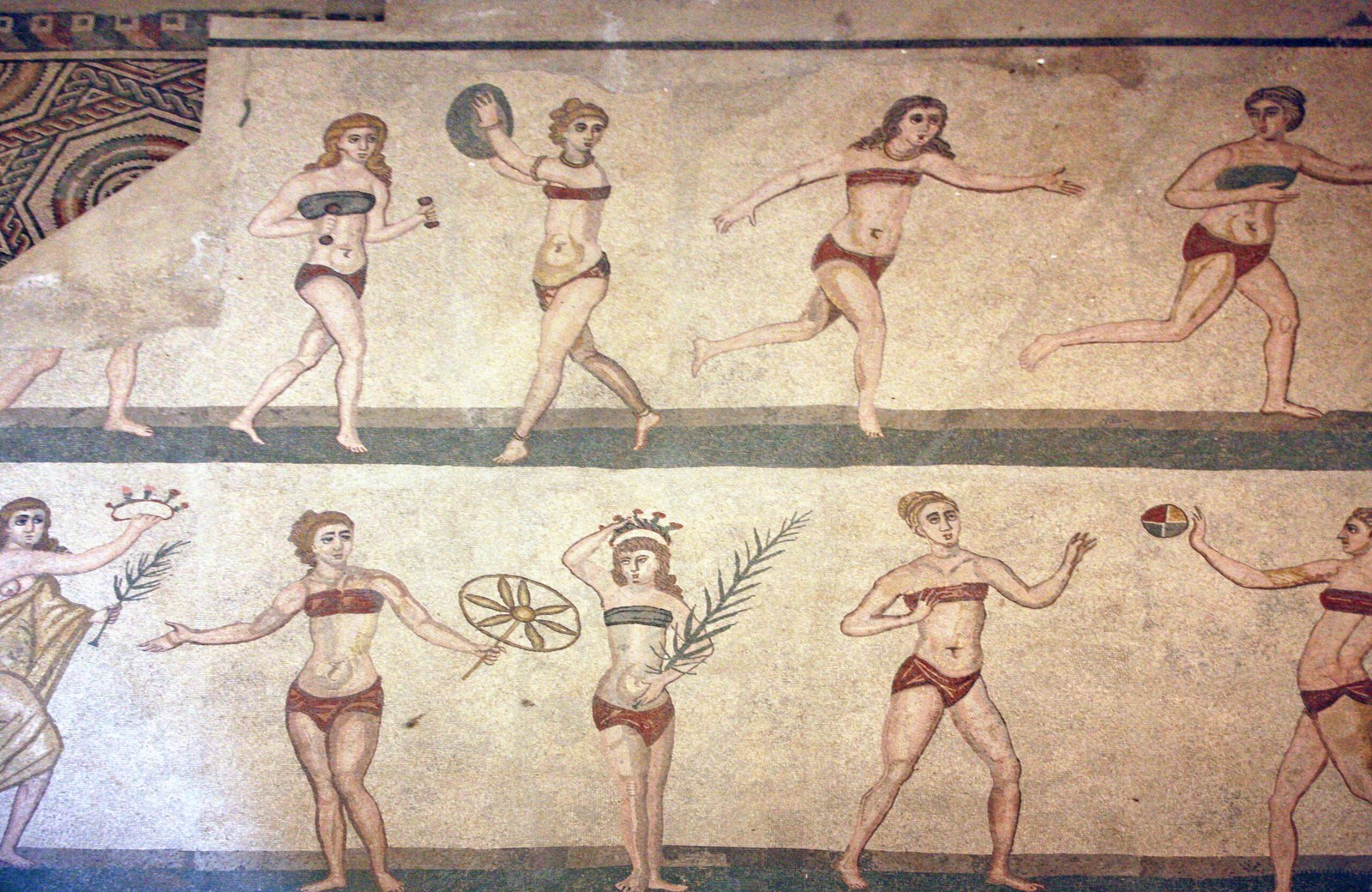
Kenton Greening · Public domain
The mosaic floors cover roughly 50 rooms in the residential quarter of a hunting villa, attributed by most scholars to a senatorial owner, possibly the emperor Maximianus Herculius or a wealthy contemporary. The famous “bikini girls” mosaic shows ten young athletes in two-piece sportswear; other rooms display elaborate hunting scenes (the so-called Great Hunt corridor stretches 65 m), mythological subjects, and geometric panels. Modern walkways suspended above the floor allow circulation without contact.
A combined visit pairs the villa with the town of Piazza Armerina (10 minutes uphill), which retains an Aragonese castle and a Norman cathedral, and with the archaeological site of Morgantina (15 km further), an ancient Sicel-Greek city. Entry to the villa is €12, with the site open year-round; arrival before 10:30 avoids both heat and tour-coach peaks. Schedule a full day for the round trip.
Valley of the Temples
Going further afield: the Aeolian Islands — start with Lipari, the largest are reachable from Milazzo (about 1h30 by direct bus from Catania) and Vulcano in particular can be done as a long day trip — see our Vulcano Sicily guide for the crater hike and ferry timings.
The Valley of the Temples in Agrigento holds the largest concentration of Greek temples outside Greece — UNESCO since 1997. The site sits 165 km from Catania, 2 hours by car along the SS640 — the longest day trip in this guide. The temples line a low sandstone ridge above the modern town, and an early-morning or late-afternoon visit avoids the worst summer heat. After sunset, several temples are floodlit and accessible until late on summer Saturdays.
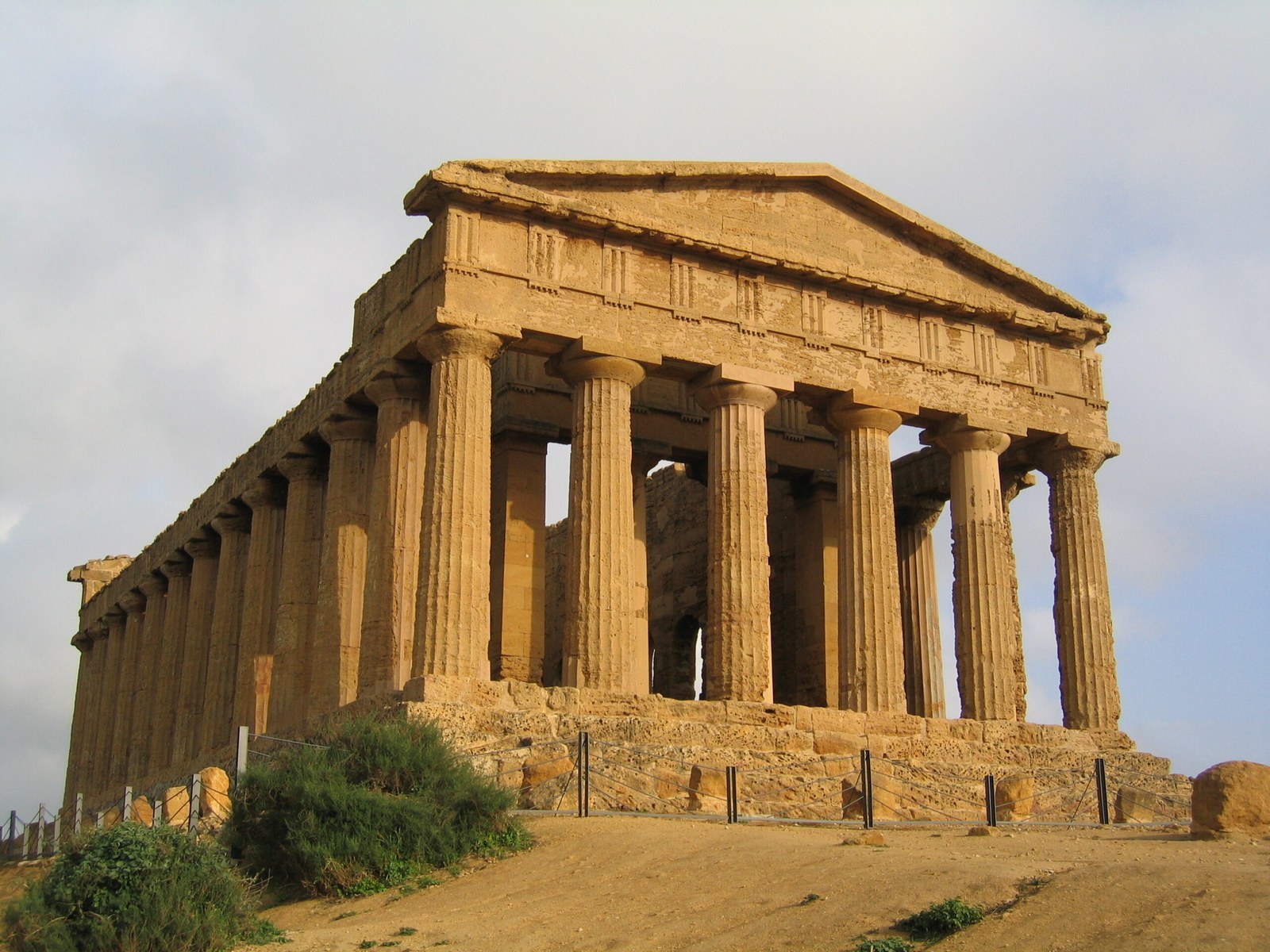
Evan Erickson · Public domain
Eight temples are concentrated in 1.300 hectares of archaeological park. The Temple of Concordia (5th century BC) is the best preserved Greek temple in the world after the Hephaisteion in Athens, owing to its conversion into a Christian basilica in the 6th century AD. The Temple of Hera and the Temple of Heracles flank Concordia along the ridge. The Temple of Olympian Zeus, though collapsed, was the largest Greek temple ever built (113 m by 56 m), originally supported by 38 atlas-figure telamons; one telamon survives reassembled in the museum. The walking distance between the eastern and western gates spans about 3 km; a shuttle service runs back to the start.
Combined entry with the regional archaeological museum costs around €15 and is worth taking, since the museum holds the original sculptural fragments that explain the site. A full day from Catania means roughly 4 hours of total drive plus 5-6 hours on site; departure before 8:00 from Catania is recommended to reach Agrigento before the midday heat.
Can you do day trips from Catania by train?
Yes. Trenitalia regional trains from Catania Centrale reach Taormina-Giardini, Syracuse, and the coastal towns directly, while Noto and Modica require a change at Syracuse. The table below summarises the four most convenient train-accessible destinations with typical 2026 fares and weekday frequencies.
| Destination | Duration | Price | Frequency |
|---|---|---|---|
| Acireale | 15 min | €2.20 | Every 30-60 min |
| Taormina-Giardini | 40-50 min | €4.60 | Hourly |
| Syracuse | 1 h 15 | €9.30 | ~8 daily |
| Noto (change at Syracuse) | 1 h 50-2 h 10 | €11.40 | 3-5 daily |
Do you need a car for day trips from Catania?
No car is needed for most day trips from Catania. Taormina is 40 minutes by direct train, Syracuse 1 h 15 by regional train, and Noto is reached by scheduled bus. Mount Etna is workable by the single daily AST bus or by half-day shared tour from the city centre.
No for 7 of 10 destinations: Taormina, Syracuse, Aci Castello and Aci Trezza, Caltagirone, and Noto are reachable by train or scheduled bus, and Mount Etna can be reached by the single daily AST bus or by group tour. Yes for 3 destinations: Modica with Ragusa Ibla (bus links awkward, train via Syracuse takes 3+ hours), Villa Romana del Casale (no convenient public transport), and the Valley of the Temples in Agrigento (long bus rides with poor frequencies).
| Destination | Train | Bus | Car needed? |
|---|---|---|---|
| Aci Castello + Aci Trezza | — | ✓ AMTS 534 | No |
| Mount Etna (Sud) | — | ✓ AST 1 daily | No (bus or tour) |
| Taormina | ✓ direct, frequent | ✓ Interbus | No |
| Alcantara Gorge | — | partial | Recommended |
| Syracuse + Ortigia | ✓ direct | ✓ Interbus | No |
| Caltagirone | ✓ slow (2 h) | partial | No |
| Noto | — | ✓ Interbus | No |
| Modica + Ragusa Ibla | ✓ via Syracuse 3 h | difficult | Yes |
| Villa Romana del Casale | — | — | Yes |
| Valley of the Temples | — | slow | Yes |
An economy rental car at Catania-Fontanarossa airport costs €30-50 per day plus fuel; collection time is around 30 minutes including the airport shuttle to the off-terminal rental compound. For travellers staying 5+ nights, a workable strategy is to use the train and scheduled buses on coastal day trips (Taormina, Syracuse, Aci villages, Noto) and rent a car for one or two days dedicated to the inland sites — Modica with Ragusa Ibla on one day, Villa Romana del Casale or the Valley of the Temples on another. Parking in central Catania is regulated; for ZTL rules and car-park options before driving out, see the dedicated guide on parking in Catania. Prices verified for 2026; see the disclaimer below.
Can you do Mount Etna as a day trip from Catania?
Yes — Mount Etna is the closest day trip from Catania. A half-day group tour (€60-80) from Catania centre includes pickup, jeep transfer to about 2.500 m, and the Silvestri craters. Independent visits drive 1 hour to Rifugio Sapienza, walk the free crater zone, and optionally ride the cable car (€30+). The single daily AST bus from Catania Centrale fits the half-day option, departing at 8:15 and returning at 16:30.
The day trip splits into four practical formats. The simplest is the Silvestri craters walk: 30 minutes loop on free terrain at 1.900 m, reachable directly from the Rifugio Sapienza car park, suitable for any age. The cable car ascent to 2.504 m adds a 15-minute ride and a short walk on the lava plateau, around €30 return. The summit guided hike to 2.900 m requires the cable car, a 4×4 jeep transfer, and a vulcanological guide; full price €75-100, half-day. The full-day eruption-monitoring tour covers both the south and north flanks with a longer guided walk and tasting stop, €100-130.
The cable car operates 09:00 to 16:30 weather permitting; the summit crater zone closes during eruptive activity, which is monitored daily by the INGV Etna Observatory. For the full Italian-language reference, see the escursione completa sull’Etna da Catania.
How many days do you need in Catania to do all day trips?
If you’re still deciding between Catania and the other Sicilian capital as your base, our Catania or Palermo for day trips guide compares both day-trip radii head-to-head — Catania wins for Taormina, Syracuse and Etna, Palermo wins for Cefalù, Monreale and Agrigento.
Plan 5 nights minimum in Catania to comfortably cover the four most popular day trips. Day 1: Catania city itself. Day 2: Mount Etna half-day with Aci Trezza in the afternoon. Day 3: Taormina full day. Day 4: Syracuse and Ortigia full day. Day 5: choice of Noto, Caltagirone, or rest day. Add 2 nights to include Val di Noto inland (Modica and Ragusa Ibla with a rental car).
Three nights are tight: only one ambitious day trip becomes realistic, typically Etna or Taormina, with one half-day for the Aci villages. Five nights deliver the sweet spot — four day trips covering volcano, coast, and Baroque, with one day for rest or for Catania itself. Seven nights allow the full ten destinations using a rental car for two days dedicated to inland trips (Modica + Ragusa Ibla, then Villa Romana del Casale or the Valley of the Temples).
| Trip length | Day-trip coverage | Verdict |
|---|---|---|
| 3 nights | City + Etna OR Taormina | Tight — 1 day trip realistic |
| 5 nights | City + Etna + Taormina + Syracuse + 1 inland | Sweet spot |
| 7+ nights | All 10 destinations with car for 2 days | Complete coverage |
All ten day trips above return to Catania the same evening. A single central base for the whole stay simplifies logistics and avoids the time cost of relocating accommodation between trips. For a full week-long itinerary built around Catania as a base, see the 7-day Sicily itinerary.
Independent vs guided tour: which is better for day trips from Catania?
Independent travel (train, bus, rental car) is cheaper and more flexible for Taormina, Syracuse, the Aci villages, Noto, and Caltagirone. Guided tours (€55-130) are worth the cost for Mount Etna summit (vulcanological guide required), Alcantara canyoning in summer, and combined wine tours on the slopes of Etna. A mixed strategy works best for stays of 5+ nights.
| Mode | Cost range | Flexibility | Best for |
|---|---|---|---|
| Train / bus | €4-15 per trip | High (frequent) | Taormina, Syracuse, Aci villages, Noto, Caltagirone |
| Rental car | €30-50/day + fuel | Highest | Modica + Ragusa Ibla, Villa Romana, Agrigento |
| Group tour | €55-130/person | Low | Etna summit, Alcantara summer, wine multi-stop |
| Private transfer | €70-200/trip | High | Couples or groups wanting comfort, no driving |
Train tickets are sold at station vending machines (Trenitalia), online via the official Trenitalia app, or through resellers; coach tickets (Interbus, AST) at the bus terminal kiosk or on board for cash. Group tours are sold through hotel desks, dedicated platforms, or directly with operators based in Catania and Nicolosi. Private transfers are quoted by NCC operators with fixed prices for set routes. Prices listed are 2026 estimates; see the disclaimer below.
When to visit: best season for day trips from Catania
April-June and September-October are the best months: temperatures sit at 18-26 °C, crowds are moderate, and accommodation prices stay below summer peak. July and August bring 30-38 °C heat, full Taormina and Aci Trezza, and accommodation premiums; Mount Etna’s altitude stays cool (11 °C at Rifugio Sapienza in August). Winter is mild on the coast (12-16 °C) but Etna closes above 1.900 m with snow from December to March.
Seasonal events worth planning around: the Carnival of Acireale (the largest in Sicily) runs in February with parades along Via Vittorio Emanuele; the Feast of Sant’Agata in Catania itself fills the city centre on 3-5 February; the Infiorata di Noto takes place on the third Sunday of May with a flower carpet on Via Nicolaci; the Greek-theatre season at Syracuse runs from May to early July; the Bronte pistachio festival sits in the first week of October. Etna eruption activity is unpredictable but more visible at night — local operators run sunset and night tours when activity allows. For a full month-by-month perspective on Sicily in autumn, see visiting Sicily in October.
Where to stay in Catania (your base for day trips)
Central Catania (Via Etnea, Piazza Duomo, Pescheria) is the ideal base for day trips: walking distance from Catania Centrale station for trains to Taormina, Syracuse, Acireale, and Caltagirone; Piazza Borsellino bus hub for AMTS 534 to Aci Castello and Aci Trezza; motorway A18 access for Etna and Taormina by car. A central apartment outperforms hotels for stays of 5+ nights because the kitchen, washing facilities, and local-style space cut both daily cost and trip-to-trip recovery friction.
For a full breakdown of Catania neighbourhoods, see the dedicated guide on where to stay in Catania. To plan a full holiday around the city, see how to plan a Catania holiday.
If a stay of 5+ nights in central Catania is the plan, the apartments in Catania sit between Piazza Duomo and Via Etnea — five minutes from Catania Centrale, the Pescheria market, and the AMTS 534 stop for the Aci villages.
Google My Maps embed in preparation. Layer 1: 10 day-trip destinations · Layer 2: 3 transport hubs (Catania Centrale, Piazza Borsellino, Catania Fontanarossa) · Layer 3: Catania centre base.
The information in this guide was correct at the time of writing. Data can change from season to season without notice: before you travel, always check the official channels and websites for updates. We review this guide periodically, but the official channels are always the authoritative source. We also cannot guarantee that the suggested routes or the attractions described are always reachable or accessible: roads, trails and sites may be closed, damaged, altered or unsafe. Assessing the practicability and safety of itineraries and attractions always remains your own responsibility.