
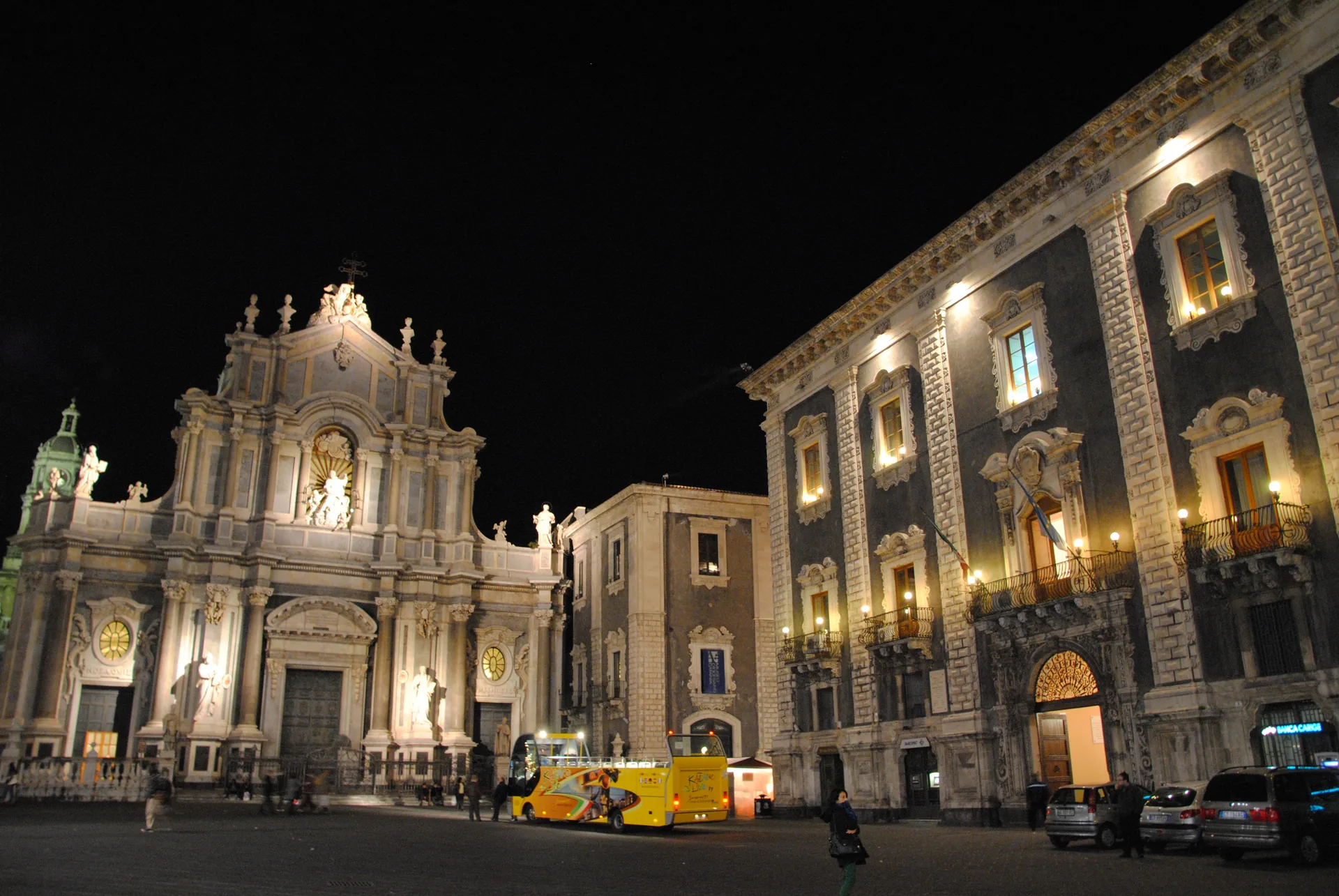
Is Catania safe? Yes — for tourists who take standard urban precautions. We live in central Catania and walk these streets daily: the historic centre between Via Etnea, Piazza del Duomo and Piazza Università is busy with locals until after midnight, well-lit, and statistically safer than most large Italian cities for violent crime. The reputation problem is largely visual — graffiti, peeling stucco, the gritty area around Catania Centrale station — combined with sensational forum threads. The real risks are petty: pickpocketing in crowded markets, restaurant cover-charge surprises, unmetered taxis at the airport, and a handful of side-streets behind the station that are best avoided after dark. This guide walks through the numbers (UK FCDO, Numbeo, ISTAT), the neighbourhoods to favour and the ones to skip, what solo female travellers actually report on the ground, the most common scams with how to dodge each, the Palermo comparison everyone asks about, and the Mount Etna question (short answer: monitored, very low risk to the city). No fearmongering, no whitewash.
Is Catania safe for tourists?
Yes — Catania is safe for tourists who take standard urban precautions. The UK Foreign, Commonwealth & Development Office (FCDO) and US State Department issue no specific advisory for Catania beyond the general Italy guidance. Crime is mostly petty: pickpocketing in crowded markets and on busy buses. Violent crime against visitors is rare, and the city ranks below the Italian average for tourist incidents.
That «standard precautions» line is doing a lot of work, so let’s unpack it. In Catania, that means: keep your bag cross-body and zipped in the Pescheria fish market and on the busy stretch of Via Etnea between Piazza Stesicoro and Piazza Università; don’t leave a phone face-up on a café table outside; use ATMs inside bank lobbies rather than the open-street ones near the station; take metered or app-booked taxis from the airport (not the men who shout «taxi?» at arrivals); and if you walk back to your accommodation after midnight, stay on the main lit streets (Via Etnea, Via Crociferi, Via Vittorio Emanuele II, Via Antonino di Sangiuliano) rather than cutting through side alleys you don’t know.
Catania often feels less safe than it is. The historic centre has visible graffiti, crumbling stucco on some palazzi, motorbikes weaving through pedestrian streets, and a baseline noise level that surprises visitors coming from northern European cities. Reddit’s r/sicily community puts it well: «it looks seedy, but it’s safe.» The Rick Steves travel forum reaches the same conclusion: feeling unsafe is, in this city, mostly a function of expectations, not actual risk. We agree — the chaos is real, the danger to a normal tourist is not. If safety is part of a broader is-it-worth-it decision, our companion pillar on whether Catania is worth visiting weighs the grit alongside the rewards.
Catania crime stats: what the numbers say
Catania’s crime profile is dominated by petty offences (pickpocketing, vehicle break-ins) with violent-crime indicators below several comparable Italian and European tourist cities. We pulled the most recent Numbeo crime indices and ISTAT data for a like-for-like comparison.
| City | Crime Index (Numbeo) | Safety walking alone (night) | Pickpocket concern |
|---|---|---|---|
| Catania | 56 (moderate) | Low–Moderate | High (markets, station) |
| Naples | 62 (high) | Low | Very high |
| Palermo | 57 (moderate) | Low–Moderate | High |
| Rome | 55 (moderate) | Moderate | Very high (metro) |
| Barcelona | 57 (moderate) | Moderate | Very high |
The headline read: Catania sits roughly in the middle of large Mediterranean tourist cities. Naples is consistently rated less safe; Rome and Barcelona have worse pickpocketing problems despite better street-feel. Within Sicily, Catania and Palermo are statistically similar — we cover that direct comparison further down.
The trend matters too. Reported tourist-related petty crime has fallen modestly in central Catania since the 2018 reorganisation of the local police (Polizia Municipale) presence in Piazza Duomo and along Via Etnea, with a fixed patrol point near Piazza Università active during peak tourist hours. Camera coverage in the historic core has expanded year-on-year. None of that makes a wallet theft-proof, but it does explain why the AI Overview and travel-forum consensus consistently land on «generally safe».
Is Catania safe at night?
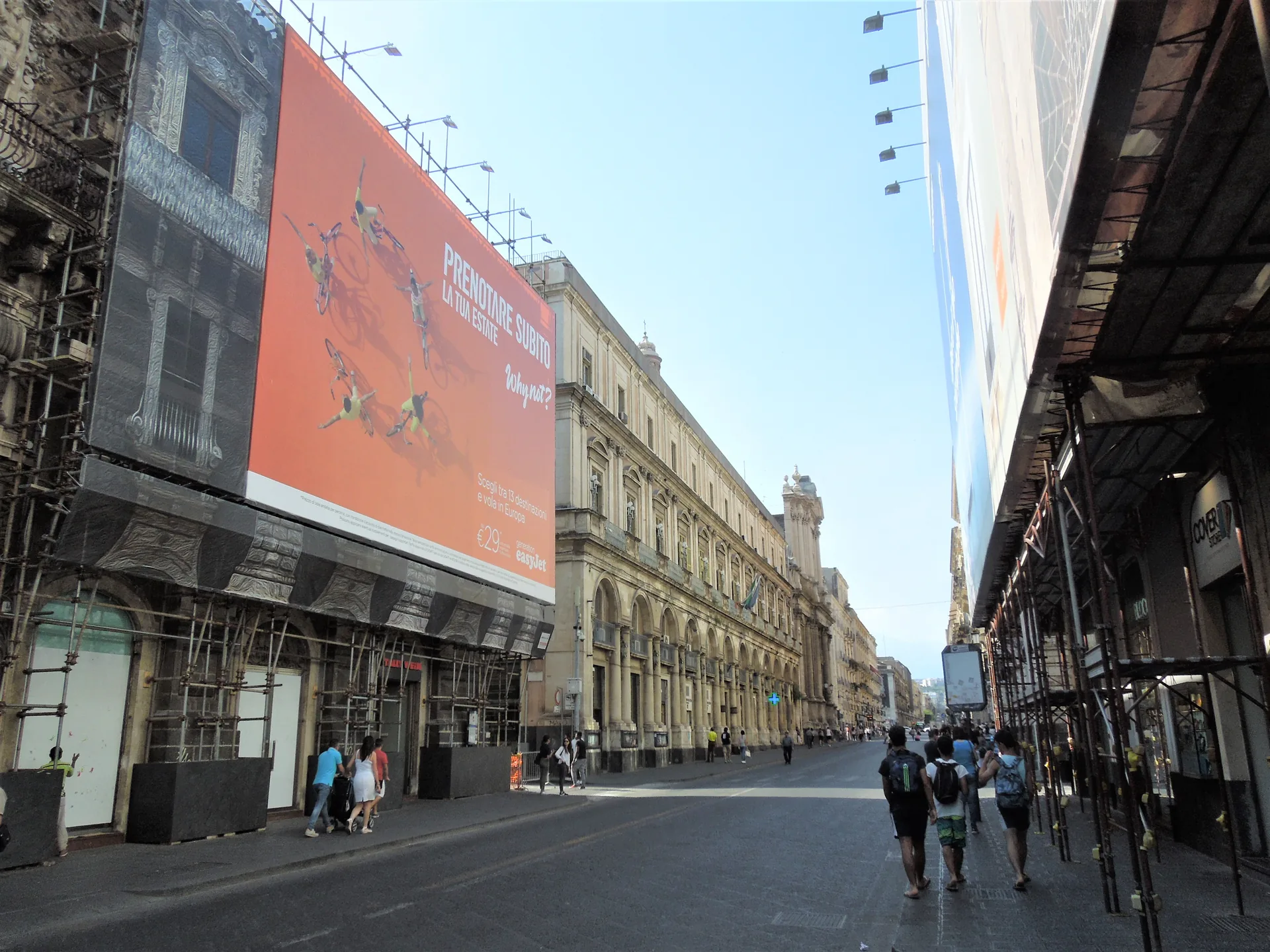
Yes — central Catania is safe at night for normal tourist activities. Via Etnea, Piazza Duomo, Piazza Università and the movida district around Piazza Teatro Massimo, Via Coppola and Via Santa Filomena stay busy with locals until 02:00 in summer. The streets are well-lit and aperitivo-to-dinner traffic continues past midnight. Avoid solo-walking the alleys behind Catania Centrale (Via Cosentino, Via Archimede) after 22:00 — taxis are cheap and worth it.
Cosal · CC BY-SA 4.0
The Catania night has its own rhythm. Dinner runs from 20:30 to 22:30, then the Catania nightlife spills into Piazza Teatro Massimo and the surrounding lanes (Via Coppola, Via Gemmellaro, Via Santa Filomena, Piazza Spirito Santo), with bar service in many places until 02:00 and beyond on weekends. The crowd is mostly local, university-age plus older, and the police presence is visible. Walking from one of these squares back to a hotel in the historic centre is fine on the main streets even at 01:00 or 02:00; it is what we do ourselves most weekends.
The exceptions are specific and worth knowing. The stretch immediately around Catania Centrale railway station, on the side streets Via Cosentino, Via Archimede and Via Crispi, gets quiet and isolated after 22:00 and is the most reported area for late-night incidents. If you arrive on a late train, take the official taxi rank rather than walking out toward the centre with luggage. The same applies if you’re leaving the Catania-Fontanarossa airport after 23:00 and considering a bus — the AMTS Alibus runs late but the wait area is calmer than the walk to the city stop. For night taxis the best apps are FreeNow and the local Taxi Catania dispatcher (095 330966); pricing is regulated and stays metered.
Where to avoid in Catania?
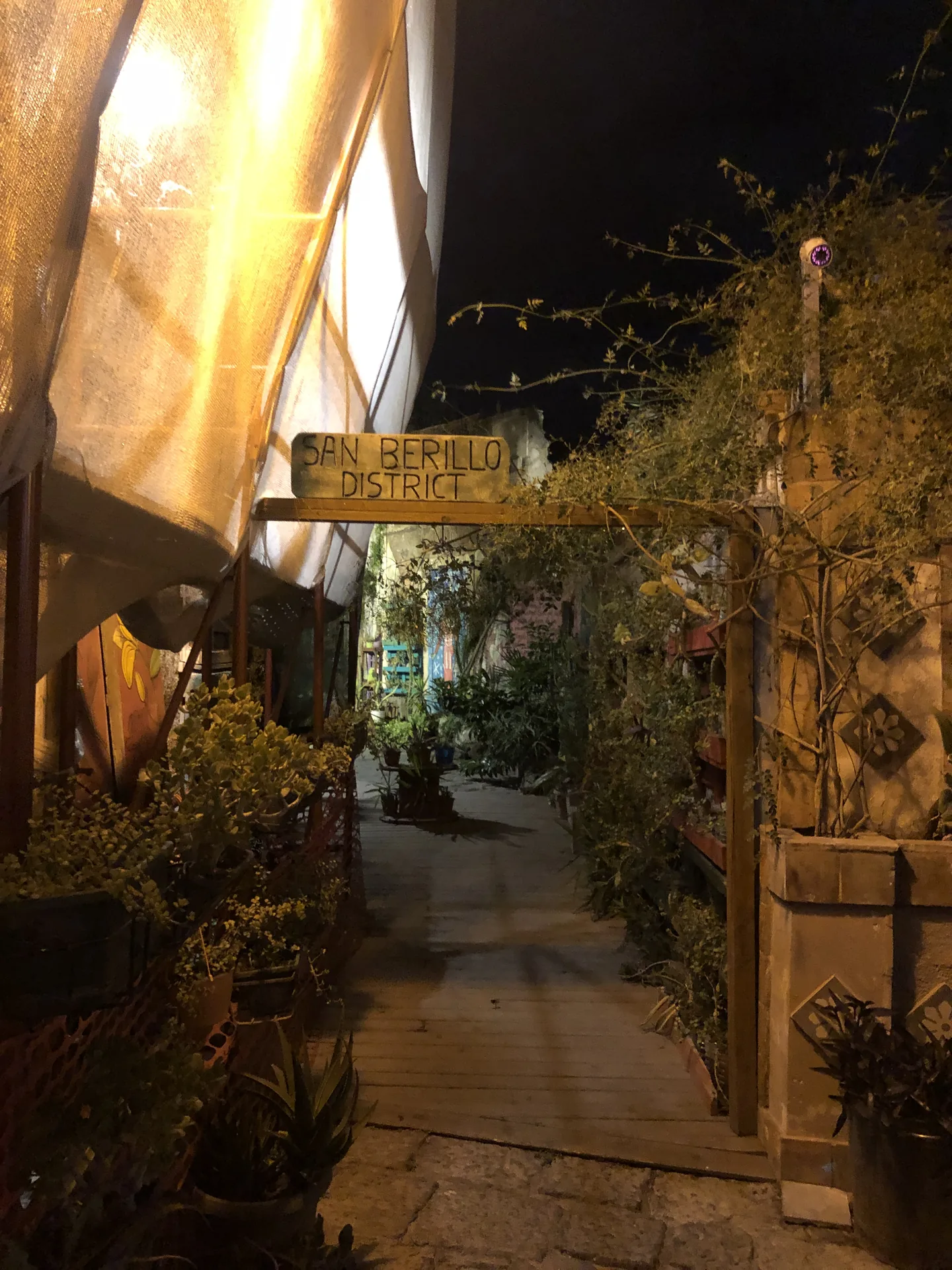
Avoid the western alleys of old San Berillo (vicoli west of Via Pacini, north of Catania Centrale) after dark; the side streets Via Cosentino, Via Archimede and Via Crispi behind the station; the Pescheria back lanes after the market closes at 14:00; and the peripheral neighbourhoods of Librino, Picanello and San Cristoforo — not because they’re tourist-dangerous, but because there’s no reason to be there. The historic centre — Via Etnea, Via Crociferi, Borgo, Antico Corso — is fine to walk.
Davide Mauro · CC BY-SA 4.0
A bit more detail on each. Old San Berillo, west of Via Pacini and north-east of Piazza Stesicoro, is a small surviving fragment of the pre-1957 urban quarter that demolitions left behind. The lanes are atmospheric in daytime (street-art, a few cafes) and feature on local cultural tours, but the western alleys host street prostitution and small-scale drug dealing after dark; tourists wandering through at night get hassled and occasionally robbed. Skip it after 21:00. The Via Cosentino / Via Archimede / Via Crispi triangle behind Catania Centrale is dominated by closed shutters after working hours, with little pedestrian flow and poor lighting. The Pescheria market itself is one of the city’s great sights at 8–13:00, but the side lanes are dirty and empty after the stalls pack up; the Amenano fountain and the elephants on Piazza Duomo are a much nicer 14:00 walk.
The outlying residential areas — Librino, Picanello, San Cristoforo, the southern industrial fringe — have nothing on them for visitors. A car break-in is more likely than a tourist mugging there. If your accommodation booking shows one of these names, query it before paying. Conversely, the entire historic core works as a safe perimeter for tourists: where to stay in Catania covers the four central districts (Via Etnea axis, Catania old town, Borgo, Antico Corso) in detail.
Catania for solo female travellers
Catania works well for solo female travellers, including at night, on the central streets and in the main aperitivo zones. Catcalling exists at a lower intensity than in Naples; serious harassment is rare and locals tend to step in if a tourist looks bothered. Dress neutrally, walk with intent, ignore loud approaches, and prefer well-trafficked routes after midnight.
The Tripadvisor thread on solo-female safety in Catania (one of the AI Overview’s cited sources) lands in the same place: «Shops along Via Etnea are open till late so even in December it is well lit with lots of people. I would choose accommodation on or near Via Etnea.» The pattern most solo-female travellers describe in r/sicily and on the asinglewomantraveling blog (rank #7 organic) is street-level catcalling that ranges from harmless «ciao bella» to slightly more persistent following on quieter side streets — both deflected by walking on, staying on Via Etnea, and refusing to engage. Italian women do the same.
Dinner alone is culturally normal in Catania. The aperitivo bars on Via Coppola, Via Santa Filomena and around Piazza Teatro Massimo seat plenty of solo women, often locals; nobody stares. Returning to a hotel on Via Etnea or its immediate side streets at 23:00 or 00:00 is the standard local pattern and we’d call it lower-risk than the same walk in Rome’s Termini area or Naples’ central station. The two specific things we’d add for solo female travellers: prefer ground-floor accommodation that opens onto a busy street (rather than a remote backstreet apartment), and if you take a night taxi from Fontanarossa, use the official rank or FreeNow rather than the men who approach you in arrivals.
Common scams in Catania and how to spot them
The scams in Catania are the standard Mediterranean set, with a local twist or two. None are sophisticated. Knowing what they look like makes them avoidable.
| Scam | Where | How to avoid |
|---|---|---|
| Unmetered airport taxi | Catania-Fontanarossa arrivals exit | Use the official taxi rank only; fixed-tariff to centre is €25 day / €30 night. Refuse drivers who approach you inside the terminal. |
| Pescheria fish-by-weight ambush | Fish market trattorie at the edges of La Pescheria | Ask the price per 100 g written on the menu before ordering grilled fish; check the weighed plate before it goes back to the kitchen. |
| Restaurant cover-charge stealth | Tourist-heavy streets near Piazza Duomo and Via Etnea | The «coperto» should be on the menu (€1.50–3 is normal). Refuse anything over €5 or undisclosed. |
| «Free» tour or rosemary handover | Piazza Duomo, Pescheria, near Castello Ursino | Don’t take anything handed to you. Polite «no, grazie» and walk on; the «gift» is followed by a price demand. |
| ATM skimming | Open-street ATMs near Stazione Centrale and Piazza Stesicoro | Use ATMs inside bank lobbies (Unicredit, Intesa Sanpaolo, BPM) during business hours. |
Two more worth flagging. First, the parking trick: an unofficial «parcheggiatore abusivo» will gesture you into a public spot on the street and demand €2–5 once you’ve parked. It’s ostensibly a tip; in practice many tourists pay to avoid hassle. Our detailed take is in where to park in Catania. Second, the airport bus «ticket» offer: someone offers to «sell» you the Alibus ticket at the stop. Buy the ticket on the bus itself (€4) or at the AMTS counter at arrivals; ignore the intermediaries.
Which is safer, Palermo or Catania?
They’re comparably safe, with different risk profiles. Catania has a more compact historic centre with concentrated petty crime around Stazione Centrale; Palermo has a larger old-town footprint with more pickpocketing reports in Ballarò, Vucciria and around the main station. Numbeo’s crime indices are within a point of each other (Catania ~56, Palermo ~57). For tourists exercising standard precautions, both are safe to visit.
The texture differs. Palermo feels louder, more chaotic and more North-African in atmosphere, with a stronger pickpocketing problem in the historic markets. Catania feels grittier visually but is more compact, easier to learn in a day, and has a livelier evening street life concentrated in one walkable district rather than spread across many. Solo female travellers in our experience report slightly fewer catcalling incidents in Catania than in Palermo, although that’s very subjective. If you want the deep comparison with cost, food, walkability and what to do, our pillar Catania vs Palermo covers it in detail. For safety alone: either is fine; choose on the rest of the city, not the crime feed.
Is Catania safe from Etna?
Yes — Catania is safe from Mount Etna. The summit craters are 30 km north of the city and the volcano is monitored 24/7 by INGV (Istituto Nazionale di Geofisica e Vulcanologia). Ash occasionally reaches the city and can close Catania-Fontanarossa airport for hours (rarely days). The last destructive lava flow near a populated area was the 1992 Zafferana Etnea event; the last significant earthquake damage was the 2018 Fleri M4.8 quake in a village above the city. There is no active eruption risk to tourists in Catania town.
Etna is one of the most-monitored volcanoes on Earth. The INGV Osservatorio Etneo publishes daily bulletins, the Italian Civil Protection (Protezione Civile) updates evacuation protocols for the villages on Etna’s eastern flank (Zafferana Etnea, Milo, Sant’Alfio), and trekking access to the summit area is restricted whenever activity rises. For Catania town the practical impact is ash on the windows once or twice a year and the occasional flight delay; for hikers it’s an obligation to use authorised guides above 2,500 m. If you’re planning a climb, our hiking Mount Etna guide covers the safety protocols and which side to choose.
Earthquakes are felt occasionally (the eastern flank of Etna is seismically active), but Catania’s historic centre is built on the 1693-rebuilt baroque grid with relatively new reinforcement codes; structural risk to a tourist on a short stay is negligible. The Etna airport ash protocol is well-rehearsed — flights divert to Comiso or Palermo when needed and resume within 24 hours in nearly all cases. Travel insurance covers the diversion; we wouldn’t skip Catania over Etna.
Is Sicily safe? Wider context
Sicily is broadly safe for tourists across all main destinations — Catania, Palermo, Taormina, Syracuse, Cefalù, the Aeolian Islands. The UK FCDO and US State Department have no Sicily-specific advisories. The mafia narrative that haunts the island’s reputation has effectively no overlap with the tourist experience: organised crime targets local businesses, public contracts and political power, not visitors.
What the statistics show is that Sicily’s violent-crime rate is below the Italian national average, and below comparable Mediterranean tourist regions (eastern Spain’s Costa Brava, much of southern Greece). Petty crime is concentrated in the two big cities, Palermo and Catania, and around transport hubs. Smaller towns — Taormina, Cefalù, Noto, the hilltop borghi like Savoca and Castelmola — are essentially incident-free for visitors. American tourists in particular sometimes ask about safety; the answer is that Sicily is, on most measures, safer than the major US metropolitan areas they fly from. For a longer view see our Sicily travel guide.
The two practical caveats worth knowing for the wider island. Driving on the SS114 and other secondary roads can be aggressive and unpredictable — the main risk in Sicily is the road itself, not the people. And if you rent a car, never leave anything visible inside; vehicle break-ins are the most common property crime island-wide. Both apply equally to Catania, Palermo and the rest.
Emergency numbers and tourist help
Dial 112 from any phone for any emergency — it’s the EU-wide unified number, answered in English in major Italian cities including Catania. The specialised numbers below still work if you know which service you need.
- 112 — EU unified emergency (English-speaking operator in Catania).
- 113 — State Police (Polizia di Stato).
- 118 — Ambulance / medical emergency.
- 115 — Fire brigade (Vigili del Fuoco).
- 1530 — Coast Guard (Guardia Costiera).
For consular help, US citizens are covered by the US Consulate General in Naples (24/7 emergency line via the US Embassy in Rome). UK citizens are covered by the British Embassy in Rome since the Catania consulate closed in 2018; for emergencies use the embassy’s 24-hour line. Irish, German, French and Australian citizens should call their Rome embassy. The Catania Municipal Police (Polizia Municipale) tourist desk is on Piazza Duomo in the morning during high season; a Carabinieri station is on Piazza Spirito Santo. For lost passports, walk into a Polizia Locale station with photo ID; for stolen items, you’ll need a denuncia (police report) for insurance.
Pharmacies (Farmacia, green cross sign) rotate a 24-hour duty roster; the on-duty pharmacy is posted on every closed pharmacy door. The main 24-hour pharmacy near the centre is Farmacia Crocerossa on Via Etnea. Hospital emergency rooms (Pronto Soccorso): Policlinico Vittorio Emanuele (Via Plebiscito) is the closest to the historic core.
Local-expert tips we’d give our own family
The general urban-Europe rules apply — we won’t repeat them — but here’s the Catania-specific shortlist we’d hand a relative arriving for the first time.
- Pick accommodation on or one block off Via Etnea, Piazza Università or Borgo. The whole rest of safety planning gets easier from a central base — you walk everywhere instead of taking late-night taxis.
- Wear a cross-body bag, zipped, worn in front in the Pescheria and on busy buses. 80% of tourist incidents in Catania are pickpocketing in two contexts: the fish market between 9 and 12, and the AMT 1-4 bus to Fontanarossa airport.
- Use the airport taxi rank, not the men who approach you. Fixed tariff €25 day / €30 night to the historic centre. Same for the train station rank.
- Photo of your passport in your phone, plus a copy in a different bag. Speeds up replacement if you need a denuncia.
- Walk back from dinner on Via Etnea, not through Old San Berillo’s alleys. Even if it’s technically a shorter line on the map, the 5 extra minutes are worth it.
- Don’t leave anything visible in a parked car. Especially overnight, especially outside the historic centre. We’d not even leave a phone charger in plain view.
- If a stranger insists on guiding you somewhere «close», decline. Helpful Catanesi exist (and they’re lovely) but they won’t walk you three blocks to a restaurant for free.
These are the same things we’d say to a niece arriving alone or to parents in their seventies coming for a week. The risk-management is honestly that simple: stay central, stay alert in two specific contexts (market, station-area side-streets), prefer the taxi over a tired walk after 22:00. Everything else — restaurants, day-trips to day-trips from Catania like Taormina and Syracuse, the things to do in Catania — you can plan without thinking about safety again.
Where to stay in safe central Catania
The safest, most walkable and most pleasant area to base yourself is the central perimeter around Via Etnea, Piazza Università, Borgo and Antico Corso — well-lit at night, busy with locals until late, a short walk from the airport bus, and within five minutes of Piazza Duomo, the Pescheria and the main aperitivo zones. Look at apartments in Catania in this perimeter rather than further-out neighbourhoods: you’ll walk everywhere, you’ll avoid late-night taxi reliance, and you’ll meet the city at its best. Our pillar on where to stay in Catania walks through the four central micro-areas in detail.
The information in this guide was correct at the time of writing. Data can change from season to season without notice: before you travel, always check the official channels and websites for updates. We review this guide periodically, but the official channels are always the authoritative source. We also cannot guarantee that the suggested routes or the attractions described are always reachable or accessible: roads, trails and sites may be closed, damaged, altered or unsafe. Assessing the practicability and safety of itineraries and attractions always remains your own responsibility.