

A Sicily cooking class usually starts at the fish market before sunrise and ends with a plate of pasta you cooked yourself, eaten somewhere with a view of Mount Etna. The catch is that “cooking class” covers everything from a 90-minute demo for cruise passengers in Taormina to a five-day cooking holiday on a Madonie estate, with price tags between €80 and €3,500. We live in Catania and answer this question for guests almost every week, so here is the honest version: how to pick a class by format, area and budget, what you’ll actually cook, whether the early-morning market tour is worth the alarm, and how pasta alla Norma, arancini, caponata, cannoli and granita fit into a typical menu.
How to pick a Sicily cooking class: 4 things that matter
Four variables decide whether a class is worth your time and money — the format (hands-on vs demo), the group size (private, small, standard), what is included (market visit, meal, wine), and whether you want a half-day class or a multi-day cooking holiday. Sort these four before comparing prices and you will avoid 80% of disappointments.
Hands-on vs demo: read the small print
A genuine hands-on class means you knead, fry, plate and clean alongside the chef — usually four to six dishes from start to finish, in a kitchen designed for guests. A demo class means the chef cooks and explains while you watch; you taste at the end. Both have value, but the marketing copy often blurs them. The keyword to look for is hands-in: you put your hands in the dough. If a listing says “learn how to make” without an explicit number of dishes prepared by the participant, assume demo unless confirmed by email.
Group size: private, small, standard
Private classes (1–2 guests) cost roughly €200–350 per person and are worth it for a honeymoon or a single milestone day — you set the menu and the pace. Small-group classes (4–8 guests) are the sweet spot for most travellers, around €120–180 per person, with enough hands-on time and the social energy of a shared lunch. Standard groups (10–16 guests) cost €80–120 but each guest gets less stove time. If knife stations are not mentioned in the description, the class is likely a demo with shared tasting rather than a kitchen experience.
What is included: market, meal, wine
The three add-ons that matter are a guided market visit (typically 60–90 minutes before the class), a full meal of what you cooked at the end, and wine pairing. A market visit can double the cultural value of the class without adding much cost — the chef shows you fish-stall etiquette at La Pescheria in Catania or the Ballarò market in Palermo, names the seasonal produce in dialect, and translates negotiating phrases. Wine pairing should mean at least three glasses with the meal, not a token aperitivo — ask for the bottles by name when you book.
Half-day, full-day or cooking holiday?
A half-day class (3–4 hours, lunch or dinner format) suits travellers passing through Sicily as part of a wider Italy trip. A full-day class (6–8 hours with market tour, lunch and afternoon technique) makes sense if cooking is the highlight of your trip. A cooking holiday (3–5 days at an agriturismo, often inland) is for the foodie traveller who wants to learn breadmaking and cheese-making as well as pasta, in residential setting. Pick a half-day to test; book multi-day only if you already know you love the format.
Is it worth doing a cooking class in Italy?
Yes — if you pick a small-group hands-on class with a market visit, not a 90-minute pasta demo with 16 people watching a chef. The cultural value is higher than the recipe yield: you walk into a Sicilian kitchen, hear the dialect names of seasonal ingredients, learn why caponata uses sweet-and-sour vinegar and not balsamic, and leave with three or four dishes you can actually reproduce at home. Expect to spend around €120 per person for the format that delivers, €250–350 for a private one with a chef and a market tour.
The classes that disappoint are the cruise-port quick demos: 90 minutes, 20 guests, the chef does all the work and you fold a single ravioli. If your trip is short, doing one well-chosen half-day class in Catania, Taormina or Palermo beats squeezing in two rushed ones. If you have a week in Sicily and food is the trip’s spine, layer a cooking class with a wine tasting at an Etna winery on a different day so the experience does not feel repetitive.
What is the difference between Sicilian and Italian cooking?
Sicilian cooking is Mediterranean cooking with an Arab-Norman layer that mainland Italy does not have. The four practical differences you will taste in a class:
- Sweet-and-sour profile (agrodolce): caponata, sardine a beccafico, and pasta con le sarde all use raisins or sugar against vinegar — a 9th-century Arab inheritance you will not find north of Naples.
- Citrus, almonds, pistachio: Sicily is the Italian region where lemons, blood oranges, almonds and pistachio appear in both savoury and sweet dishes — pistachio pesto, almond granita, lemon zest on swordfish.
- Sea over land: the island has 1,000 km of coast and seafood appears more often than meat. Swordfish, sea urchin (ricci di mare), red prawns from Mazara del Vallo and anchovies are common; on the mainland a Tuscan or Emilian menu would be meat-led.
- Granita, cassata, cannolo: three desserts that exist outside Sicily only as imitations. Granita is whipped over an hour, not stirred; cassata uses ricotta and candied fruit, not buttercream; the cannolo shell is fried to order.
In a class you’ll notice the chef reaches for olive oil constantly (butter is rare), seasons with sea salt from Trapani rather than fine table salt, and finishes pasta in the pan with the sauce rather than dressing it in a bowl — all habits shared with southern Italy but pushed further in Sicily by its island geography.
Cooking classes in Catania and around Mount Etna

Eleassar · CC BY-SA 4.0
Catania is the most practical base for a cooking class in eastern Sicily. La Pescheria fish market is a five-minute walk from the city centre, the city has classes in chef homes and small kitchens within walking distance, and the slopes of Mount Etna offer a 30–45 minute drive to agriturismo classes with volcano views. A half-day class here costs around €90–160 standard group, €220–320 private with market and full meal.
The classic Catania format is a pasta alla Norma class built around a 6am or 7am market visit at La Pescheria. The chef walks you through the fish stalls, the citrus crates and the seasonal vegetables — in early summer this means swordfish, capers from Pantelleria, fresh tuna, sea urchin and melanzane perline (small aubergines). Back in the kitchen you cook three to four dishes: caponata, pasta alla Norma, an arancino or a sword-fish involtino, and finish with a granita demonstration or a cannolo filled to order.
For something more dramatic, several agriturismi on the slopes of Etna combine a cooking session with a vineyard tour. Expect a 30-minute drive north toward Linguaglossa or Trecastagni, a class focused on Etna DOC wine pairings, and dishes built around pistachio from Bronte, ricotta and nduja-style Sicilian sausage. Day-trippers from Taormina can reach the same Etna kitchens by train and short transfer, but day-trippers from Catania save an hour each way.
If you’d rather book the class on day one and a calmer day-two, see our guide to things to do in Catania and to where to eat in Catania for the non-class days.
Cooking classes in Taormina and the east coast

Grey48 · CC0 1.0
Taormina classes are the most scenic and the most expensive on the island. Expect kitchen views over the Ionian Sea or onto Etna from a clifftop villa, smaller groups (4–8 standard), and price bands around €120–220 for half-day with lunch. Most are positioned for the cruise and luxury market; the trade-off is that the market visit is usually replaced by an ingredient-introduction in the kitchen.
A typical Taormina menu leans coastal: swordfish involtini, pasta alla Norma (Catania is only 45 minutes by train but the dish is universal), pesto alla trapanese with tomato and almond, and cannoli filled to order. Half-day classes start around 10am, so an after-class afternoon at the Teatro Antico or Isola Bella is realistic; an evening dinner class starts at 5pm and ends with the sunset over the Ionian.
A second cluster sits in Castelmola, the hilltop village above Taormina, where a few private kitchens host small classes with the almond-wine context (Castelmola is the spiritual home of vino alla mandorla). The drive up is 15 minutes; the views compensate for the cost. If you want the Taormina visual without the Taormina price, the small towns inland of Giardini Naxos run classes for €100–150 with similar menus and an easier traffic situation. See our guide to things to do in Taormina for non-cooking days.
Cooking classes in Palermo and western Sicily

Rino Porrovecchio · CC BY-SA 2.0
Palermo classes pivot around street food and Arab-Norman cuisine, with a market visit at Ballarò, Capo or Vucciria as the structural centrepiece. Half-day group classes cost €90–180; you cook four or five dishes that taste recognisably different from the east coast. If Catania vs Palermo is on your itinerary list, see Catania vs Palermo.
A Palermo class menu typically covers panelle (chickpea fritters), sfincione (the local flatbread pizza), pasta con le sarde with wild fennel and sardines, and a closing cannolo. The market tour is louder and longer than in Catania: Ballarò sprawls across five streets, the vendors call out in dialect, and the chef typically negotiates a kilo of red prawns and a piece of swordfish in front of you. Vegetarian classes are easy to arrange — ask in advance to swap the sardines for a pasta alla Norma or alle melanzane.
The western coast adds two specialties not found further east: cuscus alla trapanese (Sicilian couscous with seafood broth from Trapani) and the salt-pan cuisine of Mozia. A few classes around Trapani and Marsala include a stop at the saltpans and a tasting of passito wine; these are full-day formats at €180–240. From Catania it is a three-hour drive each way, so plan a one-night stop if west Sicily cooking is the goal.
Agriturismo cooking holidays in the Sicilian countryside
A Sicilian cooking holiday means three to five nights at an agriturismo — usually inland on the Madonie, the Etna slopes, the Iblei mountains or the baglio estates of western Sicily — with daily classes built around the farm’s own ingredients. Price bands run €1,500–4,000 per person inclusive of room, all meals, and 3–4 class sessions. This format suits cooking-curious travellers on a foodie honeymoon or a culinary anniversary trip.
The repertoire expands well beyond pasta. A multi-day stay typically covers breadmaking (twice-leavened semolina bread with sesame), ricotta production from the morning milking (cheese-making sessions usually begin at 6am at the dairy), vegetable preserves and passata, an outdoor wood-fired pizza dinner, and at least one Etna DOC or Cerasuolo di Vittoria wine pairing dinner. Mornings are residential cooking and short walks; afternoons are free for a vineyard visit or the swimming pool.
If you are planning a romantic culinary trip, the multi-day cooking-holiday angle pairs particularly well with our Sicily honeymoon guide — many couples split their week between two days of east-coast classes from a Catania base and three days at a Madonie or Etna agriturismo. For travelling with children, see Sicily family holiday — classes oriented to families typically run pizza, pasta and gelato sessions rather than fish-handling.
What do you actually cook? A typical Sicily class menu
A half-day Sicilian cooking class usually produces four to six dishes, and the menu repeats across schools with small regional variations. The six dishes below are the canonical Sicilian repertoire you will encounter in 90% of classes from Taormina to Trapani.
Pasta alla Norma

8w9d · CC0
The signature pasta of the entire island: short pasta (rigatoni or maccheroni) with tomato sauce, fried aubergine cubes, fresh basil and grated ricotta salata. Named after the opera Norma by the Catania-born composer Vincenzo Bellini. The chef’s technique points: fry the aubergine in olive oil (not deep-fry), salt it 30 minutes ahead to draw water, and finish the pasta in the pan with the sauce so it absorbs flavour.
Arancini

Enzo Rippa · CC BY-SA 4.0
Stuffed rice balls, fried golden. The eastern (Catanese) version is conical — arancino al ragù; the western (Palermitan) version is round — arancina al ragù. The class teaches the saffron-yellow rice, the meat-and-pea filling, the breadcrumb coating, and the timing of the fry. Vegetarian versions filled with burro (béchamel and prosciutto, ironically) or with spinach and mozzarella are common variants.
Caponata
The agrodolce vegetable stew that opens most Sicilian lunches: aubergine, celery, tomato, capers, green olives, pine nuts, raisins, finished with sweet-and-sour vinegar. The chef’s secret is to fry the vegetables separately — not stewed together — and combine them only at the end with the sweet-and-sour sauce. Improves overnight; many classes prepare it for the next group.
Pasta con le sarde
The dish that defines Palermo and western-Sicilian cooking: pasta with fresh sardines, wild fennel, pine nuts, raisins, saffron and breadcrumbs. The 9th-century Arab influence is most explicit here. Eastern classes sometimes skip this dish and substitute pasta with sea urchin (ricci di mare) or pasta with red prawns when the season is right.
Cannoli
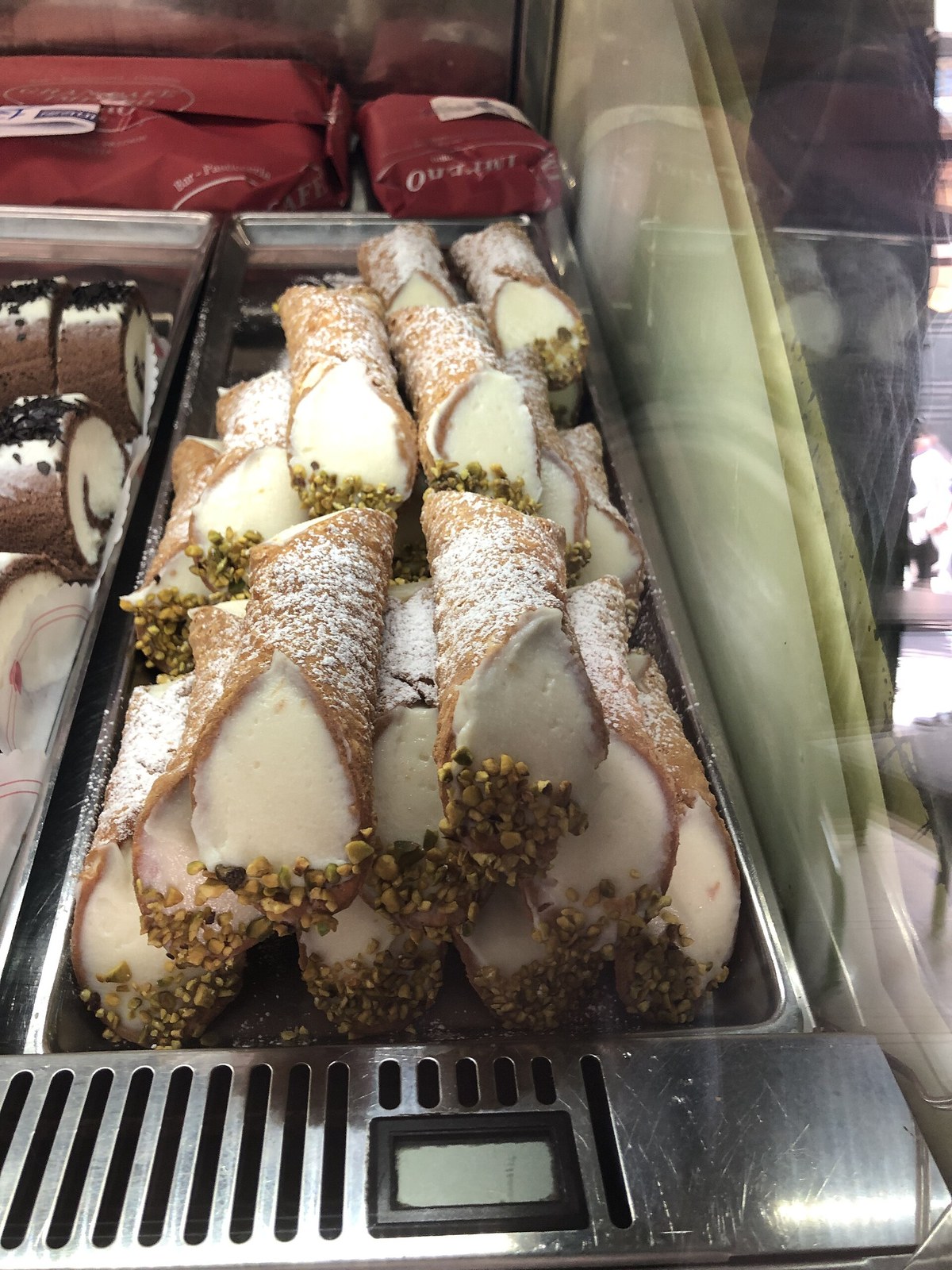
OppidumNissenae · CC BY-SA 4.0
The dessert benchmark: a fried tube of pastry filled with sweet ricotta, with candied orange peel and a dusting of pistachio or chocolate. Critical rule: a cannolo is filled to order, never in advance, or the shell turns soggy in 20 minutes. The class teaches you the dough (with Marsala wine), the shaping around the tube, the frying, and the ricotta preparation (drained for at least 12 hours).
Granita with brioche
The Sicilian breakfast and the dish most likely to be a demonstration rather than hands-on (it requires hours of intermittent freezing). Almond, lemon, coffee, pistachio and mulberry are the canonical flavours. The texture target is whipped, not chunky — the chef will explain the difference between a granita and a sorbetto (sorbet), the latter being denser. Served at breakfast with a brioche col tuppo.
The morning market tour: is it worth the alarm?
Yes, with one exception — do not book it for the morning after a transatlantic red-eye. The market visit is the cultural lever of a Sicilian cooking class: 60–90 minutes inside a working market with someone who speaks the dialect, knows the regular fishmongers and explains the seasonal calendar. Skipping it for an extra hour of sleep is a false economy.
A typical Catania market tour starts at 6:30am inside La Pescheria, behind Piazza Duomo. The morning auction is loud, slippery and crowded; whole tuna are split with sabre-length knives, sea urchins are opened on the spot, and the vendors call out the price for the day in fast Catanese dialect. The chef shows you which swordfish cut is for grilling versus involtino, points out the difference between local gamberi rossi and farmed prawns, and walks you through the fruit and vegetable side of the market behind the fish: cardoons, wild fennel, tomatoes by variety.
A Palermo equivalent starts at 7am inside Ballarò or the smaller Capo: longer (90 minutes typical), louder, with the same vendor relationships. Both Catania and Palermo markets are closed on Sundays; verify with your class before booking. If you fly in on a Sunday evening, schedule the class for Tuesday rather than Monday — Monday markets work but are quieter (Monday is the day after the fishermen rest).
What is Sicily’s most famous dish?
Pasta alla Norma — the Catanese pasta with tomato, fried aubergine, basil and ricotta salata — is Sicily’s most iconic dish. It was named after Vincenzo Bellini‘s 1831 opera Norma by the Catanese playwright Nino Martoglio, who exclaimed “this is a real Norma!” on tasting it. Beyond Norma, four other dishes deserve mention as Sicily’s signature plates:
- Arancini — stuffed rice balls (conical in Catania, round in Palermo).
- Caponata — the agrodolce aubergine and celery stew.
- Cannoli — the ricotta-filled fried pastry.
- Granita with brioche — the Sicilian summer breakfast.
Each is taught in some configuration in a half-day class. For a deeper dive into Catanese food specifically, see our companion guides to Catania’s best restaurants and the broader Sicily travel guide.
What do Sicilians eat in the morning?

Giovanni Grasso · CC BY-SA 4.0
In summer, a granita with a brioche col tuppo. The rest of the year, an espresso and a cornetto, often standing at the counter. The granita-and-brioche breakfast is unique to Sicily: a frozen flavoured ice (almond, lemon, coffee, pistachio, mulberry) eaten with a soft sweet bun that you either tear and dip or split and stuff. It is served from May to September in most pasticcerie; the rest of the year ask for the granita d’inverno (winter granita) — coffee, pistachio and chocolate flavours remain on the menu.
The cultural framing matters in a cooking class context: many chefs send students to the nearest pasticceria for granita on day one as a “starter assignment” before the kitchen session. It is also the most reliable anti-jet-lag breakfast we recommend to guests: sweet, cold, caffeinated by the coffee granita, and culturally specific enough to count as a Sicilian moment.
Practical tips: dress code, dietary needs, kids
Dress for a working kitchen, confirm dietary restrictions in writing 48 hours ahead, and pick a kid-friendly format if travelling with children under 12. Below the four most-asked practical points.
- What to wear: closed-toe shoes (kitchen rules), short sleeves or sleeves you can roll up, an apron is provided. Avoid white — tomato and olive oil splash.
- Dietary needs: vegetarian is straightforward in Sicilian cooking (caponata, pasta alla Norma, arancini with cheese all qualify); gluten-free needs 48 hours’ notice; vegan is challenging in classic Sicilian (ricotta and cheese are pervasive) — confirm an entirely separate menu in writing or pick a class that advertises vegan options explicitly.
- Children: classes that accept kids usually start at age 8 with knife-station supervision. Family-oriented classes typically swap the fish handling for pizza and gelato sessions, and shorten the duration to 2–3 hours.
- Language: English-led instruction is standard everywhere except some agriturismo classes inland; learn five Italian food words (basta = enough, poco = a little, caldo = hot, amaro = bitter, buono = good) and you will be understood.
- Tipping: tipping is not expected in Italy but a €10–20 cash tip at the end is appreciated if the host opened their home; for private home-chef classes round to the nearest €10 above the booked price.
Sicily cooking class comparison at a glance
The comparison below summarises the four formats and three areas covered above. Prices are indicative for spring 2026.
| Area | Typical format | Duration | Price band (per person) | Best for |
|---|---|---|---|---|
| Catania centre | Market tour + 4-course hands-on, chef home or small kitchen | 4–5 h | €90–160 | Best practical value; walking-distance market |
| Catania — Etna slopes | Agriturismo class + Etna DOC wine pairing | 5–6 h | €140–220 | Wine pairing focus + volcano scenery |
| Taormina — clifftop villa | Hands-on small group, no market visit | 3–4 h | €150–220 | Scenery, day-trip from Catania by train |
| Taormina — Castelmola | Private home class with almond-wine context | 3–4 h | €180–280 | Honeymoon / milestone day |
| Palermo — Ballarò/Capo | Street-food focus + market tour 90 min | 4–5 h | €90–180 | Arab-Norman cooking, sfincione & sardine pasta |
| Trapani — salt-pan area | Full-day cuscus + passito tasting | 7–8 h | €180–240 | Western Sicily flavours, requires 1 overnight |
| Madonie / Iblei agriturismo | 3–5 day cooking holiday, all meals included | 3–5 days | €1,500–4,000 | Foodie honeymoon, residential immersion |
| Etna agriturismo | Multi-day with vineyard visits | 2–4 days | €900–2,500 | Wine-and-cooking combined trip |
Where to stay for a Sicily cooking class
If a half-day class is the highlight of your trip, staying in Catania‘s old town is the most practical base. La Pescheria fish market is a five-minute walk from Piazza Duomo, several home-chef and small-kitchen classes are within walking distance, Taormina is 45 minutes by train, and the Etna agriturismo classes are a 30–45 minute drive north. The same Catania base lets you mix a cooking day with a day at the beach, an Etna excursion, or a day trip to the baroque towns of Noto and Modica, without changing accommodation.
Our apartments in Catania sit five minutes’ walk from Piazza Duomo and a short walk from the fish market — convenient for the early-morning market starts most classes ask for. We are happy to give you the practical version of this guide in person when you arrive, and recommend a class that matches your timeline and group size.
The information in this guide was correct at the time of writing. Data can change from season to season without notice: before you travel, always check the official channels and websites for updates. We review this guide periodically, but the official channels are always the authoritative source. We also cannot guarantee that the suggested routes or the attractions described are always reachable or accessible: roads, trails and sites may be closed, damaged, altered or unsafe. Assessing the practicability and safety of itineraries and attractions always remains your own responsibility.