
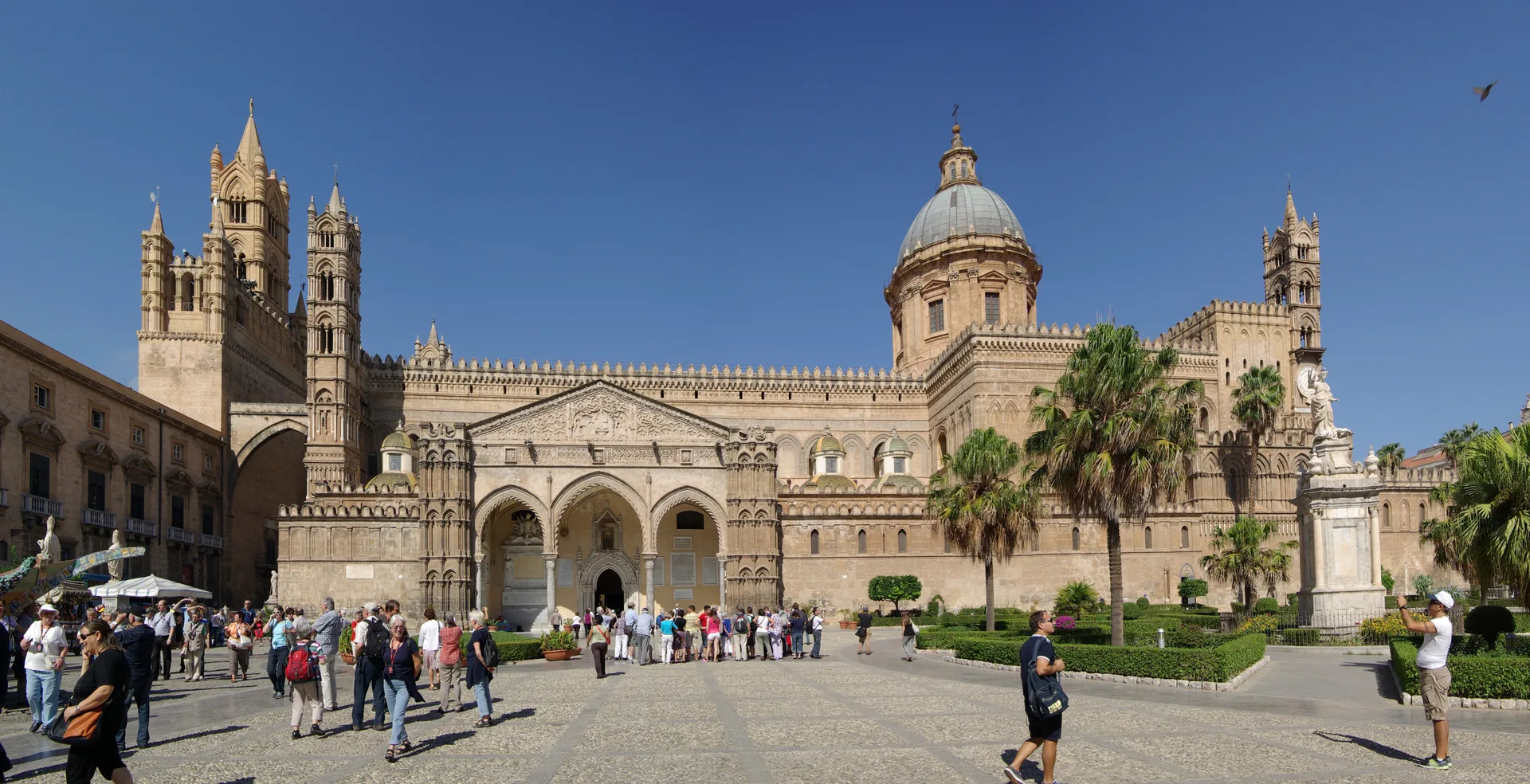
No — Sicily is not dangerous. For tourists exercising standard urban precautions, Sicily is one of the safest destinations in the Mediterranean. Crime rates across the island are lower than in many major European cities, and violent incidents against visitors are exceptionally rare. The UK Foreign Office and the US State Department issue no travel advisories beyond routine guidance for Italy.
What Sicily does have is a communication problem. Decades of mafia fiction, sensationalist headlines, and a handful of grimier neighbourhoods photographed out of context have created a perception gap that this guide is here to close. We live in Sicily — specifically in Catania — and in this article we break down what the numbers actually say, which areas to avoid province by province, and the honest context that Reddit threads and forum posts often miss.
We cover crime statistics (ISTAT and Numbeo data), the mafia reality tourists actually need to know, night safety, solo female travel, scams to watch for, natural hazards including the January 2026 Niscemi landslide, and emergency numbers — all written by locals who walk these streets daily.
How safe is Sicily for tourists?

Leandro Neumann Ciuffo / CC BY 2.0 · CC BY 2.0
Safe. The UK Foreign, Commonwealth & Development Office (FCDO) places Sicily under the same standard travel advice as the rest of Italy — no restrictions, no heightened warnings. The US State Department lists Italy at Level 2 (Exercise increased caution), the same category as France, Spain, Germany, and the United Kingdom. This is a generic terrorism-awareness advisory, not a crime or safety warning specific to Sicily.
Crime affecting tourists in Sicily is overwhelmingly petty and opportunistic: pickpocketing in crowded markets, bag-snatching from unattended chairs, valuables left visible in rental cars. Violent crime against tourists is statistically negligible. According to ISTAT (Italy national statistics institute), Sicily overall crime rate per 100,000 inhabitants ranks below the Italian national average and well below major metropolitan regions like Lombardy (Milan) and Lazio (Rome).
What should I be careful of in Sicily?
Pickpocketing in crowded markets, unmetered taxis at airports, and leaving valuables visible in parked rental cars. These are the three most common tourist incidents in Sicily. Violent crime is exceptionally rare — the risks are overwhelmingly petty, opportunistic, and easily avoided with basic awareness. Markets like Ballaro in Palermo and the Pescheria in Catania are the highest-risk spots for pickpocketing; keep bags zipped and front-facing. At Catania and Palermo airports, use only the official taxi rank with the fixed-rate board. Never leave a backpack, camera, or shopping bag visible through a car window — this is the single most reported tourist crime on the island, and it is entirely preventable.
Beyond these three, standard travel precautions apply: avoid unlit side streets around train stations after 22:00, decline unsolicited help with luggage or parking from strangers, and ask for the written price before ordering fish at seafront restaurants. The detailed breakdown is in the sections below — province-by-province areas to avoid, a full scam table, and night safety guidance for each major city.
Sicily crime stats: what the numbers say
Context matters more than raw numbers. Below is a comparison of reported tourist-relevant crime indicators for Sicily versus Italian and European benchmarks. Data sourced from ISTAT 2024 reports, Numbeo crowd-sourced crime indices (2026), and UK FCDO country profiles.
| City / Region | Pickpocketing risk | Violent crime risk | Tourist incident rate |
|---|---|---|---|
| Sicily (overall) | Low to Moderate | Very Low | Very Low |
| Italy (national avg) | Moderate | Low | Low |
| London, UK | High | Moderate | Moderate |
| Barcelona, Spain | High | Moderate | High |
| Paris, France | High | Moderate | High |
| Naples, Italy | High | Moderate | Moderate |
What this means for you: the pickpocketing risk in a Palermo or Catania market is real and you should take precautions — but it is lower than what you would face on Las Ramblas in Barcelona or on the Paris Metro. The violent crime risk is so low across Sicily that Numbeo worst Sicilian city (Catania, index ~35) still ranks safer on violent crime than London (~52), Barcelona (~50), or Paris (~55).
Numbeo Crime Index for 2026 places Sicily major cities well below the European tourist-city average. Catania scores approximately 35 on the Crime Index (where 100 = most dangerous), compared to Naples at ~55, Rome at ~48, London at ~52, and Barcelona at ~50. The safest major European cities (Zurich, Copenhagen) sit around 20 to 25. These figures reflect perception as much as incidence. The consistent message across ISTAT police data, Numbeo perception surveys, and UK FCDO travel guidance is that Sicily presents a low to moderate petty crime risk and a negligible violent crime risk for tourists taking standard urban precautions.
Mafia in Sicily today: what tourists actually need to know
The mafia (Cosa Nostra) is real, but it does not target tourists. Its economic model is built on protection rackets (pizzo) extorted from local businesses — construction companies, shops, restaurants, farmers. Tourists are not customers, victims, or even witnesses to mafia activity. You are more likely to encounter a pickpocket in Palermo Ballaro market than anyone connected to organised crime.
The anti-mafia movement Addiopizzo has transformed Sicily business landscape. Over 1,000 businesses across the island now publicly refuse to pay protection money and display pizzo-free stickers. Confiscated mafia properties — villas, farms, warehouses — have been converted into agriturismi, B&Bs, and community centres, many of which you can book as a tourist. The mafia power has declined significantly since the 1990s, though it has not disappeared. The key takeaway: The Godfather was a movie, not a travel advisory. Your Sicily trip is not a mafia experience.
Is Sicily safe at night?
Yes, in the main city centres and tourist areas. Sicily evening culture is one of its greatest pleasures. The passeggiata (evening stroll) fills main streets with families until 22:00 to 23:00, and the movida (nightlife) keeps bar districts busy until 02:00. Key well-lit, busy areas after dark: Via Etnea and Piazza Duomo in Catania, Via Maqueda and Politeama in Palermo, Corso Umberto in Taormina, Ortigia in Syracuse.
What to avoid at night: the streets immediately surrounding main train stations (Catania Centrale, Palermo Centrale, Messina Centrale) tend to empty out after 22:00 and attract petty crime. Residential periphery districts — Librino (Catania), Zen and Brancaccio (Palermo), Giostra (Messina) — have no tourist infrastructure and no reason to visit after dark. In beach towns and smaller centres (Cefalu, Modica, Ragusa Ibla, Marzamemi, the Aeolian Islands), walking at any hour feels safe and is the norm.
The movida districts — Piazza Teatro Massimo and Via Coppola in Catania, Piazza Sant Anna and Vucciria in Palermo — are crowded with locals until 02:00 on weekends and are genuinely enjoyable. These areas are self-policing by density. If you are out past midnight, take a taxi for the last kilometre rather than walking through unlit connecting streets. Official taxi apps like FreeNow and Taxi Catania operate in both Palermo and Catania; a short ride costs 8 to 15 euro. Ask your restaurant or bar to call a taxi — they always know a reliable driver.
Places to avoid in Sicily: a province-by-province guide
Sicily is large — nearly 26,000 km2, the biggest island in the Mediterranean. Safety varies more by neighbourhood than by province, but knowing which areas to skip helps you plan with confidence. Here is the honest breakdown.
Palermo
Palermo historic centre (Centro Storico, Politeama, Kalsa, Monte di Pieta) is safe and well-patrolled. Avoid at night: the Ballaro and Vucciria market areas after 21:00 (they empty and become isolated), Brancaccio (peripheral district with no tourist infrastructure), the Zen neighbourhood (Palermo northern periphery), and the streets directly behind Palermo Centrale station.

Flickr / CC BY 2.0 · CC BY 2.0
Catania
Catania centre — Via Etnea, Piazza Duomo, Piazza Universita, Borgo, Antico Corso — is safe day and night. Avoid at night: the old San Berillo neighbourhood west of Via Pacini, the streets behind Catania Centrale station (Via Cosentino, Via Archimede, Via Crispi), and the large residential periphery districts of Librino, Picanello, and San Cristoforo. For a full neighbourhood-by-neighbourhood breakdown with local insights, see our dedicated Is Catania Safe? guide.
Messina
Messina centre is small and walkable; the area around the Duomo and the port is safe. The periphery districts of Giostra and Camaro are residential zones with no tourist relevance — no reason to be there, no risk to manage.
One exception worth noting: some travellers use Messina as a ferry-transfer point between Villa San Giovanni (Calabria) and Sicily. The port area and the streets immediately around it are safe. The pedestrian underpass connecting the ferry terminal to the station, however, is poorly lit and largely empty at night. If you arrive on a late ferry, take a taxi from the port or pre-arrange a pick-up rather than walking through the underpass after midnight. During the day, the whole transfer corridor is busy and problem-free.
Trapani, Agrigento, Siracusa, Ragusa
These provinces are uniformly safe for tourists. Trapani historic centre, Erice, San Vito Lo Capo, the Egadi Islands, Agrigento Valley of the Temples area, Siracusa Ortigia, Ragusa Ibla, Modica, and Scicli are all low-crime destinations where the biggest risk is over-eating. Standard market-awareness in the larger towns (Marsala, Gela) is sufficient. The countryside — wineries, agriturismi, archaeological parks — has negligible crime.
For help choosing where to base yourself, our guide to the best areas to stay in Sicily breaks down each region character, infrastructure, and practical pros and cons. If your trip is still at the planning stage, our Sicily itinerary for 7 days covers a safe, logical route through the island eastern and central highlights.
Is Palermo safe?
Yes — Palermo is safe for tourists, and statistically safer than Milan or Rome for violent crime. ISTAT data consistently ranks Palermo below the Italian average for reported violent offences per capita. The city rough-around-the-edges appearance — peeling plaster, graffiti, chaotic traffic — creates a visual impression of disorder that visitors sometimes misinterpret as danger. It is not.
The main risk in Palermo is pickpocketing in crowded markets, especially Ballaro and Vucciria. Keep valuables zipped and front-facing, avoid dangling bags, and you will be fine. The central districts — Politeama, Teatro Massimo area, Kalsa, Monte di Pieta, Mondello beach — are safe at all hours. For solo female travellers, Palermo main streets are busy and social until late; standard urban awareness applies.
If you are deciding between Sicily two largest cities, our Catania vs Palermo comparison covers safety, atmosphere, food, and practical differences to help you choose — or combine both in a single itinerary.
Is Catania safe?
Yes — Catania is safe for tourists. The city centre along Via Etnea is one of the most vibrant and well-lit urban stretches in southern Italy, busy with locals until 02:00. Pickpocketing near the station and in the Pescheria fish market crowds is the main concern, not violent crime. We have written a complete, neighbourhood-by-neighbourhood guide: Is Catania Safe? A Local Honest Guide for Tourists. It covers safe areas, zones to avoid at night, scams, and tips from people who live here.
Sicily for solo female travelers
Sicily is generally safe for solo female travellers. The travelladies.app platform rates Sicily 3.6 out of 5 for solo female safety, based on 13 traveller reviews, with the main feedback being that locals are warm, friendly, and willing to help. Catcalling exists — it is less frequent than reported in Naples, but more common than in northern Italian cities like Bologna or Trento. The consensus from Reddit r/sicily and r/solotravel is that dressing neutrally, walking confidently, and ignoring loud street approaches are effective strategies.
Sicily aperitivo and restaurant culture is a genuine asset for solo travellers. Dining alone is culturally normal — Italians do it daily — and restaurant staff are typically welcoming rather than awkward about single diners. The late-evening street life means you are rarely walking alone on empty streets. Stick to central accommodation (Via Etnea area in Catania, Politeama in Palermo, Ortigia in Siracusa, Cefalu centre) and Sicily is an excellent solo destination.
Practical tips from Sicilian women: choose accommodation on a main street rather than a narrow vicolo — the extra foot traffic adds passive safety. Aperitivo hour (18:00 to 20:00) is the safest time to be out alone because every bar and piazza is full of locals. If someone approaches you persistently on the street, a firm No grazie without breaking stride is the culturally correct response — Sicilians respect directness. And trust the nonna network: older Sicilian women are informally vigilant about street safety and will often check on a young woman who looks lost or uncomfortable. It is one of the island quiet superpowers.
Is Sicily safe for Black travelers?
Yes, Sicily is safe for Black travellers. Sicily history at the crossroads of the Mediterranean has given it a diverse genetic and cultural heritage: the Norman-Arab architecture of Palermo Palatine Chapel and Monreale Cathedral, the couscous tradition of San Vito Lo Capo (a legacy of North African fishing communities), and the island position as a bridge between Europe and Africa for over 2,000 years.
Racially motivated incidents against tourists are extremely rare. Larger cities — Palermo, Catania, Messina — are cosmopolitan and diverse. In small rural towns with fewer than 5,000 inhabitants, you may encounter curiosity stares; these are almost always curiosity rather than hostility. Standard Italian urban awareness applies, as it does for any traveller. The Is Sicily safe for Black travelers query appears in Google related searches for Sicily safety, and the honest answer from locals is: your experience will be positive.
Are Sicilians friendly to tourists?
Yes — overwhelmingly so. Sicilian hospitality is legendary within Italy, and tourists consistently report warmth, helpfulness, and generosity from locals. The stereotype of the gruff, suspicious Sicilian dissolves on first contact: restaurant owners will explain their grandmother recipe in broken English, passers-by will walk you to your destination rather than give directions, and it is common for a barista to offer a free taste of a pastry you did not order simply because you looked curious.
There is a cultural nuance worth understanding: Sicilians can be direct in a way that northern Europeans or North Americans might initially read as brusque. A shopkeeper who says no without smiling is not being rude — they are being efficient. Eye contact is longer, personal space is closer, and conversations are louder. This is Mediterranean communication, not hostility. Once you adjust to the register, you will find Sicilians genuinely invested in your experience of their island. The Reddit r/sicily consensus from returning travellers is consistent: The people made the trip.
Why is Sicily turning away tourists?
Sicily is not turning away tourists — but it is beginning to manage overtourism in specific hotspots. This PAA question surfaced in Google after a wave of 2024-2025 news coverage about Italian destinations introducing visitor caps, timed-entry tickets, and short-term rental restrictions. The headlines often lump Sicily together with Venice, Florence, and the Amalfi Coast, but the reality on the ground is different.
As of June 2026, no Sicilian city or attraction is turning tourists away at the gate. A few locations have introduced capacity management during peak periods: Taormina restricts vehicle access to the historic centre in August (pedestrian-only after 10:00), the Scala dei Turchi has a capped-entry reservation system to protect the marl cliff from erosion, and some Aeolian Islands beaches require advance booking in July and August. These are crowd-management measures, not closures. For 99% of a Sicily trip — archaeological parks, baroque towns, countryside, beaches outside August — you will encounter no access restrictions whatsoever. Sicily remains one of the least regulated major Mediterranean destinations in terms of tourist access.
Common scams in Sicily and how to spot them
Scams exist everywhere tourists exist, and Sicily has a few well-known ones. Knowing them in advance makes you immune. Here are the six most common and how to avoid each.
| Scam | Where it happens | How to avoid it |
|---|---|---|
| Unmetered airport taxi | Catania Fontanarossa, Palermo Falcone-Borsellino | Use the official taxi rank with fixed-rate board. Catania airport to centre: fixed 20 euro (day) or 25 euro (night). Palermo airport to centre: fixed 50 euro (day) or 55 euro (night). If a driver offers a different price, say no and walk to the official rank. |
| Restaurant fish-by-weight trap | Seafront restaurants, Catania Pescheria area | Fish priced per 100g (8 euro/etto = 80 euro/kg). Ask for the written price per portion before ordering. If the menu says prezzo di mercato with no number, order something else. |
| Fake free tour or friendship bracelet | Major tourist piazzas (Duomo, Teatro Massimo) | A friendly person starts a conversation, ties a bracelet on your wrist, then demands 10 to 20 euro. Politely decline and keep walking. Do not stop to engage. |
| Unofficial parking attendant (posteggiatore) | Market areas, beach parking lots | A person in casual clothes gestures you into a free parking spot and then demands a tip. Pay the official blue-stripe meter instead and ignore them. They are harmless but persistent. |
| ATM skimming | Standalone ATMs on quiet streets, near stations | Use ATMs inside bank lobbies only (Unicredit, BPM, Intesa Sanpaolo). Cover the PIN pad with your other hand. Avoid the standalone Euronet ATMs on tourist strips — their fees are the real scam at 4 to 5 euro per withdrawal. |
| Bar or cafe forgotten receipt | Busy bars near tourist attractions | The cashier takes your order without issuing a scontrino (receipt) and overcharges at payment. Always ask for the scontrino first, pay at the till, then collect at the counter. This is the standard Italian order. |
Is Sicily safe from natural hazards? Volcanoes, earthquakes, landslides
Yes — Sicily natural hazards are well-monitored and pose minimal risk to tourists. The island is geologically active, but its monitoring infrastructure is world-class and tourists are never exposed to unmanaged risk.
Mount Etna
Etna, Europe most active volcano, is monitored 24/7 by INGV (Italy National Institute of Geophysics and Volcanology). It produces frequent but generally non-threatening eruptions — lava fountains, ash plumes, and occasional lava flows that travel slowly down uninhabited slopes. The main tourist impact is ash on Catania airport runway, which can cause closures lasting hours, not days. The airport has an ash protocol and typically reopens within 6 to 12 hours. The last eruption to threaten settlements was in 1992 (Zafferana), and it was successfully diverted. Guided Etna tours operate daily and adjust routes based on real-time INGV data. See our Mount Etna hiking guide for how to visit safely.

Flickr / CC BY 2.0 · CC BY 2.0
Stromboli
The Aeolian island of Stromboli erupts continuously (small explosions every 15 to 30 minutes) and is one of the few places on Earth where you can safely watch an erupting volcano from a few hundred metres. Access is only permitted with licensed guides; INGV and Civil Protection set daily access limits based on activity levels.
The Aeolian Islands — including Stromboli, Vulcano, and Lipari — all have continuous volcanic monitoring by INGV. Summit tours on Stromboli are only permitted when the alert level is green or yellow; at orange or red, access is restricted by Civil Protection order. No tourist has been killed by a Stromboli eruption in the guided-tour era. Vulcano last eruption was in 1888 to 1890, and its fumaroles (steam vents) are a tourist attraction, not a hazard — the sulphur-smelling mud baths are a local spa experience.
Earthquakes
Sicily sits on the boundary between the African and Eurasian tectonic plates and is seismically active. The last significant earthquake affecting a populated area was the 2018 Fleri event (M4.8, no casualties in Catania city). The last major destructive earthquake was the 1968 Belice Valley quake (M6.4). Modern Sicilian construction follows anti-seismic building codes, and tourist accommodation in city centres and coastal towns is in structurally sound buildings.
Niscemi landslide — January 2026
In January 2026, a landslide in Niscemi (Caltanissetta province, inland southern Sicily) caused the evacuation of 1,500 residents. A 4-kilometre stretch of cliff edge collapsed after heavy rainfall from Cyclone Harry. There were zero casualties. The Italian government declared a state of emergency and allocated 100 million euro for recovery. This was a highly localised event: Niscemi is a small inland town with no tourist infrastructure, 40 km from the nearest coast and 150 km from the nearest major tourist destination. All four Sicilian airports (Palermo, Catania, Trapani, Comiso) remained fully operational throughout. The UK Foreign Office did not change its travel advice for Italy or Sicily. This event has zero impact on tourist areas and is not a reason to cancel or reconsider a Sicily trip.
Emergency numbers and tourist help
Sicily uses the standard European emergency system. Save these numbers before you travel:
- 112 — EU unified emergency number (police, fire, medical). Works from any phone, no SIM needed.
- 113 — Polizia di Stato (national police).
- 118 — Ambulanza (medical emergencies).
- 115 — Vigili del Fuoco (fire brigade).
- 1530 — Coast Guard (marine emergencies, boat rescues).
For embassy assistance: US Consulate General Naples (+39 081 583 8111, uscitizensnaples@state.gov). UK Embassy Rome (+39 06 4220 0001). For health insurance, bring your European Health Insurance Card (EHIC) or UK Global Health Insurance Card (GHIC) for access to Italy public healthcare system. Late-night pharmacies (farmacia di turno) rotate; any pharmacy window displays the current night duty pharmacy.
Local-expert tips we would give our own family
- Cross-body bag, not shoulder bag. It is harder to snatch and keeps your hands free for gelato.
- No flashy jewellery on the street. Sicilians dress well but keep expensive items discreet in crowds.
- Keep a photo of your passport on your phone and leave the physical document in your accommodation safe.
- Agree a meeting point with your travel partner before entering any market (Ballaro, Pescheria, Ortigia Saturday market). Phone signal can be patchy in narrow alleys and it is easy to get separated.
- Never leave valuables visible in a parked car. This is the single most common tourist crime in Sicily — a smashed window for a backpack left on the back seat. Take everything with you or lock it in the boot before you park (in case someone is watching).
- Pay attention in markets, but relax everywhere else. The risk is concentrated in very specific settings. A beach, a countryside agriturismo, a small-town piazza, or a baroque church interior is as safe as anywhere in Europe.
- Enjoy the late-dinner culture. Sicilians eat dinner at 21:00 to 22:00. Walking back to your accommodation at 23:00 to midnight in a city centre is normal and safe. The streets are busier at 22:00 than at 18:00.
Where to stay in safe areas of Sicily
Choosing the right base makes all the difference to your Sicily experience. The safest and most convenient areas for tourists are: Catania city centre (Via Etnea, Borgo, Antico Corso — vibrant, well-lit, excellent transport links to Etna and Taormina), Palermo Politeama and Kalsa districts (central, elegant, busy), Taormina (the most polished and tourist-oriented town on the island), Syracuse Ortigia (a pedestrianised island of baroque lanes, as safe as it gets), and Cefalu (a beach-town with a Norman cathedral and a completely relaxed atmosphere).
If you are planning to visit eastern Sicily — Etna, Taormina, Syracuse, the baroque towns of the Val di Noto — Catania is the island most practical and best-connected base. We manage three holiday apartments in Catania city centre, on a quiet street just off Via Etnea in one of the safest and most convenient neighbourhoods. See apartments in Catania for availability, photos, and guest reviews.
The information in this guide was correct at the time of writing. Data can change from season to season without notice: before you travel, always check the official channels and websites for updates. We review this guide periodically, but the official channels are always the authoritative source. We also cannot guarantee that the suggested routes or the attractions described are always reachable or accessible: roads, trails and sites may be closed, damaged, altered or unsafe. Assessing the practicability and safety of itineraries and attractions always remains your own responsibility.