
Two Mediterranean islands, 90 kilometres apart, one unforgettable trip. Malta — compact, polished, English-speaking — packs 7,000 years of history into an archipelago smaller than the Isle of Wight. Sicily — wild, sprawling, volcanic — is 80 times larger with an active crater, Greek temples, Baroque towns, and arguably the best food in the Mediterranean. This Malta and Sicily itinerary combines both, with Catania as your single base on the Sicily side. We live in Catania and host guests visiting eastern Sicily, so every driving time, parking tip, and restaurant suggestion in this guide is tested by someone who does this daily.
Malta or Sicily first? Which order makes sense
TerryDOtt · CC BY 4.0
Start in Malta, finish in Sicily. Malta is the easier landing — the airport is 20 minutes from Valletta, English is an official language, and 3 days is enough to see the highlights. Sicily rewards confidence: it is larger, wilder, and benefits from having your bearings before you arrive.
The ferry from Valletta to Pozzallo takes 1 hour 45 minutes (Virtu Ferries, from €76 one-way). The direct Valletta–Catania ferry takes 1 hour 15 minutes (Grimaldi Lines, from €59). You can also fly: Malta to Catania is a 30-minute hop (Ryanair, from €25). For a full breakdown, read our Malta to Sicily ferry and flights guide.
Fly into Malta (MLA), ferry across, explore eastern Sicily with Catania as your base, and fly out of Catania (CTA). No backtracking.
| Factor | Malta First → Sicily Second | Sicily First → Malta Second |
|---|---|---|
| Ease of arrival | Small airport, 20 min to Valletta. Easy warm-up. | Larger airports, busier. Starting big. |
| Pacing | Start compact (316 km²), build to epic (25,000 km²). | Front-load the bigger, more demanding island. |
| Transport | Ferry across, drive east Sicily loop, fly out of Catania. | Reverse open-jaw also works. |
| Our pick | Yes — this is the recommended order. | Fine if flights are cheaper this way. |
Days 1–3: Malta — Valletta, Mdina, Blue Lagoon

Berthold Werner · CC BY-SA 3.0
Land at Malta Airport (MLA). Transfer to your accommodation — anywhere between Valletta and Sliema works, the island is only 27 km end to end. Public buses (Tallinja card, €2/day) cover the whole island. You do not need a car in Malta.
Valletta, Malta
- Location
- Valletta, Malta Maps
- Site
- cityofvalletta.org
- Essential fact
- UNESCO World Heritage capital built by the Knights of St John in 1566 — one of Europe’s most concentrated historic cities
- Price
- Free (city) | €15 (Co-Cathedral)
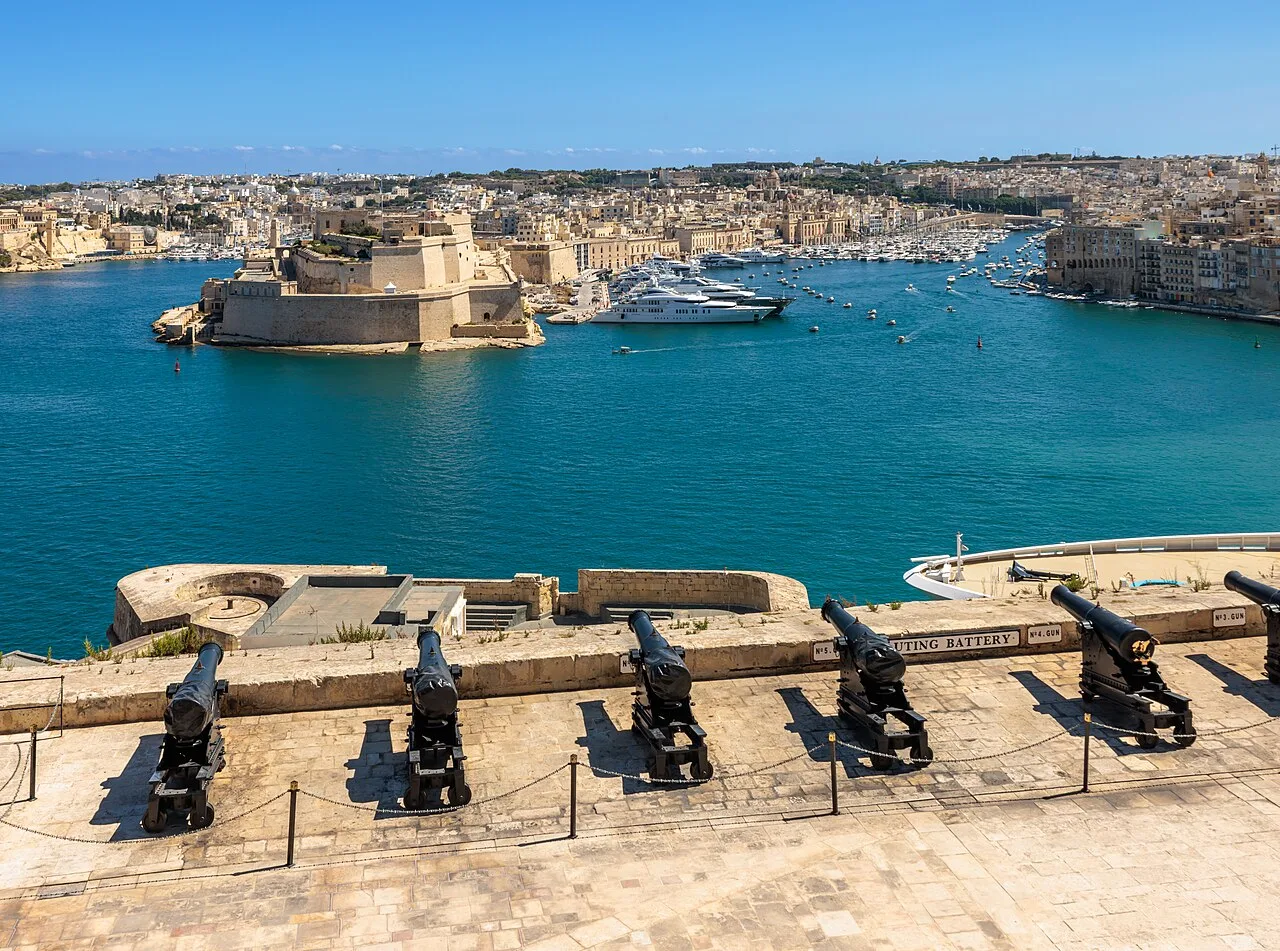
Spend your first afternoon in Valletta. Start at the Upper Barrakka Gardens for the Grand Harbour panorama — the noon cannon salute is worth timing your visit for. Then St John’s Co-Cathedral: Caravaggio’s Beheading of St John the Baptist is the largest canvas he ever painted, and it hangs exactly where he left it in 1608 (€15, no photos inside). Wander the grid of limestone streets — Valletta is one of Europe’s smallest capitals and you can cross it on foot in 15 minutes. Dinner at the Valletta Waterfront (Pinto Wharf), where 18th-century warehouses are now restaurants.
Mdina, Malta
- Location
- Mdina, Malta Maps
- Essential fact
- Malta’s 4,000-year-old former capital, known as the Silent City — car-free medieval streets and Game of Thrones filming location
- Price
- Free (city) | €5 (cathedral)
Morning in Mdina, the Silent City. The name is literal — only residents can drive in, and there are about 250 of them. Walk the car-free medieval streets, have coffee with a panoramic view at Fontanella Tea Garden, and visit St Paul’s Cathedral. Then cross into Rabat (adjacent, outside the walls) for the St Paul’s Catacombs and the Domus Romana mosaics. Lunch at a pastizzeria — Crystal Palace Bar on the Rabat side is the local favourite (pastizzi, the flaky ricotta-filled pastry, cost about €0.50 each). Go at dusk if you can: the limestone glows gold and the day-trippers have left.
Blue Lagoon, Comino
- Location
- Triq Kemmuneti, Għajnsielem KMN 1040, Malta Maps
- Essential fact
- Crystal-clear turquoise bay between Malta and Gozo — the Mediterranean’s most photogenic swimming spot
- Price
- Free | €25 (boat return)
Morning boat trip to Comino’s Blue Lagoon. The water really is that colour — a ridiculously bright turquoise over white sand, so clear you can see the bottom at 5 metres. Go before 10 AM. By midday the lagoon fills with tour boats and the magic evaporates. Most trips depart from the northern port of Ċirkewwa (bus 41 or 42 from Valletta, about 1 hour). The boat crossing takes 25 minutes and costs around €25 return. Bring water, sunscreen, and a waterproof phone case. Comino has no cars, no shops, and 3 permanent residents. If you have time, walk 10 minutes from the lagoon to the island’s interior — you will have it to yourself.
Day 4: Ferry to Sicily, arrive in Catania
Take the morning Virtu Ferries catamaran from Valletta to Pozzallo (1h45, check-in 1 hour before, passport or ID card required). Book your ticket at least a week ahead in summer — sailings sell out. Pick up your rental car at Pozzallo port (book in advance) and drive 1.5 hours north to Catania on the A18 motorway. Alternative: the Grimaldi Lines ferry goes directly from Valletta to Catania port (1h15), putting you in the city centre without the drive.
What the ferry crossing is like. The Virtu Ferries catamaran seats about 800 passengers. Boarding starts 45 minutes before departure. The seats are airline-style — comfortable enough for a short crossing, but book business class (€30–40 extra) if you want more space and a quieter cabin. There is a café on board serving sandwiches, coffee, and surprisingly good pastizzi. The crossing is usually smooth in summer; in winter, the channel can be rough — take seasickness medication if you are prone. On a clear day, you will see Sicily appearing on the horizon about 40 minutes before docking.
Once in Catania, check into your accommodation and take the evening to settle in. Walk to Piazza del Duomo as the sun sets — the Baroque cathedral and the Elephant Fountain (u Liotru, Catania’s symbol carved from Roman basalt) are at their best in golden hour. Dinner at a trattoria around Via Santa Filomena. Order pasta alla Norma: it was invented here, and Catania does it better than anywhere else.
Day 5: Catania — Baroque streets, fish market, Etna views
Piazza del Duomo, Catania
- Location
- Piazza del Duomo, Catania Maps
- Essential fact
- Baroque heart of Catania with the Elephant Fountain (u Liotru) — UNESCO-listed, rebuilt after the 1693 earthquake
- Price
- Free
Start at Piazza del Duomo. The cathedral of Sant’Agata is a layered cake of Norman, Baroque, and 20th-century architecture — the 1693 earthquake flattened most of Catania and the rebuild defines what you see today. Opposite, the Elephant Fountain by Vaccarini (1736) uses a Roman basalt elephant as its centrepiece. Walk up Via Etnea, Catania’s main street, with Mount Etna straight ahead on a clear day. At Villa Bellini, Catania’s main park, turn around for the view back down Via Etnea to the sea.
Midday at the Pescheria. Catania’s fish market is a theatre: Sicilian vendors shouting prices, swordfish heads the size of basketballs, trays of ricci (sea urchins) cracked open on the spot. Go between 10 AM and noon for peak energy. For lunch, grab an arancino at Savia on Via Etnea — their classic ragù version (€3.50) is the benchmark. Afternoon: Castello Ursino, the 13th-century Swabian castle that used to be on the coast — lava from the 1669 eruption pushed the shoreline 500 metres out. Walk back through Via Crociferi, Catania’s most beautiful Baroque street. Evening aperitivo in the streets around Piazza Teatro Massimo — Catania’s aperitivo culture rivals Milan’s, with generous buffets at €8–12 including a drink.
Via Crociferi is Catania’s most beautiful street — a straight 200-metre stretch of Baroque churches, monasteries, and wrought-iron balconies that feels like an open-air museum. The Chiesa di San Benedetto (€5) has a stunning 18th-century marble staircase and a frescoed ceiling. Next door, the Jesuit College is one of the largest in Sicily. Walk it slowly — there is a detail in every doorway.
Day 6: Mount Etna — craters, cable car, lava fields
Mount Etna, Sicily
- Location
- Mt Etna, Castiglione di Sicilia, Metropolitan city of Catania Maps
- Essential fact
- Europe’s tallest active volcano at 3,357m — UNESCO World Heritage site with lunar landscapes and year-round hiking
- Price
- €30 (cable car) | €80 (jeep + guide)
Drive 40 minutes from Catania to Rifugio Sapienza (1,910m, Nicolosi side). The cable car takes you to 2,500m (€30 return), then a 4×4 jeep + guide takes you to the summit craters at 2,900m (€80 total, including cable car). The landscape up here is genuinely lunar — black ash, steam vents, and the smell of sulphur. On a clear day you can see Calabria across the Strait of Messina. The guided summit portion is mandatory above 2,500m and lasts about 2 hours. Bring a jacket even in August: at 2,900m the temperature can be 15°C colder than Catania.
What to wear: sturdy shoes (no flip-flops — the ash is sharp), long trousers, a warm layer even in August, sunglasses, sunscreen. The temperature drops about 1°C for every 150 metres of altitude, so at the summit it can be 15–20°C colder than Catania. There is a small café at Rifugio Sapienza for a pre-ascent coffee. If the summit craters are closed due to volcanic activity (which happens a few times a year), the cable car to 2,500m is still worth it — you can walk the Silvestri craters and feel the heat of the volcano through the soles of your shoes.
Free alternative: the Crateri Silvestri, two extinct craters right next to the Rifugio Sapienza parking lot, are free to explore and give you a real volcanic landscape without the cable car cost (€0, 30–45 minutes). Lunch at a winery on Etna’s lower slopes — there are dozens between Nicolosi and Zafferana Etnea offering tastings of Etna Rosso with views of the volcano you just climbed. Back to Catania by late afternoon.
Day 7: Taormina — Greek theatre, Isola Bella, panoramic views

Nicolas Chadeville · CC BY-SA 4.0
Ancient Theatre of Taormina
- Location
- Via Teatro Greco 1, Taormina Maps
- Site
- parconaxostaormina.com/taormina/teatro-antico-taormina
- Essential fact
- 2nd-century BC Greek theatre perched on a cliff with Mount Etna as the backdrop — one of the world’s most spectacular ancient venues
- Price
- €12
Drive 50 minutes north to Taormina. Park at the Porta Catania car park (€15/day). Morning: the Teatro Antico, a 2nd-century BC Greek theatre that the Romans later expanded. The stage is framed by the Ionian Sea on one side and Mount Etna on the other — it is still used for summer performances (€12, go at opening time, 9 AM, to have it nearly to yourself). Walk Corso Umberto, Taormina’s pedestrian spine: chic boutiques, ceramic shops, and the Piazza IX Aprile balcony with panoramic sea views.
Lunch at a trattoria off the main street — prices drop 30% one block back from Corso Umberto. Afternoon: Isola Bella, the pebble beach and nature reserve below Taormina. Reach it via the cable car (€6 return) from Via Pirandello, or walk down the 200 steps. The water is clear enough for swimming and the island itself is connected to the beach by a narrow sandbar. Back to Catania in time for dinner.
Day 8: Syracuse and Ortigia — Greek temples on an island

Ввласенко · CC BY-SA 3.0
Ortigia, Syracuse
- Location
- Island of Ortigia Maps
- Essential fact
- Ancient island heart of Syracuse — Greek temple transformed into a Baroque cathedral, surrounded by turquoise water
- Price
- Free (island) | €2–13 (sites)
Drive 45 minutes south on the A18 to Syracuse. Park at Molo Sant’Antonio (€1/hour). Morning: the Neapolis Archaeological Park — the 5th-century BC Greek Theatre carved into the hillside (still used for summer performances), the Roman Amphitheatre, and the Ear of Dionysius, a 23-metre-high cave with legendary acoustics (€13). Cross the bridge to Ortigia island. This is where ancient Greek Syracuse was founded in 734 BC — today it is a maze of narrow lanes, Baroque churches, and sea-view piazzas.
The Duomo is a Greek temple disguised as a cathedral — the massive Doric columns of the 5th-century BC Temple of Athena are still visible inside the walls (€2). Walk to the Fonte Aretusa, a freshwater spring with papyrus plants growing at the water’s edge — the only place in Europe where papyrus grows wild. Lunch at a trattoria on a side street: Ortigia’s seafood is among Sicily’s best. Mid-afternoon drive back to Catania (50 minutes).
Day 9: Val di Noto — three Baroque jewels in one day
Noto, Sicily
- Location
- Noto, Free municipal consortium of Syracuse Maps
- Essential fact
- UNESCO-listed Baroque masterpiece rebuilt after 1693 — honey-coloured limestone cathedral and palaces on a single dramatic street
- Price
- Free
Drive 1 hour 15 minutes south from Catania to the Val di Noto, the UNESCO-listed cluster of Baroque towns rebuilt after the devastating 1693 earthquake. Start with Noto: Corso Vittorio Emanuele is a single, perfectly planned Baroque street lined with honey-coloured limestone palaces and churches. The cathedral, with its dramatic twin-towered facade and broad staircase, is best seen at sunset. Walk to the top of the staircase and turn around — the view back down Corso Vittorio Emanuele is the postcard shot.
Ragusa Ibla, Sicily
- Location
- Ibla, Ragusa Maps
- Essential fact
- Baroque hilltop old town with 300+ steps connecting to the modern city — UNESCO-listed, featured in Inspector Montalbano
- Price
- Free | €3 (Duomo)
From Noto, drive 45 minutes to Ragusa Ibla. The old town sits on a hilltop, connected to modern Ragusa by 300+ steps — or take the €1 shuttle bus. The Duomo di San Giorgio dominates the main piazza (€3); its neoclassical dome is visible from kilometres away. Walk through the Giardino Ibleo for valley views, then get lunch at a trattoria in the old town. If you have time, a 15-minute detour to Modica adds Sicily’s most unusual chocolate tradition — Modica chocolate is still made cold, as the Aztecs taught the Spanish who brought it here in the 16th century, giving it a grainy, intense flavour unlike any other chocolate. Antica Dolceria Bonajuto (founded 1880) does free tastings. Drive back to Catania (1.5 hours).
Modica’s chocolate tradition dates to the 16th century, when the Spanish brought cocoa beans back from the Aztecs. Unlike European chocolate, Modica chocolate is worked cold — the sugar crystals never fully dissolve, giving it a grainy, almost sandy texture and a pure, intense cocoa flavour. Traditional flavours include vanilla, cinnamon, chilli, and sea salt. A 100g bar costs about €4–6 and makes an excellent edible souvenir.
Extending your trip: more Malta days, Gozo, or western Sicily
If you have more than 9 days, here is where to spend them:
The Citadel, Gozo
- Location
- Citadel, It-Telgħa tal-Belt, Victoria, Malta Maps
- Essential fact
- Fortified hilltop city on Gozo island with 360° views, older than the pyramids — Ġgantija Temples nearby date to 3,600 BC
- Price
- Free (Citadel) | €10 (Ġgantija temples)
Add a Gozo day (Malta side, Day 3.5). Gozo is greener, quieter, and older than Malta. Take the ferry from Ċirkewwa (25 minutes, €4.65 return). The Citadel in Victoria has 360° views across the island. The Ġgantija Temples (€10) predate Stonehenge — built around 3,600 BC, they are among the oldest free-standing structures on Earth. Lunch in Xlendi, a fishing village with a sheltered cove and excellent seafood.
Marsaxlokk, Malta
- Location
- Marsaxlokk, Malta Maps
- Essential fact
- Malta’s most photogenic fishing village — colourful Luzzu boats with Eye of Horus prows, legendary Sunday fish market
- Price
- Free
Add Marsaxlokk and the Blue Grotto (Malta side). Marsaxlokk is Malta’s most photogenic fishing village — the Luzzu boats with their painted Eye of Horus prows bob in the harbour, and the Sunday fish market (6 AM–1 PM) is the best hour of people-watching on the island. Nearby, the Blue Grotto sea caves (boat trip ~€10, best between 9 AM and 1 PM) glow an electric blue in the morning light.
Add Palermo and western Sicily (Sicily side, 2–3 extra days). If you have 12+ days total, from Catania drive 2.5 hours west to Palermo for the markets (Ballarò, Vucciria), the Palatine Chapel mosaics, and the Monreale Cathedral. Fly out of Palermo Airport (PMO). This adds a western dimension but sacrifices some of the relaxed east-coast pace.
Is it worth going to Malta from Sicily?
Yes, absolutely — and we say this as people who live in Sicily. The two islands are close enough (90 km) that adding Malta to a Sicily trip is easy logistically, and different enough that the contrast makes the trip richer. Malta gives you compact, walkable, English-friendly history with a North African limestone glow. Sicily gives you raw scale, volcanic drama, and food that resets your standards. Together they make a Mediterranean trip that does not feel redundant.
How long is the ferry from Malta to Sicily?
The fastest ferry takes 1 hour 15 minutes (Grimaldi Lines, Valletta to Catania). The most frequent route, Virtu Ferries from Valletta to Pozzallo, takes 1 hour 45 minutes. Both are high-speed catamarans. Flying takes 30 minutes (Malta to Catania) but factor in airport transfers and security — door to door, the ferry is often faster than the flight. Full details in our Malta to Sicily ferry guide.
Malta vs Sicily: which is better?
Neither is better — they are different tools for different travellers. Malta is easier (English everywhere, buses on time, everything within 30 minutes). Sicily is more rewarding (volcanoes, Greek ruins, street food, baroque towns that look like film sets). If you can only do one, pick based on your travel style. If you can do both — and you have at least a week — you get the best of both Mediterranean worlds. The table below breaks it down.
| Malta | Sicily | |
|---|---|---|
| Size | 316 km² (27 km long) | 25,711 km² (Wales-sized) |
| Language | English + Maltese (both official) | Italian (English spoken in tourist areas) |
| Best for | History, diving, short breaks, first-time Med travellers | Food, volcanoes, road trips, culture, beaches |
| Getting around | Excellent public buses, no car needed | Car recommended for east coast; train Catania–Syracuse works |
| Cost (mid-range couple) | €120–180/day | €100–150/day (Catania cheaper than Taormina) |
| Food style | Pastizzi, rabbit stew, seafood, Cisk lager | Arancini, pasta alla Norma, cannoli, granita, Etna wines |
| Beaches | Rocky coves, Blue Lagoon (iconic but busy) | Long sandy stretches (San Lorenzo), pebble coves (Isola Bella) |
| Iconic sight | Valletta’s Grand Harbour from Barrakka Gardens | Mount Etna smoking above Taormina’s Greek Theatre |
Practical tips for your Malta-Sicily trip
- Currency: Euro (€) in both Malta and Sicily. No money changing needed.
- Language: English is official in Malta. In Sicily, five words go a long way: buongiorno (good morning), grazie (thank you), per favore (please), il conto (the bill), dov’è (where is).
- Documents: EU citizens — valid ID card or passport. UK/US/other — valid passport. Malta and Italy are both in Schengen. You clear immigration once (arriving in Malta) and cross to Sicily without passport control.
- Best time: April–June and September–October. Warm seas, fewer crowds, 20–28°C. July–August is hot (30–35°C) and busy but has the fullest ferry schedule. November–March is mild (12–18°C), green, and quiet — good for sightseeing, but ferry schedules reduce.
- Driving: Both Malta and Italy drive on the right. Malta’s roads are British-influenced (roundabouts, narrow). Sicily’s A18 motorway is toll-free. Parking in Catania: free at Parcheggio R1 (Via Plebiscito) or paid at Piazza Borsa (€1/hour).
- Ferry booking: Book Virtu Ferries or Grimaldi Lines at least 1–2 weeks ahead in summer. Check-in closes 30 minutes before departure. Arrive 1 hour before (1.5 hours with a car).
- Siesta: Shops in Sicily close 13:00–16:00. Restaurants serve lunch 12:30–14:30, dinner from 19:30. Showing up at 18:00 for dinner gets you a closed kitchen and a strange look.
Where to stay in Catania
After crossing from Malta, you need a base in Sicily that is central, connected, and comfortable. We run apartments in Catania city centre, in a historic building on Via Santissima Trinità, walking distance from the Pescheria fish market, Piazza Duomo, and the best street food in town. From here you can reach Mount Etna in 40 minutes, Taormina in 50 minutes, Syracuse in 45 minutes, and the Pozzallo ferry terminal in 1.5 hours. See our Catania apartments.
The information in this guide was correct at the time of writing. Data can change from season to season without notice: before you travel, always check the official channels and websites for updates. We review this guide periodically, but the official channels are always the authoritative source. We also cannot guarantee that the suggested routes or the attractions described are always reachable or accessible: roads, trails and sites may be closed, damaged, altered or unsafe. Assessing the practicability and safety of itineraries and attractions always remains your own responsibility.