

The Catania fish market — La Pescheria, or A’ Piscarìa in Catanese dialect — sits in a sunken alley behind Piazza del Duomo, a few metres from the Amenano Fountain and the Aragonese Porta Carlo V. We live a twelve-minute walk from it and end up here most Saturday mornings between 8 and 10. This guide is the practical version we give to guests: when it’s open and when it’s emphatically not (Sundays), what you’ll actually see across the four zones, how to behave with a camera, the Stanley Tucci backstory, and where to eat the catch fifty metres away. The market has run on this spot since at least the 1500s and survived the 1693 Val di Noto earthquake that flattened most of the old city — on a busy morning, it still feels older than anything around it.
What is La Pescheria, and why it matters
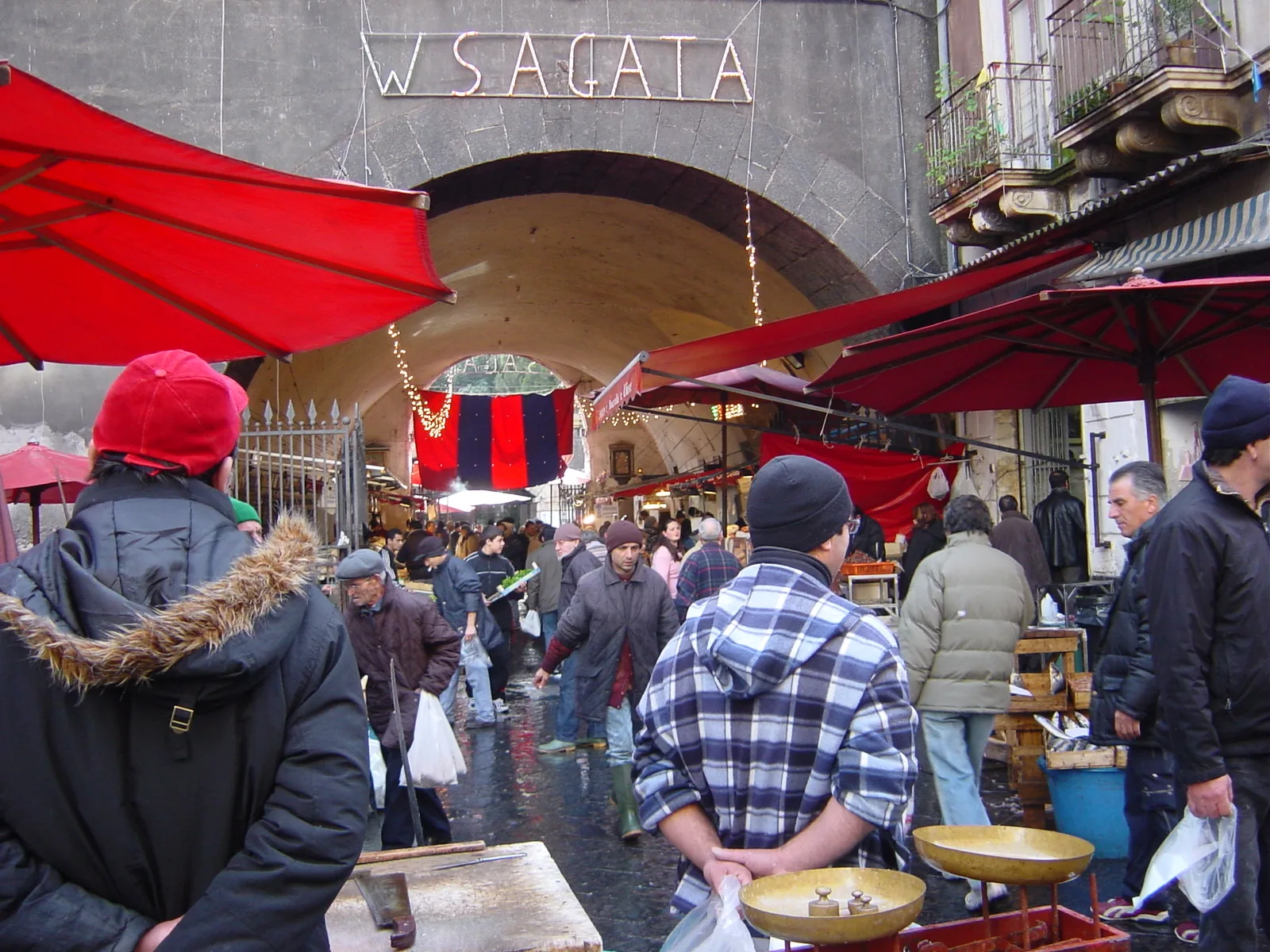
La Pescheria is Catania’s open-air fish, fruit and vegetable market, set in a small piazza below street level next to the Amenano Fountain. It has been the city’s working market for at least five centuries and is one of the rare corners of central Catania to have survived the 1693 earthquake roughly intact.
Giovanni Dall’Orto · CC BY-SA 2.5
The dialect name A’ Piscarìa still appears on hand-painted signs at the stalls and is what older Catanese use among themselves. The market is anchored by the Aragonese gate of Porta Carlo V, built in the early 1500s as part of the city’s sea-facing walls, and by the underground Amenano river which still flows beneath the cobbles — you can see its single surfaced point at the small fountain just above. The fishmongers’ chant, called l’abbanniata, is a sung price-call passed from father to son: each stall has its rhythm, its trademark insult, and its theatrical knife-flourish over a whole tuna. The market reaches deeper than seafood: behind the fish stalls a second piazza opens for fruit, vegetables, butchers and dried-goods sellers, and the whole thing spills along Via Pardo towards Porta Uzeda. For the wider context of the surrounding district, see our guide to Catania’s old town.
When is the Catania fish market open?
La Pescheria is open Monday to Saturday, from around 7:00am to 2:00pm, with peak activity between 9:00 and 11:00. It is closed all day on Sunday. Most fish stalls start packing up by 1:30pm; if you arrive at 1pm, you’ll find half the boards already washed down. The first hour (7–8am) is the wholesale and locals’ window, with vans and trolleys still moving in the alleys — vivid, but cramped. The 9–11am window is the best balance of full stalls and walkable space; the post-11am window is quieter but the freshest fish is gone.
Three calendar caveats are worth knowing. The market may run reduced hours on national holidays (25 December, 1 January, 15 August / Ferragosto). On 5 February, the feast day of Sant’Agata — Catania’s patron saint — the whole city closes for the procession; the market closes too, sometimes from the afternoon of 3 February. And in the summer (late July through August), some stalls take rolling holidays, so the market feels visibly thinner on a Tuesday in early August than in early October. None of this affects the overall daily window of Monday to Saturday, 7am to 2pm.
What days are the markets in Catania?
La Pescheria runs Monday to Saturday (closed Sunday). The other major Catania market, Fera ’o Luní, runs Monday to Saturday too, 8am to roughly 1pm, in Piazza Carlo Alberto. Fera ’o Luní despite its name (“Monday Fair”) runs daily except Sunday, and is the city’s general flea, clothes and household-goods market with a smaller food section. For Sunday morning, the closest local alternative is the small Mercato di San Domenico in the Via Plebiscito area, which keeps a handful of food stalls open Saturday and Sunday morning, though it is far less spectacular than La Pescheria. Visitors used to year-round markets in their home country should plan their visit before Saturday lunchtime.
Is the Catania fish market open on Sunday?
No — La Pescheria is closed every Sunday, all year, with no exceptions for tourist season. This is the question we get most often by email; the answer surprises guests who expect a Mediterranean fish market to peak on Sunday morning like a French marché. The Sunday closure is religious-cultural (Catania remains a churchgoing city on Sundays) and practical (the wholesale supply chain from Mazara del Vallo and the smaller Sicilian ports rests on Sunday too).
If your only Catania morning is a Sunday, three workarounds are worth considering. The closed Pescheria piazza is still photogenic at 9am — empty stalls, the Amenano Fountain, Porta Carlo V — and you can do the walk in 15 minutes as part of an old-town route. The small Mercato di San Domenico off Via Plebiscito has a residual Sunday morning life, mostly local rather than tourist. Or you can shift the market visit to your Monday morning before flying out (the start of the week is calmer than Saturday and the fish is fresh: trawlers return on Sunday night).
How to get to La Pescheria (entry points)
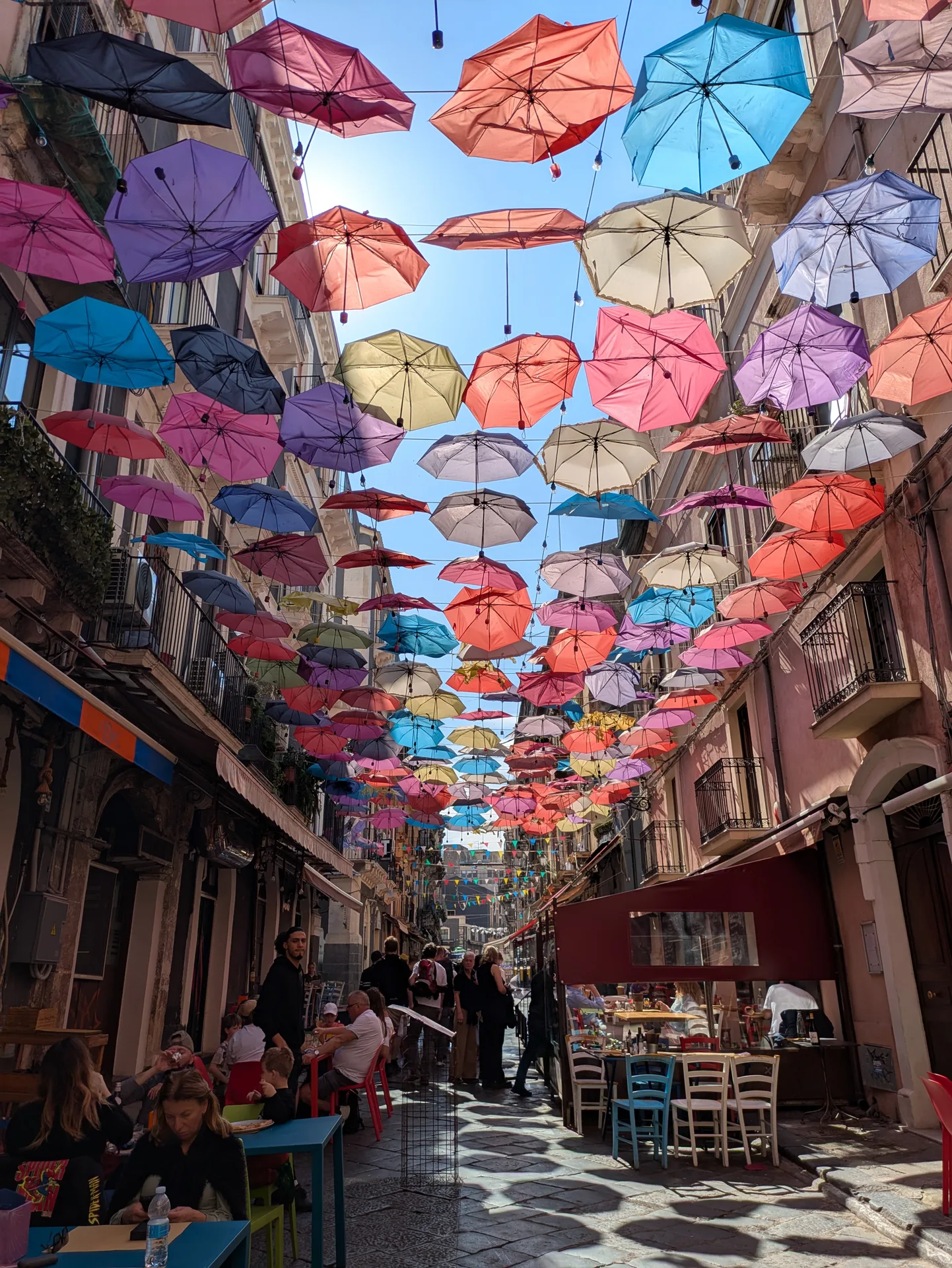
La Pescheria is a five-minute walk from Catania Centrale station and twelve minutes from Via Etnea. There are three useful entry points — the photogenic one is from Piazza del Duomo, descending past the Amenano Fountain.
Auregann · CC BY-SA 4.0
From Piazza del Duomo — the photogenic entry
Stand with your back to the Duomo, walk towards the Amenano Fountain in the south-west corner of the piazza, and you’ll see a flight of stairs dropping below street level into the market square. The descent reveals the stalls slowly, with the noise rising as you go. This is the entry every photographer wants and the most disorienting one if you arrive at peak time — the staircase narrows and you’ll meet trolleys coming up.
From Porta Carlo V — the historic gate
Walk south from Piazza del Duomo along Via Garibaldi for one block, turn left into Via Pardo and you reach the surviving fragment of the Aragonese Porta Carlo V. The gate itself is small and easy to miss; the market opens up directly beyond it. This is the calmer entry and the one locals use when they’re shopping rather than touring — you avoid the staircase scrum and land straight in the fish section.
From Via Garibaldi — the service entrance
The third entry, on Via Garibaldi past the Porta Uzeda, is the early-morning delivery route — trucks until about 8:30am. We’d skip it before 9am unless you specifically want to photograph the unloading. Bus lines 1-4, 4-7 and 534 (AMTS) stop within a five-minute walk along Via Vittorio Emanuele II. For arrivals by car, parking on the surrounding streets is almost always taken; see our guide to parking near Piazza Duomo for the closest paid garages.
What to expect: a sensory walk-through
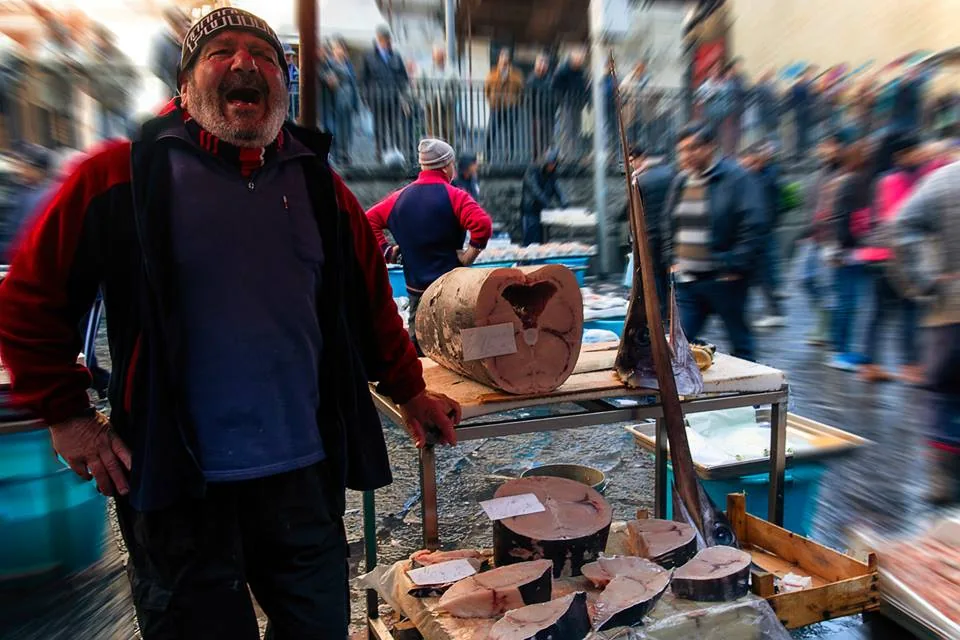
Four overlapping zones, walkable in fifteen minutes if you don’t stop — fish and seafood first, then fruit and vegetables, then butchers and cheese, then spices and dried goods. The signature soundtrack is the singsong chant of the fishmongers; the signature smell is iced fish on stone, occasionally bracing.
andrea · CC BY-SA 2.0
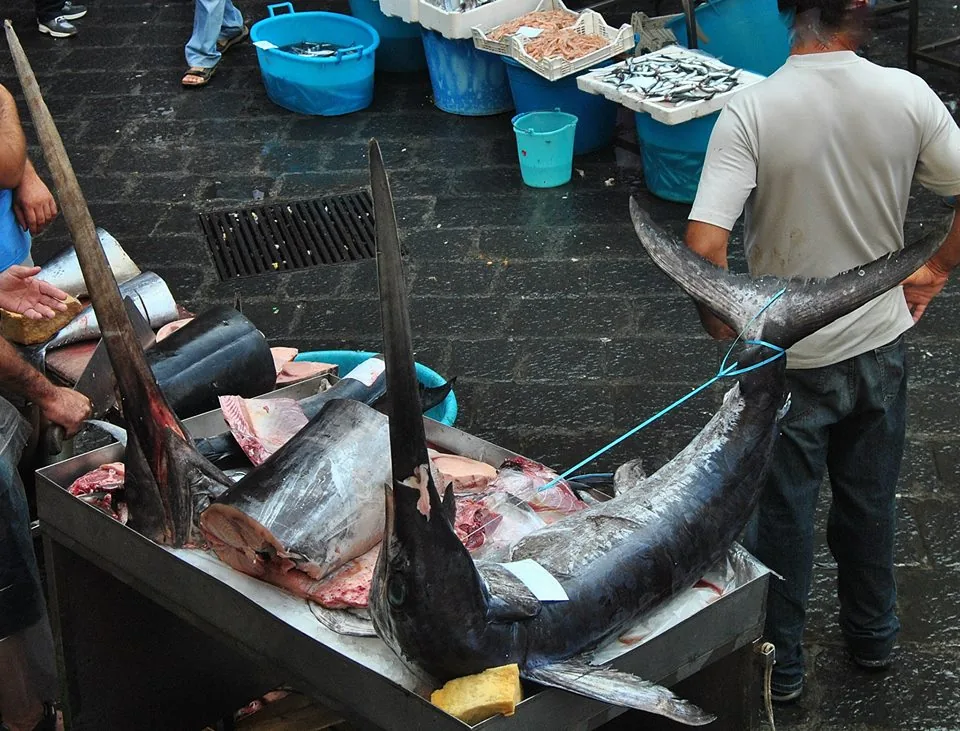
The fish and seafood zone is the core. A typical morning you’ll see whole pesce spada (swordfish) split open along the sword bone, sides of tonno rosso (bluefin tuna) cut to order, baskets of ricci di mare (sea urchin, in season roughly November to April), trays of small masculini (anchovies), and seasonal neonata (the heavily-regulated whitefish fry, only sold in regulated windows). Eels coil in shallow tubs; occasionally a vendor flicks them with a flat hand to demonstrate they’re alive. Dried mosciame (cured fish, similar to tuna prosciutto) hangs at one or two specialised stalls.
Beyond the fish, the fruit and vegetable zone shifts the colour palette completely: pink-veined Sicilian blood oranges (December to April), wild fennel, Sant’Erasmo artichokes, cardoons, ten varieties of tomatoes. The butcher and cheese row sits along the western side — quartered horse meat (a Catanese tradition), pecorino siciliano, fresh ricotta in baskets, and provola dei Nebrodi. Finally, the spices and dried goods stalls — sun-dried tomatoes, capers from Pantelleria packed in salt, dried oregano in bunches, jars of pistachio paste from Bronte, almonds from Noto. The whole circuit takes twenty minutes if you walk straight through, two hours if you stop to talk.
What’s actually sold (and indicative prices)
The table below summarises the four zones, what you’ll typically find in each, an indicative price range (spring 2026, per kilogram unless noted), and the best time of day to visit each.
andrea · CC BY-SA 2.0
| Zone | What’s there | Indicative price (spring 2026) | Best time |
|---|---|---|---|
| Fish & seafood | Swordfish, bluefin tuna, anchovies, sardines, prawns, sea urchin (Nov–Apr), eels, mosciame | Swordfish €18–26/kg · Tuna €22–30/kg · Sea urchin €1.50–2.50/piece | 8:30–10:30am |
| Fruit & veg | Blood oranges, wild fennel, Sicilian tomatoes, artichokes, cardoons, prickly pear (Sep–Oct) | Blood oranges €2–3/kg · Tomatoes €3–5/kg · Artichokes €0.80–1.50/piece | 9:00am–1:00pm |
| Butcher & cheese | Horse meat, pecorino siciliano, fresh ricotta, provola dei Nebrodi | Pecorino €18–25/kg · Fresh ricotta €6–10/kg · Horse fillet €14–20/kg | 9:00am–12:00pm |
| Spices & dried | Capers in salt, dried oregano, Bronte pistachio paste, Noto almonds, sun-dried tomatoes | Bronte pistachio paste €15–25/jar · Capers €5–8/100g · Oregano bunch €2–4 | Any time |
Two notes on payment: most stalls are cash-only, so bring €20–40 in small notes; and prices at La Pescheria are not negotiated — the listed price is the price, unlike Marrakech or Istanbul. A small “extra anchovy in the bag” gesture from a regular vendor is the closest you’ll get to a discount.
What to do in the Catania fish market?
Walk slow, taste a sea urchin or oyster opened at the stall, buy ingredients for a half-day picnic, photograph the stalls (politely), and watch the swordfish-cutting demonstration that happens every twenty minutes or so. Five do-and-don’t rules to keep in mind:
- Do try a freshly-opened sea urchin in season (November to April, €1.50–2.50 per piece) — the vendor will hand you a slice of bread with it.
- Do buy take-home gifts that travel: a jar of Bronte pistachio paste, a bunch of dried oregano, capers in salt — all hand-luggage-friendly.
- Don’t touch the fish or produce without asking — this is universally annoying and is the gesture that triggers the loudest reaction.
- Don’t try to haggle: prices at La Pescheria are not negotiated. You can ask for a smaller cut, never a lower per-kilo rate.
- Don’t expect fluent English at the older stalls — a smile, buongiorno, and a pointing finger work fine.
Photo etiquette: how to shoot La Pescheria without being annoying
Wide shots and video are fine without asking; close-up portraits of a vendor are not. Catania is camera-tolerant compared to Palermo, but the rules below keep things friendly.
- Wide shots and video of stalls, alleys and the general scene are part of the deal — no permission needed.
- Close-up portraits of a fishmonger’s face: ask first, with a gesture towards the camera. Most will say yes, some will pose; a small purchase afterwards is the polite move.
- No flash, ever — the light is plenty at 9am east-facing, and flash bothers everyone within five metres.
- Don’t photograph children in someone else’s frame — not yours, not anyone’s. This is the single rule that escalates fastest if broken.
- Best light: 9–10am east-facing stalls, where the sun reaches down the staircase from Piazza Duomo. After 11am the upper alleys are in heavy shadow.
Where did Stanley Tucci eat in Catania?
In the CNN series “Searching for Italy” (season 2, episode 2, 2022), Stanley Tucci films a market scene inside La Pescheria and eats around the historic centre of Catania. The dinner sequence is shot at Trattoria del Forestiero in the Via Coppola / Via Crociferi area, not inside the market itself. The episode also shows him at Piazza del Duomo with Castello Ursino in the background and tasting sea urchin opened at a Pescheria stall.
The episode caused a small bump in English-speaking visitors to the market in 2022–2023, especially American families who quote it almost word for word at the stalls. A practical note: the trattoria where Tucci dines is a small place and now books up two to three weeks ahead in shoulder season; if you want the scene without the reservation hassle, the seafood spots around La Pescheria below give you the same Catanese-fish experience at a similar price point.
Where to eat the catch right after: 3 picks near La Pescheria
Three seafood restaurants within a four-minute walk of the market, listed from inside-the-Pescheria to a short walk away. All three serve a midday meal until roughly 3pm. For the wider Catania food landscape, see our best restaurants in Catania guide.
Osteria Antica Marina — inside the Pescheria
- Location
- Zona Pescheria, Via Pardo 29, Catania Maps
- Site
- anticamarina.it
- Essential fact
- Open since 1968 and located literally inside the Pescheria perimeter, the kitchen sources from the stalls a few metres away each morning. Small dining room with white tablecloths and a wall of black-and-white photos.
- Signature dish
- Crudo di mare: red prawns, sea bass carpaccio, mosciame
- Price
- €45–65 per person without wine
Antica Marina sits literally inside the market perimeter, so the kitchen sources from the stalls a few metres away each morning — what you see on ice at 8am is what lands on the plate at 1pm. The dining room is small and a little theatrical, with white tablecloths and a wall of black-and-white photos; expect a slow, generous meal rather than a quick lunch. The crudo platter is the obvious order, but the pasta with sea urchin (when in season, roughly November to April) is what regulars come back for.
Scirocco Sicilian Fish Lab — modernist seafood two minutes away
- Location
- Piazza Alonzo di Benedetto 7, Catania Maps
- Site
- sciroccolab.com
- Essential fact
- Bright, fast street-food spot two minutes from the Pescheria, built around modernist cones of fried market fish you eat standing at the counter. Dinner shifts to sit-down with a short tasting menu.
- Signature dish
- Modernist street-food cones with fried market fish (pan-fried calamari, anchovy fritters)
- Price
- €15–25 (lunch) — €35–50 (dinner pp)
Scirocco is the opposite end of the spectrum from Antica Marina — bright, fast, and built around street-food cones of fried market fish you eat standing at the counter. It works best as a lunchtime stop straight off the Pescheria: walk out of the market, cross Piazza Pardo, and you’re there in under two minutes. Dinner shifts the format to sit-down with a short tasting menu; if you only have time for one meal, go at lunch for the cones.
Trattoria del Cavaliere — family-run pasta four minutes away
- Location
- Via Paternò 11, Catania Maps
- Site
- gmaps.top/trattoria-del-cavaliere
- Essential fact
- Family-run for three generations on a narrow room on Via Penninello, four minutes from the Pescheria. Handwritten daily menu depending on what came up from the market that morning; about 24 covers.
- Signature dish
- Pasta con le sarde and pasta with sea urchin in season
- Price
- €25–40 per person without wine
Cavaliere is the neighbourhood pick — a narrow room on Via Penninello, family-run for three generations, with a handwritten daily menu that depends on what came up from the Pescheria that morning. The pasta con le sarde is the house benchmark (wild fennel, pine nuts, sardines, saffron); off-season, ask what the catch is and trust the answer. It’s the slowest of the three but also the most local: at 1.30pm the room is full of catanesi on their lunch break, not tourists.
Where not to go in Catania
The central tourist areas — Piazza Duomo, Via Etnea, Via Crociferi, the Pescheria itself in daylight hours — are fine. After midnight, less experienced solo travellers should avoid the quiet pockets of San Berillo Vecchio (a small residual area between Via Pacini and Stesicoro) and the far edges of the Librino district (well outside the centre). Petty theft — not violent crime — is the practical risk.
Treat this as a navigation note rather than a fear list: Catania is a working southern Italian city, not a museum, and the same common-sense rules that apply in Naples or Palermo apply here. Don’t flash phones in deserted streets after midnight, watch your bag in crowded markets, and stick to the brightly-lit corso evenings (Via Etnea, the Duomo–Via Crociferi axis) and you’ll be fine. The Pescheria area itself is unproblematic during opening hours; we walk through it on the way home from most of the city’s sights daily without incident.
What to bring (and what to skip)
Bring cash, a reusable bag if you’re buying take-home goods, and comfortable closed shoes — the floor is often wet by 10am. The shortlist:
- €20–40 in cash in small notes — most stalls do not take cards.
- A reusable shopping bag if you plan to buy more than two items (vendors give thin plastic, which tears).
- Closed-toe shoes you can wash — canvas trainers are fine; bright-white sneakers will not survive an hour.
- A light jacket in shoulder season; the alley below street level stays cool until 11am.
- Skip the white outfits, large strollers (the cobbles and the wet ground are hostile), expensive cameras around your neck (pickpocket signal), and dogs (the crush of trolleys is stressful for them).
- Skip the early-morning visit if you have under 90 minutes total: the staircase entry takes 10 minutes to clear at 9am, and the four zones need at least 30 minutes to feel walked.
Where to stay in Catania
Staying inside the old town puts La Pescheria within walking distance of breakfast: our apartments in Catania sit a twelve-minute walk from the market and five minutes from Piazza Duomo, which means you can do the early-morning visit and be back in time for a granita and brioche before the heat builds. For a deeper look at the neighbourhood options and Catania-specific accommodation styles, see our guides to where to stay in Catania and Catania B&B.
The information in this guide was correct at the time of writing. Data can change from season to season without notice: before you travel, always check the official channels and websites for updates. We review this guide periodically, but the official channels are always the authoritative source. We also cannot guarantee that the suggested routes or the attractions described are always reachable or accessible: roads, trails and sites may be closed, damaged, altered or unsafe. Assessing the practicability and safety of itineraries and attractions always remains your own responsibility.