

If you’re working out where to stay in Taormina, Sicily, the real question isn’t whether to go — it’s where within the Taormina area to book. We live down the coast in Catania, and when guests ask us which single place in East Sicily they’d pick for a long weekend with a view, the answer is always Taormina. The town sits on a cliff 200 metres above the sea, its beach suburb Mazzarò clings to the bay below, and three neighbouring towns — Giardini Naxos, Letojanni and the hilltop village of Castelmola — all sit within a 15-minute bus ride. Each area has a completely different feel, a different price point, and a different set of trade-offs. This guide breaks them down honestly, area by area and profile by profile, so you can book the right one first time.
Is Taormina the right base for your Sicily trip?
Before you choose an area within Taormina, it’s worth checking that Taormina itself is the right fit. It depends on what kind of trip you’re planning.
Honeymoon couples comparing destinations beyond Sicily can read our Italy honeymoon guide for the case for Taormina vs Amalfi, Lake Como and Tuscany.
For couples planning Taormina as part of a wider trip, see our Sicily honeymoon guide — a 10-day romantic itinerary that uses Catania as a single base and includes a full Taormina day trip with sunset and Isola Bella swim.
If you have 3 or more nights and want cliff-top views, ancient history and a compact walkable centre — Taormina is perfect. The Greek Theatre, Corso Umberto, Isola Bella and Castelmola are all reachable on foot or by a short bus ride. You can fill three days without touching a car.
If beaches and nightlife are the priority — you’ll still find both within the Taormina cluster, just not in Taormina town itself. Giardini Naxos, 15 minutes downhill by bus, has the sandy beach and the summer nightlife scene. Mazzarò has the postcard bay. You don’t need to go elsewhere — you just need the right area.
If you want city energy, street food and maximum day-trip flexibility — consider Catania instead. It’s 50 minutes south by Interbus, has Fontanarossa airport right on its doorstep, a proper central train station, two motorway junctions and mid-range apartments at half of what Taormina charges. You can visit Taormina as a day trip from Catania (and most of our guests do exactly that), while also reaching Etna, Syracuse, Noto and Ragusa within 90 minutes. For a trip of 5 nights or more, Catania as your single base and Taormina as a day trip is often the smarter move — you save on accommodation and lose nothing on the experience. We’ve written a full guide comparing every base in Sicily if you’re weighing the options.
Where to stay in Taormina, Sicily: 5 areas at a glance
Most guides cover three or four neighbourhoods. We include five because Castelmola — the hilltop village above Taormina — deserves its own section. It’s cheaper, quieter and has the best panoramic view of the entire coast, yet almost no English-language guide treats it as a genuine accommodation option.
| Area | Cost | Walk to centre | Beach | Restaurants | Nightlife | Transport | Family | Car-friendly | Charm | Views |
|---|---|---|---|---|---|---|---|---|---|---|
| Centro storico | €€€ | you’re in it | cable car to Mazzarò | ★★★★★ | ★★★★ | ★★ | ★★ | ❌ ZTL | ★★★★★ | ★★★★★ |
| Mazzarò / Isola Bella | €€€€ | cable car 2 min | ★★★★★ | ★★★ | ★★ | ★★★ | ★★★★ | ★★★ | ★★★★ | ★★★★ |
| Giardini Naxos | €€ | bus 15 min | ★★★★★ | ★★★★ | ★★★★ | ★★★★ | ★★★★★ | ★★★★ | ★★★ | ★★ |
| Letojanni | €€ | bus 20 min | ★★★★ | ★★★ | ★★ | ★★★ | ★★★★ | ★★★★★ | ★★★ | ★★ |
| Castelmola | €€ | bus 15 min | ❌ | ★★ | ★ | ★★ | ★★ | ★★★ | ★★★★★ | ★★★★★★ |
Centro storico (Corso Umberto)
The historic centre is the Taormina most people picture: narrow lanes between medieval palazzi, the Greek Theatre at one end, Piazza IX Aprile overlooking the bay in the middle, and the Duomo at the other. Corso Umberto runs the length of it, car-free and lined with restaurants, gelaterias and small boutiques. It’s roughly 800 metres from gate to gate — Porta Messina in the north to Porta Catania in the south — and everything you’d want to see on foot is within that strip.

Eleassar · CC BY-SA 4.0
Pros:
- Walk out your door and you’re already in the middle of it — no commute, no bus schedule to check.
- The best restaurant density in the area: from casual arancini at a counter to full sit-down Sicilian seafood.
- Taormina after 19:00 is a different town — golden light on the palazzo facades, aperitivo on Piazza IX Aprile, the theatre lit up against the Etna silhouette. You only get that if you sleep here.
- Villa Comunale (the public gardens built by Lady Florence Trevelyan) is a peaceful 10-minute walk from the Corso — quiet benches, sea views, no crowds.
Cons:
- Prices are the highest in the Taormina cluster. Expect to pay 30–50% more than Giardini Naxos for equivalent quality.
- No direct beach access — reaching Mazzarò means a cable car ride (€6 one-way, €10 return) or a 40-minute walk downhill that becomes a punishing climb on the way back.
- The ZTL (restricted traffic zone) covers the entire old town. You cannot park here — you’ll need to leave the car at Lumbi or Porta Catania and walk or shuttle in (more on this below).
- Steep lanes and uneven cobblestones: not easy with pushchairs or heavy luggage.
Mazzarò & Isola Bella (seafront)
Mazzarò is the beach suburb directly below Taormina town, connected by the funivia (cable car) that runs every 15 minutes from early morning until well past midnight in summer. Isola Bella — the small island in the middle of the bay — is a nature reserve you can walk to at low tide. The accommodation here tends to be resort-style or mid-range hotels with sea views.

Abxbay · Public domain
Pros:
- Direct beach access — step out of your hotel and you’re on the pebble beach within minutes.
- The cable car to the centre takes 2 minutes and runs until 01:30 in summer, so you’re never stranded.
- Good for families with children: the beach is supervised in season, the water is clear and sheltered, and there’s no climbing involved.
Cons:
- The most expensive area per night in the entire Taormina cluster. Peak-season prices for a sea-view room routinely exceed those of the centro storico.
- Restaurant choice is limited compared to the town above — a handful of beach clubs and hotel restaurants, mostly priced for captive guests.
- Without the cable car, reaching the centre on foot means a steep 40-minute climb up Via Pirandello. That climb is the single most common complaint from guests who book Mazzarò without realising it.
Giardini Naxos (budget-friendly beach town)
Giardini Naxos sits on the coast 5 km south of Taormina, at the foot of the cliff. It has a long sandy beach (unlike Taormina’s pebbles), an archaeological park with the ruins of the first Greek colony in Sicily, and a seafront promenade lined with pizzerias and gelaterias. The Interbus to Taormina centro runs roughly every 15 minutes and takes about 15 minutes.

Hein56didden · CC BY-SA 3.0
Pros:
- Prices are 30–50% lower than Taormina centre for equivalent accommodation quality.
- The sandy beach is long, shallow and family-friendly — better for children than Mazzarò’s pebbles.
- More restaurant variety at local prices: fish restaurants on the lungomare serve fresh catch at half of what you’d pay on Corso Umberto.
- The best nightlife in the Taormina area during July and August — beach bars, live music, a younger Italian and international crowd.
- Easy car access and free or cheap parking along the seafront.
Cons:
- You’re not in Taormina — you’re 15 minutes away by bus. If the main draw for you is the evening atmosphere of the old town, staying here means a bus ride back every night.
- The town itself has less charm than Taormina — it’s a modern seaside resort, not a medieval hilltop village.
- In July and August, the beach gets crowded and noisy. If you wanted quiet, this is the wrong choice in peak season.
Letojanni (quiet coastal alternative)
Letojanni is a small fishing town 7 km north of Taormina, on the coastal road towards Messina. It has a long grey-sand beach that’s rarely crowded even in August, a handful of family-run trattorias, and a pace of life that feels more like a real Sicilian town than a tourist destination. Buses to Taormina take about 20 minutes; there’s also a small train station on the Messina–Catania line.
Pros:

Viktorija O. · Public domain
- Genuinely quiet. If you want to read a book on the beach without electronic music from a beach club, Letojanni delivers.
- Prices are comparable to Giardini Naxos — significantly cheaper than the centro.
- Easiest car access in the Taormina area: flat streets, free parking, no ZTL.
- The beach is long and uncrowded, with a mix of free stretches and low-cost lidos.
Cons:
- Very limited dining options — a handful of trattorias, no variety.
- Essentially no nightlife. After dinner, the town goes quiet.
- The bus to Taormina is less frequent than from Giardini Naxos, and the last return bus runs earlier.
Castelmola (hilltop retreat above Taormina)
This is the area no other English-language guide covers properly, and it’s the one we think deserves more attention. Castelmola is a tiny medieval village perched on a rocky peak 5 km above Taormina, at about 530 metres elevation. The panoramic view from up here — the entire bay, Etna, the Ionian coast stretching south towards Catania — is genuinely better than the view from Taormina itself. The Interbus IN10 line connects it to Taormina with dozens of daily departures; the ride takes about 15 minutes.

trolvag · CC BY-SA 3.0
Pros:
- The best view in the entire area, bar none. Sunrise and sunset from the castle ruins are worth the trip alone.
- Accommodation costs 30–50% less than Taormina centre. A B&B with a panoramic terrace here costs what a windowless room on Corso Umberto costs.
- Almost no tourists stay overnight — you get the village to yourself after the day-trippers leave around 17:00.
- Bar Turrisi, the village’s famous bar decorated with eccentric sculptures, is a curiosity worth seeing regardless of where you stay.
Cons:
- Only two or three restaurants. You’ll eat well but without choice.
- No beach — reaching Mazzarò means bus to Taormina, then cable car down. Budget 45 minutes each way.
- The village is all stairs and steep lanes. Not suitable for anyone with mobility issues or travelling with a pushchair.
- After 20:00 there is nothing open except Bar Turrisi and your accommodation. If you need evening entertainment, this isn’t it.
Which area fits you? 5 traveller profiles
Couples & romance
Recommended: Centro storico (sunset aperitivo at Piazza IX Aprile, evening stroll on the lit Corso) or Castelmola (sunset from the castle ruins, total quiet, panoramic B&Bs at half the price). Avoid: Giardini Naxos in July–August — the beach-party atmosphere is more family and young-group than romantic.

Jeanne Griffin · CC BY-SA 4.0
Families with kids
Recommended: Mazzarò (direct beach access, cable car is an adventure for children, no hill-climbing needed) or Giardini Naxos (sandy beach, shallow water, kid-friendly restaurants at local prices). Avoid: Castelmola (only stairs, no beach, limited food options) and Centro storico (steep cobblestone lanes with pushchairs are a nightmare).
First-time visitors
Recommended: Centro storico, ideally within a 5-minute walk of the Greek Theatre or Piazza IX Aprile. Your first visit to Taormina should be about being in the middle of it without logistics. Walk out, see things, walk back. Avoid: splitting your stay between two areas — the bus commute eats into your time more than you’d expect.
Budget travellers
Recommended: Giardini Naxos (bus to Taormina every 15 minutes, same views from below at 40–50% of the cost) or Castelmola (even cheaper, better views, but no beach). Avoid: Mazzarò — it’s the most expensive area per night and the restaurant prices match.
Nightlife & young travellers
Recommended: Giardini Naxos in summer (beach clubs, cocktail bars on the lungomare, live music until late) or the northern end of Corso Umberto in the centro storico (bars within walking distance, no taxi needed to get home). Taormina town is surprisingly calm after midnight — if you want proper nightlife in July and August, Giardini Naxos is where it happens. Avoid: Letojanni and Castelmola — both shut down after dinner.
What you need to know before booking
This is the section most guides skip, and it’s the one that saves you the most money and frustration. We drive up to Taormina from Catania regularly, and the logistics catch visitors off guard more than anything else. If you are arriving by plane, start with our guide to getting from Catania airport to Taormina — it covers every transport option with current fares.
The ZTL myth: is Taormina town really car-free?
Formally, yes — the entire centro storico is a ZTL (zona a traffico limitato), restricted 24 hours a day. In practice, the enforcement cameras are not currently active. That doesn’t mean you can drive in freely: the streets are physically too narrow for most cars, and pedestrians fill Corso Umberto from morning to midnight. But the fear of automatic fines that dominates forum threads is, as of now, unfounded.
If you’re staying at a hotel or B&B inside the ZTL, the accommodation will register your number plate with the local police (Comando Polizia Municipale) within 48 hours of check-in, granting you access for loading and unloading. Ask your host to confirm this before arrival — most know the procedure by heart.
Parking if you arrive by car
You cannot park inside Taormina’s old town (ZTL — see above). The two main options are Parcheggio Lumbi on the north side (965 spaces, free shuttle to the centre every 15 minutes) and Parcheggio Porta Catania on the south side (650-space multi-storey, right at the Duomo gate). Lumbi is the default choice for most visitors; Porta Catania is more convenient if your accommodation is in the southern half of the Corso. Smaller alternatives include Porta Pasquale (blue stripes, north side) and the Mazzarò blue-stripe area near the cable car station. If you’re staying in Giardini Naxos or Letojanni, parking is straightforward — flat streets, no ZTL, free or cheap street parking.
Getting around without a car
Taormina is surprisingly manageable without a car, as long as you know the network:
Davidemara · CC0
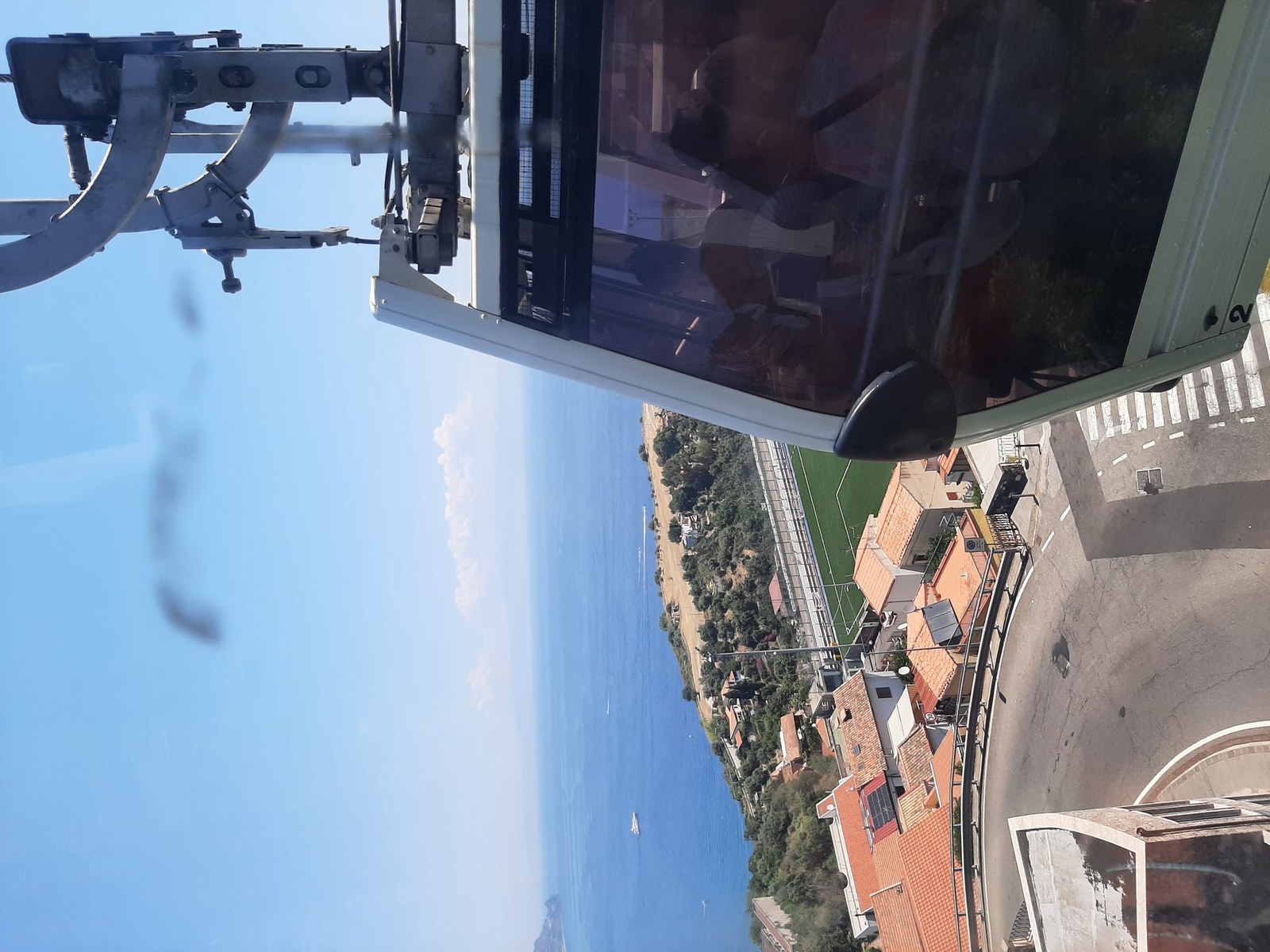
- Cable car (funivia) — connects Mazzarò beach to Taormina centro in 2 minutes, every 15 minutes. Summer hours 08:00–01:30, winter 08:00–20:00. Tickets: €6 one-way, €10 return.
- Interbus — the regional bus company that connects Taormina to Giardini Naxos (15 min), Letojanni (20 min), Castelmola (15 min, line IN10), Catania airport (1 h 15 min) and Messina. Frequent departures throughout the day.
- Taormina-Giardini train station — on the Messina–Catania coastal line. The station is at sea level, not in the town itself. A shuttle bus runs between the station and the centro. Useful if you’re arriving from Catania or Syracuse without a car.
- Walking — within the centro storico, everything is on foot. Corso Umberto is 800 m end to end. Via Pirandello runs parallel with panoramic views. Via Roma connects to the cable car station.
Arriving from Catania airport
The most common route in. Interbus runs a direct shuttle from Catania Fontanarossa airport to Taormina, departing roughly every hour throughout the day. Journey time is about 1 hour 15 minutes, and a one-way ticket costs around €7–10 depending on the booking channel. The bus drops you at the Taormina bus terminal on Via Luigi Pirandello, a 2-minute walk from Corso Umberto.
A private transfer costs €80–120 per car (not per person) and takes about 50 minutes. Worth it if you’re arriving late at night when bus frequency drops, or if you’re a group of 3–4 splitting the cost.
How long to stay in Taormina
There’s no single answer — it depends on your profile and what else is on your Sicily itinerary. Here’s how we’d think about it:
| Profile | 1 night | 2 nights | 3 nights | 5+ nights |
|---|---|---|---|---|
| Couples | too rushed | OK | ⭐ ideal | luxury pace |
| Families | too rushed | ⭐ sweet spot | great | may get restless |
| First-time visitors | rushed | ⭐ minimum | ideal | use as base for east coast trips |
| Budget travellers | day trip instead | OK | ⭐ ideal | ideal + day trips |
| Nightlife | enough for one big night | ⭐ ideal | enough | enough |
The sweet spot for most visitors is 2 to 3 nights. That gives you a full day in the old town, half a day at Mazzarò beach, and time for either Castelmola or Giardini Naxos. If you’re staying longer in Sicily, Taormina works well as one of two bases — combine it with Catania or Syracuse rather than trying to see the whole island from here. We’ve mapped out a 7-day East Sicily itinerary that shows how the pieces fit together.
Common mistakes tourists make when booking in Taormina
We’ve watched guests make these mistakes year after year. All of them are avoidable with 5 minutes of planning.
- Booking Mazzarò without realising the climb to the centre. The cable car is convenient, but it closes at 20:00 in winter and at 01:30 in summer. If you miss the last one, the walk back down is fine — the walk back up is 40 minutes of steep switchbacks. Many guests book Mazzarò for the beach view, then spend half their holiday deciding whether to go up to town or not.
- Believing the ZTL will fine them automatically. Forum threads are full of horror stories about Taormina ZTL fines. The cameras are not currently active. If you’re staying inside the ZTL, your host registers your plate. If you’re just visiting for the day, you park outside and walk or shuttle in. The panic is outdated.
- Booking Giardini Naxos in July–August expecting peace and quiet. Giardini Naxos is the busiest beach area on this stretch of coast in high summer. It’s excellent if you want that energy. It’s the wrong choice if you wanted a calm seaside retreat — in that case, book Letojanni.
- Choosing Castelmola with toddlers. The village is built on a peak and connected by stairs. There are no lifts, no ramps and no flat stretches. Beautiful for adults, impractical with small children.
- Last-minute booking in July and August. Taormina is not a city with 5,000 hotel rooms. Good mid-range properties sell out months ahead in peak season. Prices double, and what’s left tends to be either top-end or bottom-end. If you’re visiting in summer, book at least 3 months ahead.
- Renting a car just to leave it in a garage. If your entire Taormina stay involves walking the centro, taking the cable car and busing to Castelmola, you don’t need a car. Parking at Porta Catania or Lumbi for 5 days adds up quickly. Rent a car only for the day trips you actually plan to drive.
Best time to visit Taormina
Off-season (November–March): the cheapest time to visit. Many restaurants and some hotels close, but the Greek Theatre, Corso Umberto and the views don’t shut down. Weather is mild by northern European standards (10–15°C), rainy spells possible. Beach swimming is off the table. Good for couples who want the atmosphere without the crowds.

Benjamin Smith (Benjism89) · CC BY-SA 4.0
Shoulder season (April–May and October): the ideal window. Warm enough for beach days (18–25°C), everything is open, and prices are 20–40% lower than peak. The town is busy but not suffocating. If you have flexibility on dates, aim here.
Peak season (June–September): full amenities, full beaches, full prices. Taormina hosts the annual film festival (TaorminaFilmFest, usually late June) and various summer concert series at the Greek Theatre. Expect queues for the cable car, crowded restaurants on the Corso, and the need to book everything in advance. The trade-off is genuine: you get the complete Taormina experience, but at a premium.
Apartments vs hotels vs B&Bs
Taormina has all three, and the right choice depends more on your group size than on any quality difference.

Pymouss · CC BY-SA 4.0
Holiday apartments work best for families and groups of 3+. A two-bedroom apartment in Giardini Naxos or Castelmola can cost less per night than a single hotel room in the centro, and you get a kitchen — a serious saving when breakfast for four at a café costs €40. The downside: no reception desk, no daily cleaning, and check-in logistics can be awkward (key boxes, codes, meeting the owner at a specific time).
Hotels give you convenience and service but at a price premium, especially in the centro storico and Mazzarò. If you’re a couple on a short stay (2–3 nights), a mid-range hotel eliminates friction. Look for properties with a terrace or rooftop — in Taormina, the view from your accommodation is half the experience.
B&Bs are the sweet spot for budget-conscious couples. Taormina has dozens of family-run B&Bs, particularly in the centro and in Castelmola, where the host is often a local who can point you to the right trattoria and the best time to visit the theatre. Breakfast is included, rooms are personal, and prices sit between apartment and hotel.
Whichever you choose, good Taormina properties book out 3–6 months ahead for July and August. Don’t wait.
Frequently asked questions
Where is the best area to stay in Taormina for first-time visitors?
Centro storico, within walking distance of the Greek Theatre and Piazza IX Aprile. Your first visit should be about immersion, not logistics. Stay in the middle of the old town and explore on foot.
Is Giardini Naxos better than Taormina town?
Different, not better. Giardini Naxos is a modern beach town — sandy beach, lower prices, nightlife in summer. Taormina town is a medieval hilltop — views, history, charm, higher prices. If your priority is the beach, Giardini Naxos wins. If your priority is atmosphere and walking, Taormina wins.
Where to stay in Taormina with family?
Mazzarò for direct beach access with no hill-climbing, or Giardini Naxos for a sandy beach, kid-friendly restaurants and lower costs. Both have flat terrain, unlike the centro storico and Castelmola.
Can you drive into Taormina town?
The entire centro storico is a ZTL (restricted traffic zone). The enforcement cameras are not currently active, but the streets are physically too narrow for comfortable driving. If you’re staying inside the ZTL, your accommodation will register your plate with the local police for loading access. Otherwise, park at Lumbi (free shuttle) or Porta Catania (multi-storey) and walk in.
Is Taormina a walkable city?
Taormina‘s centro storico on Corso Umberto is almost entirely pedestrianised and very walkable once you’re inside — 15 minutes end to end. However, the town sits at 200 metres above sea level, so reaching it from Mazzarò or the bus station involves either the cable car (€3 one-way, runs until midnight) or a staircase climb. Within the historic centre, narrow stepped alleys and uneven volcanic-stone paving require some care; travellers with mobility limitations should stay as close to Corso Umberto as possible. Giardini Naxos and Letojanni, on the coast below, are flat and easy to walk, but a 20-minute bus or cable car ride from Taormina’s sights.
How many nights do you need in Taormina?
Two to three is the sweet spot for most visitors. Two nights gives you a day in the old town plus a beach morning. Three nights adds time for Castelmola or a day trip to the Etna. Beyond that, Taormina works well as one base in a wider East Sicily itinerary.
Where to stay in Taormina on a budget?
Giardini Naxos and Castelmola are both 30–50% cheaper than the centro storico for equivalent quality. Giardini Naxos has the beach; Castelmola has the views. Both are connected to Taormina by frequent buses.
Is Taormina very expensive?
Taormina’s centro storico is among the most expensive destinations in Sicily. In high season (July–August), mid-range rooms in the centre run €150–300 per night; luxury hotels reach €400–800+. Giardini Naxos and Letojanni cost 30–50% less for equivalent quality and have direct bus links. Castelmola is cheaper still and a unique option for those prioritising views over convenience. Outside July–August, prices drop sharply: November through February (excluding Christmas week) typically sees rates 50–60% below peak. Food and dining in the centro storico are also tourist-priced; heading one street back from Corso Umberto cuts costs significantly.
Is Mazzarò the same as Isola Bella?
Essentially, yes. Mazzarò is the name of the bay and the beach area. Isola Bella is the small island in the middle of the bay — technically a nature reserve you can walk to at low tide. Hotels marketed as “Isola Bella” are located in Mazzarò.
Is Castelmola worth staying in?
If you value views, quiet and value for money over beach access and nightlife, absolutely. It’s the least-known accommodation option in the Taormina area and the one with the best panorama. The bus to Taormina takes 15 minutes and runs frequently. It’s not for everyone — but for the right traveller, it’s the best-kept option in the area.
What’s the cheapest month for Taormina accommodation?
November through February, excluding the Christmas–New Year period. You’ll find rates 50–60% below peak season, and many properties that are fully booked in July will have availability. The trade-off is reduced restaurant hours and no beach swimming.
Where to stay in Taormina for nightlife?
Giardini Naxos in summer — beach clubs and bars on the lungomare stay open late, especially in July and August. Within Taormina town, the bars along the northern stretch of Corso Umberto (near Porta Messina) have the latest closing times. Castelmola and Letojanni have essentially no nightlife.
Ready to explore Taormina?
Once you’ve booked your area, the next step is filling your days. Our guide to things to do in Taormina covers everything from the Greek Theatre to hidden beaches. Taormina packs more into a small space than almost any town in Sicily — the Greek Theatre, Isola Bella, the Corso, Castelmola — and the surrounding coast opens up day-trip options to the Etna, Syracuse and the baroque towns of Val di Noto.
If you’re planning a wider Sicily itinerary, our guide to the best areas to stay in Sicily puts Taormina in context with Catania, Syracuse, Palermo and the other bases. For an East Sicily road trip that includes Taormina as a stop, see our 7-day Sicily itinerary. And if beaches are your focus, our beach holiday in Sicily guide covers the best stretches of coastline from Taormina to Syracuse and beyond.
The information in this guide was correct at the time of writing. Data can change from season to season without notice: before you travel, always check the official channels and websites for updates. We review this guide periodically, but the official channels are always the authoritative source. We also cannot guarantee that the suggested routes or the attractions described are always reachable or accessible: roads, trails and sites may be closed, damaged, altered or unsafe. Assessing the practicability and safety of itineraries and attractions always remains your own responsibility.