
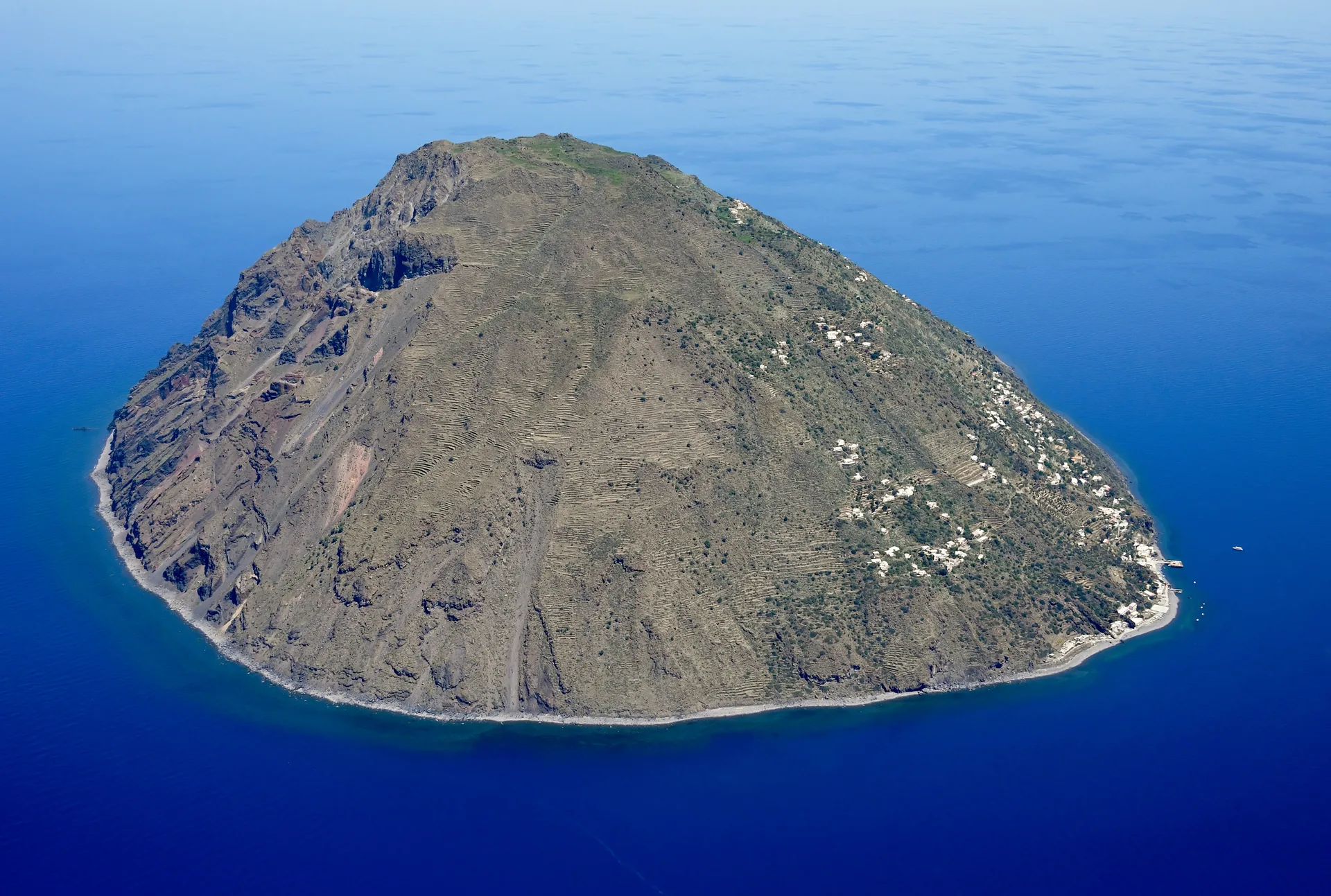
Alicudi is the westernmost and most remote of the Aeolian Islands, a near-circular volcanic cone rising 675 m out of the Tyrrhenian Sea off the north coast of Sicily. Part of Sicily (province of Messina) and protected as UNESCO World Heritage since 2000, Alicudi island has no roads, no cars, and no motorised traffic of any kind — only stone steps, terraced lava fields, and donkeys carrying supplies up to the hillside houses. Around 100 people live here year-round, making it the least populous permanently inhabited island in Italy. The single village, Alicudi Porto, sits at sea level on the eastern slope; from there the path climbs steeply toward the summit trail of Filo dell’Arpa, the finest high-altitude hike in the Aeolian archipelago.
Alicudi is reached by ferry or hydrofoil from Milazzo (roughly four to five hours via Lipari and Salina), or from Lipari directly (about one to one and a half hours). A same-day round trip from Catania is not realistic — plan at least one night on the island or position yourself on Lipari and come for the day. The standout experiences are the Filo dell’Arpa summit trail (2–3 hours round trip, no guide required), swimming off the volcanic rocks at Filo Braccio, and the sheer silence of an island that has opted out of the modern world.
What is Alicudi known for?
Alicudi is known above all for being Italy’s most isolated inhabited island and the one that has changed least in the last century. There are no roads — only a network of ancient stepped paths carved into the lava — no cars, no scooters, and no bicycle lanes. The island’s only wheeled vehicles are the carts pulled by donkeys, which remain the sole means of carrying goods from the harbour to the houses above. Electricity arrived only in the 1990s, and mobile connectivity is still intermittent.
Beyond its radical simplicity, Alicudi is known for the Filo dell’Arpa trail (its highest point at 675 m), for crystal-clear water off volcanic rock coves, and for the ancient stone terraces built by generations of farmers who cultivated capers and grain on the steep slopes. Historically, the island was also associated with a widespread phenomenon of collective hallucinations recorded in the 17th and 18th centuries, believed to be caused by ergot fungus contaminating the local rye bread — an eerie footnote to an already exceptional place.

Unukorno · CC BY 3.0
Is Alicudi worth visiting?
Yes — but only if you are the right kind of traveller. Alicudi rewards those looking for slow tourism, genuine isolation, and a landscape almost entirely unmarked by tourism infrastructure. There are no beach bars, no luxury hotels, no Wi-Fi in most accommodation, and nightlife does not exist. What you get instead is silence, starlight, donkeys on the path, and some of the clearest water in the Mediterranean.
If you are looking for a beach holiday with amenities, you will find Lipari or Panarea better suited. If you want volcanic drama, Stromboli delivers a more visceral show. But if the idea of an island that woke up sometime in the 1950s and decided to stay there is appealing — Alicudi is unlike anywhere else in Italy.
Does anyone live on Alicudi island?
Yes. Around 100 people live on Alicudi year-round, making it the smallest permanent community of any Italian island. In the 19th century the population peaked at over 3,000, sustained by caper farming and fishing; emigration through the 20th century — accelerated by the hardship of island life without any road or mechanical transport — reduced it to its present level. Many islanders have relatives in Buenos Aires, destination of a massive wave of Alicudesi emigrants in the early 1900s.
In summer the number swells significantly as Italians from the mainland — many of them descendants of emigrant families — return to holiday homes. Practically all permanent residents live in or near Alicudi Porto, the island’s only village; a handful of houses on the higher terraces are occupied seasonally. The community is self-governing and shares responsibility for maintaining the stepped path network, the island’s only infrastructure.
Hiking Filo dell’Arpa: Alicudi’s summit trail
- Location
- Filo dell’Arpa, Lipari Maps
- Essential fact
- Summit at 675 m; views of all seven Aeolian Islands on clear days; 2–3 hours return
- Price
- Free
The Filo dell’Arpa trail is the definitive Alicudi experience and one of the most rewarding hikes in the entire Aeolian archipelago. The route climbs from Alicudi Porto along ancient stepped paths through capers, wild fennel, and terraced lava fields to the summit ridge at 675 m, where on a clear day you can see all seven Aeolian Islands, the Sicilian coastline from Milazzo to Capo Peloro, and on exceptional days as far as Stromboli and the Calabrian coast.
No guide is required and there are no access restrictions of the kind that govern the Stromboli volcano trail. Bring at least 2 litres of water per person — there is nothing to buy on the way up — sturdy footwear, and sun protection. The descent is harder on the knees than the ascent on these steep lava-stone steps; trekking poles help. Allow a full morning or afternoon, and plan to be back at the harbour well before your ferry.

I viaggi della Van · CC BY-SA 4.0
Beaches and swimming spots on Alicudi
- Location
- Via pecorini 1, Filicudi Maps
- Essential fact
- Volcanic rock and small pebble coves; visibility 20–30 m; no sandy beach; 5-minute walk from the harbour
- Price
- Free
There are no sandy beaches on Alicudi. The coastline is entirely volcanic rock, alternating between smooth lava shelves and small pebble coves. Water entry requires care, but the reward is extraordinary clarity — visibility of 20–30 metres is standard. The water around Alicudi, rarely visited by charter yachts or tourist boats in high numbers, is some of the cleanest in the Aeolian archipelago.
The area around the harbour itself — to the south of the ferry dock — also offers entry points into the water, and in calm conditions snorkelling is excellent. Bring your own snorkelling gear; there is nowhere to rent equipment on the island. Avoid swimming during the afternoon maestrale (northwest wind), which can make the western coves rough and access slippery.
How do you get to Alicudi?
Alicudi is served by Liberty Lines (hydrofoil) and Siremar/Caronte & Tourist (car ferry, though no cars travel to Alicudi). The main mainland gateway is Milazzo on the north Sicilian coast. Most connections call at Lipari and often Salina or Filicudi en route, making Alicudi the last stop on the western run. Journey times depend on the route and vessel type.
| Departure port | Type | Approx. duration | Notes |
|---|---|---|---|
| Milazzo | Hydrofoil (aliscafo) | 3.5–4.5 h | Via Lipari/Salina; 2–4 sailings daily in summer, reduced in winter |
| Milazzo | Car ferry (traghetto) | 5–6 h | Via Lipari/Salina/Filicudi; slower but cheaper; no cars embarked for Alicudi |
| Lipari | Hydrofoil | ~1–1.5 h | Via Filicudi; best option if you base yourself on Lipari |
| Palermo | Car ferry (seasonal) | ~5 h | Summer only; check Liberty Lines/Siremar timetables in advance |
| Catania | Transfer + Milazzo ferry | ~7–8 h total | Catania → Milazzo by train (~3 h) + hydrofoil; day trip from Catania not realistic |
Where to stay on Alicudi
Accommodation on Alicudi is extremely limited. The island has a small number of B&Bs, case vacanza (holiday apartments), and rooms rented by islanders — no branded hotels, no chains, and no resort infrastructure. In July and August capacity fills fast; if you plan to sleep on the island, book several months in advance.
A realistic alternative for most travellers is to base yourself on Lipari — which has a full range of accommodation and is served by far more connections — and take the hydrofoil to Alicudi for a long day visit. This allows you to do the Filo dell’Arpa hike and swim in the morning before catching an afternoon return. See our guide to Lipari island for accommodation options there.

GerritR · CC BY-SA 4.0
When to visit Alicudi
May, June, and September are the ideal months. Temperatures are comfortable for hiking (20–26°C), the sea is warm enough to swim from mid-June, ferry connections are at full summer frequency, and the island is not yet overwhelmed by returning summer residents. June in particular sees Alicudi at its most vivid: yellow broom and white caper flowers cover the terraces, and the light has the long evenings typical of a Mediterranean early summer.
July and August bring the island’s maximum activity and population (still modest by mainland standards), higher temperatures, and occasional wind that can disrupt ferries. Accommodation becomes very hard to find and must be booked far in advance. October to April sees sharply reduced ferry connections — sometimes as few as one hydrofoil per day — most accommodation closed, and the island settled into its quiet winter rhythm. The upside is almost complete solitude and lower prices; the downside is the real risk of being stranded if seas deteriorate.
Where to stay in Catania
Catania is the natural gateway for a Sicilian itinerary that includes the Aeolian Islands. From Catania’s train station you can reach Milazzo — the main departure point for Alicudi — in roughly three hours by direct train, making it easy to combine an Aeolian island stay with several days in the city. Explore our full guide to the Aeolian archipelago, or discover the other islands: Lipari, Vulcano, Panarea, and Stromboli. To make the most of your trip, stay in apartments in Catania — well-connected, central, and the perfect base for exploring eastern Sicily and beyond.
The information in this guide was correct at the time of writing. Data can change from season to season without notice: before you travel, always check the official channels and websites for updates. We review this guide periodically, but the official channels are always the authoritative source. We also cannot guarantee that the suggested routes or the attractions described are always reachable or accessible: roads, trails and sites may be closed, damaged, altered or unsafe. Assessing the practicability and safety of itineraries and attractions always remains your own responsibility.