
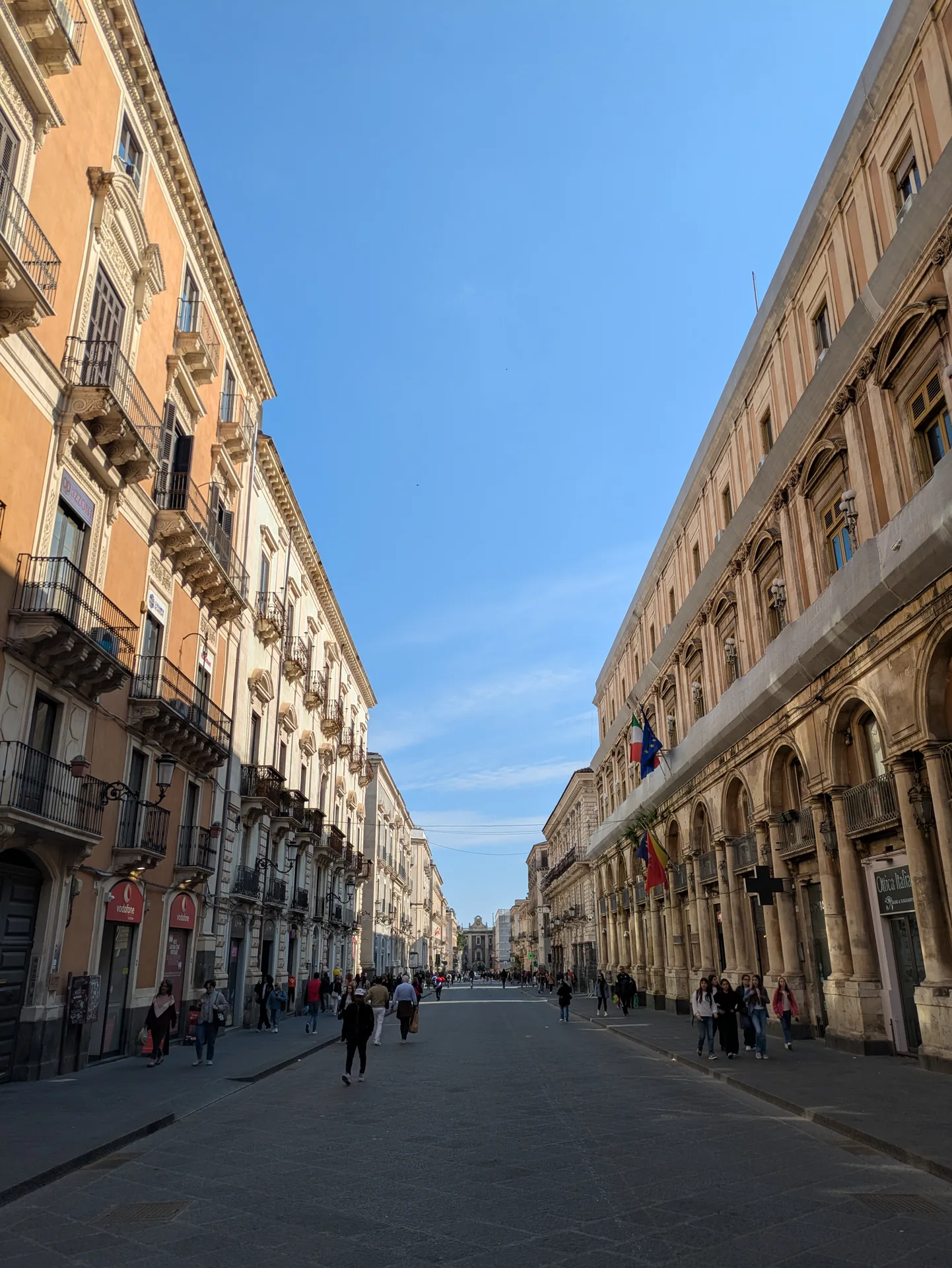
A baby does not make Catania difficult. Trying to cover it like an adult city break does. Catania with a baby works best when you keep the day compact, use the broad central streets, and return to your base before heat, hunger and tiredness arrive together.
The historic centre is not uniformly pushchair friendly. Via Etnea and the main squares are manageable, while lava stone, broken pavements, market lanes and church steps can turn a short walk into a slow one. Bring a lightweight pushchair with solid wheels, plus a carrier for the places where wheels stop being useful.
The reward is a city where babies are welcomed into daily life, meals can be informal, and the airport is close to the centre. This guide shows you how to plan Catania around naps, feeds and short return routes without giving up the city itself.
Is Catania a good city to visit with a baby?
Yes, Catania is a good city to visit with a baby if you choose a central base and reduce the number of daily stops. The centre is compact, restaurants usually accept families without fuss, and the main squares give you space to pause. The difficult parts are surfaces, traffic and summer heat, not a lack of things you can do together.
Catania feels more like a lived-in city than a polished resort. That matters with an infant. You will find useful shops, pharmacies, supermarkets and casual food close to the sights, but you should not expect a changing table in every small café or step-free access at every historic building. Carry a compact changing mat and treat special baby facilities as a bonus.
Local food culture also helps. An early lunch, a quick arancino, fruit from a market stall or a granita break can fit between feeds more easily than a formal sightseeing schedule. Catania culture happens in streets and squares, so a day can still feel complete even when you enter only one attraction.
| What helps | What needs planning |
|---|---|
| Compact historic centre | Uneven lava paving and narrow pavements |
| Welcoming food culture | Limited changing facilities in small venues |
| Airport close to the city | Infant seat needed for a safe private transfer |
| Broad squares and Via Etnea | Traffic outside pedestrian sections |
| Short beach and park options | Midday heat from late spring to early autumn |
For a broad overview before choosing your priorities, use our guide to the main things to do in Catania. With a baby, the useful question is not how many you can see. It is how many you can see without making the next feed or nap stressful.
Pushchair or baby carrier in Catania?
Bring both if you can: use the pushchair for Via Etnea, the main squares and Villa Bellini, then switch to a carrier for steps, archaeological sites and rough market lanes. A small travel pushchair is easier to lift, but tiny wheels perform badly on gaps and dark lava stone.
A pushchair earns its luggage allowance because it creates a mobile nap space and carries nappies, water and spare clothes. Choose one that folds quickly and has a proper sun canopy. Good wheels and suspension matter more than the lightest possible frame. If two adults are travelling, one can lift the front wheels over short rough sections without unloading everything.
The carrier becomes essential at the Roman Theatre, inside some churches, around stair-heavy viewpoints and whenever the pavement disappears behind parked scooters. It is also useful in La Pescheria, where the atmosphere is worth experiencing but the wet, crowded lanes are not a comfortable pushchair route.
| Place or situation | Best choice | Why |
|---|---|---|
| Via Etnea and Piazza Università | Pushchair | Broad, mostly level central axis |
| Piazza Duomo | Pushchair | Open space with room to stop |
| Villa Bellini | Pushchair | Paths, shade and nap potential |
| La Pescheria market | Carrier | Crowds, wet paving and tight lanes |
| Roman Theatre | Carrier | Steps and archaeological surfaces |
| Busy bus or short taxi transfer | Carrier plus folded pushchair | Faster boarding and less obstruction |
Do not plan a long route based only on map distance. Two kilometres across smooth pavement is easy; one kilometre with steps, kerbs and traffic can be exhausting. Our guide to the Catania sights worth prioritising can help you cut secondary stops before you leave the apartment.
The easiest Catania route with a baby
The easiest central route runs from Piazza Duomo along Via Etnea to Villa Bellini. It is about 1.2 kilometres in a straight direction, but allow two to three hours with stops. The point is not to walk it all at once. It is to stay on a simple axis with cafés, pharmacies and several opportunities to turn back.
Start in Piazza Duomo early, ideally before the centre becomes hot and busy. Continue through Piazza Università, then decide at Piazza Stesicoro whether the baby is settled enough to continue uphill to Villa Bellini. If the timing is wrong, stop there and return. You have already seen the city’s main ceremonial spaces without forcing another hour.
The map shows an orientation spine, not a rigid itinerary. Side streets can be rougher than Via Etnea, and a short detour into a church or market can add stairs. Keep the return route familiar, particularly on your first day when you are still learning the baby’s rhythm in a warmer climate.
| Time | Low-stress plan | Reason |
|---|---|---|
| 08:00 to 10:30 | Piazza Duomo and lower Via Etnea | Cooler streets and lighter crowds |
| 10:30 to 12:00 | Feed, coffee and return or continue | Decision point before midday heat |
| 12:00 to 16:30 | Lunch and apartment rest | Protects the main nap and adults’ energy |
| 17:00 to 19:30 | Villa Bellini or a short passeggiata | Shade and gentler temperatures |
| After 19:30 | Early dinner near the apartment | Easy exit if the baby becomes tired |
Best things to do in Catania with a baby
The best baby-friendly experiences in Catania are places where adults see something meaningful and the baby can remain in a pushchair or carrier without a long formal visit. Piazza Duomo, Villa Bellini and La Playa cover city culture, shade and the sea with very different levels of effort.
Piazza Duomo and the pedestrian centre

Cayambe · CC BY-SA 4.0
- Location
- Piazza del Duomo, Catania Maps
- Essential fact
- The easiest first stop in central Catania, with a broad open square and a mostly level link to Via Etnea.
- Price
- Free
Piazza Duomo is the best first stop because it is visually important and logistically forgiving. You can see the Elephant Fountain, the cathedral façade and the entrance to La Pescheria without committing to a ticketed visit. The square also gives two adults room to reorganise bags without blocking a narrow pavement.
If the baby is calm, walk a short section of Via Etnea and Piazza Università. If not, return to your accommodation. This flexible loop is more useful than saving the cathedral for the end of an overloaded day. Catania culture is visible here even during a ten-minute stop.
Villa Bellini for shade and naps

Triquetra · CC BY-SA 2.5
- Location
- Via Etnea 292, Catania Maps
- Site
- comune.catania.it/vivere-il-comune/luoghi-di-interesse-turistico/giardino-bellini.aspx
- Hours
- Daily 07:00–21:00
- Essential fact
- Catania’s main public garden, useful for shade, a quiet feed and a pushchair nap close to Via Etnea.
- Price
- Free
Villa Bellini is the centre’s most practical reset point. The public garden sits directly on Via Etnea and offers trees, paths and benches away from the busiest traffic. It works well for a feed, a pushchair nap or a slow break after walking uphill from Piazza Duomo.
The Comune di Catania currently lists the garden as open daily from 07:00 to 21:00, but public-space hours can change for maintenance or events. Check the official Villa Bellini page close to your visit. In summer, aim for morning or late afternoon rather than treating shade as complete protection from heat.
La Playa for a simple beach day

andrea · CC BY-SA 2.0
- Location
- Viale Presidente Kennedy, Catania Maps
- Essential fact
- Catania’s long sandy coast, simpler with a baby than the lava-rock shoreline north of the city.
- Price
- Free
La Playa is the easiest Catania beach to manage with baby equipment because it is sandy and has seasonal services. The free sections cost nothing, while private lidos may offer shade, toilets, food and showers. Facilities and prices vary, so choose convenience rather than a famous name.
A baby should have reliable shade and should not be placed in direct sun. Keep the visit short, especially from June through September, and treat the beach as an early-morning activity. For other sandy and rocky options, compare our guide to the best beaches near Catania before adding a longer transfer.
Feeding, nappies and eating out
Catania’s relaxed food culture makes eating with a baby easier than formal restaurant research suggests. Choose places with outdoor tables, enough room beside the chair and food that can arrive quickly. An early lunch around 12:30 and dinner before the local evening rush usually give you more space and calmer service.
High chairs are common but not guaranteed, particularly in tiny bars and historic premises. Ask for a seggiolone. If your baby is weaning, simple food such as plain pasta, bread, fruit and unsalted vegetables is often easy to request. Bring the food and utensils you cannot substitute rather than relying on a specific brand being available nearby.
Supermarkets and pharmacies sell nappies, wipes and baby products, but the exact range can differ from home. Pack enough for the first 24 hours so arrival delays do not become urgent. A foldable changing mat is valuable because many older cafés have small toilets with no dedicated changing surface.
Food is also part of the sightseeing. One parent can hold or feed the baby while the other tries granita, arancini or pasta alla Norma, then swap. That small adjustment keeps Catania food culture enjoyable without expecting the baby to sit through a long tasting itinerary.
- Pack for the first day: nappies, wipes, familiar food, spoon and bib.
- Ask locally: farmacia for a pharmacy and seggiolone for a high chair.
- Choose outdoor space: easier for a pushchair and a quick exit.
- Use the apartment: breakfast and one quiet meal can protect the day.
- Keep water for adults: carrying a baby or pushchair in heat increases fatigue.
Catania Airport and getting around with a baby

Castielli · CC BY-SA 3.0
Catania Fontanarossa Airport is close to the centre, but your first transfer should be decided before you land. A public airport bus can be economical and avoids car-seat questions, while a booked private transfer can be simpler with luggage if the operator confirms the correct infant restraint in advance.
Do not assume that a taxi waiting outside will carry the seat you want. State the baby’s age, weight and the required restraint when booking. If you bring your own seat, confirm airline rules and check that it can be installed in the vehicle you plan to use. Safety equipment is not a detail to solve at the kerb.
The airport’s official child-care information describes family facilities, but availability can change. Review the Catania Airport child-care page before travel, then keep one feed and a complete nappy change accessible in hand luggage.
Inside Catania, walking is usually the simplest option for central sights. Buses are useful for selected journeys, but boarding with a folded pushchair is easier than relying on space for an open one. The metro serves limited parts of the city and does not replace a compact central walking plan.
A hire car is more useful for multiple rural or beach trips than for seeing central Catania. Parking, restricted traffic zones and loading luggage can cancel the convenience. If most days begin in the historic centre, choose accommodation first and rent a car only for the days that require it.
When to visit and how to handle the heat
Spring and autumn are the easiest seasons for Catania with a baby. April, May, late September and October usually offer a better balance between outdoor time and manageable temperatures. Weather still varies, but you have more usable hours than during the hottest part of summer.
June through early September can work if the holiday is organised around heat rather than against it. Start outside early, return for lunch and the main nap, then go out again near sunset. Stone streets and building façades can hold heat after the official air temperature begins to fall.
Never cover a pushchair with a blanket to create shade, because airflow can be reduced and heat can build underneath. Use the manufacturer’s ventilated sun canopy, breathable clothing and frequent checks. For medical or heat-safety advice specific to your baby, consult a qualified healthcare professional before travel.
Winter is quieter and can suit parents who prioritise city culture and food over the beach. Rain is possible and some seasonal services close, but cooler streets make carrying easier. Pack a rain cover that does not block ventilation and choose an apartment where you can comfortably spend a slow afternoon.
Easy day trips from Catania with a baby
The easiest day trips are direct, short and valuable even if you return early. Ortigia and Taormina can work by train or planned transfer, while Mount Etna requires more judgement about altitude, weather, roads and the baby’s age. Do not combine two major destinations in one infant day.
Ortigia is the gentlest urban choice. Much of the historic island is relatively compact, and the seafront gives you an easy walk without a long attraction visit. Choose a direct connection where possible and keep the station transfer simple. A carrier remains useful for occasional steps and rough paving.
Taormina is beautiful but hillier. Corso Umberto is manageable, while the Greek Theatre and routes toward the coast involve slopes, steps or cable-car logistics. Treat one main sight and lunch as a successful day. A pushchair may reach much of the centre, but a carrier gives you a safer fallback.
Mount Etna is not a routine baby outing. Conditions change quickly, high-altitude areas are colder and access may involve rough transport. Ask your child’s healthcare professional about altitude and individual health factors before planning it. A lower-slope stop or a view from the city may be the sensible choice.
If Catania is one part of a longer trip, our guide to planning a wider Sicily family holiday compares bases and trip lengths. With a baby, changing accommodation less often is usually worth more than adding one distant destination.
Frequently Asked Questions (FAQ)
Is Catania stroller friendly?
Catania is partly stroller friendly, not uniformly stroller friendly. Via Etnea, Piazza Duomo, Piazza Università and Villa Bellini are the easiest central areas. Markets, archaeological sites, kerbs and side streets can require lifting the pushchair or switching to a carrier.
Do restaurants in Catania have high chairs?
Many restaurants have high chairs, but small bars and historic venues may not. Ask for a seggiolone when reserving. Outdoor tables and early meal times usually give you more room for a pushchair and an easier exit.
Do I need a car in Catania with a baby?
You do not need a car for a central Catania stay. Walking and selected public transport cover the city better than driving and parking. A car becomes useful for several rural or beach trips, provided you have the correct infant seat and accommodation with a realistic parking plan.
Where can a baby nap in central Catania?
Villa Bellini is the best outdoor pause for a pushchair nap, while a central apartment is the most reliable option for the main nap. Piazza Duomo has space but little guaranteed quiet. In warm weather, indoor rest is safer and more restorative than extending a shaded walk.
Is La Playa suitable with a baby?
La Playa can be suitable for a short early beach visit because it is sandy and has seasonal services. Bring reliable shade, avoid peak heat and verify what a chosen lido provides. Sea conditions and facilities vary, so inspect the beach before settling in.
How many days should we spend in Catania with a baby?
Three or four nights give you enough time for two slow city days and one optional beach or day trip. A two-night stay is possible but leaves little margin for a disrupted nap, late flight or hot afternoon. Extra time reduces the pressure to make every morning productive.
Where to stay in Catania
With a baby, location is less about the prettiest street and more about how quickly you can return for a feed, nap or clothing change. A central self-catering base near Via Etnea or the lower historic centre lets you walk to the main sights, buy food nearby and avoid packing for an entire day every time you leave.
Prioritise a lift or low floor, air conditioning for warm months, a washing machine, blackout options and enough space for the cot without blocking the room. Ask about stairs before booking, including steps between the street and the lift. Our neighbourhood guide explains where to stay in Catania in more detail.
For a slower family stay, compare our apartments in Catania. A central apartment gives you a kitchen, a private place for naps and a short route back from the city, which are practical advantages when the baby’s schedule changes.
The information in this guide was correct at the time of writing. Data can change from season to season without notice: before you travel, always check the official channels and websites for updates. We review this guide periodically, but the official channels are always the authoritative source. We also cannot guarantee that the suggested routes or the attractions described are always reachable or accessible: roads, trails and sites may be closed, damaged, altered or unsafe. Assessing the practicability and safety of itineraries and attractions always remains your own responsibility.